
Company News
January 13, 2026
Arclin to Purchase Willamette Valley
Arclin Expands Presence with Strategic Acquisition of Willamette Valley Company
December 18, 2025, 6:27 AM ET
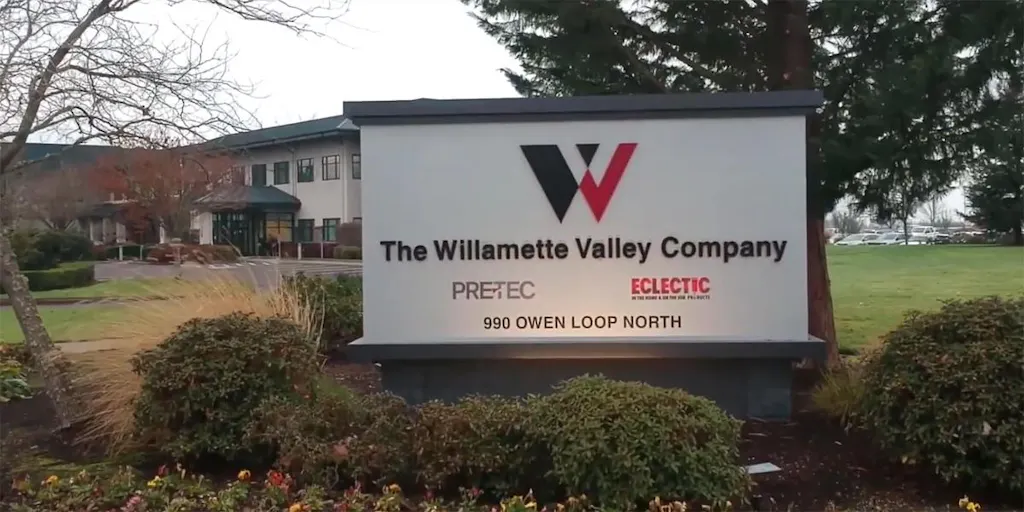

ALPHARETTA, Ga., Dec. 18, 2025 /PRNewswire/ — Arclin, a leading material science company, announced that it has entered into an agreement to purchase Willamette Valley Company (“WVCO”), a manufacturer and distributor of a wide variety of custom products and services in the wood products, railroad, concrete repair, transportation, infrastructure and consumer products segments.
“We are thrilled to welcome Willamette Valley Company to our organization,” said Bradley Bolduc, Arclin’s CEO. “Their innovative technologies and product portfolio perfectly complement our business, creating a beneficial combination for our customers. With a shared commitment to quality across wood products, this acquisition positions us to deliver even greater value and expand opportunities across the segments we serve,” said Bolduc.
The acquisition of WVCO is a pivotal step in extending Arclin’s materials science capabilities into engineered repair systems, specialty adhesives, and infrastructure solutions where performance-critical polymers and formulations are central to customer outcomes. The acquisition will add eight manufacturing facilities and approximately 500 new team members to Arclin’s existing 1,200-person team.
“The acquisition represents a highly strategic move with clear operational efficiencies,” said Mark Glaspey, Arclin’s President. “By combining our capabilities, we will deliver a broader portfolio of solutions to our customers, while expanding geographic reach and unlocking new growth opportunities.”
“The decision to sell Willamette Valley Company to Arclin represents a natural progression for our business,” said John Murray, WVCO’s President and CEO. “Arclin’s world-class operational framework will accelerate our product innovation and drive sustainable growth. Combining Arclin and WVCO’s deep technical expertise, broad knowledge base and ability to rapidly deploy resources will be instrumental in driving our growth strategy. Joining Arclin is an exciting opportunity for our team and we’re eager to drive the business forward,” Murray added.
About Arclin
Arclin is a leading materials science company and manufacturer of polymer technologies, engineered products and specialized materials for the construction, agriculture, transportation infrastructure, weather & fire protection, pharmaceutical, nutrition, electronics, design and other industries. Headquartered in Alpharetta, Georgia, Arclin has offices and manufacturing facilities throughout the U.S., Canada, U.K., and manufactures for customers worldwide. For more information, visit www.arclin.com.
About Willamette Valley Company
Founded in 1952, the Willamette Valley Company is an engineered solutions provider specializing in a broad array of chemistry and application systems. WVCO is a multinational corporation that manufactures and distributes a wide variety of custom products and services around the globe. While their roots are in the wood products industry, their expertise and solutions encompass innovative railroad tie repair solutions, concrete repair systems, patching, fillers, adhesives, robotics, engineering and more across dozens of industries. For more information, visit https://wilvaco.com
January 7, 2026
AI Use in Logistics
How is C.H. Robinson using AI? Its CFO has a story to tell
Lee talks about what 2 of its 30 agentic tools are doing at the 3PL that has Wall Street abuzz
· Tuesday, January 06, 2026

Key Takeaways:
There are two numbers that might help define the impact of AI at 3PL giant C.H. Robinson.
One of them is 55.3%. That’s the growth in the company’s stock price during 2025. There are no other logistics companies that had a record like that in the recently-completed year. Every analyst would say AI is a key part of that surge.
The second is 30. That’s the number of actual agentic AI tools in use at C.H. Robinson.
Damon Lee, the company’s CFO, reviewed C.H. Robinson’s use of AI in a recent interview with FreightWaves. Lee’s comments moved away from the general message on AI usage that C.H. Robinson (NASDAQ: CHRW) has been touting–with profitability and operational figures to back it up–to more specific details on what the company is using AI to get done.
It’s impossible to know if 30 is a large number or a small one. There is no measuring stick for how many agentic AI tools a freight brokerage that will produce 2025 revenue somewhere close to $11 billion should have at this stage in the AI revolution.
But the verdict from investors seems to be that 30 is a good number, they like the results and are hoping for more in 2026.
Lots of companies read invoices
At the annual meeting of the Transportation Intermediaries Association in April, a parade of companies touted their freight tech applications at a day-long session with journalists. Most of them talked about AI, but the message at one point became sort of repetitive: we use AI to read invoices or take an incoming call and convert it to language-based data that a broker could use.
The reality is that many companies across the spectrum of industries–not just logistics–that have plunged into AI aren’t seeing benefits, at least not yet.
That isn’t surprising to Lee. “I believe people using an off-the-shelf solution for AI, in many cases, will be nothing but a cost adder for their business,” he said. “I don’t think they’ll ever see positive productivity to offset the cost that they’re incurring, because the pay-by-the drink model of AI is very expensive.”
450 men and women at work
That’s why C.H. Robinson has a team of 450 engineers writing their own AI applications. They are the source of the 30 agentic AI tools cited by Lee.
“We’re using bespoke customized AI solutions to drive demonstrable business results,” Lee said.
Lee spoke about one of the 30 agentic AI solutions in going from the theoretical to the specific.
C.H. Robinson receives requests for about 600,000 rate quotes each year at its North American Surface Transport (NAST), the division that includes its core over the road brokerage activities.
Historically, it had the ability to respond to about 60% to 65% of those quotes, Lee said.
“So when a person was manually doing that exercise, somewhere around a third of those requests either never got answers, or they got answered in a timeline that didn’t meet the customer expectations,” Lee said.
With an agentic AI tool now at the center of the process for responding to those requests, Lee said C.H. Robinson is able to respond to 100% of the queries.
“I’m now getting to a third of the universe of freight that was available to me before that I never got to,” Lee said. “The sophistication in how I’m responding to the customer has gone up exponentially.”
A human might have five to 10 data points to use in responding to a quote. But the agentic AI tool, Lee said, has “tens of thousand if not hundreds of thousands of data points available to them.”
The price quote from the human would be “unsophisticated,” Lee said. Response time was 17 to 20 minutes.
But Lee said the agentic AI tool will respond in 32 seconds.
Optimizing margin rapidly
Asked to describe “favorite AI agent number two,” Lee turned to a tool he said is designed to optimize revenue management.
Pricing strategy at C.H. Robinson, Lee said, would be “fairly unsophisticated. It was targeted to figure out ‘I want to try to get this much margin, or this much volume, at this much margin.’”
If the gross margin rate in that strategy is 40%, loads are accepted or rejected on that basis, Lee said. “At the end of the month or the quarter, I see how my pricing strategy did,” he said.
What he described as “course correction” in the middle of that strategy wasn’t easy, according to Lee.
With the strategy now being powered by an in-house developed agentic AI tool, “we’ll set a pricing strategy at 8 a.m. on Monday, and by 8:05, we’re testing that strategy,” Lee said. The tool asks the question, “is the strategy yielding the volume and the margin that I expected to get?”
And if the answer is no, Lee said, “it will change the strategy two minutes later.” That replaces a system, Lee said, where “you might have a 30-day increment with no adjustments, or even a 90-day increment with no adjustments.” In its place, Lee said, is an approach where “the strategy gets adjusted hundreds of times a day.”
Lee referred to that model as “gross margin arbitrage.” Previously, Lee said, playing that strategy was largely impossible.
“Folks would say gross margin is commoditized,” Lee said, defining gross margin as a formula of revenue per load minus the cost of capacity. “But we’re able to optimize price, and we’re able to optimize cost because of the frequency in which we’re able to test the market and react to the market in terms of price,” he said.
If the data coming from the agentic AI tool is showing “volume coming in hot, I can choose to optimize margin,” Lee said. But if “there’s not as many loads on the market, I can get more aggressive in price.”
That’s what every broker does. But C.H. Robinson’s message is they can do it far more rapidly because of AI.
C.H. Robinson does not disclose gross margin in its earnings. It’s a derivative of adjusted gross profits, which are published with the company’s earnings.
The most recent earnings report shows that in the three months ended September 30, C.H. Robinson’s adjusted gross profit in its truckload brokerage was down 2% year-on-year. That is a relatively small drop considering the freight market in 2025 compared to the already weak one in 2024.
But the 3PL’s adjusted gross profits in its LTL operations were up 10.5%. For the nine months, the figures were down 0.9% in truckload and up 6.7% in LTL
Not everybody is buying the C.H. Robinson story. For example, data on Yahoo Finance shows a 6.47% share of the company’s stock float was sold short as of December 15. That is a relatively high number.
The question is whether C.H. Robinson’s price has surged because it’s a brokerage play–hard to imagine that, given the performance of other 3PLs like RXO (NYSE: RXO) and Landstar (NASDAQ: LSTR)–or an AI play. Lee wouldn’t say it wasn’t because of brokerage, but he said “we’ve had a few investors tell us we may be the only company that is getting the level of benefits from AI that we’ve enjoyed in this ecosystem.”
Within the AI play, Lee said there are chip makers and data centers and other companies whose stocks are more of a pure AI play.
What are harder to find are the operating beneficiaries, Lee said, “examples of folks that are winning at the application layer. And that’s certainly where C.H. Robinson is winning.”
January 5, 2026
Hanwha TDI Update
Hanwha TDI Temporary Shutdown in South Korea
PUdaily | Updated: January 4, 2026
Market sources indicate that Hanwha’s 150,000 tpa TDI plant in South Korea has been temporarily shut down starting from January 2 due to feedstock shortages. The outage is preliminarily expected to last until January 9.
January 5, 2026
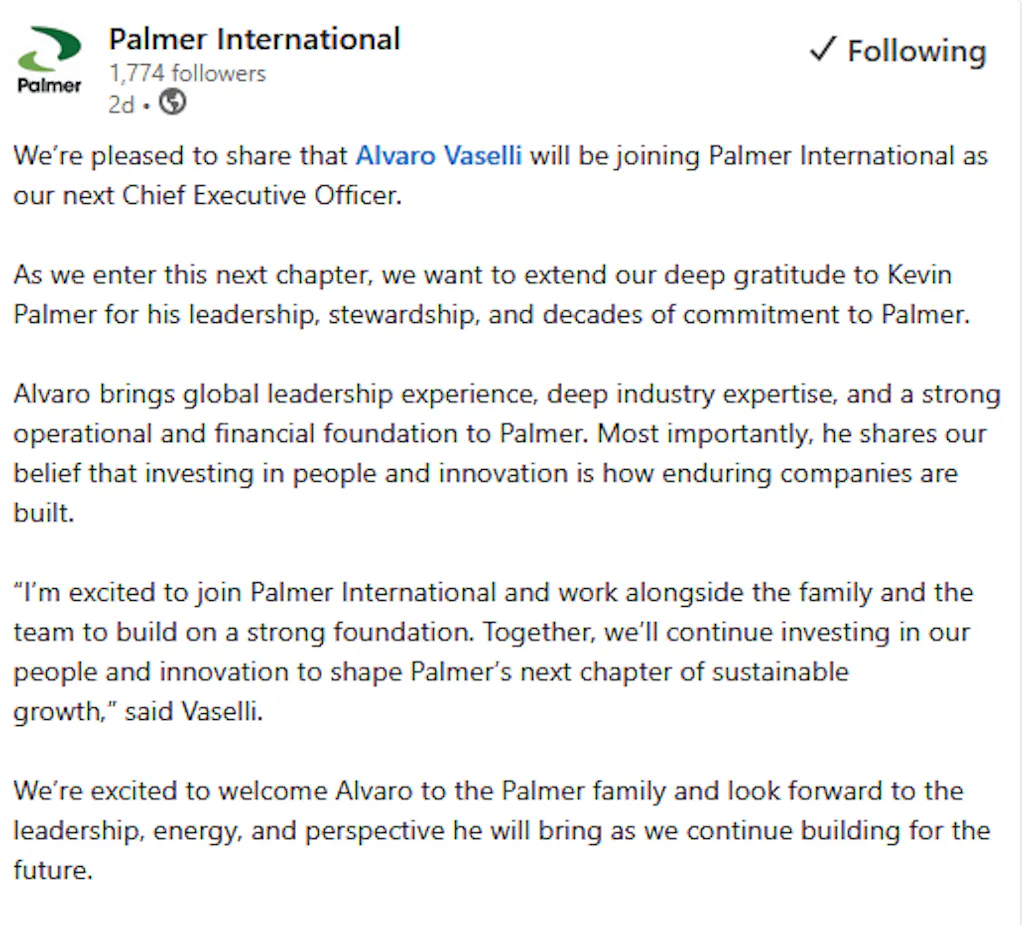
Palmer International Hires Alvaro Vaselli
Linkedin.com
December 28, 2025
MOL Polyol Complex Still on Track
MOL Group Discloses Details about Fire Occurred in this October
PUdaily | Updated: December 24, 2025

On December 19, by a letter, MOL disclose the details about the fire incident which was occurred in this October.
According to the letter, On 20 October 2025, a fire broke out in the AV3 crude distillation unit at the Danube Refinery. Based on the initial damage assessment, the fire was caused by equipment failure and the consequential disintegrity of a pump.
MOL anticipates that the reparation works will be completed, enabling the refinery to resume full capacityin Q3 2026. During the refurbishment period, MOL expects an average production loss of around 30%. With the damage investigation works still ongoing, and the scheduling of the engineering, procurementand construction works mostly based on very first expert-level estimates rather than evidence, theaforementioned time need for the repair works is subject to change.
The incident and its consequences do not directly affect the ongoing commissioning work at MOL’s PolyolComplex which is set to start in the near future.
 Everchem Updates Archive
  Sign Up for Email Updates