
Company News
May 19, 2021
Greiner in Bid for Recticel
Greiner Plans Recticel Bid Valuing Firm at $915 Million
By Aaron Kirchfeld May 14, 2021, 8:37 AM EDT Corrected May 14, 2021, 3:59 PM EDT
Greiner AG, an Austrian plastics maker, is preparing a takeover offer for Recticel SA valuing the Belgian foam company at about 754 million euros ($915 million), a person with knowledge of the matter said.
Greiner is buying Cie. du Bois Sauvage SA’s 27% stake in the company for 13.50 euros per share and plans to offer the same price to other investors, according to the person, who asked not to be identified because the information is private. The Austrian firm is seeking a majority stake in Recticel and aims to keep its listing on the Euronext Brussels exchange, the person said.
It’s seeking to gain acceptances from shareholders holding at least 50% of the company’s voting rights plus one share, according to the person.
Recticel shares have risen 41% in Brussels trading this year, giving the company a market value of 844 million euros. The planned offer represents a 10.7% discount to Recticel’s closing price of 15.12 euros on Thursday, when the shares rallied 14%.
Cie. du Bois Sauvage and Recticel were both halted from trading on Friday, pending statements. Representatives for Greiner, Cie. du Bois Sauvage and Recticel didn’t immediately respond to requests for comment.
Recticel makes foams for everything from construction to bedding and automotive. The company has received takeover interest before. In 2019, the Belgian company rejected an offer from Irish insulation maker Kingspan Group Plc for just two of its units. At the time, it signaled it would be open to considering an offer for the whole company.
Greiner and Recticel have been working together for decades. They formed a joint venture in 1992 called Eurofoam, which makes flexible foams. The Austrian company agreed to buy out the venture last year.
Recticel agreed in March to acquire the thermal PIR insulation board business of Poland’s Gor-Stal Sp. z o.o for 30 million euros including debt. Later that month, it completed its purchase of Conzzeta AG’s FoamPartner unit for an enterprise value of 270 million Swiss francs ($300 million).
May 17, 2021
Wind Turbine Blade Recycling Project
Home/Environment/New Technology for Full Recyclability of Wind Turbine Blades Environment
New Technology for Full Recyclability of Wind Turbine Blades
Energy Industry Review4 hours agoLast Updated: May 17, 2021 30 4 minutes read
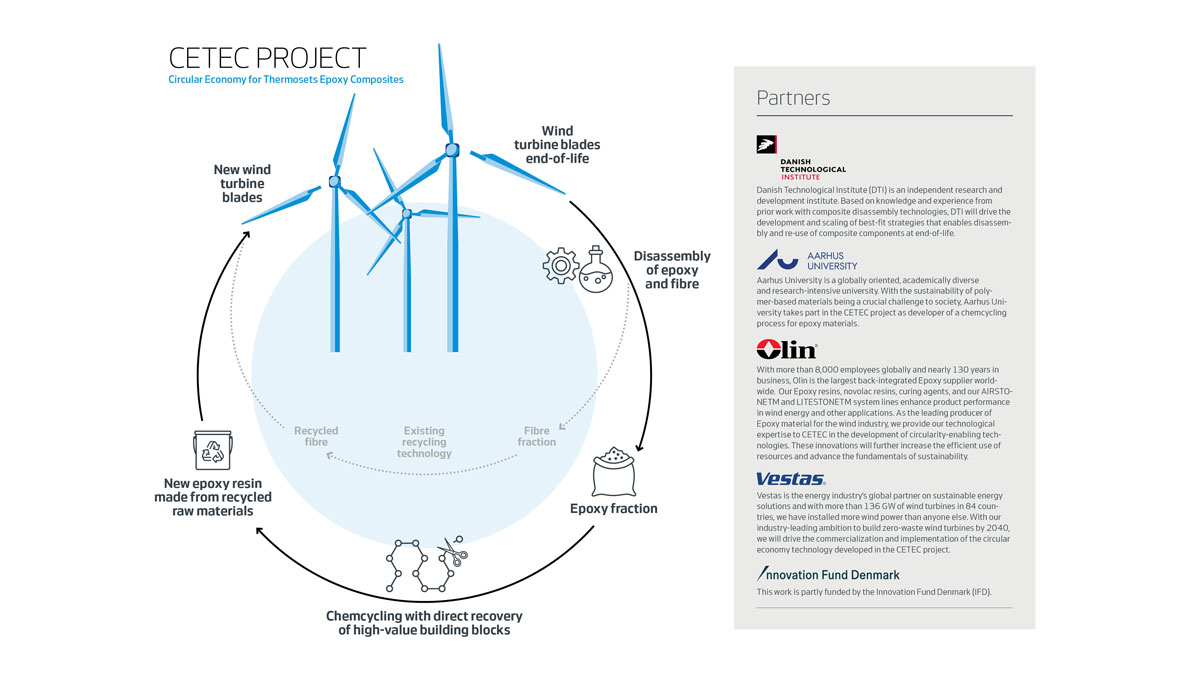
A coalition of industry and academic leaders have developed a new technology to enable circularity for thermoset composites, the material used to make wind turbine blades. The new technology delivers the final technological step on the journey towards a fully recyclable wind turbine value chain. To enable the adoption of this new technology, and to advance a circular economy across the wind industry, a new initiative entitled CETEC (Circular Economy for Thermosets Epoxy Composites) has been established. Within three years, CETEC is aiming to present a fully scoped solution ready for industrial adoption, based on commercialisation of the novel circularity technology.
Partly funded by Innovation Fund Denmark (IFD), CETEC is spearheaded by Vestas, the global leader in sustainable energy solutions, and involves both industrial and academic leaders including Olin, the world leading producer of Epoxy, the Danish Technological Institute (DTI), and Aarhus University.
Developed by DreamWind, an innovation initiative driven by the same partners, the new technology consists of a two-step process. Firstly, thermoset composites are disassembled into fibre and epoxy. Secondly, through a novel chemcycling process, the epoxy is further broken up into base components similar to virgin materials. These materials can then be reintroduced into the manufacturing of new turbine blades, constituting a new circularity pathway for epoxy resin.
Wind turbines are 85-90 percent recyclable, with turbine blades material constituting the remaining percentage that cannot be recycled, due to the nature of thermoset composites. CETEC is aiming to close this recycling gap and enable a significant step forward in the elimination of waste across the wind energy industry.
“As global commitments to a net-zero future increase, it’s absolutely crucial to ensure the wind industry can scale sustainably, which includes Vestas fulfilling our ambition to produce zero-waste turbines by 2040. Leveraging this new technological breakthrough in chemcycling epoxy resin, the CETEC project will be a significant milestone in Vestas’ journey towards achieving this goal, and in enabling a future where landfill is no longer required in blade decommissioning,” said Allan Korsgaard Poulsen, Head of Sustainability and Advanced Materials, Vestas Innovation and Concepts.
“The key characteristic of composite materials is their unique combination of low weight and high strength. This is governed by the strong bonding of two different materials – fibre and epoxy. The dilemma is that this strong bond is also the feature that renders these materials difficult to recycle. Therefore, the development of CETEC’s novel technology, enabling disassembly of the composite at end-of-life, is a gamechanger, that will allow us to capture the value represented by each material stream in a new circular value chain”, said Simon Frølich, Team Manager, PhD, Danish Technological Institute.
“Chemcycling of epoxy-based materials would allow deconstructing these highly stable polymer chains into molecular building blocks. These building blocks are easily processable and can be utilised to produce new epoxy, which will have the same quality as the original material. Avoiding the loss of valuable molecular complexity in such a way is a highly desirable concept and an important step to sustainable materials,” said Prof. Dr. Troels Skrydstrup, Aarhus University.
CETEC’s solution will address the lack of available recycling technology for epoxy resins. This would in turn create the possibility to introduce new recycling solutions to the wind industry. This holds significant potential for commercial value capture, particularly in markets where regulation around waste management for manufacturing industries is tightening to serve a broader sustainability agenda. When fully developed, the solution may also have an impact for other industries that rely on thermoset composite in production, such as automotive and aviation.
“As the leading Epoxy producer and global supplier for the wind industry, Olin is proud to provide our technological expertise to this important sustainability project,” said Leif Ole Meyer, TS&D Leader EMEAI at Olin. “To develop technologies which close an existing gap of thermosets by creating a circularity is yet another example of putting our Resource Efficiency sustainability goal into action. This innovation will help the industry to minimize consumption of virgin material sources and increase the reuse and recycling of materials.”
About Danish Technological Institute
Danish Technological Institute (DTI) is an independent research and development institute. It takes an innovative approach to improving the competitiveness of business and industry, society and public life. With more than 12,000 customers in 65 countries, they develop new knowledge through research and development activities in close corporation with Danish and international companies and research institutes.
About Aarhus University
Aarhus University is a globally oriented, academically diverse, and research-intensive university. Aarhus University ranks among the top 100 universities in the world on several of the most important international ranking lists, out of over 17,000 universities worldwide. Around 12 per cent of AU’s 40.000 students are international, representing over 120 nationalities. Aarhus University offers state-of-the-art facilities and laboratories having a strong tradition of multidisciplinary research for instance in one of its 42 major research centres. The university’s goal is to contribute towards solving the complex global challenges facing the world. The university therefore strives to combine the high level of academic standards of its researchers with collaboration across disciplinary boundaries to combine research in new ways and solve challenges in close contact with the world around us.
About Olin
With over 8,000 employees globally and almost 130 years in business, Olin Corporation is the world’s chlor-alkali leader, including epoxy products and chlorinated organics. Olin’s regional headquarters for Europe, Middle East, Africa, and India is based in Zug, Switzerland. The company employs over 650 professionals in its European offices, research, and innovation centres, and manufacturing locations in Baltringen, Rheinmunster and Stade, Germany, Pisticci, Italy, and Terneuzen, Netherlands. Olin is committed to exceeding customer expectations through operational and commercial excellence, innovation capabilities and quality people who serve their valued customers.
About Vestas
Vestas is the energy industry’s global partner on sustainable energy solutions. They design, manufacture, install, and service onshore and offshore wind turbines across the globe, and with more than 136 GW of wind turbines in 84 countries, Vestas has installed more wind power than anyone else. Through its industry-leading smart data capabilities and unparalleled more than 117 GW of wind turbines under service, Vestas uses data to interpret, forecast, and exploit wind resources and deliver best-in-class wind power solutions. Together with their customers, Vestas’ more than 29,000 employees are bringing the world sustainable energy solutions to power a bright future.
May 17, 2021
Wind Turbine Blade Recycling Project
Home/Environment/New Technology for Full Recyclability of Wind Turbine Blades Environment
New Technology for Full Recyclability of Wind Turbine Blades
Energy Industry Review4 hours agoLast Updated: May 17, 2021 30 4 minutes read
A coalition of industry and academic leaders have developed a new technology to enable circularity for thermoset composites, the material used to make wind turbine blades. The new technology delivers the final technological step on the journey towards a fully recyclable wind turbine value chain. To enable the adoption of this new technology, and to advance a circular economy across the wind industry, a new initiative entitled CETEC (Circular Economy for Thermosets Epoxy Composites) has been established. Within three years, CETEC is aiming to present a fully scoped solution ready for industrial adoption, based on commercialisation of the novel circularity technology.
Partly funded by Innovation Fund Denmark (IFD), CETEC is spearheaded by Vestas, the global leader in sustainable energy solutions, and involves both industrial and academic leaders including Olin, the world leading producer of Epoxy, the Danish Technological Institute (DTI), and Aarhus University.
Developed by DreamWind, an innovation initiative driven by the same partners, the new technology consists of a two-step process. Firstly, thermoset composites are disassembled into fibre and epoxy. Secondly, through a novel chemcycling process, the epoxy is further broken up into base components similar to virgin materials. These materials can then be reintroduced into the manufacturing of new turbine blades, constituting a new circularity pathway for epoxy resin.
Wind turbines are 85-90 percent recyclable, with turbine blades material constituting the remaining percentage that cannot be recycled, due to the nature of thermoset composites. CETEC is aiming to close this recycling gap and enable a significant step forward in the elimination of waste across the wind energy industry.
“As global commitments to a net-zero future increase, it’s absolutely crucial to ensure the wind industry can scale sustainably, which includes Vestas fulfilling our ambition to produce zero-waste turbines by 2040. Leveraging this new technological breakthrough in chemcycling epoxy resin, the CETEC project will be a significant milestone in Vestas’ journey towards achieving this goal, and in enabling a future where landfill is no longer required in blade decommissioning,” said Allan Korsgaard Poulsen, Head of Sustainability and Advanced Materials, Vestas Innovation and Concepts.
“The key characteristic of composite materials is their unique combination of low weight and high strength. This is governed by the strong bonding of two different materials – fibre and epoxy. The dilemma is that this strong bond is also the feature that renders these materials difficult to recycle. Therefore, the development of CETEC’s novel technology, enabling disassembly of the composite at end-of-life, is a gamechanger, that will allow us to capture the value represented by each material stream in a new circular value chain”, said Simon Frølich, Team Manager, PhD, Danish Technological Institute.
“Chemcycling of epoxy-based materials would allow deconstructing these highly stable polymer chains into molecular building blocks. These building blocks are easily processable and can be utilised to produce new epoxy, which will have the same quality as the original material. Avoiding the loss of valuable molecular complexity in such a way is a highly desirable concept and an important step to sustainable materials,” said Prof. Dr. Troels Skrydstrup, Aarhus University.
CETEC’s solution will address the lack of available recycling technology for epoxy resins. This would in turn create the possibility to introduce new recycling solutions to the wind industry. This holds significant potential for commercial value capture, particularly in markets where regulation around waste management for manufacturing industries is tightening to serve a broader sustainability agenda. When fully developed, the solution may also have an impact for other industries that rely on thermoset composite in production, such as automotive and aviation.
“As the leading Epoxy producer and global supplier for the wind industry, Olin is proud to provide our technological expertise to this important sustainability project,” said Leif Ole Meyer, TS&D Leader EMEAI at Olin. “To develop technologies which close an existing gap of thermosets by creating a circularity is yet another example of putting our Resource Efficiency sustainability goal into action. This innovation will help the industry to minimize consumption of virgin material sources and increase the reuse and recycling of materials.”
About Danish Technological Institute
Danish Technological Institute (DTI) is an independent research and development institute. It takes an innovative approach to improving the competitiveness of business and industry, society and public life. With more than 12,000 customers in 65 countries, they develop new knowledge through research and development activities in close corporation with Danish and international companies and research institutes.
About Aarhus University
Aarhus University is a globally oriented, academically diverse, and research-intensive university. Aarhus University ranks among the top 100 universities in the world on several of the most important international ranking lists, out of over 17,000 universities worldwide. Around 12 per cent of AU’s 40.000 students are international, representing over 120 nationalities. Aarhus University offers state-of-the-art facilities and laboratories having a strong tradition of multidisciplinary research for instance in one of its 42 major research centres. The university’s goal is to contribute towards solving the complex global challenges facing the world. The university therefore strives to combine the high level of academic standards of its researchers with collaboration across disciplinary boundaries to combine research in new ways and solve challenges in close contact with the world around us.
About Olin
With over 8,000 employees globally and almost 130 years in business, Olin Corporation is the world’s chlor-alkali leader, including epoxy products and chlorinated organics. Olin’s regional headquarters for Europe, Middle East, Africa, and India is based in Zug, Switzerland. The company employs over 650 professionals in its European offices, research, and innovation centres, and manufacturing locations in Baltringen, Rheinmunster and Stade, Germany, Pisticci, Italy, and Terneuzen, Netherlands. Olin is committed to exceeding customer expectations through operational and commercial excellence, innovation capabilities and quality people who serve their valued customers.
About Vestas
Vestas is the energy industry’s global partner on sustainable energy solutions. They design, manufacture, install, and service onshore and offshore wind turbines across the globe, and with more than 136 GW of wind turbines in 84 countries, Vestas has installed more wind power than anyone else. Through its industry-leading smart data capabilities and unparalleled more than 117 GW of wind turbines under service, Vestas uses data to interpret, forecast, and exploit wind resources and deliver best-in-class wind power solutions. Together with their customers, Vestas’ more than 29,000 employees are bringing the world sustainable energy solutions to power a bright future.
May 17, 2021
Mitsui Results
Mitsui Chemicals net profit up 70.3% last year May 17/2021 MOSCOW (MRC) — Mitsui Chemicals’ net profit for the fiscal year ending March 2021 posted 70.3% growth despite lower sales, as profitability of its basic materials business benefited from better overseas markets, said the company.
Lower group sales were attributed to declines in product prices, dragged down by falls in values of naphtha and other raw materials and fuel amid the coronavirus pandemic. Its basic materials segment reported a 12.6% year-on-year decline in sales to Y541.4bn, but operating income before special items more than doubled to Y19.6bn from Y9.4bn in the previous fiscal year “due to improved overseas market”.
Mitsui Chemicals said that operating rates at its naphtha crackers were lower than the previous fiscal year due to decreased demand for downstream products, caused by the impact of the coronavirus. “Performance of polypropylene was affected by slowing demand for automotive products. For bisphenol A (BPA) and acetone, the overseas market was at a higher level than the previous fiscal year,” the Japanese producer said.
For the current fiscal year ending March 2022, Mitsui Chemicals is projecting higher earnings, in line with the global economic recovery from a pandemic-induced slump in 2020. Basic materials should be able to generate sales of Y635bn and yield an operating profit before special items of Y36bn, based on the company’s forecasts. “In the chemical industry, although demand is expected to expand due to signs of economic recovery, chemical companies should remain vigilant regarding fluctuations of raw materials and other chemical product markets,” it said.
As per MRC, Kumho Mitsui Chemicals Inc. said it will invest about 400 billion won (USD358.1 million) to expand its chemical manufacturing factory in South Korea’s southwestern region. The joint venture between Korean synthetic rubber maker Kumho Petrochemical and Mitsui Chemicals of Japan said its shareholders approved the investment plan to scale up a methylene diphenyl diisocyanate (MDI) factory in Yeosu, 455 kilometers southwest of Seoul.
Phenol is the main feedstock component for the production of bisphenol A (BPA), which, in its turn, is used to produce polycarbonate (PC).
According to MRC ScanPlast report, Russia’s overall estimated consumption of PC granules grew in the Russian market by 27% year on year in January-February 2021 (excluding imports and exports to/from Belarus) to 16,000 tonnes, compared to 12,600 tonnes a year earlier. 
http://www.mrcplast.com/news-news_open-387766.html
May 17, 2021
Mitsui Results
Mitsui Chemicals net profit up 70.3% last year May 17/2021 MOSCOW (MRC) — Mitsui Chemicals’ net profit for the fiscal year ending March 2021 posted 70.3% growth despite lower sales, as profitability of its basic materials business benefited from better overseas markets, said the company.
Lower group sales were attributed to declines in product prices, dragged down by falls in values of naphtha and other raw materials and fuel amid the coronavirus pandemic. Its basic materials segment reported a 12.6% year-on-year decline in sales to Y541.4bn, but operating income before special items more than doubled to Y19.6bn from Y9.4bn in the previous fiscal year “due to improved overseas market”.
Mitsui Chemicals said that operating rates at its naphtha crackers were lower than the previous fiscal year due to decreased demand for downstream products, caused by the impact of the coronavirus. “Performance of polypropylene was affected by slowing demand for automotive products. For bisphenol A (BPA) and acetone, the overseas market was at a higher level than the previous fiscal year,” the Japanese producer said.
For the current fiscal year ending March 2022, Mitsui Chemicals is projecting higher earnings, in line with the global economic recovery from a pandemic-induced slump in 2020. Basic materials should be able to generate sales of Y635bn and yield an operating profit before special items of Y36bn, based on the company’s forecasts. “In the chemical industry, although demand is expected to expand due to signs of economic recovery, chemical companies should remain vigilant regarding fluctuations of raw materials and other chemical product markets,” it said.
As per MRC, Kumho Mitsui Chemicals Inc. said it will invest about 400 billion won (USD358.1 million) to expand its chemical manufacturing factory in South Korea’s southwestern region. The joint venture between Korean synthetic rubber maker Kumho Petrochemical and Mitsui Chemicals of Japan said its shareholders approved the investment plan to scale up a methylene diphenyl diisocyanate (MDI) factory in Yeosu, 455 kilometers southwest of Seoul.
Phenol is the main feedstock component for the production of bisphenol A (BPA), which, in its turn, is used to produce polycarbonate (PC).
According to MRC ScanPlast report, Russia’s overall estimated consumption of PC granules grew in the Russian market by 27% year on year in January-February 2021 (excluding imports and exports to/from Belarus) to 16,000 tonnes, compared to 12,600 tonnes a year earlier.
http://www.mrcplast.com/news-news_open-387766.html
 Everchem Updates Archive
  Sign Up for Email Updates