
Company News
November 18, 2019
UPS and CVS Partner on Drone Delivery

UPS is rolling along with its drone delivery program, working with partner CVS Pharmacy to deliver prescription drugs to customer doorsteps via its newly deployed commercial drones. UPS delivered medications to two paying customers on November 1 using the Matternet M2 drone system that the logistics company is using in partnership with Matternet ..
UPS received approval last month from the FAA to fly its fleet of commercial drones in service of customers, and now it plans to iterate its drone delivery program “in the coming months,” with the aim of ensuring that it can deploy UAVs in a commercial capacity at increasing scale. It also launched “UPS Flight Forward,” a dedicated division focused on autonomous drone delivery.
For these early deliveries, drones were loaded with prescriptions filled by pharmacists at a CVS location in Cary, NC. Once a UPS employee loaded the cargo onto the drones, they flew autonomously from the store location to nearby customer homes, dropping off the packages from a hover height of around 20 feet above these locations. One of the customers has mobility challenges that would make travel to a CVS store for prescription pickup difficult, UPS points out.
This isn’t the first time UPS has deployed drones in a healthcare industry setting: The company has been working with Mattternet and WakeMed Hospital in Raleigh, doing commercial deliveries of medical samples in a B2B setting.
UPS and CVS deliver prescription medicine via drone to US residential customers for the first time
November 13, 2019
Edge-Sweets History
Edge-Sweets was nice enough to give out an old book: A Glossary of Urethane Industry Terms at the recent PFA meeting (www.PFA.org) in Louisville, KY.

Here’s the history of the company:
Company History Timeline
1883
Frank Edge
ESCO [Edge-Sweets Company] got its start in 1883 when Frank Edge fabricated his first jigsaw blades.
1887
Frank Edge Company Formed
Building on this concept, Frank formed The Frank Edge Company in 1887 to produce saw blades for the booming furniture industry in Grand Rapids, Michigan.
1887-1953
The First 70 Years
The first 70 years of the company were spent supplying blades and equipment to the bustling furniture manufacturers.
1953
Edge Saw Formed
In 1953, Edge Saw was formed to manufacture the first saw for cutting flexible “foam rubber.”
1957
Growth
By 1957, the manufacture of foam cutting equipment was the main activity for Edge Saw and growth of the company kept pace with the fast growth of foam production in the U.S.
1971
Edge Conveyor
In 1971, Edge Conveyor was formed to supply specialized conveyors essential to economical foam production. With the advent of Edge Conveyor, the company expanded its production facilities and its engineering capabilities and offered the foam industry high volume production cutting lines to supplement foam fabrication on individual units.
1973
Purchase North American Urethanes [NAU]
In 1973, Edge purchased North American Urethanes (NAU), a company with several years experience in the engineering and manufacture of urethane metering and dispensing equipment. With the acquisition of NAU, Edge Industries became the only machinery company in the industry capable of supplying equipment for the production, processing, and cutting of soft or rigid foam. The acquisition of NAU’s Machinery Division added foam and elastomer dispensers to the product line and gave Edge the ability to provide “wet end” systems for flexible and rigid foam.
1985
Edge-Sweets Company Formed
In 1985, Edge-Sweets Company was formed as Edge merged with Martin Sweets Company of Louisville, Kentucky, a company who similarly specialized in the manufacture of machinery and equipment for processing and cutting of polyurethane foam products and other cellular and noncellular plastics.
2019
Today
Edge-Sweets Company, today referred to as ESCO, resides in a 70,000+ square foot facility in Grand Rapids, Michigan and offers the combined products and knowledge of both cutting and dispensing equipment, along with a unique ability to custom engineer systems.
https://www.edge-sweets.com/history.aspx
November 9, 2019
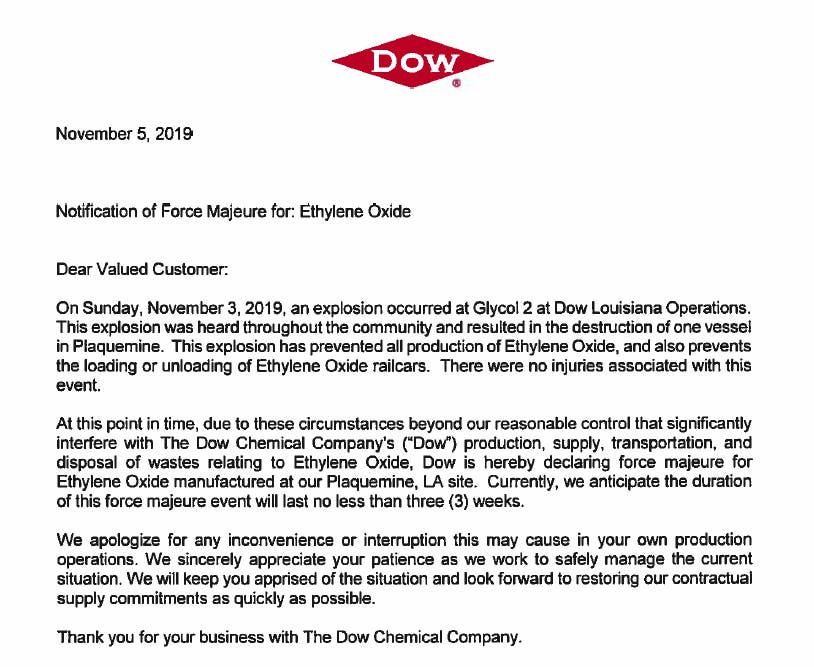
Dow EO Force Majeure
November 9, 2019
Dow EO Force Majeure
November 7, 2019
Covestro Closes Divestiture

Plixxent
Schottek
“We have been working for more than four months to carve out the businesses from Covestro,” explained its CEO Jorg Schottek at an airport hotel in Hamburg, Germany, with Urethanes Technology International.
Plixxent is not a name that trips off the tongue, but it is not designed to.
Schottek has a core goal: To weld the individual entities into a business that can grow its sales from 250 million euros ($278.8 million) to 400 million euros ($446.2 million) in five years. His strategy is to use a single sales team cross-selling the expertise within the group and, possibly, some acquisition activity. But, he said, the focus will very much be on organic growth and filling in the gaps between the businesses.
Apart from the Spanish business, which was deliberately built as a systems house, the other parts of Plixxent were bought and run independently. The businesses that form the new company typically handle smaller volumes, and those businesses with customized products are relatively complex, Schottek said.
“This makes it challenging for a large company which is, naturally, more focused on larger volumes and standardized products,” he added.
This comes through in his description of the carve-out process.
“We have had to implement a completely new IT structure, computers, servers must be new from day one,” he said. “As a consequence of the carve-out, we also had to build a new back office structure at a group level.”
In total, the Plixxent business had contracts to supply customers with about 100 kilotonnes per year at the point of the spin-off. The move simplifies matters for Covestro, which is more focused on larger accounts.
“We are independent, and have a strong relationship with Covestro to source raw materials,” he said. “Customers should know that our raw material supply is 100 percent assured. We can source from other suppliers, too. This will help customers because we can offer them a broader portfolio of materials.”
Plixxent includes plants in Tarragona, Spain; Foxhol, Netherlands; Oldenburg, Germany; and Otterup, Denmark. There is also a sales office in Italy.
“We are planning to keep the individual approaches and use the core manufacturing, technology and service competences in each region,” Schottek said. “But we are looking to significantly strengthen our sales force across our regions. We will have four plants producing different materials with a sales force operating across markets and customers.”
He added that the sales team will look for opportunities and make sales across the whole portfolio. “We have experts on different segments,” he said. “There are a lot of opportunities to grow organically.”
This organic growth is likely to be achieved by asking what share of the polyurethane market a type of product has, and then striving to match the sales to that share in each country. This will be done by a larger, technically competent workforce which will sell the groups portfolio of products. Italy is the front runner for expansion.
“Looking at Europe in general, we will try to increase our sales organically, but we will also look at opportunities for acquisitions. For example, Italy is the second biggest market, and what we see is a lot of small, family-owned customers that need technical service. It is highly attractive for us,” he said.
H.I.G. has invested in nine other chemical-related groups in the past decade. Schottek said.
“We are excited to work with such an experienced investor,” he added. “Together we will target growth for Plixxent, organically and via M&A.”
H.I.G. has a buy-and-build approach toward its investments, which are mainly directed at the small and mid-sized business segment.
https://www.plasticsnews.com/news/covestro-sells-pu-business-private-equitys-hig
 Everchem Updates Archive
 Sign Up for Email Updates