Company News

October 18, 2019

Recticel Fire in Belgium

Fire incident at Flexible Foams unit in Wetteren (Belgium)


Occasional information, Brussels, 18/10/2019 — 17:29 CET, 18.10.2019


Recticel informs that around 12:30 CET today, a fire broke out in one of the storage units in its Flexible Foams site in Wetteren (Belgium). The fire was rapidly brought under control by the fire brigade. Production facilities at the plant were not affected by the fire.

https://www.recticel.com/fire-incident-flexible-foams-unit-wetteren-belgium.html

October 16, 2019

Foamers Making Beds

A good article:  https://bedtimesmagazine.com/2019/10/the-new-fundamentals-of-foams/

An excerpt:

From foamers to bed builders

Perhaps the biggest foam trend has less to do with foam bedding components themselves and more to do with the changing role of foam suppliers, who, along with their sewn cover supplier counterparts, have become bedding manufacturers in their own right.

For some foam suppliers, the vast majority of their business now is producing finished foam beds, typically boxed — and often handling fulfilment, too — mostly for direct-to-consumer e-commerce companies but also for more traditional bedding makers and retailers. Even foamers that still concentrate on pouring say they now offer finished mattresses.

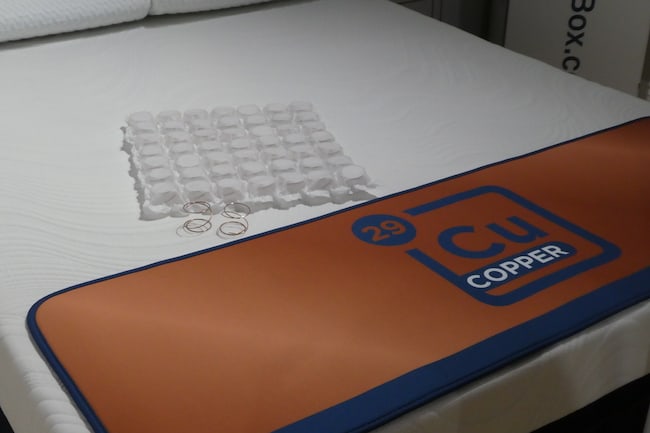
NCFI The Cure mattress uses copper
At the Summer Las Vegas Market, NCFI showcased a hybrid mattress with copper throughout — in the foam comfort layer, in the springs and in the ticking.

NCFI, which produces both components and finished beds, has opened a wholesale showroom at the Las Vegas Market’s World Market Center to showcase its finished mattresses, including hybrid models, and introduce its foam advances. At the summer show, the company unveiled a new look and lineup for its BedInABox brand, which it bought in 2018. For the BedInABox line, NCFI produces the foam, manufactures the beds, packs and ships them — full service and in-house.

“How we go to market is like most foam companies right now: We make foam for bedding producers and we make finished mattresses,” says Chris Bradley, NCFI executive vice president for consumer products. The company, based in Mount Airy, North Carolina, has a flexible polyurethane foam production center at its headquarters, plus another plant in Hickory, North Carolina, and two others in Dalton, Georgia, and Salt Lake City.

Bradley says producing finished mattresses is helping foam suppliers better understand the needs of mattress manufacturers, retailers and, ultimately, consumers, and is helping to drive foam innovations.

The main part of Latexco’s bedding business continues to be components but the finished mattress segment — in the company’s case aimed at business-to-business customers rather than the direct-to-consumer channel — “is growing every day,” says Brent Limer, chief sales officer for Latexco U.S. Holdings LLC, which has headquarters in Lavonia, Georgia, and another U.S. manufacturing facility in Phoenix. The company offers a variety of polyurethane, visco and high-resilience foams, as well as latex.

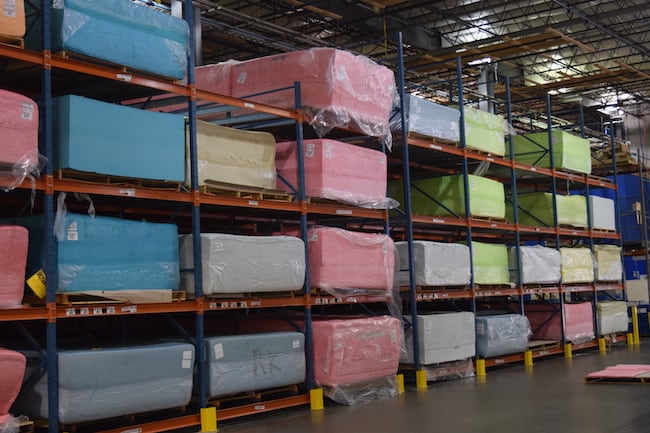
foam buns on shelves at a Latexco warehouse
Latexco offers a variety of polyurethane, viscoelastic and high-resilience foams, as well as latex.

Similarly, Future Foam remains first and foremost a foamer, but also builds finished beds to meet customers’ design specifications and offers a private-label, good-better-best boxed program through its plants in California, Massachusetts, North Carolina, Texas and Wisconsin, says Brett Almquist, regional sales manager for the Council Bluffs, Iowa-based company. Future Foam has 25 U.S. facilities, including six pouring plants; a pouring and fabrication plant in China; and a foam recycling facility in Germany.

Future Foam also is developing a proprietary Allay foam line for a top-of-bed program out of its plant in Fullerton, California, pairing mattress toppers and pillows, Almquist says. “It allows customers to customize their entire product line,” he says. “There’s a lot we can do to customize comfort layers and molded pillows — coat them with PCMs (phase-change materials), aerate them with pinholes, infuse them with thermal conductors, and add fragrances like lavender and even coconut.”


Read more here:

https://bedtimesmagazine.com/2019/10/the-new-fundamentals-of-foams/

October 14, 2019

Dow Propane DeHydrogenation Expansion

US Dow to retrofit Louisiana cracker for on-purpose propylene

Author: Stefan Baumgarten

2019/08/20

HOUSTON  (ICIS)–Dow will retrofit proprietary fluidised catalytic dehydrogenation (FCDh) technology into one of its mixed-feed crackers in Plaquemine, Louisiana, to produce on-purpose propylene, the US-based chemicals major said on Tuesday.

The retrofit will enable production of more than 100,000 tonnes/year of additional on-purpose propylene at full run-rate, further back-integrating Dow’s derivative facilities to cost-advantaged propylene while also maintaining the unit’s current ethylene production capacity, the company said.

The project is expected to begin producing on-purpose propylene by the end of 2021.

Dow said the retrofit would enable it to meet growing demand for its businesses serving consumer, infrastructure and packaging end-markets, while also remaining within its stated near-term capital expenditure targets, it said.

In 2016, Dow expanded the ethylene capacity of this same cracker by more than 225,000 tonnes/year and added the ability to crack ethane, while maintaining the flexibility to crack propane, butane and naphtha.

Dow and other US cracker operators are consuming more ethane instead of heavier feed slates, resulting in a reduction of co-product production, including propylene.

This reduction in propylene has created a supply/demand gap in the US that requires additional on-purpose propylene sources to meet the needs of downstream derivatives, Dow said.

FCDh technology is seen as one of the most economical propane dehydrogenation (PDH) technologies available today.

It can be used to construct a stand-alone PDH facility or can be integrated with existing crackers to provide “plug and play” capabilities for a variety of plant configurations, Dow said.

“Deploying FCDh technology supports Dow’s continued focus on delivering low-risk, low-cost and high-return projects while reducing the energy intensity and carbon footprint associated with conventional technologies,” said Keith Cleason, vice president of Dow’s Olefins, Aromatics & Alternatives business.

https://www.icis.com/explore/resources/news/2019/08/20/10406189/us-dow-to-retrofit-louisiana-cracker-for-on-purpose-propylene?utm_source=dlvr.it&utm_medium=twitter