
Company News
October 24, 2024
Urethane Highlights from Dow Investors Call
Dow Inc. (DOW) Q3 2024 Earnings Call Transcript
Oct. 24, 2024 11:16 AM ETDow Inc. (DOW) Stock
Q3: 2024-10-24 Earnings Summary
EPS of $0.47 misses by $0.00 | Revenue of $10.88B (1.39% Y/Y) beats by $200.05M
Dow Inc. (NYSE:DOW) Q3 2024 Earnings Conference Call October 24, 2024 8:00 AM ET
Company Participants
Andrew Riker – IR, VP
Jim Fitterling – Chair and CEO
Jeff Tate – CFO
Conference Call Participants
Vincent Andrews – Morgan Stanley
Hassan Ahmed – Alembic Global
Richard Garchitorena – Wells Fargo Securities
Jeff Zekauskas – JPMorgan
Bhavesh Lodaya – BMO Capital Markets
David Begleiter – Deutsche Bank
Steve Byrne – Bank of America
Josh Spector – UBS
Chris Parkinson – Wolfe Research
Patrick Cunningham – Citi
Kevin McCarthy – Vertical Research Partners
Frank Mitsch – Fermium Research
John Roberts – Mizuho
Mike Leithead – Barclays
Duffy Fischer – Goldman Sachs
Matthew Blair – TPF
Aleksey Yefremov – KeyBanc
Laurence Alexander – Jefferies
Arun Viswanathan – RBC Capital Markets
Jim Fitterling
Thank you, Andrew. Beginning on Slide 3, our cost advantage footprint in the Americas continues to provide strong competitive edge capturing demand growth in attractive markets and regions. In the third quarter, Team Dow delivered our fourth consecutive quarter of year-over-year volume growth. We delivered this despite a soft macroeconomic environment, primarily in Europe and China, as well as an unplanned cracker outage in Texas, which has been successfully restarted and is running well.
Net sales in the Q3 were $10.9 billion, this is up 1% versus the year ago period led by higher demand and local prices in the United States and Canada. Volume increased 1% versus the year ago period and prior periods. Sequentially, we saw gains in Packaging and Specialty Plastics and Industrial Intermediates and Infrastructure.
Local price was flat year-over-year as gains in Packaging and Specialty Plastics were offset by decreases in Performance Materials and Coatings. Sequentially, local price was down 1% due to minor declines across all segments. Operating EBIT was $641 million, up $15 million year-over-year, reflecting higher integrated margins in Packaging and Specialty Plastics, which were partly offset by the impact of the unplanned cracker outage in Texas and higher planned maintenance activity. Cash flow from continuing operations was $800 million down year-over-year, primarily due to higher inventories to support both sales growth and labor related supply chain disruptions.
Shareholder remuneration for the quarter was $584 million including dividends and share repurchases. In addition, we progressed our long-term growth strategy including signing a long-term agreement with Linde for the supply of clean hydrogen for our Path2Zero project in Fort Saskatchewan. We also completed the acquisition of US based polyethylene recycler Circulus. This will add capacity of 50,000 metric tons of recycled materials annually to Dow’s portfolio.
Now turning to our operating segment performance on Slide 4. In the Packaging and Specialty Plastics segment, local price increased year-over-year led by higher polyethylene prices in all regions except Latin America, which was flat. Volume was flat year-over-year as higher demand for functional polymers in all regions was offset by lower polyethylene volumes. Operating EBIT was $618 million an increase of $142 million year-over-year. This was primarily driven by higher integrated margins, which were partly offset by the impact of the unplanned cracker outage I mentioned earlier.
Moving to the Industrial Intermediates and Infrastructure segment, local price was flat year-over-year. In addition, volume was down 2%. This was driven by lower volumes in Polyurethanes and Construction chemicals, which were primarily due to a force majeure in MDI following a third-party supplier outage.
Operating EBIT decreased $74 million versus the year ago period. Results were driven by higher planned maintenance activity and lower integrated margins, which were partly offset by improved equity earnings. And in the Performance Materials and Coatings segment, local price declined year-over-year, while volume was up 5% with gains in both businesses and across all geographic regions. Operating EBIT was $140 million down $39 million compared to the year ago period, driven by higher raw material costs, which were partly offset by higher volumes.
Moving to Slide 5. The strength of Dow’s differentiated portfolio is defined by our strategic and purpose built asset footprint which leverages low cost feedstock positions, primarily in the Americas. Our growth investments are concentrated in higher value businesses and regions, particularly where demand is resilient and we have a competitive cost advantage. Over the past few years, we’ve demonstrated our commitment to operating with the best owner mindset by taking proactive actions with select higher cost assets aligned with the evolving market dynamics.
Since 2023, we have undertaken more than 20 asset actions. These include targeted rationalization of our global polyols capacity, shutting down our propylene oxide unit in Freeport, Texas in 2025 to reduce lower value merchant PO exposure, strengthening our coatings footprint with select asset closures and announcing the sale of our laminating adhesives business for $150 million including two manufacturing sites in Italy, which we expect to finalize in the fourth quarter of this year.
Overall, these actions have been primarily focused on our industrial, intermediates and infrastructure segment and in the EMEA region. On Slide 6, current market dynamics are impacting Europe, including continued soft demand, coupled with a persistent lack of long-term regulatory policy. This ongoing absence of clear, consistent, and competitive regulatory policy in Europe has resulted in many challenges for our industry.
These challenges have been acknowledged in statements by EU government leaders, top economists, and our peers. And while a demand recovery in other parts of the world was expected to provide swift upside across the markets we serve, this alone is unlikely to be enough in Europe. Given these dynamics, we’ve begun a strategic review of select European assets, primarily those in our polyurethane business. This review includes all value-creating options for these assets and currently consists of approximately 20% of our sales in the EMEA region.
We expect to complete this review by mid-2025. We continue to engage with governments both directly as well as through our leadership in trade associations to improve the industry’s overall competitiveness in the region. Decisions regarding the strategic review, similar to our prior actions, will focus on strengthening Dow’s global portfolio. This enables us to invest in the most attractive opportunities and create long-term value growth for our shareholders.
Hassan Ahmed
Good morning Jim. Just a question around some of the sort of review work that you guys are doing in Europe. You guys specifically talked about polyurethanes. I’m just trying to sort of get a better sense of all the moving parts with regards to how you see the polyurethane cycle sort of panning out. Obviously, we’ve seen or about to see some assets change hands within the global polyurethane market. The destocking was particularly severe in polyurethanes, but the supply side seems a bit tepid. So as sort of you sift through all of these moving parts, how do you see the polyurethane market sort of coming out on the other side?
Jim Fitterling
Good morning Hassan. Actually, we’re still poised for a very good recovery in construction and durables markets, which really drive a lot of what’s going on in polyurethanes. I’d add automotive on top of that because I think automotive has been under some pressure in Europe. So I agree with you, there is no signs that there’s any stocking and destocking has run its course. But I think we are waiting for that obvious turn in the economy that gets people moving into those segments.
And those assets in Europe is really a portfolio shift move. It really has nothing to do with the business. Polyurethanes is a good business, a pretty diverse downstream markets. We’ve got good positions there. And as I mentioned, we’re thinking about 20 asset actions so far across the globe, mostly in II&I, which is really to tighten up the footprint and get our capacity focused on our lowest cost assets there. So I think it is strengthened, both polyurethane business and also the coatings business as well.
Thank you, good morning. Jim, on the European assets under review, are they EBITDA positive? And if so, how much? And if you do close both of your MDI plants in Europe, would you still look to supply Europe MDI from your plants in Saudi and Texas? Thank you.
Jim Fitterling
Yes, good morning David. I don’t have a specific number to give you on the European assets right now, but they are EBITDA positive. They are good cost positions in the European market. Again, we are looking at all value-creating opportunities. I don’t believe – I don’t want to preclude anything, but I don’t believe shutting down MDIS, that is going to be a value-creating opportunity, but we’re going to look at everything.
John Roberts
Thank you. Jim, you’ve got chlorine integration in Europe. So how separable are the decisions you’re looking at in Europe for polyurethanes versus the [cab] (ph) assets?
Jim Fitterling
They’re not, John. Obviously, we’re not going to do anything without close contact with our own chlorine assets but also with our partners in Europe. And so we’ll keep a close eye on that. Chlorine PO integration is critical for us, and so we will make sure we’re eyes wide open to that.
Aleksey Yefremov
Thanks good morning everyone. Jim, I was quite surprised to see about $100 million in EBITDA for II&I into this quarter. The segment started the year pretty strongly with $234 million, and then EBITDA continued to soften. Could you give us, just to reflect on this year, what product specifically or regions maybe did not perform as well? And what do you expect next year here?
Jim Fitterling
Yes. So obviously, we had Glycol-2 up and running, so that was to a positive. We had price pressure on PO Polyols and we had lower volumes in MDI. I mentioned in the opening that we had a third-party outage in North America, which supplied industrial gas to our MDI process there, the plants back up but still running at lower rates. And then look, the other thing that happened when Texas-8 was out, Texas-8 produces propylene for us as well. And so when we had Texas-8 out, we had to go into the market to get some of that propylene so that was a higher cost.
So I think it was on to one-time, the MDI issue is a one-time, which will correct itself. The PO polyols that was a big driving force around the decision to tighten up the footprint in Freeport. So as we go forward, we don’t have as much length in PO, which brings the North American market more in the balance. So I think, as we move forward, it is polyurethanes in North America, that was the bigger slowdown and drag in the quarter.
Arun Viswanathan
Hi, guys great. Thanks for taking my question. So I guess I just wanted to ask about — there’s been a lot of portfolio reviews, especially of European assets at this point. So just wondering if you’ve gone through some kind of analysis here, assuming any of those shutdowns happen or potentially portfolio reviews result in shutdowns. How much maybe capacity could be coming out of the industry and P&SP in — as you look into ’25.
And maybe if you can give us your thoughts as well on PMC kind of global supply demand as well, just because we’ve been mired in weakness on the coating side for a while, from a demand standpoint, but maybe there is some green shoots with rates coming down. So do you see any improvement in operating rates on the PMC side as well. So just maybe you could get your comments on both P&SP and PMC utilization as you look into ’25? Thanks.
Jim Fitterling
Yes good morning Arun. Look, I think, again, our portfolio work in Europe is around polyurethanes. And as I mentioned before, it really isn’t driven primarily by shutdowns, we’ll look at that. But I think we’ve done a lot to bring smaller assets down and bring that capacity into our low-cost locations. It’s really looking at what is there a better owner for the portfolio? Does that allow us to continue to focus on our Invest for Growth businesses, which went from Investor Day, you’ll remember we’re P&SP our silicones business and also our Industrial Solutions business.
October 24, 2024
Dow Q3 Results
Dow’s stock rises as Q3 sales beat estimates
Oct. 24, 2024 9:20 AM ETDow Inc. (DOW) StockBy: Rob Williams, SA News Editor
Dow’s (NYSE:DOW) stock rose 1.5% on Thursday morning after the chemical maker reported third-quarter results.
Adjusted earnings were $0.47 a share, in line with the consensus estimate.
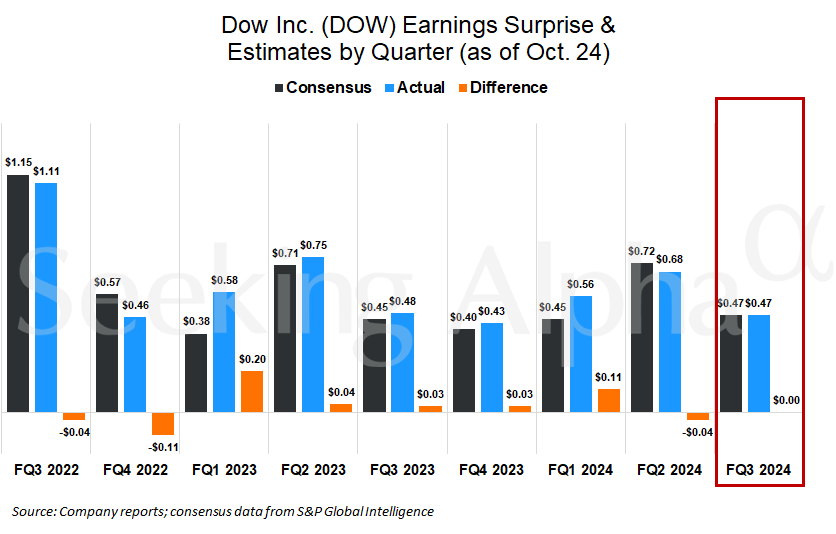
Net sales rose 1% from a year earlier to $10.88 billion in the third quarter, led by higher sales in the United States and Canada. Analysts on average forecast sales of $10.68 billion.
The company last month had warned third-quarter sales would be less than previously forecast.
“Our cost-advantaged footprint in the Americas continues to provide a strong competitive edge, enabling Dow (DOW) to capture demand growth in attractive markets,” Jim Fitterling, chair and chief executive of Dow (DOW), said in a statement. “However, a meaningful recovery has yet to materialize in Europe and China.”
Sales grew 1.1% from the prior year in its packaging and specialty plastics business, and by 3.9% for its performance materials and coatings unit. However, sales fell 2.4% in its industrial and infrastructure unit.
October 23, 2024
Quadrant Communication Regarding TCPP
October 18, 2024

Update: Compliance with Antidumping Duties and Tariffs for Spray Foam Products
U.S. International Trade Commission (USITC) into imports of alkyl phosphate esters (TCPP fire retardants) from China for price dumping (701-TA-721 and 731-TA-1689).
To all Quadrant Performance Materials Customers,
On September 30, 2024, the Department of Commerce International Trade Administration announced their preliminary determination, concluding that countervailable subsidies—financial assistance and other unfair trade practices—have been provided by the Chinese government to its domestic producers of alkyl phosphate esters (TCPP), thus distorting international trade. These subsidies have given unfair advantages to Chinese manufactures, enabling them to sell goods at lower prices. For more details, please see the Federal Register notice: Federal Register Document C-570-169.
Countervailing duties (additional tariffs) have been imposed on the importation of Chinese manufactured TCPP, with tariffs ranging from 50% to 564%, depending on the company.
A variety of US Industries, including spray foam, use imported TCPP as the US domestic production capacity is insufficient to meet Industry demands. Consequently, the raw material costs for spray foam are expected to increase.
Furthermore, the investigation is still ongoing, to further assess additional antidumping tariff and or penalties; with a final determination expected in late November and or before February 9, 2025.
We strongly recommend that you obtain documentation from your spray foam suppliers to ensure that the products you have purchased since 2018, as well as those you are currently buying, comply with all applicable duty and tariff regulations.
Quadrant’s Commitment to Compliance
Quadrant Performance Materials has and will continue to adhere to all relevant duties and tariffs for any imported materials used in our spray foam systems and other products. We verify and ensure the payment of these duties and tariffs, to maintain transparency and compliance.
If you have any questions or need further clarification on this issue, please do not hesitate to contact us.
Quadrant Performance Materials
200 Industrial Blvd, McKinney, TX 75069
(972)542-0072
October 14, 2024
Petroquímica Río Tercero to Close TDI Plant in Argentina
The closure of the TDI plant due to lack of competitiveness causes the first layoffs
The closure of the TDI (toluene diisocyanate) production plant, belonging to the Petrochemical company Río Tercero, begins to cause layoffs and suspensions of personnel, as the firm had anticipated.
On Sunday night, the Petrochemical Chemical Industries Staff Union of Río Tercero promoted a protest measure in front of the entrance to the chemical center, which consisted of the total closure of Savio Avenue in that sector for a few hours.
The action is a direct union response to the first telegrams of dismissal and dismissal of personnel that, they claim, were sent by the company to the workers via email. In principle, about 120 separations are mentioned.
The lack of competitiveness in the face of the national government’s opening of TDI imports from Asian countries was the cause alleged by the Piero group firm to close the main production unit of the local factory, although it stressed that it will remain active. the rest of the plants.
In that direction, Mayor Marcos Ferrer expressed his concern about the conflict, and blamed the national economic policies of indiscriminate opening of foreign products.
He argued that the national industry cannot compete on equal terms with Asia, due to the great asymmetry of tax, labor, and energy costs.
In that sense, he assured that he will begin negotiations with the Nation to attempt some dialogue that could lead to concrete measures to protect the industry, although he admitted that it is a very difficult option to achieve.
Regarding the layoffs, Ferrer said that he fears a domino effect in the rest of the industries in the chemical sector, mainly in the Military Factory, since Petrochemical buys almost all of the nitric acid production from him as an input for the TDI, which it will no longer produce.
Thus, there are fears for the future of the almost 60 workers affected by the operation of the state company’s nitric plant.
This Monday, at 10, a presentation by the chemical union is scheduled before the Provincial Labor Secretariat, in order to request a mandatory conciliation that takes the conflict back to its origin, to open a stage of negotiation.
Meanwhile, at 6:30 p.m. a protest march is called through the streets of the city.
TDI is the main input for the manufacture of foam rubber for mattresses and pillows, as well as accessories for the automotive industry.
October 14, 2024
Honeywell Spin Off
HONEYWELL ANNOUNCES PLAN TO SPIN OFF ADVANCED MATERIALS BUSINESS TO SHAREOWNERS
Oct. 08, 2024 6:00 AM ETHoneywell International Inc. (HON)
- Independent company to be a leading provider of sustainability-focused specialty chemicals and materials with approximately $3.8 billion of revenue and an EBITDA margin greater than 25% expected in FY24
- Advanced Materials portfolio includes leading brands such as Solstice®, Spectra®, Hydranal® and Aclar®, among others
- Honeywell (HON) continues to simplify and optimize its portfolio around three compelling megatrends: automation, the future of aviation and energy transition
- Tax-free spin to shareowners targeted to be completed by the end of 2025 or early 2026
CHARLOTTE, N.C., Oct. 8, 2024 /PRNewswire/ — Honeywell (Nasdaq: HON) today announced a plan to spin off its Advanced Materials business into an independent, U.S. publicly traded company, which is targeted to be completed by the end of 2025 or early 2026. Honeywell expects to execute the planned spin in a tax-free manner to its shareowners.

As a leading global provider of sustainability-focused specialty chemicals and materials, this pure-play business will be well-positioned to benefit from an enhanced strategic focus and the financial flexibility to pursue innovation and growth opportunities through investment cycles. Further, the planned spin-off will enable Honeywell to progress its strategic priorities of accelerating organic growth, evolving its Accelerator operating system, and optimizing its portfolio.
“Given the sustained market demand for advanced specialty chemicals and materials around the globe, we are confident now is the right time for this business to grow independently, leveraging its leading technologies and deep customer relationships. As a sector leader, this new company will have a greater strategic focus on innovation, enabling it to develop new, more sustainable solutions and products with next-generation chemistry to create further value for shareowners,” said Vimal Kapur, Chairman and CEO of Honeywell.
Kapur added, “Today’s announcement is the latest step in the optimization of the Honeywell portfolio, a key priority I laid out in my first year leading the company. Through the powerful combination of strategic bolt-on acquisitions and subtractions of high quality but non-core business lines, we continue to enhance our portfolio mix and further tighten Honeywell’s alignment to three compelling megatrends: automation, the future of aviation, and energy transition—underpinned by our Accelerator business models.”
The planned spin-off is expected to create value for all stakeholders as both Honeywell and the Advanced Materials business will benefit from:
- A simplified strategic focus;
- A greater financial flexibility to pursue prioritized organic growth opportunities throughout investment cycles;
- An improved ability to customize capital allocation priorities in alignment with strategic focus; and
- Distinct investment profiles that position each company to unlock greater long-term value for shareowners.
Honeywell’s Continued Simplification and Portfolio Optimization
The planned spin-off of the Advanced Materials business follows four recent acquisitions Honeywell announced as part of its disciplined capital deployment strategy. The company is focused on high-return acquisitions that will drive future growth across its portfolio in alignment with the three powerful megatrends. In the past 12 months, Honeywell completed the acquisitions of: Carrier Access Solutions, Civitanavi, CAES and Air Products’ liquified natural gas (LNG) business.
Honeywell is currently on pace to exceed its commitment to deploy at least $25 billion toward high-return capital expenditures, dividends, opportunistic share purchases and accretive acquisitions through 2025, with approximately $9 billion deployed towards acquisitions to date in 2024.
Following the completion of the planned spin of the Advanced Materials business, Honeywell will be positioned to further improve its organic sales growth, lower capital intensity, reduce cyclicality of sales and enhance free cash flow generation capability.
Advanced Materials
Upon completion of the spin-off, the Advanced Materials business will be a sustainability-focused specialty chemicals and materials pure play with leading positions across fluorine products, electronic materials, industrial grade fibers, and healthcare packaging solutions. The business offers technologies that include the breakthrough low global warming Solstice® hydrofluoro-olefin (HFO) technology, which has helped avoid the potential release of the equivalent of more than 326 million metric tons of carbon dioxide into the atmosphere.[1] Additionally, the business manufactures a wide variety of high-performance specialty materials technologies ranging from Spectra®, a fiber used in high-end armor technology to protect in law enforcement and military applications, to Hydranal®, the most trusted brand in Karl Fischer titration, to Aclar®, a high-performance pharmaceutical packaging material critical to preserving prescription drugs and keeping them safe.
Advanced Materials is expected to have FY24 estimated revenue of between $3.7 billion and $3.9 billion with an EBITDA margin greater than 25%. As a standalone company with a large-scale domestic manufacturing base, it will be positioned to benefit from a compelling investment profile and a more flexible and optimized capital allocation strategy.
Transaction Details
The planned spin-off transaction is targeted for completion by the end of 2025 or early 2026, subject to certain customary conditions, including, among others, the filing and effectiveness of applicable filings (including a Form 10 registration statement) with the U.S. Securities and Exchange Commission, assurance that the spin-off of the Advanced Materials business will be tax-free to Honeywell’s shareowners, receipt of applicable regulatory approvals and final approval by Honeywell’s board of directors. Approval by Honeywell’s shareowners is not required.
The spin transaction will not impact Honeywell’s FY24 guidance.
As the process progresses, Honeywell intends to provide additional information regarding the future management team and board of directors for the independent Advanced Materials company.
Goldman Sachs & Co. LLC is serving as financial advisor to Honeywell. Skadden, Arps, Slate, Meagher & Flom LLP is providing external legal counsel.
 Everchem Updates Archive
  Sign Up for Email Updates