
Company News
June 13, 2023
Possible SKpucore Divestiture by SKC
Korea’s SKC in talks to sell polyol subsidiary SK pucore to private equity firm
0
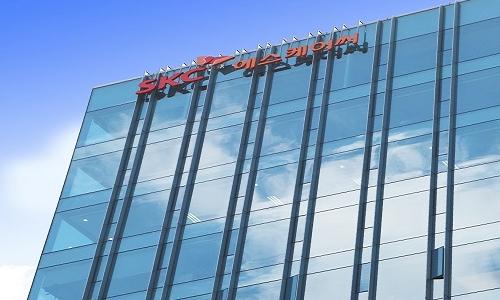 |
| [Courtesy of SKC] |
SKC Corp., a South Korean polyethylene terephthalate (PET) film manufacturer, will sell its polyol subsidiary SK pucore Co. to a private equity firm in a move to liquidate assets to focus on chips and secondary battery materials business.
According to multiple sources from the investment bank industry on Monday, SKC is currently in talks to sell SK pycore to Glenwood Private Equity for about 500 billion won ($390 million).
The two companies recently signed a memorandum of understanding and are expected to sign a contract soon after conducting due diligence.
Samil PricewaterhouseCoopers is known to lead the sales as financial adviser of the buyer.
The deal is expected to be valued at about 10 times the last year‘s earnings before interest, taxes, depreciation, and amortization (EBITDA), which stood at 48.8 billion won.
SK pucore, formerly MCNS, which was jointly established by SKC and Japan’s Mitsui Chemicals Inc. in 2015, produces polyols, a raw material for polyurethane.
The partnership with Mitsui Chemicals ended in 2021 and the company changed its name. SK pucore has a dominant position in the domestic polyol market. Last year, it accounted for 40 percent of the entire market.
The sale comes as SKC is hoping to stack cash for investments and improve financial health.
SKC announced to invest 1.8 trillion won to strengthen its semiconductor and secondary battery materials business capacity. SKC is also in the process of acquiring semiconductor testing company ISC Co. for about 400 billion won.
SKC’s net debt to EBITDA was more than 6 times in the first quarter of this year, up from 3.5 times in 2021. The company’s net debt stood at 3.6 trillion won as of the first quarter.
Glenwood PE is a mid-sized private equity fund manager in Korea. It recently acquired the diagnostics division of LG Chem Ltd. and is the second-largest shareholder of Hanwha Advanced Materials Corp. and CJ Olive Young Corp.
Glenwood PE, in particular, manages PI Advanced Materials Co., which it previously acquired from SKC. The latest deal is expected to create synergy.
Polyurethanes manufactured through SK pucore’s flagship product, polyols, are utilized in a wide range of downstream industries, including automotive, fashion, electronics, and medical devices.
The company has more than 450 customers, more than 130 distribution partners, and production facilities in five countries. Last year, SK pucore raised 32.4 billion won in operating profit on sales of 720.6 billion won.
The company has secured future growth engines recently by developing eco-friendly polyol products. Customers return waste polyols to SK pucore, and the company makes recycled polyols from them and supplies them back to customers. The company is also accelerating the production of bio-polyols based on vegetable oils.
The investment bank industry is observing whether SKC will continue to secure more assets to build a portfolio that centers on new businesses.
“This year, we plan to strengthen the competitiveness of our core businesses by expanding global expansion and sales of copper foil and increasing the proportion of high-value-added products in our semiconductor and chemical businesses,” said SKC Chief Executive Officer Park Won-cheol in March.
“We will expand new growth businesses through active additional mergers and acquisitions.”
The company also sold its film division to private equity firm Hahn & Company for 1.6 trillion won last year.
Some critics, however, raise concerns about the sales being carried out by SKC as the M&A market is still unstable.
“We are concerned that the company is selling assets in a rush when the buyer has more power,” said an industry insider. “The company is desperate to secure liquidity but it should also be considered that it may send an excessive signal to the market that SKC’s financial situation is unstable.”
June 7, 2023
SSB Reorganization Plan Approved
US mattress maker Serta Simmons receives Chapter 11 plan approval
Story by Reuters • Yesterday 10:57 PM

June 6 (Reuters) – Mattress maker Serta Simmons Bedding on Tuesday said that its Chapter 11 reorganization plan has been confirmed by a U.S. bankruptcy court, bringing the bedding company one step closer to emerging from bankruptcy.
The Doraville, Georgia-based company, whose roots date to 1870, filed for Chapter 11 protection from creditors in January with the U.S. Bankruptcy Court in the Southern District of Texas, in a bid to eliminate most of its debt.
The mattress manufacturer, which accounts for nearly one-fifth of U.S. bedding sales and whose brands include Serta, Simmons, Beautyrest, and Tuft & Needle, said it is operating normally as usual.
Serta Simmons, backed by Apollo Global Management and Gamut Capital Management through its restructuring plan aims to reduce its debt to $315 million from $1.9 billion, in addition to which it projects that the company’s annual cash interest expense will fall by more than $100 million.
The company during the COVID-19 pandemic had added $200 million of new capital to weather higher raw material costs and supply chain disruptions.
However, significant amounts of debt maturing in 2023 have made the company’s capital structure unsustainable, necessitating a comprehensive restructuring that is now supported by more than three-quarters of its key lenders. (Reporting by Mrinmay Dey in Bengaluru; Editing by Sonia Cheema)
June 7, 2023
Univar Shareholders Approve Sale
Univar Solutions Stockholders Approve Acquisition by Apollo Funds

News provided by Univar Solutions Inc.
06 Jun, 2023, 16:15 ET
DOWNERS GROVE, Ill., June 6, 2023 /PRNewswire/ — Univar Solutions Inc. (NYSE: UNVR) (“Univar Solutions” or the “Company”), a leading global solutions provider to users of specialty ingredients and chemicals, announced today that its stockholders have voted at a special meeting of Univar Solutions stockholders (the “Special Meeting”) to approve the Company’s pending acquisition by funds managed by affiliates of Apollo (NYSE: APO). Under the terms of the merger agreement, Univar Solutions stockholders will receive $36.15 per share in cash for every share of Univar Solutions common stock they own immediately prior to the effective time of the merger.
At the Special Meeting, approximately 93.6% of the shares voted were voted in favor of the merger, which represented approximately 81.3% of the total outstanding shares of Univar Solutions common stock as of May 1, 2023, the record date for the Special Meeting.
Univar Solutions Stockholders Approve Acquisition by Apollo Funds
“We are pleased that our stockholders overwhelmingly supported our transaction with Apollo,” said Chris Pappas, chairman of the Univar Solutions Board of Directors. “We now shift our focus to the important next steps toward completing the transaction and maximizing value for Univar Solutions stockholders.”
Assuming timely satisfaction of necessary closing conditions, the transaction is expected to close in the second half of 2023.
The final voting results on the proposals voted on at the special meeting will be set forth in a Form 8-K filed by Univar Solutions with the U.S. Securities and Exchange Commission.
May 30, 2023
CertiPUR-US® Program Adds Enthalpy Analytical as Approved Laboratory


CertiPUR-US® Program Adds Michigan-Based
Enthalpy Analytical as Approved Laboratory
Enthalpy Analytical in Mount Pleasant, Michigan, becomes fourth laboratory
authorized to test foams to meet CertiPUR-US® program requirements
(Rochester Hills, Mich. – May 30, 2023) The CertiPUR-US® foam certification program has approved its fourth testing laboratory for CertiPUR-US® certification of flexible polyurethane foam for use in upholstered furniture and bedding.
Following a rigorous selection and approval process that has spanned more than two years, Enthalpy Analytical has been approved by the Alliance for Flexible Polyurethane Foam’s CertiPUR-US Board of Directors to conduct the content analysis and emissions testing to determine if submitted foams meet the certification program’s requirements as outlined in the program’s Technical Guidelines.
Few labs have the equipment and capacity to do all the testing required, which is one of the conditions for being an approved lab.
“Enthalpy was thoroughly vetted by our board and our Technical Advisory Group and, in addition to having the required equipment, had to pass round-robin testing with sample foams to show results matched results of other approved labs on identical foams,” explained Michael Crowell, CertiPUR-US executive director.
“We are pleased to join the CertiPUR-US program as an approved laboratory,” said Sarah Mack, business development manager for Enthalpy Analytical. Mack elaborated: “We have seen environmental and sustainability initiatives focus on and continue to promote accountability programs such as this and are proud to actively support this important work. It is an honor to assist organizations with their goal of protecting consumers and is a direct complement to our mission to protect the air we breathe, the water we drink, and the soil that feeds us!”
Only one other lab that is approved for testing compliance with the CertiPUR-US program requirements is located in the U.S. Other labs are located in Denmark and Germany. There are now four approved labs worldwide and listed at www.certipur.us/labs.
“We are very pleased to welcome this highly regarded company with a solid reputation,” said Crowell. “Adding another U.S.-based testing facility provides more choices for the more than 90 foam producers participating in the program and certifying more than 200 foam families on an annual basis.”
Certified flexible polyurethane foam products are analyzed by these independent, accredited testing laboratories and are certified to be made without ozone depleters, made without lead and heavy metals, made without formaldehyde, made without phthalates regulated by the Consumer Product Safety Commission and screened for relevant chemicals (including flame retardants) classified as carcinogenic, mutagenic or reprotoxic (see Technical Guidelines at certipur.us/technicalguidelines for details). Foams are also tested for emissions and must be low VOC (Volatile Organic Compound) emissions for indoor air quality (less than 0.5 parts per million).
In addition to foam producers submitting foams for testing, the CertiPUR-US program itself uses the approved labs to conduct testing of foam samples acquired through random on-site foam production plant checks of participating producers.
Enthalpy Analytical LLC is a wholly owned subsidiary of Montrose Environmental Group Inc., providing environmental laboratory services as part of Montrose’s Measurement and Analysis division. Enthalpy operates a network of accredited laboratories across the U.S. Within the network, Enthalpy has laboratories that specialize in analysis of air, soil, water and sediment.
# # #
May 29, 2023
PO Trade Flows in the Future
Will Shutdown of Dow’s PO Plant in U.S. Change Asian Trade Flow?
PUdaily | Updated: May 29, 2023
The end-users of propylene oxide (PO) include industries such as real estate, automobiles, furniture, refrigerators, and freezers, which are closely related to the development of the national economy. An increase in demand for polyurethane due to the rise in the prosperity of these industries will stimulate polyols suppliers to increase production, thereby increasing the demand for PO and driving up prices.
On May 16, it was reported that Dow Chemical plans to close its PO plant in Freeport, Texas, by the end of 2025.
The decision to close the PO plant arose from the fact that the plant is approaching its end-of-life, and the overall chemical industry is not prosperous due to the slowing global economic growth and various uncontrollable factors. The demand from most end-users is weakening, and polyurethane suppliers are paying more attention to higher value-added segments. Therefore, the decision to close the plant is part of Dow Chemical’s efforts to optimize costs and supply conditions.
Dow’s PO plant in Freeport will continue to operate until the end of 2025, while downstream polyether polyol plants will continue to operate after the PO plant is shut down. After 2025, Dow will use resources from other regions or third-party suppliers to supply PO to its polyol plants. Dow is also investing in logistics capabilities, such as PO tanks, pipelines, and new barges to ensure the normal supply.
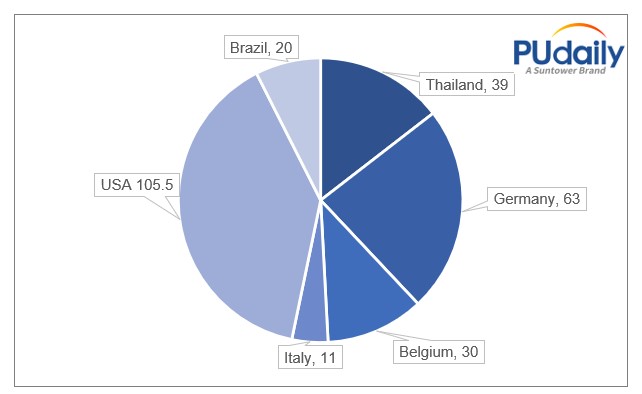
Currently, Dow Chemical is the world’s largest PO producer with an extensive layout of plants in the U.S., Germany, Brazil, Belgium, and Thailand. Its total capacity is 2.685 mtpa, contributing 20.24% of the global PO output.
Dow Chemical’s PO Capacity Layout (10kT)
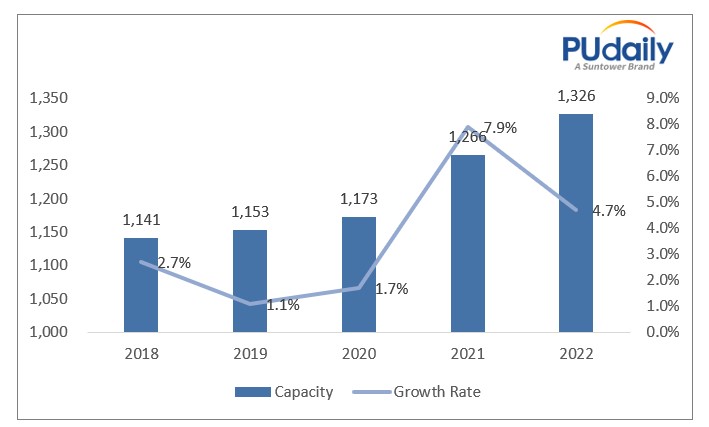
Global PO Capacity & YoY Changes, 2018-2022 (10kT, %)
Dow’s PO production uses the chlorohydrin process technology. The patent owners of the chlorohydrin process are mainly Dow in U.S., Asahi Glass, Mitsui Toatsu and Showa Denko in Japan. The chlorohydrin process was industrialized as early as 1931 and has the advantages of mature technology, short process, low purity requirements for raw materials, and low investment. The key of this technology is the chlorohydrin reactor, and Dow Chemical’s tubular reactor is representative of the chlorohydrin process.
But the chlorohydrin process causes severe environmental pollution, and under the background of increasingly stringent environmental regulations, the use of chlorohydrin technology faces enormous challenges. The US government has already eliminated chlorohydrin technology in 2000, and China has also listed chlorohydrin process as a restricted item in the Guidance Catalogue for Industrial Structure Adjustment (2011), and new facilities cannot adopt this technology.
The shutdown of Dow’s PO plant in the U.S. will cause a supply gap. Part of the gap will be filled by LyondellBasell (In March of this year, LyondellBasell successfully started up the world’s largest PO and TBA plant in Texas. These new assets on the U.S. Gulf Coast have an annual capacity of 470,000 tonnes of PO and 1 million tonnes of TBA and its derivatives). Some PO suppliers in countries such as South Korea, Saudi Arabia, and Thailand will also increase exports to the U.S. China’s PO export is constrained by process requirements and lack of export tax refunds. The tax rebate rate for downstream products of PO, such as polyether polyols, propylene glycol, and propylene glycol methyl ether, has been increased to 13%, further enhancing their export competitiveness.
 Everchem Updates Archive
  Sign Up for Email Updates