
Current Affairs
September 28, 2021
Railcar Primer
Why Is The Number Of Railcars In Storage Important?
by Tyler DurdenTuesday, Sep 28, 2021 – 02:10 PM
By Joanna Marsh of FreightWaves,
Rail equipment manufacturers, suppliers and industry observers will talk about the number of railcars in storage being up or down. But why is that figure important?
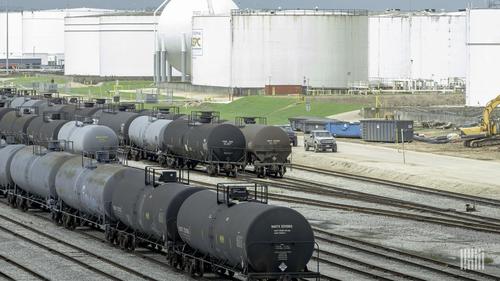
Knowing how many railcars are in storage is significant because that figure helps observers understand network capacity in relation to the broader economy. Industry participants also look at the number of railcars in storage by railcar type to gauge expectations for where railcar lease rates are heading and the volume of orders that manufacturers will receive for newly built railcars.
A number of organizations, such as the advocacy group Railway Supply Institute and the data firm Commtrex, keep track of how many railcars are in storage, including what type of railcar as different railcars can haul different commodities. The kinds of railcars that may be stored can range from pool fleets and auto racks to coal cars and tank cars.
One reason why there are so many railcars in storage is that railcars are very specific to the type of freight being moved. There are often shortages of some railcar types and surpluses of other railcar types at the same time.
For instance, if more grain needs to be shipped domestically and for export, then more hopper cars will be needed to move that grain. If there is less grain to be shipped, then railcar owners may store some of those hopper cars temporarily.
Sometimes a commodity will see volumes facing a systemic decline and that will be reflected in the type of railcars in storage. Sand used in the natural gas fracking process was transported in small cube covered hoppers. But when companies began using local sand instead of shipping sand via rail, that lessened the number of small cube covered hoppers on the rail network — and increased the number of those railcars in storage.
Also, when natural gas began to displace coal as the primary feedstock to generate electricity, coal volumes fell, sending coal cars into storage.
“As demand goes down, some of those cars go into storage and that drives the number of cars in storage,” said Lee Verhey, director of regulatory and industry affairs for the Railway Supply Institute.
The broader economy can influence how many railcars are in storage. When the COVID-19 pandemic first hit in the spring of 2020, manufacturing rates and in-store consumer activity took a nosedive amid social distancing measures. As a result, U.S. rail volumes sank in April and May 2020. Because there was less rail traffic, more railcars went into storage.
“The market really drives the availability of cars,” Verhey said.
“As demand [to haul certain commodities] goes down, some of those cars go into storage and that drives the number of cars in storage.”
The number of railcars in storage was as high as more than 525,000 cars in July and August 2020, a manager with railcar manufacturer Greenbrier said recently. That number has been steadily declining over the last 14 months to below 400,000, which is more in line with normal levels.
“As the economy starts to gain momentum and we start to see manufacturing starting to increase and supply starting to be more available, then you have greater demand for cars,” Verhey said.
A portion of the railcars in storage are older and less efficient than newer railcars because they have lower payload-to-weight ratios. Therefore, some of the railcars in storage may never come back into service.
Railcar leasing companies own roughly 70% of the U.S. fleet, while freight railroads own about 30%. A customer, such as a chemical company, will need railcars to move product, and that customer will get quotes from the railcar lessors for rates. The leases may be short term or long term.
Meanwhile, the railroads tend to own boxcars or railcars to haul grain or agricultural products. The company TTX is a joint venture owned by the railroads that serves as a railcar pool. But the railroads don’t own tank cars, which have their own special regulations for handling.
Lastly, a handful of companies will own their railcars, such as Exxon Mobil, Shell and ConocoPhillips. The decision to own railcars depends on the company’s financial strategy, according to Verhey. Some may lease cars because they don’t want to invest in the cars, but some might find it financially advantageous to own their railcars if they serve a niche market.
https://www.zerohedge.com/economics/why-number-railcars-storage-important
September 28, 2021
Railcar Primer
Why Is The Number Of Railcars In Storage Important?
by Tyler DurdenTuesday, Sep 28, 2021 – 02:10 PM
By Joanna Marsh of FreightWaves,
Rail equipment manufacturers, suppliers and industry observers will talk about the number of railcars in storage being up or down. But why is that figure important?
Knowing how many railcars are in storage is significant because that figure helps observers understand network capacity in relation to the broader economy. Industry participants also look at the number of railcars in storage by railcar type to gauge expectations for where railcar lease rates are heading and the volume of orders that manufacturers will receive for newly built railcars.
A number of organizations, such as the advocacy group Railway Supply Institute and the data firm Commtrex, keep track of how many railcars are in storage, including what type of railcar as different railcars can haul different commodities. The kinds of railcars that may be stored can range from pool fleets and auto racks to coal cars and tank cars.
One reason why there are so many railcars in storage is that railcars are very specific to the type of freight being moved. There are often shortages of some railcar types and surpluses of other railcar types at the same time.
For instance, if more grain needs to be shipped domestically and for export, then more hopper cars will be needed to move that grain. If there is less grain to be shipped, then railcar owners may store some of those hopper cars temporarily.
Sometimes a commodity will see volumes facing a systemic decline and that will be reflected in the type of railcars in storage. Sand used in the natural gas fracking process was transported in small cube covered hoppers. But when companies began using local sand instead of shipping sand via rail, that lessened the number of small cube covered hoppers on the rail network — and increased the number of those railcars in storage.
Also, when natural gas began to displace coal as the primary feedstock to generate electricity, coal volumes fell, sending coal cars into storage.
“As demand goes down, some of those cars go into storage and that drives the number of cars in storage,” said Lee Verhey, director of regulatory and industry affairs for the Railway Supply Institute.
The broader economy can influence how many railcars are in storage. When the COVID-19 pandemic first hit in the spring of 2020, manufacturing rates and in-store consumer activity took a nosedive amid social distancing measures. As a result, U.S. rail volumes sank in April and May 2020. Because there was less rail traffic, more railcars went into storage.
“The market really drives the availability of cars,” Verhey said.
“As demand [to haul certain commodities] goes down, some of those cars go into storage and that drives the number of cars in storage.”
The number of railcars in storage was as high as more than 525,000 cars in July and August 2020, a manager with railcar manufacturer Greenbrier said recently. That number has been steadily declining over the last 14 months to below 400,000, which is more in line with normal levels.
“As the economy starts to gain momentum and we start to see manufacturing starting to increase and supply starting to be more available, then you have greater demand for cars,” Verhey said.
A portion of the railcars in storage are older and less efficient than newer railcars because they have lower payload-to-weight ratios. Therefore, some of the railcars in storage may never come back into service.
Railcar leasing companies own roughly 70% of the U.S. fleet, while freight railroads own about 30%. A customer, such as a chemical company, will need railcars to move product, and that customer will get quotes from the railcar lessors for rates. The leases may be short term or long term.
Meanwhile, the railroads tend to own boxcars or railcars to haul grain or agricultural products. The company TTX is a joint venture owned by the railroads that serves as a railcar pool. But the railroads don’t own tank cars, which have their own special regulations for handling.
Lastly, a handful of companies will own their railcars, such as Exxon Mobil, Shell and ConocoPhillips. The decision to own railcars depends on the company’s financial strategy, according to Verhey. Some may lease cars because they don’t want to invest in the cars, but some might find it financially advantageous to own their railcars if they serve a niche market.
https://www.zerohedge.com/economics/why-number-railcars-storage-important
September 27, 2021
Supply Chain Blues
Why are supply chains so messed up?
Craig Fuller, CEO at FreightWaves Follow on Twitter Saturday, September 25, 2021 4 minutes read

This is the question that I am asked on a daily basis. The issue is very complex, so I usually quip with a surprising response, “They’ve always had issues, but no one was really paying attention.” Turns out, unless the person works in freight, they are very unsatisfied with this answer. After all, freight and products just seemed to automatically show up before, but that is no longer the case.
Anyone that has been around supply chains knows that there have always been issues and challenges. Weather, economic cycles, capacity, pricing fluctuations, labor strikes, war, terrorism, policy changes, etc. -– have been with us since trade first began and those issues (and others) have always been a part of managing cargo flows. But 2021 is something much bigger entirely. Why is that?
The simple answer is there is a sudden and massive surge of demand that far outweighs the market’s capacity. The global supply chain infrastructure that exists simply can’t handle the volume of products flowing through the economy. The root cause can be blamed on the extraordinary government stimulus that has stimulated demand.

As the money flowed from the government, it ended up in the hands of consumers and businesses that spent it. The transfer of money coincided with a shift in consumer demand from purchasing services to purchasing physical products. This caused the United States to race through trillions of dollars of inventory while domestic and global production was shut down.
Simply stated, production was shut down while the U.S. economy went into demand overdrive. As production came back online, the manufacturing sector responded by fulfilling an unprecedented backlog of orders.
China ramped up manufacturing and products started to flow again. And the volumes were much bigger than before. Every container ship was put to work to move the cargo across the oceans. However, ports were built to handle a certain volume and each port has a finite number of cranes and space to store containers. When the ports became flooded with cargo, they simply didn’t have the capacity to handle it. A lack of labor, trucks, warehouse capacity, and rail infrastructure all started to create significant supply chain challenges in handling the surge of cargo.
Ships have been piling up off the coasts in ever-increasing numbers and this is taking that capacity offline as the ports try to handle it.

And this is not just an issue in the United States. This issue also exists in China. In fact, as I write this, the coastal cities of China have four times as many ships sitting off the coast as the Pacific ports in the United States do.
The oceans are also just one part of the story. To get freight to American consumers, it must go through an intricate system – shifting from port to other modes of transportation. This may include dozens of touchpoints in the domestic freight network, all of which are vulnerable to their own choke points.
Once a cargo shipment reaches the U.S. docks, it may go from truck to rail to truck to distribution center back to truck and dozens of sorting facilities in between before you receive it. Most of the capacity constraints in the domestic market have been labor-related, i.e. not enough workers at the distribution centers or drivers in the trucks. Trucking companies and warehouse operators have tried to respond by jacking up wages, but are finding that it isn’t solving their employment challenges.
Trucking has the most challenging labor picture of all; it simply is a job of last resort for many people. When construction, retail, food service, gig economy, and warehousing are all competing with the trucking industry for labor, it is often the trucking industry that loses.
After all, the lifestyle for an over-the-road driver is unique and difficult. Being forced to stay away from home for three weeks at a time is a major turn-off for many.
Truck driving is hard work and often the only recourse carriers have to attract more drivers is more money. But with alternative employment offering similar pay packages – but not requiring someone to stay away from home for weeks at a time, trucking companies are finding that new would-be drivers are not coming into the market in the numbers needed.
The challenges don’t end there. Warehouses and distribution centers have their own labor issues along with space constraints.
In the industrial sector, the supply chain issues that are causing chaos for retailers are also keeping domestic manufacturers from being able to complete the production of their finished products. The most obvious is in the automotive industry. This has an additional knock-on effect of restricting truck capacity. Even if labor supply wasn’t a major factor in the trucking industry, the carriers wouldn’t be able to get their hands on new trucks to handle the freight supply. Simply said, there aren’t enough trucks and trailers on the road to handle all of the demand.
Will the supply chain issues end soon? Very unlikely.
Even if we solve for current demand on the oceans, at the ports, in the distribution centers, and in the trucking industry, we haven’t begun to discuss what happens when the government ramps up additional domestic spending. While most supply chain professionals would agree that investing in infrastructure is the right thing to do, the worry is that it will continue to compound the imbalances between supply and demand across the supply chain.
As domestic manufacturing ramps up to handle the building of new roads, bridges, and other physical construction projects, this will put a massive onslaught of freight on the market. It will also pull labor out of the trucking industry, which will further exacerbate the driver shortage. Construction jobs will become more valuable, as contractors try to handle the surge of new projects. In turn, this will drive wages higher and increase economic growth.
For transportation providers, the good news is that it appears that we have a long way to go before the market catches up with demand. This could go on for a few years and break the typical three-year boom-and-bust cycle. For shippers and supply chain professionals that pay for capacity, while the work has never been more challenging, the rewards have also never been greater. Managing supply chains is no longer a back-office function, largely ignored and taken for granted. Going forward, business survival will require a highly functioning supply chain run by professionals with the experience and instincts to respond.
Embrace it.
September 27, 2021
Supply Chain Blues
Why are supply chains so messed up?
Craig Fuller, CEO at FreightWaves Follow on Twitter Saturday, September 25, 2021 4 minutes read
This is the question that I am asked on a daily basis. The issue is very complex, so I usually quip with a surprising response, “They’ve always had issues, but no one was really paying attention.” Turns out, unless the person works in freight, they are very unsatisfied with this answer. After all, freight and products just seemed to automatically show up before, but that is no longer the case.
Anyone that has been around supply chains knows that there have always been issues and challenges. Weather, economic cycles, capacity, pricing fluctuations, labor strikes, war, terrorism, policy changes, etc. -– have been with us since trade first began and those issues (and others) have always been a part of managing cargo flows. But 2021 is something much bigger entirely. Why is that?
The simple answer is there is a sudden and massive surge of demand that far outweighs the market’s capacity. The global supply chain infrastructure that exists simply can’t handle the volume of products flowing through the economy. The root cause can be blamed on the extraordinary government stimulus that has stimulated demand.
As the money flowed from the government, it ended up in the hands of consumers and businesses that spent it. The transfer of money coincided with a shift in consumer demand from purchasing services to purchasing physical products. This caused the United States to race through trillions of dollars of inventory while domestic and global production was shut down.
Simply stated, production was shut down while the U.S. economy went into demand overdrive. As production came back online, the manufacturing sector responded by fulfilling an unprecedented backlog of orders.
China ramped up manufacturing and products started to flow again. And the volumes were much bigger than before. Every container ship was put to work to move the cargo across the oceans. However, ports were built to handle a certain volume and each port has a finite number of cranes and space to store containers. When the ports became flooded with cargo, they simply didn’t have the capacity to handle it. A lack of labor, trucks, warehouse capacity, and rail infrastructure all started to create significant supply chain challenges in handling the surge of cargo.
Ships have been piling up off the coasts in ever-increasing numbers and this is taking that capacity offline as the ports try to handle it.
And this is not just an issue in the United States. This issue also exists in China. In fact, as I write this, the coastal cities of China have four times as many ships sitting off the coast as the Pacific ports in the United States do.
The oceans are also just one part of the story. To get freight to American consumers, it must go through an intricate system – shifting from port to other modes of transportation. This may include dozens of touchpoints in the domestic freight network, all of which are vulnerable to their own choke points.
Once a cargo shipment reaches the U.S. docks, it may go from truck to rail to truck to distribution center back to truck and dozens of sorting facilities in between before you receive it. Most of the capacity constraints in the domestic market have been labor-related, i.e. not enough workers at the distribution centers or drivers in the trucks. Trucking companies and warehouse operators have tried to respond by jacking up wages, but are finding that it isn’t solving their employment challenges.
Trucking has the most challenging labor picture of all; it simply is a job of last resort for many people. When construction, retail, food service, gig economy, and warehousing are all competing with the trucking industry for labor, it is often the trucking industry that loses.
After all, the lifestyle for an over-the-road driver is unique and difficult. Being forced to stay away from home for three weeks at a time is a major turn-off for many.
Truck driving is hard work and often the only recourse carriers have to attract more drivers is more money. But with alternative employment offering similar pay packages – but not requiring someone to stay away from home for weeks at a time, trucking companies are finding that new would-be drivers are not coming into the market in the numbers needed.
The challenges don’t end there. Warehouses and distribution centers have their own labor issues along with space constraints.
In the industrial sector, the supply chain issues that are causing chaos for retailers are also keeping domestic manufacturers from being able to complete the production of their finished products. The most obvious is in the automotive industry. This has an additional knock-on effect of restricting truck capacity. Even if labor supply wasn’t a major factor in the trucking industry, the carriers wouldn’t be able to get their hands on new trucks to handle the freight supply. Simply said, there aren’t enough trucks and trailers on the road to handle all of the demand.
Will the supply chain issues end soon? Very unlikely.
Even if we solve for current demand on the oceans, at the ports, in the distribution centers, and in the trucking industry, we haven’t begun to discuss what happens when the government ramps up additional domestic spending. While most supply chain professionals would agree that investing in infrastructure is the right thing to do, the worry is that it will continue to compound the imbalances between supply and demand across the supply chain.
As domestic manufacturing ramps up to handle the building of new roads, bridges, and other physical construction projects, this will put a massive onslaught of freight on the market. It will also pull labor out of the trucking industry, which will further exacerbate the driver shortage. Construction jobs will become more valuable, as contractors try to handle the surge of new projects. In turn, this will drive wages higher and increase economic growth.
For transportation providers, the good news is that it appears that we have a long way to go before the market catches up with demand. This could go on for a few years and break the typical three-year boom-and-bust cycle. For shippers and supply chain professionals that pay for capacity, while the work has never been more challenging, the rewards have also never been greater. Managing supply chains is no longer a back-office function, largely ignored and taken for granted. Going forward, business survival will require a highly functioning supply chain run by professionals with the experience and instincts to respond.
Embrace it.
September 27, 2021
Future Forecast
Future US chem demand fueled by re-shoring, strained by supply
Author: Al Greenwood
2021/09/22
HOUSTON (ICIS)–The US chemical industry should continue growing in the next few years, with demand being fueled by manufacturing plants returning to the country, economist Kevin Swift said on Wednesday.
However, shortages in labour and raw materials could keep chemical demand from growing faster, since these are slowing down important end markets such as automobiles and housing, Swift said.
He spoke during a presentation at the Societe de Chimie Industrielle. Swift’s comments were among his first since retiring as the chief economist for the American Chemistry Council (ACC).
The supply constraints were the downside in what is otherwise an optimistic outlook for the economy.
The purchasing managers’ index (PMI) from the Institute for Supply Management (ISM) points to further growth, Swift said. Another leading indicator, which was developed by Swift, has slowed down, but it still indicates more growth.
Swift’s indicator generally takes about three months of decline for it to signal a turn in the business cycle. “It’s not signalling that yet,” he said.
The decline is showing the effects of the Delta variant of the coronavirus, which is slowing down the leisure, hospitality and travel sectors of the economy, he said. Manufacturing continues to perform fairly well.
The number of new homes that have started construction stand at about 1.5m units, the highest since the housing crisis from 2006-2008, Swift said.
That level of housing starts reflects the millennial generation entering their peak years for house buying, Swift said.
The number of houses that have received permits but have not started construction illustrates the shortages of building materials and labour, Swift said. Some homebuilders are finishing houses without refrigerators and appliances.
The housing market is a key consumer of plastics and chemicals, such as plastic pipe, insulation, paints and coatings, adhesives and synthetic fibres. The ACC estimates that each new home built represents $15,000 worth of chemicals and derivatives.
Automobiles, another important end market, are also contending with supply shortages, particularly for semiconductor chips.
Those shortages should cause US automobile sales to dip during the third quarter before rebounding to an annualised rate of 17m/year, Swift said. “That’s actually a very good level, and that supports a lot of chemistry.”
In addition, automobiles in the US are becoming larger, so that will increase the amount of plastic and other chemicals that each one will consume, he said. As electric vehicles (EVs) become more popular, that will increase demand for other types of chemicals.
One exception is catalysts, which automobile companies use in catalytic converters. Because EVs have no emissions, they do not need catalytic converters.
Swift expects every major chemical end market in the US will expand in 2021. He noted weakness in printing, which reflects fewer people reading physical copies of media.
In 2022, he expects weakness in apparel and textile-mill products, two other US industries that have been in long-term decline.
RESHORING
The disruptions to supply chains have accelerated a trend towards bringing manufacturing plants closer to demand centres, a phenomenon known as reshoring.
Companies began considering reshoring 10 years ago in the aftermath of the Fukushima earthquake in Japan.
The earthquake shut down plants that were the sole suppliers of critical electrical chemicals, Swift said. Fukushima was a wake-up call for companies to start developing more resilient supply chains.
The coronavirus pandemic proved to be a bigger shock to supply chains, and Swift expects more companies to reshore production to North America.
The trend should benefit demand for plastic additives and electronic chemicals.
CHEM INVENTORIES REMAIN LOW
Inventories of chemicals should remain low until 2022, Swift said.
US chemical producers have struggled to restock because of disruptions caused by the coronavirus, an active hurricane season in 2020, winter storm Uri and more hurricanes in 2021.
“We just can’t seem to win this year with the weather,” Swift said.
For the economy in general, Swift warned that it could take time for all the supply constraints to become resolved. “It might take two years in some cases.”
US CHEMS TO MAINTAIN COST ADVANTAGE
Swift expects the US chemical industry to maintain its cost advantage through at least 2024. During that time, Brent oil prices should remain at $60-80/bbl.
US chemical producers benefit from relatively high oil prices because they overwhelmingly rely on gas-based feedstock such as ethane. Meanwhile, much of the world relies on oil-based naphtha.
As a rule of thumb, the US chemical industry has a cost advantage when oil prices are at least 7 times higher than those for natural gas.
That ratio has remained above 7 even with the recent rally in US prices for natural gas, which broke $5/MMBtu for the first time in years.
CHEMICAL UTILISATION RATES TO RISE
Swift expects average utilisation rates for the chemical industry to rise in the upcoming years because companies have announced few new projects.
Chemical producers began announcing plans to build new US plants in the early 2010s in response to the advent of shale gas, Swift said. Those announcements peaked in 2014 and have since trailed off.
New plants take six to eight years to complete, he said. With that, the pace of new plant start-ups should slow in the second half of this decade.
If demand continues to rise, then utilisation rates should increase rise by quite a bit, Swift said.
High operating rates benefit chemical companies because it lowers their production costs for each tonne of product that they manufacture.
 Everchem Updates Archive
  Sign Up for Email Updates