
Current Affairs
August 17, 2021
Port Congestion
Vessel Congestion At LA Ports Soars As More Ships Join Queue
by Tyler DurdenTuesday, Aug 17, 2021 – 05:45 AM
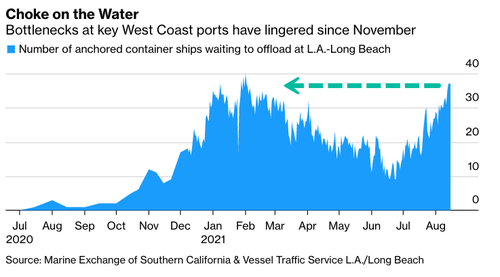
Vessel congestion outside the busiest US gateway for trade with Asia is clogged with the most inbound container vessels in nearly six months.
Bloomberg data shows the number of containerships queuing off the coast of Los Angeles has reached 37 on Sunday evening, that’s three less than the all-time-high observed on Feb. 1.
On Sunday, the average waits for berth space, a designated location in a port used for mooring vessels when vessels are not at sea, was 6.2 days, compared with 5.7 in late June. That number topped eight days in April.
Readers may recall the collapse of the trans-pacific supply chains has been among the main reasons for soaring consumer goods prices. It’s also hardly a secret that the most vulnerable section of supply chains are West Coast ports where congestion remains off the charts.
The transpacific trade routes have experienced significant port delays in China in recent weeks because COVID outbreaks are shutting down terminals.
We’ve discussed the latest meltdown down of the trans-pacific supply chains in “Supply-Chains Brace For Collapse: Port Of LA Fears Repeat Of “Shipping Nightmare” As China Locks Down” and “Shippers Frantic After China’s Busiest Port Shuts Container Terminal Due To Covid.”
Goldman Sachs has explicitly warned that “port closures or stricter control measures at ports could also put further upward pressure on shipping costs, which are already very high.”
But as new data suggest, shipping congestion at the ports of Los Angeles and Long Beach is worsening and could even surpass levels seen earlier this year. The timing of this bottleneck is ahead of back-to-school and the holiday season when importers ramp up shipments of goods from Asia.
https://www.zerohedge.com/markets/vessel-congestion-la-ports-soars-more-ships-join-queue
August 17, 2021
Port Congestion
Vessel Congestion At LA Ports Soars As More Ships Join Queue
by Tyler DurdenTuesday, Aug 17, 2021 – 05:45 AM
Vessel congestion outside the busiest US gateway for trade with Asia is clogged with the most inbound container vessels in nearly six months.
Bloomberg data shows the number of containerships queuing off the coast of Los Angeles has reached 37 on Sunday evening, that’s three less than the all-time-high observed on Feb. 1.
On Sunday, the average waits for berth space, a designated location in a port used for mooring vessels when vessels are not at sea, was 6.2 days, compared with 5.7 in late June. That number topped eight days in April.
Readers may recall the collapse of the trans-pacific supply chains has been among the main reasons for soaring consumer goods prices. It’s also hardly a secret that the most vulnerable section of supply chains are West Coast ports where congestion remains off the charts.
The transpacific trade routes have experienced significant port delays in China in recent weeks because COVID outbreaks are shutting down terminals.
We’ve discussed the latest meltdown down of the trans-pacific supply chains in “Supply-Chains Brace For Collapse: Port Of LA Fears Repeat Of “Shipping Nightmare” As China Locks Down” and “Shippers Frantic After China’s Busiest Port Shuts Container Terminal Due To Covid.”
Goldman Sachs has explicitly warned that “port closures or stricter control measures at ports could also put further upward pressure on shipping costs, which are already very high.”
But as new data suggest, shipping congestion at the ports of Los Angeles and Long Beach is worsening and could even surpass levels seen earlier this year. The timing of this bottleneck is ahead of back-to-school and the holiday season when importers ramp up shipments of goods from Asia.
https://www.zerohedge.com/markets/vessel-congestion-la-ports-soars-more-ships-join-queue
August 4, 2021
Port of LA Update
In the eye of the congestion storm: Q&A with Port of LA’s Gene Seroka
Southern California gateway still clogged as wave of peak-season cargo looms
Greg Miller, Senior Editor Follow on Twitter Tuesday, August 3, 2021 6 minutes read

Peak season, for all practical purposes, is here. There are once again 25 or more container ships at anchor in San Pedro Bay off the ports of Los Angeles and Long Beach. Rail lines UP and BNSF were so backed up that they recently throttled container flows from Southern California to Chicago.
With no end in sight, how can West Coast ports handle the ongoing flood of imports?
To answer that question, American Shipper interviewed Gene Seroka, executive director of the Port of Los Angeles, on Wednesday. Following is an edited version of that conversion:
AMERICAN SHIPPER: There’s a parade of ships now headed from Asia to California. With peak season cargo coming in and new trans-Pacific services and extra loaders, is there any way for Los Angeles to squeeze out more productivity on the land side and dig out of this? Or does normalcy have to wait for imports to abate?

SEROKA: “The railroads are full. The warehouses are full. Port terminals are full. Ships are coming in and waiting to get worked. The factories are behind in orders. This incredible demand has got everybody in the entire value chain just clipping out at levels we never could have imagined — and it’s still not enough.
“We’ve still got so much cargo coming in. We were on the phone with a big retailer this morning and they said that they’re still going to need another year to get inventories up to a level they think is appropriate.
“Something’s got to ease. We’ve got 23 vessels scheduled to come into both ports over the next three days. That’s pretty high. We’ve now got 25 ships at anchor for both ports, 17 of which are directed to LA.
“But, for example, if we suddenly got a break in the warehouse system and a bunch of cargo was pushed out after being put in 53-foot boxes, we could have an immediate release valve on these terminals. One overnight run of 60,000 containers makes us look very, very different tomorrow than we do right now.”
AMERICAN SHIPPER: There have been several times when the number of ships at anchor dropped by 10 or more over a single weekend. Is that part of the strategy?
SEROKA: “Yes, it has been preprogrammed and planned. One of the things that’s difficult is getting the trucker community aligned with those additional gates and work times. Because these guys and ladies have the 11-hour federal mandate of work plus extra rest time. So, we’ve got to be in real synchronicity with these folks to say, ‘Hey, look, we’re going to be able to move a ton of cargo out on Saturday, Saturday night, Sunday, Sunday night. Can you have the power available?’ And they may forgo a little bit of work on Thursday and Friday, for example.”
AMERICAN SHIPPER: You just mentioned warehouses as a possible release valve. You’re implying more can be done at warehouses productivity-wise?
SEROKA: “Absolutely. It works on either end. If ships slow down for a week coming in, we could push out some of this cargo. There would be a little bit of a flow issue to direct the trucks and trains, but at least it would put a dent into the anchorages. Conversely, a similar outcome — maybe even with faster results — would be at the warehouses. You’ve got 2 billion square feet of space. If you were suddenly able to push out 53-foot domestic boxes at an abnormal pace — because these guys are only open from 8 to 5 — but if you added night shifts and weekend shifts, we could really release the air out of these terminals and get this port in better shape to welcome that next vessel.”
AMERICAN SHIPPER: There has been a shortage of job applicants across the country, in many different industries. How much is this a factor, not just in the warehouses, but across the entire land-based logistics system?
SEROKA: “I’ll break it down into three areas. The ILWU [longshore union] rank and file has been on the job between five and a half and six days a week since the pandemic began. We’ve added about 1,000 longshoremen and women during this process and it could be more. The employers and the union have to agree on those numbers within the collective-bargaining agreement, but if we can get more workers out there, even better in my view.
“On the trucking side, we’ve got about 18,000 truckers registered individually to do business at this port, only half of which call at the port at least once a week. With these terminals super-full with containers, that slows down truck times. Because we’re not getting four turns a day, we’re only getting two, we need more drivers and you still have half the population you can recruit into this business. How quickly individual companies and independent contractors want to [resume work at the port] remains the question.
“On the third segment, the warehousing guys, that’s been hit or miss all throughout COVID. You’ve got physical distancing and the teams that work in warehouses are now smaller and working farther apart. With stimulus, some may have forgone working in warehouses because those checks took care of the needs of them and their families. Now bringing them back are things like rent abatements and eviction moratoriums and unemployment benefits starting to wane and expire. So, you may see more people in the [warehouse labor] market.”
AMERICAN SHIPPER: There have also been huge challenges on the rail side. You reported in mid-June that Los Angeles’ on-dock rail time was still 12 days, not far from its peak earlier in the year. Then, in July, UP suspended Southern California-Chicago service for a week and BNSF rationed service for two weeks. How has that affected the port?
SEROKA: “That was a very difficult decision — pausing trains from Los Angeles/Long Beach to Chicago — and I think it had to be done. I talk to the senior guys and ladies at both companies, regularly, if not daily. What I learned from UP was that at the time that decision was made, they had 25 miles worth of trains sitting outside of Joliet. Lo and behold, very shortly thereafter, BNSF had 22 miles of trains sitting outside that facility.
“They are facing some of the same difficulties that we do here in LA. Their dwell time for containers, once a train gets discharged, was three times as long as it used to be, pre-pandemic, pre-surge. The expectation is that their customers come in within the day and pick up their boxes. It was going to three-plus days. And their on-the-street dwell time [at warehouses] was up to eight days, very similar to ours. So, they’re not getting equipment back nearly fast enough. Their normal model is about two days’ street dwell.
“These guys were saying, ‘How many more trains can I put in there because the guys in Southern California are screaming we need more rail cars, engine power and crews to get the next ship’s cargoes out. If [equipment] is just sitting in Chicago or other locations, I can’t get those assets and crews back.’ [Pausing service] was a painful decision they had to make.
“Combined, about 15% of our cargo was paused for that point in time. So, it didn’t decimate us, but every container that doesn’t move out of the port creates more of a clog right here. We’re once again sitting at about 95-98% of our land usage capacity and 80% is considered full-throttle for us.”
AMERICAN SHIPPER: How has this emergency pause in service affected rail dwell time at the port?
SEROKA: “For the small snapshot in time that they went into this pause, it increased dwell times, as you could imagine, because you’ve got containers that are not moving out. So, right now, we’re sitting at 13.1 days rail dwell and that’s just off the peak that we witnessed back in February. But then we will see it slide as these Midwest trains start to be built and move out.
“What it did was help clear out Joliet to an extent where it’s now manageable [in terms of] the cargo they can put through their terminal — and that will accelerate trains moving out of here going to Chicago.”
AMERICAN SHIPPER: Looking at all that’s happened already in 2021 — from the rail situation to the anchorages and all the other issues — it has really been an incredible year.
SEROKA: “And the story still has not been finished yet.”
August 4, 2021
Port of LA Update
In the eye of the congestion storm: Q&A with Port of LA’s Gene Seroka
Southern California gateway still clogged as wave of peak-season cargo looms
Greg Miller, Senior Editor Follow on Twitter Tuesday, August 3, 2021 6 minutes read
Peak season, for all practical purposes, is here. There are once again 25 or more container ships at anchor in San Pedro Bay off the ports of Los Angeles and Long Beach. Rail lines UP and BNSF were so backed up that they recently throttled container flows from Southern California to Chicago.
With no end in sight, how can West Coast ports handle the ongoing flood of imports?
To answer that question, American Shipper interviewed Gene Seroka, executive director of the Port of Los Angeles, on Wednesday. Following is an edited version of that conversion:
AMERICAN SHIPPER: There’s a parade of ships now headed from Asia to California. With peak season cargo coming in and new trans-Pacific services and extra loaders, is there any way for Los Angeles to squeeze out more productivity on the land side and dig out of this? Or does normalcy have to wait for imports to abate?
SEROKA: “The railroads are full. The warehouses are full. Port terminals are full. Ships are coming in and waiting to get worked. The factories are behind in orders. This incredible demand has got everybody in the entire value chain just clipping out at levels we never could have imagined — and it’s still not enough.
“We’ve still got so much cargo coming in. We were on the phone with a big retailer this morning and they said that they’re still going to need another year to get inventories up to a level they think is appropriate.
“Something’s got to ease. We’ve got 23 vessels scheduled to come into both ports over the next three days. That’s pretty high. We’ve now got 25 ships at anchor for both ports, 17 of which are directed to LA.
“But, for example, if we suddenly got a break in the warehouse system and a bunch of cargo was pushed out after being put in 53-foot boxes, we could have an immediate release valve on these terminals. One overnight run of 60,000 containers makes us look very, very different tomorrow than we do right now.”
AMERICAN SHIPPER: There have been several times when the number of ships at anchor dropped by 10 or more over a single weekend. Is that part of the strategy?
SEROKA: “Yes, it has been preprogrammed and planned. One of the things that’s difficult is getting the trucker community aligned with those additional gates and work times. Because these guys and ladies have the 11-hour federal mandate of work plus extra rest time. So, we’ve got to be in real synchronicity with these folks to say, ‘Hey, look, we’re going to be able to move a ton of cargo out on Saturday, Saturday night, Sunday, Sunday night. Can you have the power available?’ And they may forgo a little bit of work on Thursday and Friday, for example.”
AMERICAN SHIPPER: You just mentioned warehouses as a possible release valve. You’re implying more can be done at warehouses productivity-wise?
SEROKA: “Absolutely. It works on either end. If ships slow down for a week coming in, we could push out some of this cargo. There would be a little bit of a flow issue to direct the trucks and trains, but at least it would put a dent into the anchorages. Conversely, a similar outcome — maybe even with faster results — would be at the warehouses. You’ve got 2 billion square feet of space. If you were suddenly able to push out 53-foot domestic boxes at an abnormal pace — because these guys are only open from 8 to 5 — but if you added night shifts and weekend shifts, we could really release the air out of these terminals and get this port in better shape to welcome that next vessel.”
AMERICAN SHIPPER: There has been a shortage of job applicants across the country, in many different industries. How much is this a factor, not just in the warehouses, but across the entire land-based logistics system?
SEROKA: “I’ll break it down into three areas. The ILWU [longshore union] rank and file has been on the job between five and a half and six days a week since the pandemic began. We’ve added about 1,000 longshoremen and women during this process and it could be more. The employers and the union have to agree on those numbers within the collective-bargaining agreement, but if we can get more workers out there, even better in my view.
“On the trucking side, we’ve got about 18,000 truckers registered individually to do business at this port, only half of which call at the port at least once a week. With these terminals super-full with containers, that slows down truck times. Because we’re not getting four turns a day, we’re only getting two, we need more drivers and you still have half the population you can recruit into this business. How quickly individual companies and independent contractors want to [resume work at the port] remains the question.
“On the third segment, the warehousing guys, that’s been hit or miss all throughout COVID. You’ve got physical distancing and the teams that work in warehouses are now smaller and working farther apart. With stimulus, some may have forgone working in warehouses because those checks took care of the needs of them and their families. Now bringing them back are things like rent abatements and eviction moratoriums and unemployment benefits starting to wane and expire. So, you may see more people in the [warehouse labor] market.”
AMERICAN SHIPPER: There have also been huge challenges on the rail side. You reported in mid-June that Los Angeles’ on-dock rail time was still 12 days, not far from its peak earlier in the year. Then, in July, UP suspended Southern California-Chicago service for a week and BNSF rationed service for two weeks. How has that affected the port?
SEROKA: “That was a very difficult decision — pausing trains from Los Angeles/Long Beach to Chicago — and I think it had to be done. I talk to the senior guys and ladies at both companies, regularly, if not daily. What I learned from UP was that at the time that decision was made, they had 25 miles worth of trains sitting outside of Joliet. Lo and behold, very shortly thereafter, BNSF had 22 miles of trains sitting outside that facility.
“They are facing some of the same difficulties that we do here in LA. Their dwell time for containers, once a train gets discharged, was three times as long as it used to be, pre-pandemic, pre-surge. The expectation is that their customers come in within the day and pick up their boxes. It was going to three-plus days. And their on-the-street dwell time [at warehouses] was up to eight days, very similar to ours. So, they’re not getting equipment back nearly fast enough. Their normal model is about two days’ street dwell.
“These guys were saying, ‘How many more trains can I put in there because the guys in Southern California are screaming we need more rail cars, engine power and crews to get the next ship’s cargoes out. If [equipment] is just sitting in Chicago or other locations, I can’t get those assets and crews back.’ [Pausing service] was a painful decision they had to make.
“Combined, about 15% of our cargo was paused for that point in time. So, it didn’t decimate us, but every container that doesn’t move out of the port creates more of a clog right here. We’re once again sitting at about 95-98% of our land usage capacity and 80% is considered full-throttle for us.”
AMERICAN SHIPPER: How has this emergency pause in service affected rail dwell time at the port?
SEROKA: “For the small snapshot in time that they went into this pause, it increased dwell times, as you could imagine, because you’ve got containers that are not moving out. So, right now, we’re sitting at 13.1 days rail dwell and that’s just off the peak that we witnessed back in February. But then we will see it slide as these Midwest trains start to be built and move out.
“What it did was help clear out Joliet to an extent where it’s now manageable [in terms of] the cargo they can put through their terminal — and that will accelerate trains moving out of here going to Chicago.”
AMERICAN SHIPPER: Looking at all that’s happened already in 2021 — from the rail situation to the anchorages and all the other issues — it has really been an incredible year.
SEROKA: “And the story still has not been finished yet.”
July 27, 2021
PFA’s Batson In the News
In-Depth: US furniture stores face foam shortage
Supply issues cause delivery delays Industry experts say a foam shortage wreaked havoc on the furniture and mattress industry, and it likely won’t end for months.
By: Jared Aarons Posted at 6:16 AM, Jul 27, 2021 and last updated 10:26 AM, Jul 27, 2021
SAN DIEGO (KGTV) – Industry experts say a foam shortage wreaked havoc on the furniture and mattress industry, and it likely won’t end for months.
Speaking with ABC 10News, Russ Batson, the Executive Director of the Polyurethane Foam Association, says he doesn’t expect supply levels to normalize until the holiday shopping season.
“It’s a really unfortunate confluence of factors,” Batson says.
The shortage has been going on for months, with no single reason to blame.
When the pandemic started, industry experts had to guess what would happen to demand. They thought demand would go down as people stayed home. Because of that, the industry, which uses a “just in time delivery” model for production, cut back on foam.
Instead, the opposite happened. As people redecorated their homes, they bought new mattresses and furniture. Demand quickly outpaced supply.
“All of the guesses that people made about where mattress sales, where furniture sales, and where car sales would be were wrong,” explains Batson.
Production quickly ramped up to meet demand, but the backlog of orders, combined with some production plants being closed for maintenance, created the shortage.https://flo.uri.sh/visualisation/6811572/embed?auto=1A Flourish chart
In February of 2021, it got worse when Winter Storm Uri hit Texas and Louisiana, knocking a handful of plants that make the chemical ingredients for foam offline.
“At a point when (production) needed to be going up, it was going down,” says Batson.
Batson also points out that pandemic-related embargoes on foreign goods kept supply low as well. And shortages of other raw materials like lumber made the problem worse.
As all of this played out, furniture stores and other businesses that rely on foam were left scrambling.
“It’s been a roller coaster, to say the least,” says Paul Rees, the co-owner of Greathouse in Miramar.
Once pandemic-related shut down restrictions were lifted, his store did a month’s worth of sales in less than two weeks after reopening in May. It hasn’t slowed down since.
Meanwhile, the foam shortage meant that orders which usually took 4-6 weeks to deliver started to take twice that long.
“The biggest challenge was setting the right expectations for the customers,” says Rees. “We tell them just to be patient, be understanding, and ultimately you’ll get what you want.”
Other stores took drastic measures to fulfill orders. At Altered Decor in the East Village, the owners told ABC 10News they sold some of their floor models. They also worked with new suppliers to find readily available pieces, and they began selling more plants, rugs, and home accessories.
Rees says he has faith the industry will weather the storm. In the meantime, he tells people looking to buy furniture to look at it as a long-term investment.
“They’re going to have this stuff for a very long time,” he says. “So even if you have to wait a little bit extra, and you may be disappointed, get what you want because you’re gonna be looking at it, using it, and enjoying it for years and years and years to come.”
https://www.10news.com/news/in-depth/in-depth-us-furniture-stores-face-foam-shortage
 Everchem Updates Archive
  Sign Up for Email Updates