
Current Affairs
February 22, 2021
Storm Impact
Winter storm impact may exceed Hurricane Harvey’s but US chemicals earnings to rise
Author: Joseph Chang
2021/02/19
NEW YORK (ICIS)–The severe winter storm and ultra-low temperatures on the US Gulf Coast put a deep freeze on the nation’s petrochemicals sector with multiple crackers and refineries shutting down amid already tight markets.
While it will take weeks for many of the plants to restart, the impact on supply will be felt for months to come with ripple effects across the globe, tightening key markets even further.
Yet as was the case with Hurricane Harvey, the earnings impact on US chemicals producers is likely to be a net positive with higher margins ultimately outweighing the temporary loss of volumes.
As of 19 February, close to 70% of US ethylene capacity is offline because of the winter storm and freezing temperatures, along with over 80% of propylene capacity, including splitters, noted Kim Haberkost, director of olefins at Chemical Data (CDI), which is part of ICIS.
Propylene had been especially tight even before the storm, with spot prices hitting record highs.
Downstream, around 90% of polypropylene (PP) capacity is impacted, while estimates for high density polyethylene (HDPE) are near 80%.
“We will know more this weekend as things are supposed to thaw out, giving producers a chance to evaluate and restart,” said Brian Pruett, senior vice president, PE and PP, at CDI.
“Given the tightness and low inventories prior to the deep freeze, this one might be equivalent to Hurricane Harvey, and maybe even the back-to-back Rita/Katrina hurricanes in 2005,” he added.
“I expect this storm to affect supplies from our industry worse than Hurricane Harvey,” a US PE trader said.
He expects plant disruptions to last around six months amid a shortage of parts needed to repair and replace equipment.
Another source expects PP tightness to last through the first half of the year.
“Covid has already disrupted many different global supply chain components. And given that Covid is a global issue, the combined impact with the US Gulf Coast storm could end up being worse than that of Harvey,” said James Ray, ICIS vice president of consulting – Americas.
About 42% of US base oil refining capacity is confirmed offline with ExxonMobil in Baytown, Texas, and Motiva in Port Arthur, Texas, shut due to weather and HollyFrontier in Tulsa, Oklahoma, and Calumet in Shreveport, Louisiana, shut for maintenance.
“This may be worse than Harvey because all Gulf Coast refineries are impacted,” a base oils source said.
REFINERIES HOLD KEY TO PROPYLENE
How fast refineries can start up will be key in alleviating the extreme shortage in US propylene as they account for around 55% of supply. Propylene inventories started the year at 17-year lows and fell further even before the winter storm.
More than 20 US refineries were shut down or faced production and feedstock issues, according to sources, with many saying there will be weeks of repairs before many can restart.
Already there are reports of widespread equipment damage. The refineries that can restart should be starting the process next week.
Early estimates for refinery outages are 5.5m bbl/day of capacity offline.
“What we don’t know yet is how much damage is done, but the situation with refineries does not bode well for propylene. There is much more upside for pricing in the short term,” said Haberkost.
“The assumption is that some of these units will be down for longer than others because of burst pipes and damaged equipment,” she added.
And then there’s another scenario where above-ground ethylene and propylene pipelines could have leaks or failures, further delaying start-ups, she noted.
“Propylene prices are already so high, but we are projecting increases for February and March. April prices will likely come down or else demand will be driven away,” said Haberkost.
“With what we know today, ethylene prices are forecast to also decline in April, but they could come down as early as March if crackers successfully restart in the next week,” she added.
INTERMEDIATES IMPACT
In intermediates, 100% of US capacity is offline for epichlorohydrin (ECH), propylene oxide (PO), tertiary butyl alcohol (TBA) and toluene di-isocyanate (TDI), while about 85% of EG (ethylene glycol) capacity is impacted, 88% of propylene glycols and 73% of acrylonitrile (ACN).
Plant inspections at certain intermediates units have found multiple cracked pipes that will impact the timing of restarts, sources said.
One EG producer said it expects overall Louisiana chemicals plants to come back online before those in Texas due to fewer power issues.
“A lot of supply chains were still trying to recover after impacts from Q4 so this current round of force majeures is tough to endure,” said a butanediol (BDO) buyer in the polyurethanes sector.
Nylon 6 producer AdvanSix is taking down operating rates and pulling forward planned maintenance to deal with the supply disruptions in raw material cumene, which is also downstream of propylene.
“All North American producers of cumene have declared force majeure… Given the evolving nature of the situation, we have elected to… de-rate our plants and proactively think about how we minimise disruption,” said AdvanSix CEO Erin Kane, on the company’s Q4 earnings conference call on 19 February.
Planned maintenance that would have taken place predominantly in March will be pulled forward to the back half of February, she said.
“It gives us time to assess the situation and gain some clarity on what’s going to happen,” said Kane.
EARNINGS IMPACT
The earnings impact for chemicals companies will be significant, but not necessarily negative looking out through 2021. Volume losses from shutdowns will likely be outweighed later by prolonged tightness of markets, leading to margin gains.
“At this point for the commodity guys, we view it as a potential Q1 earnings negative but pretty bullish for Q2 and delaying the expected return to balanced conditions – more than making up for the volume impact,” said Frank Mitsch, analyst at Fermium Research.
Indeed, US chemicals stocks, particularly those of commodity producers, continued to rally sharply through 19 February. Companies posting notable gains on 19 February included Dow, LyondellBasell, Olin and Trinseo.
| US chemicals stock prices | |||
| 12-Feb | 19-Feb | % Change | |
| Dow | $58.15 | $60.43 | 3.9% |
| LyondellBasell | $96.14 | $100.34 | 4.4% |
| Olin | $28.70 | $29.95 | 4.4% |
| Trinseo | $59.05 | $62.70 | 6.2% |
| Huntsman | $28.52 | $28.89 | 1.3% |
| Eastman | $109.23 | $111.84 | 2.4% |
| Westlake | $87.08 | $87.55 | 0.5% |
| Celanese | $132.73 | $135.36 | 2.0% |
| AdvanSix | $25.15 | $28.52 | 13.4% |
| Source: Yahoo Finance |
“We would also remind investors that this level of shutdowns is similar to what we saw during Hurricane Harvey – a period of strong outperformance for US chemical equities,” said Hassan Ahmed, analyst at Alembic Global Advisors.
“I personally think it will be a Hurricane Harvey-like situation, where the commodity-chemical names will end up benefitting from these outages – the lost earnings from lower volumes will be more than offset by pricing gains. However, specialties may take a hit,” he added.
Stock price gains have been more muted for coatings and specialty chemicals players as they will be exposed to higher raw material cost headwinds. Yet these impacts are likely to be temporary while end market demand should be robust.
“We think the coatings guys will be seeing raw materials inflation and near-term impacted demand as we progress over the next few months, but overall, this is a transitory event for them. That is, the world is not coming to an end as the bad weather is transitory. We believe the fundamental demand continues to be strong across many end markets,” said Mitsch.
RESTART AND RECOVERY ESTIMATES VARY
Estimates of restarts vary widely. A clearer picture should emerge by early next week as companies assess potential damage to equipment as the US Gulf Coast emerges from the deep freeze.
One olefins producer noted the best case scenario for restart is about a week and the worst case is several weeks, depending on how controlled the shutdowns were.
Some aromatics producers expect to restart some facilities in the next few days. Barring any complications, production could begin in the next 10-14 days, they noted.
Chlor-vinyls producers, being large consumers of electricity, are now providing their cogeneration to the public grid.
Chlor-vinyls and polyolefins producer Formosa Plastics USA, whose sites at Point Comfort, Texas and Baton Rouge, Louisiana continue to be shut down or operating at reduced capacity, said on 18 February that it is prioritising the restart of its utility plans to support power needs for local communities.
“Any power and steam production from natural gas will be directed toward electrical support for the community and the safety of our complex until the current weather emergency subsides,” said Formosa Plastics USA in a statement.
While Hurricanes typically take out a narrow swathe of production along the coast, the deep freeze has disrupted operations from Corpus Christi, Texas to Pascagoula, Mississippi.
To conduct repairs, marshal feedstocks, including air, nitrogen and other inputs and to balance the production chain, the most optimistic timeline for recovery is mid-March. More typical estimates are mid-April and later, chlor-vinyls sources said.
“People will be scrambling for the next four to six weeks to get things back to some semblance of normal,” a chemicals distributor said. https://dataviz.icis.com/views/PlantsimpactedbycoldweatherinUS/overallgraphic?:embed=y&:showVizHome=no&:host_url=https%3A%2F%2Fdataviz.icis.com%2F&:embed_code_version=3&:tabs=no&:toolbar=yes&:display_spinner=no&:showAppBanner=false&:display_count=n&:origin=viz_share_link&:loadOrderID=0
Additional reporting by Zachary Moore, Michael Sims, Bill Bowen, Antoinette Smith, Amanda Hay, Deniz Koray, Alex Snodgrass and Al Greenwood
Insight article by Joseph Chang
February 19, 2021
Great Summary of Where We Are–It’s Going to be a Rough Few Weeks
U.S. Gulf Coast storm outages rise, send ripples round global markets; Area plant status list update included
by WILL BEACHAM, Deputy Editor, ICIS Chemical Business
February 19, 2021
The US polar storm has now shut down 90% of US polypropylene (PP) capacity, 67% of ethylene and devastated other important products, sending ripples around global chemical markets prices soaring.
More chemical plants and refineries across the Gulf Coast region have been hit by prolonged power and feedstock outages caused by freezing weather, snow and ice which have also halted logistics networks. More bad weather, forecast for later in the week, may prolong the disruption.
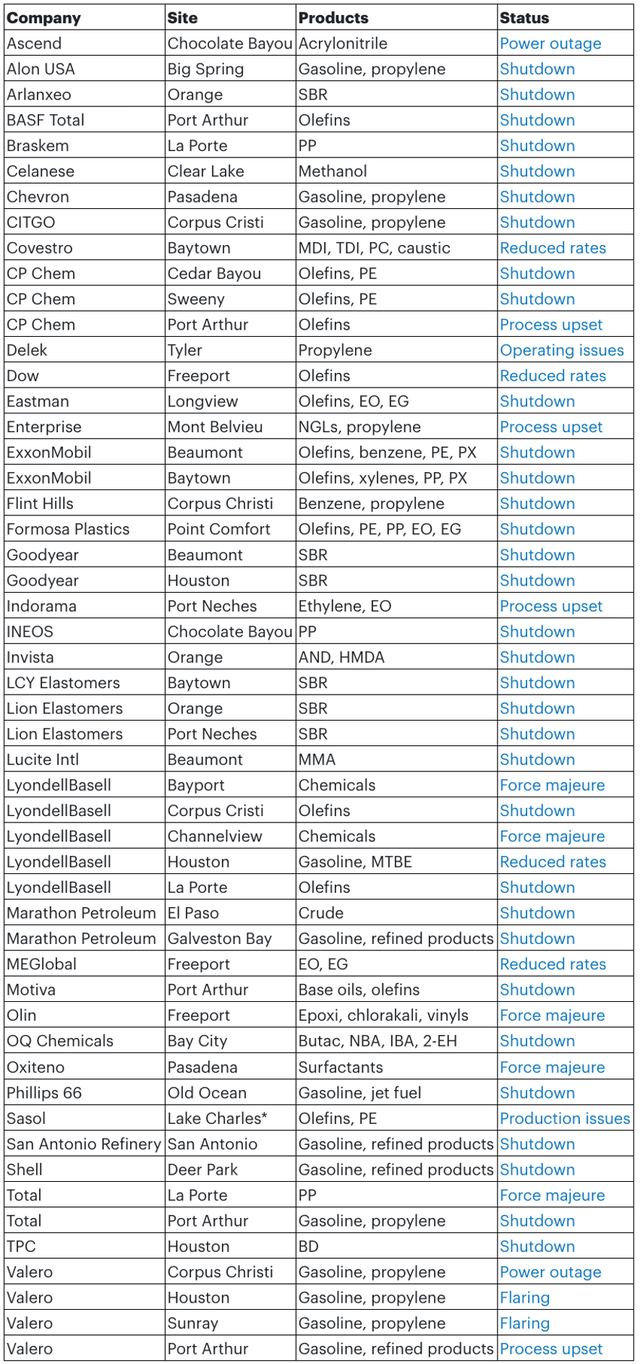
So far, ICIS has reported more than 60 plant outages as a result of the storm, with analysis using data from the ICIS Supply & Demand database showing that a wide swathe of the Gulf petrochemical sector has now been severely impacted.
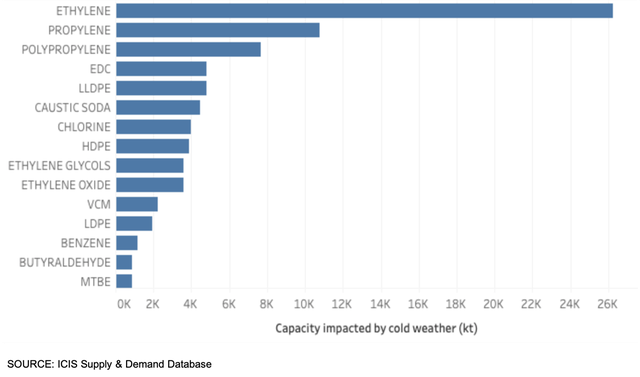
Worst hit in volume terms is ethylene, with 26m tonnes of capacity offline, representing 67% of the US total. Around 11m tonnes, or 50%, of propylene capacity is also offline, with many of the region’s oil refineries also seeing curtailed production. More than 2m bbl/day of US oil refining capacity is shut down.
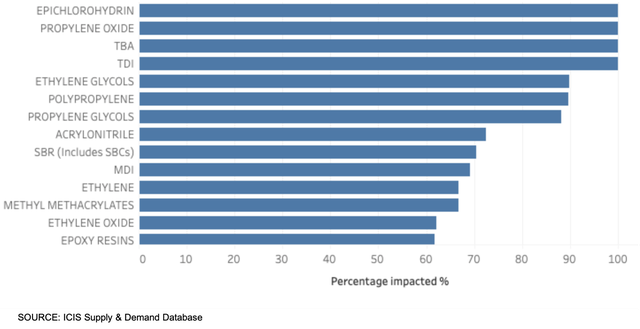
In percentage terms, the major commodities worst affected are epichlorohydrin (ECH) (100% of US capacity offline), propylene oxide (PO) (100%), toluene diisocyanate (TDI) (100%), ethylene glycol (EG) (90%), polypropylene (PP) (90%), propylene glycol (88%), acrylonitrile (ACN) (73%) and styrene butadiene rubber (SBR) (71%).
The outages are tightening global markets which were already suffering shortages of material and rising prices. Problems with the global container shipping system, plant outages plus healthy downstream demand have caused tightness, notably down the propylene and polyethylene (PE) chains.
Propylene and PP are likely to be one of the hardest-hit by the storms because the market was already in turmoil. The coronavirus pandemic has reduced demand for transport fuels, and led to oil refineries closing or cutting production, particularly in Europe and the US.
These closures had a knock-on effect on the supply of propylene and PP, leading to price spikes. With US PP production capacity so highly concentrated on the Gulf Coast, even temporarily constrained production capabilities will have a massive effect on an already tightly supplied market.
US propylene prices are at 10-year highs and inventories are roughly half of what they were a year ago. Consumption has outpaced production due to reduced propylene production over the last year.
PP inventories in the US hit seven-year lows in late 2020, partially driven by rebounding demand and partially driven by limited monomer availability. Some PP production issues also preceded this weather event.
The situation is less dramatic in PE. Constrained supply and demand for packaging has sustained global markets through the pandemic, with logistics challenges and outages causing shortages and price spikes in 2021.
With almost two thirds of US ethylene capacity now offline, global PE markets are likely to tighten further.
US methyl methacrylate (MMA) supply is also expected to be further constrained thanks to the storm, as Lucite has taken down its plant in Beaumont, Texas. Severe constraints in feedstock acetone continue to limit production. Due to high costs, a producer is heard to be levying a temporary acetone surcharge on orders starting this month.Expand
With the Chinese New Year holidays coming to an end from 17 February, demand is picking back up in the world’s largest chemicals market. ICIS reported today that a supply shortage and improving demand after the holidays, supported China’s polyolefins market, leading to a surge in futures and spot prices.
Futures prices in China also rose sharply for styrene, mono ethylene glycol (MEG), polyester and polypropylene.
Prior to the holiday, domestic petrochemical trading had been robust accompanied by sharp price increases as market players anticipated strong post-holiday demand. Surging oil prices provided additional impetus for the uptrend.
In Africa, PE and PP sellers, from all origins, have withdrawn their offers in anticipation of disruption to US exports and a strong return post-holiday market.
Asia’s monoethylene glycol (MEG) prices surged on Thursday by 11% – the biggest daily gain on record – underpinned by tightening global supply, as the Chinese markets re-opened after a week-long holiday.
There are fears that US exports to Asia of key commodities such as ethylene could be disrupted by the storm-related outages.
Europe prices have also been buoyed by the storms. Rising upstream prices and bullish sentiment sent benzene prices up, and styrene prices are now at highs not seen since April 2018.Expand
Area plant status
Additional reporting by: Lucy Shuai, Pearl Bantillo, Ben Lake, Judith Wang, Felicia Loo, Nurluqman Suratman, Amanda Hay, Tom Brown, Yashas Mudumbai, Helena Strathearn and Tarun Raizada,
https://www.bicmagazine.com/departments/operations/us-gulf-coast-storm-outages-rise-send-ripples/
February 19, 2021
Great Summary of Where We Are–It’s Going to be a Rough Few Weeks
U.S. Gulf Coast storm outages rise, send ripples round global markets; Area plant status list update included
by WILL BEACHAM, Deputy Editor, ICIS Chemical Business
February 19, 2021
The US polar storm has now shut down 90% of US polypropylene (PP) capacity, 67% of ethylene and devastated other important products, sending ripples around global chemical markets prices soaring.
More chemical plants and refineries across the Gulf Coast region have been hit by prolonged power and feedstock outages caused by freezing weather, snow and ice which have also halted logistics networks. More bad weather, forecast for later in the week, may prolong the disruption.
So far, ICIS has reported more than 60 plant outages as a result of the storm, with analysis using data from the ICIS Supply & Demand database showing that a wide swathe of the Gulf petrochemical sector has now been severely impacted.
Worst hit in volume terms is ethylene, with 26m tonnes of capacity offline, representing 67% of the US total. Around 11m tonnes, or 50%, of propylene capacity is also offline, with many of the region’s oil refineries also seeing curtailed production. More than 2m bbl/day of US oil refining capacity is shut down.
In percentage terms, the major commodities worst affected are epichlorohydrin (ECH) (100% of US capacity offline), propylene oxide (PO) (100%), toluene diisocyanate (TDI) (100%), ethylene glycol (EG) (90%), polypropylene (PP) (90%), propylene glycol (88%), acrylonitrile (ACN) (73%) and styrene butadiene rubber (SBR) (71%).
The outages are tightening global markets which were already suffering shortages of material and rising prices. Problems with the global container shipping system, plant outages plus healthy downstream demand have caused tightness, notably down the propylene and polyethylene (PE) chains.
Propylene and PP are likely to be one of the hardest-hit by the storms because the market was already in turmoil. The coronavirus pandemic has reduced demand for transport fuels, and led to oil refineries closing or cutting production, particularly in Europe and the US.
These closures had a knock-on effect on the supply of propylene and PP, leading to price spikes. With US PP production capacity so highly concentrated on the Gulf Coast, even temporarily constrained production capabilities will have a massive effect on an already tightly supplied market.
US propylene prices are at 10-year highs and inventories are roughly half of what they were a year ago. Consumption has outpaced production due to reduced propylene production over the last year.
PP inventories in the US hit seven-year lows in late 2020, partially driven by rebounding demand and partially driven by limited monomer availability. Some PP production issues also preceded this weather event.
The situation is less dramatic in PE. Constrained supply and demand for packaging has sustained global markets through the pandemic, with logistics challenges and outages causing shortages and price spikes in 2021.
With almost two thirds of US ethylene capacity now offline, global PE markets are likely to tighten further.
US methyl methacrylate (MMA) supply is also expected to be further constrained thanks to the storm, as Lucite has taken down its plant in Beaumont, Texas. Severe constraints in feedstock acetone continue to limit production. Due to high costs, a producer is heard to be levying a temporary acetone surcharge on orders starting this month.Expand
With the Chinese New Year holidays coming to an end from 17 February, demand is picking back up in the world’s largest chemicals market. ICIS reported today that a supply shortage and improving demand after the holidays, supported China’s polyolefins market, leading to a surge in futures and spot prices.
Futures prices in China also rose sharply for styrene, mono ethylene glycol (MEG), polyester and polypropylene.
Prior to the holiday, domestic petrochemical trading had been robust accompanied by sharp price increases as market players anticipated strong post-holiday demand. Surging oil prices provided additional impetus for the uptrend.
In Africa, PE and PP sellers, from all origins, have withdrawn their offers in anticipation of disruption to US exports and a strong return post-holiday market.
Asia’s monoethylene glycol (MEG) prices surged on Thursday by 11% – the biggest daily gain on record – underpinned by tightening global supply, as the Chinese markets re-opened after a week-long holiday.
There are fears that US exports to Asia of key commodities such as ethylene could be disrupted by the storm-related outages.
Europe prices have also been buoyed by the storms. Rising upstream prices and bullish sentiment sent benzene prices up, and styrene prices are now at highs not seen since April 2018.Expand
Area plant status
Additional reporting by: Lucy Shuai, Pearl Bantillo, Ben Lake, Judith Wang, Felicia Loo, Nurluqman Suratman, Amanda Hay, Tom Brown, Yashas Mudumbai, Helena Strathearn and Tarun Raizada,
https://www.bicmagazine.com/departments/operations/us-gulf-coast-storm-outages-rise-send-ripples/
February 19, 2021
Benzene Update
Low temperature climate causes U.S. benzene prices to soar
2021-02-19
On February 16, the spot price of benzene in the U.S. rose significantly. As the temperature on the U.S. Gulf Coast dropped below freezing, many refineries were shut down, but downstream styrene prices remained firm.
The spot benzene spot price calculated by DDP was up 8 cents from last Friday, and the price on February 16 was 264 cents per gallon. Due to the holiday in the United States, there will be no benzene price on February 15. Sources said that spot activity has increased.
On February 12, under the support of downstream styrene, the spot price of benzene began to rise. European production problems pushed up the price of styrene in the region to $1,410 per ton, which subsequently boosted US pricing.
Because of the temperature below zero, many U.S. refineries went offline, and U.S. benzene prices were further supported. According to reports, ExxonMobil’s Bay City plant with a benzene production capacity of 730,000 tons/year failed. TCEQ reported that Total closed its Port Arthur plant with a benzene production capacity of 104,000 tons/year after losing steam. Citrogo USA closed its Corpus Christi plant with a benzene production capacity of 167,000 tons/year. In addition, Shell has closed its Deer Parker refinery with a benzene production capacity of 217,000 tons/year. The Corpus Christi plant in Flint Hills, USA, with a benzene production capacity of 343,000 tons/year has also ceased production.
A total of 1.561 million tons/year of benzene production capacity is affected by storm-related shutdowns, which means that as many as 4,277 tons of benzene may be lost daily on the U.S. Gulf Coast. In addition to the shutdown related to the storm, Marathon Crude Oil Company is also preparing to maintain its Texas City refinery, which has an improved plant with a benzene production capacity of 400,000 tons/year. The maintenance is expected to last approximately 6 weeks.
While benzene production is decreasing, downstream styrene producers are also facing problems. According to sources, Styrolution has closed its plants in Texas City and Bayport, with capacities of 500,000 tons/year and 771,000 tons/year respectively. On February 16, the spot price of styrene was 1,200 USD/ton FOB USG.
February 19, 2021
Benzene Update
Low temperature climate causes U.S. benzene prices to soar
2021-02-19
On February 16, the spot price of benzene in the U.S. rose significantly. As the temperature on the U.S. Gulf Coast dropped below freezing, many refineries were shut down, but downstream styrene prices remained firm.
The spot benzene spot price calculated by DDP was up 8 cents from last Friday, and the price on February 16 was 264 cents per gallon. Due to the holiday in the United States, there will be no benzene price on February 15. Sources said that spot activity has increased.
On February 12, under the support of downstream styrene, the spot price of benzene began to rise. European production problems pushed up the price of styrene in the region to $1,410 per ton, which subsequently boosted US pricing.
Because of the temperature below zero, many U.S. refineries went offline, and U.S. benzene prices were further supported. According to reports, ExxonMobil’s Bay City plant with a benzene production capacity of 730,000 tons/year failed. TCEQ reported that Total closed its Port Arthur plant with a benzene production capacity of 104,000 tons/year after losing steam. Citrogo USA closed its Corpus Christi plant with a benzene production capacity of 167,000 tons/year. In addition, Shell has closed its Deer Parker refinery with a benzene production capacity of 217,000 tons/year. The Corpus Christi plant in Flint Hills, USA, with a benzene production capacity of 343,000 tons/year has also ceased production.
A total of 1.561 million tons/year of benzene production capacity is affected by storm-related shutdowns, which means that as many as 4,277 tons of benzene may be lost daily on the U.S. Gulf Coast. In addition to the shutdown related to the storm, Marathon Crude Oil Company is also preparing to maintain its Texas City refinery, which has an improved plant with a benzene production capacity of 400,000 tons/year. The maintenance is expected to last approximately 6 weeks.
While benzene production is decreasing, downstream styrene producers are also facing problems. According to sources, Styrolution has closed its plants in Texas City and Bayport, with capacities of 500,000 tons/year and 771,000 tons/year respectively. On February 16, the spot price of styrene was 1,200 USD/ton FOB USG.
 Everchem Updates Archive
  Sign Up for Email Updates