
Current Affairs
October 20, 2020
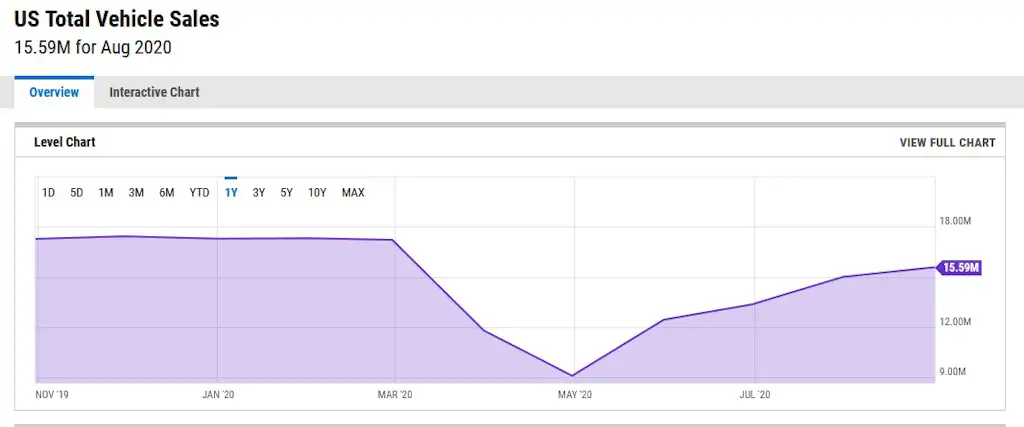
Auto Sales Rebound
October 20, 2020
Auto Sales Rebound
October 19, 2020
Airline Passengers Top One Million on Sunday
TSA Passenger Traffic Tops One Million Sunday As Return To Normalcy Continues
by Tyler Durden Mon, 10/19/2020 – 15:35
Shares of US airlines lifted off Monday morning after data this past weekend showed passenger numbers hit seven-month highs as air travelers take advantage of super low-cost airfare despite the reemergence of COVID-19.
TSA published a press release early Monday saying it “screened over 1 million passengers Sunday, representing the highest number of passengers screened at TSA checkpoints since March 17, 2020.”

The release continued: “In addition to screening one million passengers in a single day, TSA screened 6.1 million passengers at checkpoints nationwide during the week (Mon., October 12 through Sun., October 18). That weekly volume also represents the highest weekly volume for TSA since the start of the COVID-19 pandemic.”h/t Reuters
According to TSA spokesperson Lisa Farbstein, airport security checkpoints nationwide screened 1,031,505 people on Sunday – this is still 60% lower than one year ago. https://platform.twitter.com/embed/index.html?dnt=false&embedId=twitter-widget-0&frame=false&hideCard=false&hideThread=false&id=1318157136602550274&lang=en&origin=https%3A%2F%2Fwww.zerohedge.com%2Fpersonal-finance%2Ftsa-passenger-traffic-tops-million-sunday-return-normalcy-continues&siteScreenName=zerohedge&theme=light&widgetsVersion=ed20a2b%3A1601588405575&width=550px
TSA numbers this month show a return to normalcy, about eight months since the virus pandemic began. So far, the numbers this month show a rapid increase in travelers:
- Oct. 18 – 1,031,505 people screened
- October 14 – 717,940 people screened
- October 7 – 668,519 people screened
Readers may recall the lowest number of people screened at US airports was 87,534 on April 14, during lockdowns, where much of the airline and travel and tourism industry ground to a halt.
The increase in air travel has occurred as US virus cases topped 70,000 last Friday, the highest level since July. Single-day caseload records were seen in Wyoming, Minnesota, Wisconsin, West Virginia, North Dakota, Indiana, New Mexico, Utah, and Colorado.
As we’ve pointed out to our millennial readership, roundtrip airfare has never been cheaper – and with the virus mainly affecting the older segments of the population – now could be the time to travel.

Goldman Sach’s Jan Hatzius compiled travel and tourism high-frequency data that suggests US air travel is steadily increasing from the April-May trough. US international passenger arrivals at the top five airports are also rising. Global air travel has rebounded as well.

Another proxy of the travel and tourism rebound is Airbnb searches, which rebounded and recovered back to the February baseline but have since slumped into fall.

Robinhood traders have spent the last seven months panic buying JETS ETF, with hopes the airline industry will recover in a “V-shaped” fashion.

The question traders have on their mind: How long will it take for the airline industry to recover?

October 19, 2020
Airline Passengers Top One Million on Sunday
TSA Passenger Traffic Tops One Million Sunday As Return To Normalcy Continues
by Tyler Durden Mon, 10/19/2020 – 15:35
Shares of US airlines lifted off Monday morning after data this past weekend showed passenger numbers hit seven-month highs as air travelers take advantage of super low-cost airfare despite the reemergence of COVID-19.
TSA published a press release early Monday saying it “screened over 1 million passengers Sunday, representing the highest number of passengers screened at TSA checkpoints since March 17, 2020.”
The release continued: “In addition to screening one million passengers in a single day, TSA screened 6.1 million passengers at checkpoints nationwide during the week (Mon., October 12 through Sun., October 18). That weekly volume also represents the highest weekly volume for TSA since the start of the COVID-19 pandemic.”h/t Reuters
According to TSA spokesperson Lisa Farbstein, airport security checkpoints nationwide screened 1,031,505 people on Sunday – this is still 60% lower than one year ago. https://platform.twitter.com/embed/index.html?dnt=false&embedId=twitter-widget-0&frame=false&hideCard=false&hideThread=false&id=1318157136602550274&lang=en&origin=https%3A%2F%2Fwww.zerohedge.com%2Fpersonal-finance%2Ftsa-passenger-traffic-tops-million-sunday-return-normalcy-continues&siteScreenName=zerohedge&theme=light&widgetsVersion=ed20a2b%3A1601588405575&width=550px
TSA numbers this month show a return to normalcy, about eight months since the virus pandemic began. So far, the numbers this month show a rapid increase in travelers:
- Oct. 18 – 1,031,505 people screened
- October 14 – 717,940 people screened
- October 7 – 668,519 people screened
Readers may recall the lowest number of people screened at US airports was 87,534 on April 14, during lockdowns, where much of the airline and travel and tourism industry ground to a halt.
The increase in air travel has occurred as US virus cases topped 70,000 last Friday, the highest level since July. Single-day caseload records were seen in Wyoming, Minnesota, Wisconsin, West Virginia, North Dakota, Indiana, New Mexico, Utah, and Colorado.
As we’ve pointed out to our millennial readership, roundtrip airfare has never been cheaper – and with the virus mainly affecting the older segments of the population – now could be the time to travel.
Goldman Sach’s Jan Hatzius compiled travel and tourism high-frequency data that suggests US air travel is steadily increasing from the April-May trough. US international passenger arrivals at the top five airports are also rising. Global air travel has rebounded as well.
Another proxy of the travel and tourism rebound is Airbnb searches, which rebounded and recovered back to the February baseline but have since slumped into fall.
Robinhood traders have spent the last seven months panic buying JETS ETF, with hopes the airline industry will recover in a “V-shaped” fashion.
The question traders have on their mind: How long will it take for the airline industry to recover?
October 17, 2020
MDI Update
US MDI markets tightening on shortages for isocyanate precursors
Author: Zachary Moore
2020/10/16
HOUSTON (ICIS)–US methylene diphenyl diisocyanate (MDI) supplies are facing further tightening amid shortages of precursors used in isocyanate production.
Dow and Covestro have recently declared force majeure at their US MDI plants while Huntsman is experiencing a partial shutdown at its MDI plant in Geismar, Louisiana, with all three producers pointing to raw material shortages as the main cause of their reduced operating rates.
HURRICANE LAURA, DELTA IMPACTS
The impacts of hurricanes Laura and Delta on the US Gulf has resulted in some tightness for some MDI intermediates.
While the hurricanes brought about no major impacts on any US Gulf MDI sites, plants producing intermediate chemicals such as aniline, nitrobenzene and chlorine were impacted.
Logistics were also interrupted due to closures at railyards and waterways, which also resulted in limitations to intermediate supply to isocyanate plants.
According to data from the Chlorine Institute, operating rates at US chlor-alkali plants have been at multi-year lows since the start of the coronavirus outbreak, with operating rates turning lower in September from August.
Westlake’s 1.29m tonnes/year chlorine plant in Lake Charles, Louisiana has experienced a prolonged outage owing to the disruption to chemical operations in the Lake Charles area caused by the impact of Hurricane Laura, which left much of the area without electricity for several weeks.
CARBON MONOXIDE ISSUES
Shortages of carbon monoxide (CO) have also played a role in the recent tightness in the MDI industry.
Chlorine is combined with CO to produce phosgene, which is reacted with methylenedianiline (MDA) to produce MDI.
Shortages impacting these intermediate chemicals have pressured MDI operating rates in North America lower even as demand for MDI and downstream polyurethane systems has been strengthening.
RECOVERING DEMAND
MDI demand recorded a strong recovery in the third quarter after a sharp decline in consumption during the second quarter during the period of strictest coronavirus-related restrictions on economic activity.
The automotive sector has seen a significant rise in operating rates in recent months as producers of vehicles and vehicle components are working to refill their supply chains after operating rates throughout the industry were reduced to record low levels in April and May.
Demand for home appliances has also moved higher in recent months as consumers are spending much of their disposable income on home improvements as travel and entertainment spending has been deferred.
The construction sector has also been a strong spot for MDI demand, with residential construction activity seeing an uptick as some home buyers are opting to larger homes in the suburbs in preference for urban housing.
MDI is consumed mainly in polyurethane foams, which account for about 80% of global consumption. Rigid foams, the largest outlet for MDI, are used mostly in construction, refrigeration, packaging and insulation. MDI is also used to make binders, elastomers, adhesives, sealants, coatings and fibres.
Major US MDI producers include BASF, Covestro, Dow and Huntsman.
Focus article by Zachary Moore
 Everchem Updates Archive
 Sign Up for Email Updates


