
Current Affairs
December 19, 2021
Africa’s Largest Economies
Africa’s Biggest Economies
by Tyler DurdenSunday, Dec 19, 2021 – 08:45 AM
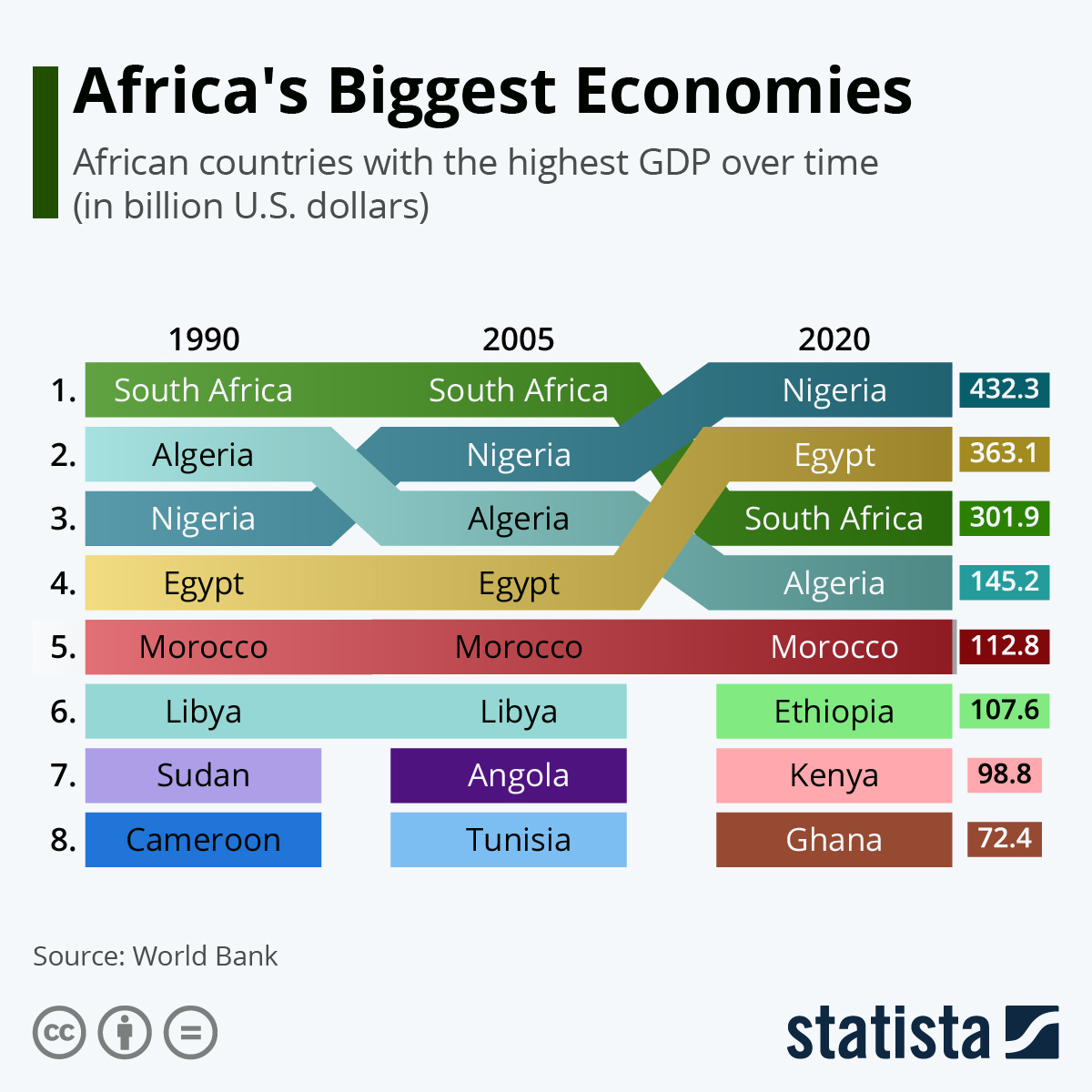
With a total GDP of $432.3 billion, Nigeria has become the biggest economy on the African continent over the last 30 years. While the five highest spots on this ranking have been more or less constant over the last three decades, Statista’s Florian Zandt notes that the rest of the top 8 are subject to bigger fluctuations as our chart shows.
You will find more infographics at Statista
Libya, for example, managed to come in sixth in 1990 and 2005, but dropped out of the top 8 and only made the 17th rank in 2020. One of the most probable reasons for this dropoff is the Second Libyan Civil War. The multi-sided conflict started in 2014 in the aftermath of the election results of 2012 putting the General National Congress into power. Kenya, on the other hand, passed a new constitution in 2010 which limited the power held by the country’s president and enabled business and technology centers like Nairobi to grow. The city is now home to the African offices of Google, Coca-Cola, IBM and Cisco, among others.
Nigeria’s first place is largely attributable to its rapidly expanding financial sector, which grew from one percent of the total GDP in 2001 to ten percent in 2018, and its role as one of the world leaders in petroleum exports. The growing tech hub of Lagos, the second-largest metropolitan area in Africa and among the largest in the world, is also likely to further bolster Nigeria’s growth in the coming years, even though the divide between the part of the population living in slums without access to basic sanitation and its upper class making the city one of the most expensive in the world is likely to grow as well. This is also reflected in its comparably low GDP per capita of $2,100. When considering this indicator, Nigeria doesn’t even make the top 10 in Africa.
Of the 54 countries in Africa, only four countries made the top 50 of all nations with the highest GDP according to data from World Bank. The top spots on this list are reserved for the US, China, Japan and Germany, whose residents generate a combined GPD of $45 trillion, a whopping 50 percent of the global GDP.
https://www.zerohedge.com/economics/africas-biggest-economies
December 19, 2021
Africa’s Largest Economies
Africa’s Biggest Economies
by Tyler DurdenSunday, Dec 19, 2021 – 08:45 AM
With a total GDP of $432.3 billion, Nigeria has become the biggest economy on the African continent over the last 30 years. While the five highest spots on this ranking have been more or less constant over the last three decades, Statista’s Florian Zandt notes that the rest of the top 8 are subject to bigger fluctuations as our chart shows.
You will find more infographics at Statista
Libya, for example, managed to come in sixth in 1990 and 2005, but dropped out of the top 8 and only made the 17th rank in 2020. One of the most probable reasons for this dropoff is the Second Libyan Civil War. The multi-sided conflict started in 2014 in the aftermath of the election results of 2012 putting the General National Congress into power. Kenya, on the other hand, passed a new constitution in 2010 which limited the power held by the country’s president and enabled business and technology centers like Nairobi to grow. The city is now home to the African offices of Google, Coca-Cola, IBM and Cisco, among others.
Nigeria’s first place is largely attributable to its rapidly expanding financial sector, which grew from one percent of the total GDP in 2001 to ten percent in 2018, and its role as one of the world leaders in petroleum exports. The growing tech hub of Lagos, the second-largest metropolitan area in Africa and among the largest in the world, is also likely to further bolster Nigeria’s growth in the coming years, even though the divide between the part of the population living in slums without access to basic sanitation and its upper class making the city one of the most expensive in the world is likely to grow as well. This is also reflected in its comparably low GDP per capita of $2,100. When considering this indicator, Nigeria doesn’t even make the top 10 in Africa.
Of the 54 countries in Africa, only four countries made the top 50 of all nations with the highest GDP according to data from World Bank. The top spots on this list are reserved for the US, China, Japan and Germany, whose residents generate a combined GPD of $45 trillion, a whopping 50 percent of the global GDP.
https://www.zerohedge.com/economics/africas-biggest-economies
December 14, 2021
Urethane PPI Update
December 14, 2021
Urethane PPI Update
December 11, 2021
The Oil Blues
World Economy Entering Period Of Oil Scarcity, Halliburton CEO Says
by Tyler DurdenFriday, Dec 10, 2021 – 07:00 PM
Authored by Nicholas Dolinger via The Epoch Times,
Halliburton CEO and president Jeff Miller made waves this week by predicting that the world is due for a period of oil scarcity in comments at the World Petroleum Congress in Houston, Texas.
“I think that for the first time in a long time, we will see a buyer looking for a barrel of oil, as opposed to a barrel of oil looking for a buyer,” Miller said.
Since 2014, the oil industry has generally deemphasized building new infrastructure in the face of low prices. However, that trend may now catch up with the industry, which now finds demand for oil exceeding the available supply given current infrastructure.
Some analysts have speculated that it is increasingly likely that oil prices will soon climb to $100 per barrel, a price unseen in the past seven years and which has serious potential to disrupt the economy.
An additional factor contributing to predicted oil scarcity is a labor shortage in the fossil fuel industry surpassing that in the general economy.
The widespread perception that fossil fuels will be marginalized in the future of energy and transportation makes long-term careers in petroleum unattractive to young workers, with many oil workers seeking to switch to renewables or leave the energy industry outright.
A recent survey revealed that 43 percent of oil industry employees sought to transition to other sectors in the next five years, as reported by Reuters.
As baby boomer employees retire, the industry struggles to replace them with young workers, who see the oil industry as unfavorable to long-term careers because of concerns about climate change models, and pressure by politicians, environmentalists, and investors to transition to renewable energy sources.
This combination of infrastructural underinvestment and labor shortages is likely to result in an oil supply stretched thin to meet demand, resulting in higher prices and possible shortages.
With oil extraction occurring at a significant time lag from industry investment and the skill shortage in the labor industry showing no signs of abating, there are major reasons to believe that any scarcity in oil supplies could last long into the future.
https://www.zerohedge.com/energy/world-economy-entering-period-oil-scarcity-halliburton-ceo-says
 Everchem Updates Archive
 Sign Up for Email Updates