Epoxy
September 2, 2021
Arsenal’s Meridian Makes Another Acquisition
Arsenal’s Meridian Acquires Prime Blend, LLC September 1, 2021 – Meridian Adhesives Group (Meridian) announced the addition of its fourteenth company to the group’s portfolio today upon the acquisition of Prime Blend, LLC, (Prime Blend). Prime Blend is a manufacturer and formulator of water-based and hot melt adhesives and coatings. The company primarily serves the food and beverage packaging, paper/film and foil converting, and furniture markets. Based in Elk Grove Village, Illinois, the company offers products that are used to adhere and coat decorative beverage cartons, microwave bags, industrial strapping, point of purchase displays and various furniture applications.
“We found the right home in Meridian Adhesives Group,” said Jerry Stempel, CEO of Prime Blend. “This investment by Meridian will enhance our steep growth trajectory in our legacy markets and open doors to new opportunities by allowing Prime Blend to leverage Meridian’s broad technology platform to our extremely loyal customer base and end-users.”
The Prime Blend team brings over 100 years of experience in formulating, manufacturing, and selling adhesives. The company’s extensive manufacturing and warehouse capacity provides customers with quicker deliveries and greater inventories, as well as personal service, dedicated equipment, and highly qualified technical support.
“The addition of Prime Blend will strengthen the Meridian portfolio as we work to extend our product and technology offerings in our Industrial Division,” said Daniel Pelton, CEO of Meridian. “The acquisition of Prime Blend adds considerable end-use application knowledge and a customer-focused business model to further support our vision as a leader in the adhesives industry.” For more information regarding Prime Blend, visit https://www.pblend.com.
About Meridian Adhesives Group Meridian Adhesives Group is a leading manufacturer of high-value adhesive technologies. With a broad portfolio of dynamic solutions, Meridian serves the electronics, infrastructure, flooring, packaging and product assembly markets. The group’s operations are located in the Americas, EMEA and Asia, with a multitude of sales/service offices worldwide that are positioned to serve Meridian’s global customer base. For more information, visit https://meridianadhesives.com.
About Arsenal Capital Partners Arsenal is a leading private equity firm that specializes in investments in middle-market industrial growth and healthcare companies. Since its inception in 2000, Arsenal has raised institutional equity investment funds of $5.3 billion, has completed more than 200 platform and add-on investments, and achieved more than 30 realizations. Arsenal invests in industry sectors in which the firm has significant prior knowledge and experience. The firm works with management teams to build strategically important companies with leading market positions, high growth, and high value-add. Visit www.arsenalcapital.com.
September 1, 2021
BASF Increases Polyetheramines
BASF to increase prices for select polyetheramines in North America
FLORHAM PARK, NJ, September 1, 2021 – Effective October 1, 2021 or as existing contracts permit, BASF will increase its prices in North America for select polyetheramines sold under the brand name Baxxodur®.
Product Price Increase
Polyetheramine D230 (Baxxodur® EC 301) $0.19 / lb.
Polyetheramine D2000 (Baxxodur® EC 303) $0.24 / lb.
Polyetheramine T403 (Baxxodur® EC 310) $0.19 / lb.
Isophorone diamine (Baxxodur® EC 201) $0.23 / lb.
Under the brand name Baxxodur®, BASF markets a diversified portfolio of amine-based curing components for the professional and application-oriented processing of epoxy resins. BASF’s Baxxodur products are featured in many applications as highly efficient curing agents in various coating applications and sealing compounds, for the wind energy, electrical industry as well as in composites, adhesives and flooring.
September 1, 2021
BASF Increases Polyetheramines
BASF to increase prices for select polyetheramines in North America
FLORHAM PARK, NJ, September 1, 2021 – Effective October 1, 2021 or as existing contracts permit, BASF will increase its prices in North America for select polyetheramines sold under the brand name Baxxodur®.
Product Price Increase
Polyetheramine D230 (Baxxodur® EC 301) $0.19 / lb.
Polyetheramine D2000 (Baxxodur® EC 303) $0.24 / lb.
Polyetheramine T403 (Baxxodur® EC 310) $0.19 / lb.
Isophorone diamine (Baxxodur® EC 201) $0.23 / lb.
Under the brand name Baxxodur®, BASF markets a diversified portfolio of amine-based curing components for the professional and application-oriented processing of epoxy resins. BASF’s Baxxodur products are featured in many applications as highly efficient curing agents in various coating applications and sealing compounds, for the wind energy, electrical industry as well as in composites, adhesives and flooring.
August 31, 2021
More Backlog, Although This Too Will End, Just a Question of When
California Port Pileup Shatters Record And Imports Still Haven’t Peaked
by Tyler DurdenTuesday, Aug 31, 2021 – 07:30 PM
By Greg Miller of FreightWaves
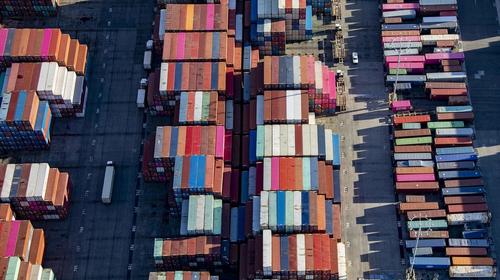
From anchorage stats to forward arrivals, ocean bookings, and inventory-to-sales numbers, all the latest data paints the same picture: The U.S. congestion crisis has never been more severe than it is now — and it’s getting worse.
Hope for any relief this year has vanished. French carrier CMA CGM is the latest in a long line of market participants to push back its timeline on normalization. Capacity constraints “are expected to continue until the first half of 2022,” CMA CGM warned on Friday.
Alarmingly, America’s import system — which is already stretched to the limit — looks like it will have to handle even higher volumes next month. The likely outcome: Carriers will be forced to cancel more sailings as terminal berths max out and ships get stuck at anchor, even more cargo will get “rolled” (pushed to a future sailing), and importers will face even longer delays and even less slot availability as they scramble to build inventories for holiday sales.
More ships stuck at anchor than ever before
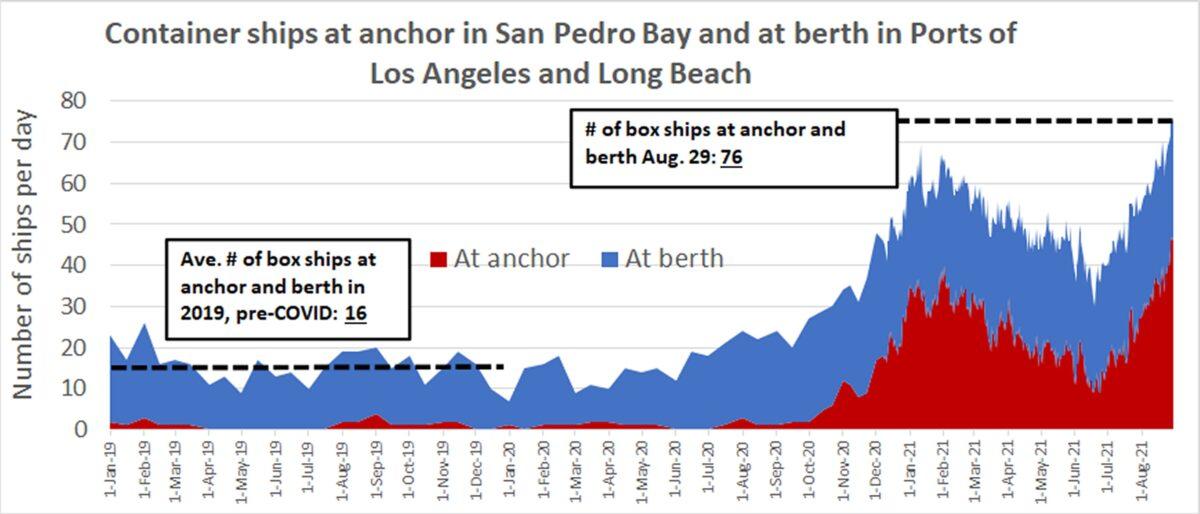
According to the Marine Exchange of Southern California, there were 47 container ships at anchor or drifting off the ports of Los Angeles and Long Beach on Sunday, a new all-time high. The earlier high of 40 at anchor was set on Feb. 1 and matched several times last week. The tally rose to 44 on Friday and stood at 46 on Monday.
Pre-COVID, an average of 16 container ships were at berths or at anchor on any given day (with any ships at anchor being a rare occurrence). On Sunday, there were 76 box ships either at berths, at anchor or drifting — 4.8 times the pre-COVID level.(Chart data: American Shipper based on data from Marine Exchange of Southern California. Data bi-monthly Jan 2019-Nov 2020; daily Dec 2020-present)
There are now almost 60% more container ships at anchor than at berth. The Marine Exchange data shows that Los Angeles/Long Beach terminals accommodated an average of 28 ships each day this month. All the rest is overflow that heads to the so-called “parking lot” in San Pedro Bay.
Automatic identification system (AIS) ship-positioning data from MarineTraffic revealed extreme congestion in Southern California on Monday, with more than a half-dozen ships forced to drift because anchorage spots were full.Container-ship positions as of Monday afternoon (Map: MarineTraffic)
Even higher volumes on the way
“The expected spike in imports generated by the peak season and pre-shipped cargo is already here, making the operation more complex,” said Hapag-Lloyd on Friday, referring to congestion in Los Angeles and Long Beach. Hapag-Lloyd said that it does not expect California anchorages to clear in 2021.
The Port of Los Beach’s WAVE report, which estimates future arrivals, predicts volumes will rise in the weeks ahead. It forecast loaded import volumes of 120,928 twenty-foot equivalent units for the last week of September, up 34% from the estimated 89,980 TEUs of imports due to arrive next week.
Signal, the Port of Los Angeles’ planning tool, shows the same upward trend, with import volumes of 178,426 TEUs expected the week of Sept. 12-18, up 49% from an estimated 120,070 TEUs this week.
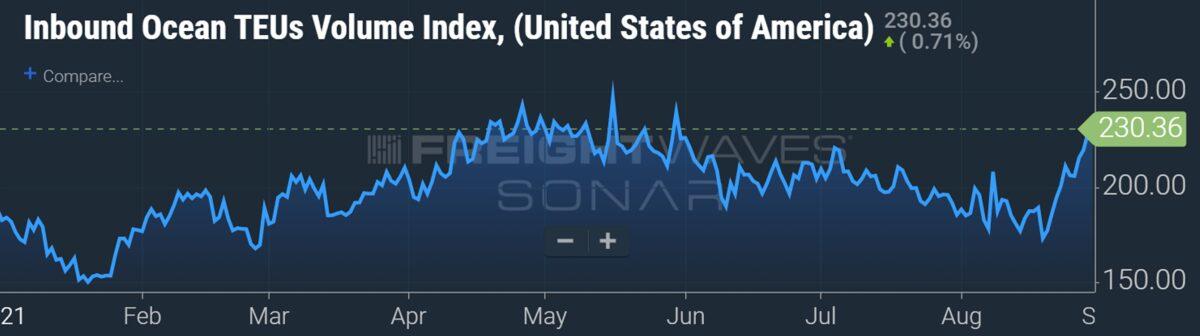
Another forward indicator is a proprietary index of shippers’ bookings on FreightWaves’ SONAR platform. The index has risen sharply in recent weeks, implying higher volumes arriving at U.S. ports in late September and into October.
Inventories not even close to being replenished
Despite record imports in the first eight months of this year, U.S. retail sales continue to outpace inventory replenishment. Assuming sales don’t collapse and businesses seek to reach pre-COVID inventory-to-sales levels, imports still have a long way to run due to restocking.
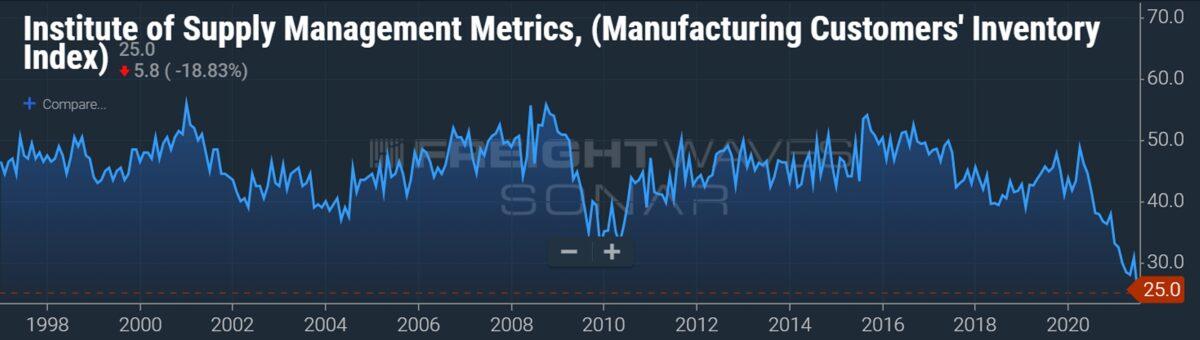
The Institute for Supply Management (ISM) produces a monthly report that includes an index of sentiment on customer inventories. That index fell to 25 points in July, the lowest level in its history.(Chart: FreightWaves SONAR)
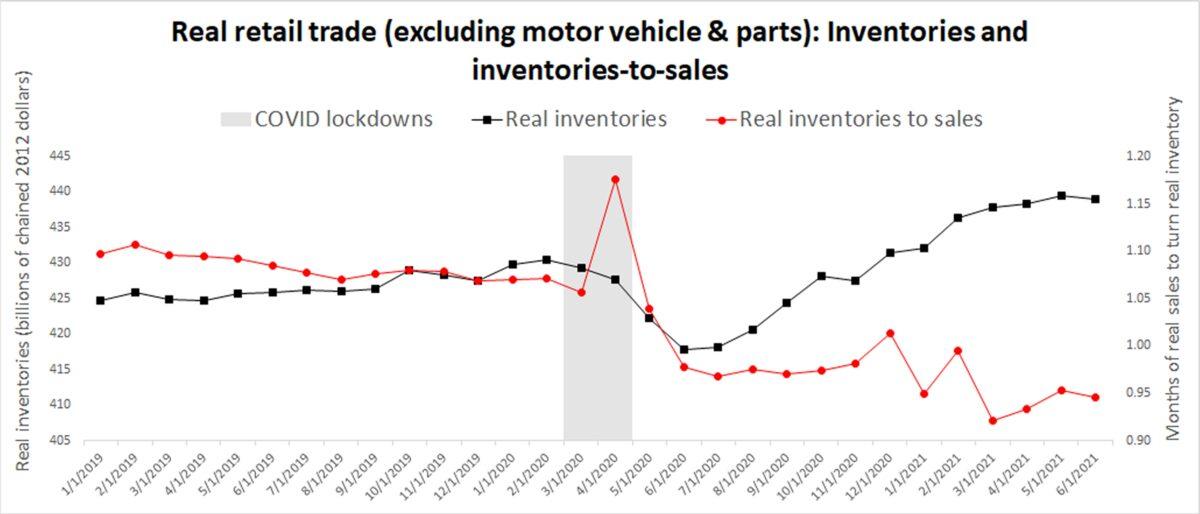
The Bureau of Economic Analysis publishes detailed monthly data on retail inventories and inventory-to-sales ratios. While there is a lag — the June numbers were published on Friday — the data underscores the magnitude of America’s inventory restocking challenge.
Jason Miller, associate professor of supply chain management at Michigan State University’s Eli Broad College of Business, provided inflation-adjusted BEA figures excluding motor vehicles and automotive parts (which skew the data). This data shows that retail inventories are now substantially higher than pre-COVID, but sales have been so high that the inventory-to-sales ratio is far below where it was pre-COVID. The level of inventory to sales actually fell slightly in June, to 0.94 months of sales.(Chart: Jason Miller)
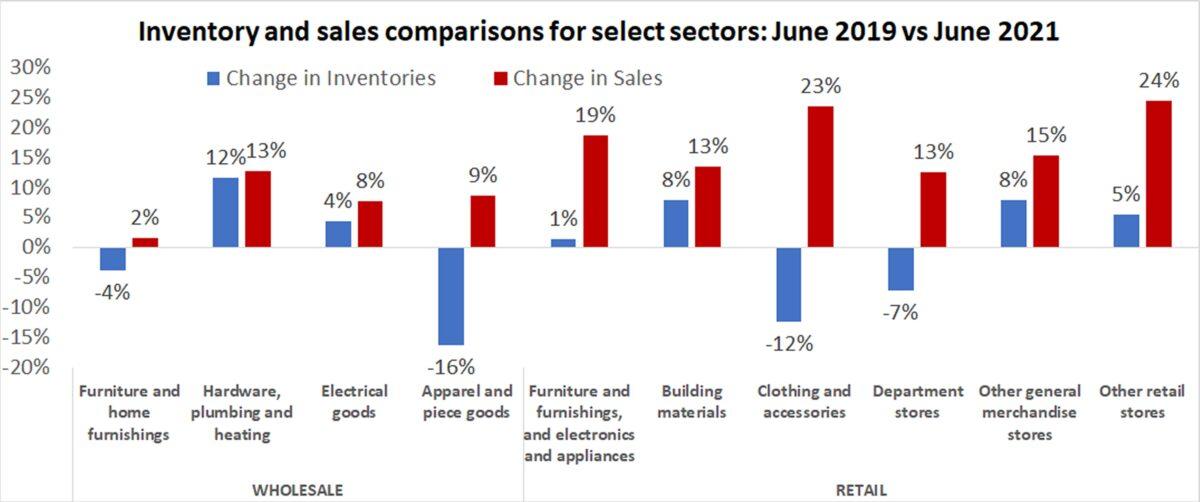
Miller also compared the June sales and inventory figures for specific categories of wholesale and retail imports. (Chart: Jason Miller)
The rise in sales far outpaced the rise in inventories — in some categories, inventories fell — which helps explain the ongoing flood of cargo into U.S. ports and the unprecedented pileup of ships at anchor off Los Angeles/Long Beach.
August 31, 2021
More Backlog, Although This Too Will End, Just a Question of When
California Port Pileup Shatters Record And Imports Still Haven’t Peaked
by Tyler DurdenTuesday, Aug 31, 2021 – 07:30 PM
By Greg Miller of FreightWaves
From anchorage stats to forward arrivals, ocean bookings, and inventory-to-sales numbers, all the latest data paints the same picture: The U.S. congestion crisis has never been more severe than it is now — and it’s getting worse.
Hope for any relief this year has vanished. French carrier CMA CGM is the latest in a long line of market participants to push back its timeline on normalization. Capacity constraints “are expected to continue until the first half of 2022,” CMA CGM warned on Friday.
Alarmingly, America’s import system — which is already stretched to the limit — looks like it will have to handle even higher volumes next month. The likely outcome: Carriers will be forced to cancel more sailings as terminal berths max out and ships get stuck at anchor, even more cargo will get “rolled” (pushed to a future sailing), and importers will face even longer delays and even less slot availability as they scramble to build inventories for holiday sales.
More ships stuck at anchor than ever before
According to the Marine Exchange of Southern California, there were 47 container ships at anchor or drifting off the ports of Los Angeles and Long Beach on Sunday, a new all-time high. The earlier high of 40 at anchor was set on Feb. 1 and matched several times last week. The tally rose to 44 on Friday and stood at 46 on Monday.
Pre-COVID, an average of 16 container ships were at berths or at anchor on any given day (with any ships at anchor being a rare occurrence). On Sunday, there were 76 box ships either at berths, at anchor or drifting — 4.8 times the pre-COVID level.(Chart data: American Shipper based on data from Marine Exchange of Southern California. Data bi-monthly Jan 2019-Nov 2020; daily Dec 2020-present)
There are now almost 60% more container ships at anchor than at berth. The Marine Exchange data shows that Los Angeles/Long Beach terminals accommodated an average of 28 ships each day this month. All the rest is overflow that heads to the so-called “parking lot” in San Pedro Bay.
Automatic identification system (AIS) ship-positioning data from MarineTraffic revealed extreme congestion in Southern California on Monday, with more than a half-dozen ships forced to drift because anchorage spots were full.Container-ship positions as of Monday afternoon (Map: MarineTraffic)
Even higher volumes on the way
“The expected spike in imports generated by the peak season and pre-shipped cargo is already here, making the operation more complex,” said Hapag-Lloyd on Friday, referring to congestion in Los Angeles and Long Beach. Hapag-Lloyd said that it does not expect California anchorages to clear in 2021.
The Port of Los Beach’s WAVE report, which estimates future arrivals, predicts volumes will rise in the weeks ahead. It forecast loaded import volumes of 120,928 twenty-foot equivalent units for the last week of September, up 34% from the estimated 89,980 TEUs of imports due to arrive next week.
Signal, the Port of Los Angeles’ planning tool, shows the same upward trend, with import volumes of 178,426 TEUs expected the week of Sept. 12-18, up 49% from an estimated 120,070 TEUs this week.
Another forward indicator is a proprietary index of shippers’ bookings on FreightWaves’ SONAR platform. The index has risen sharply in recent weeks, implying higher volumes arriving at U.S. ports in late September and into October.
Inventories not even close to being replenished
Despite record imports in the first eight months of this year, U.S. retail sales continue to outpace inventory replenishment. Assuming sales don’t collapse and businesses seek to reach pre-COVID inventory-to-sales levels, imports still have a long way to run due to restocking.
The Institute for Supply Management (ISM) produces a monthly report that includes an index of sentiment on customer inventories. That index fell to 25 points in July, the lowest level in its history.(Chart: FreightWaves SONAR)
The Bureau of Economic Analysis publishes detailed monthly data on retail inventories and inventory-to-sales ratios. While there is a lag — the June numbers were published on Friday — the data underscores the magnitude of America’s inventory restocking challenge.
Jason Miller, associate professor of supply chain management at Michigan State University’s Eli Broad College of Business, provided inflation-adjusted BEA figures excluding motor vehicles and automotive parts (which skew the data). This data shows that retail inventories are now substantially higher than pre-COVID, but sales have been so high that the inventory-to-sales ratio is far below where it was pre-COVID. The level of inventory to sales actually fell slightly in June, to 0.94 months of sales.(Chart: Jason Miller)
Miller also compared the June sales and inventory figures for specific categories of wholesale and retail imports. (Chart: Jason Miller)
The rise in sales far outpaced the rise in inventories — in some categories, inventories fell — which helps explain the ongoing flood of cargo into U.S. ports and the unprecedented pileup of ships at anchor off Los Angeles/Long Beach.
 Everchem Updates Archive
  Sign Up for Email Updates