Epoxy
July 26, 2022
Natural Gas Spreads Between Europe and U.S.
EU Natural Gas Prices Soar As Gazprom Readies Nord Stream Cuts, US NatGas Hits 14-Year High
by Tyler DurdenTuesday, Jul 26, 2022 – 09:16 AM
European natural gas futures extended gains by 12% after Russian state-owned energy producer Gazprom PJSC unexpectedly announced it would halt a Nord Stream 1 turbine at its Portovaya compressor station from Wednesday. Simultaneously, US NatGas futures have spiked to 14-year highs.
Russian NatGas supplies to Europe via Nord Stream pipeline fell to 38% capacity from 40% on Tuesday, ahead of a more significant cut from current levels to just 20% on Wednesday.
In a statement, Gazprom said the Nord Stream pipeline would be pumping 33 million cubic meters a day, or 20% of capacity, from Wednesday, adding another turbine for the pipeline will be taken offline due to maintenance work.
Kremlin spokesman Dmitry Peskov said another Nord Stream turbine has “problems” and will be taken offline for maintenance.
Peskov noted a turbine sent to Canada earlier is “en route” but didn’t specify its exact location.
Western sanctions prolonged the average maintenance time of the Nord Stream.
“The situation is critically aggravated by the restrictions and sanctions imposed against our country,” the Kremlin spokesman continued.
Russian state media reported Monday that the turbine recently serviced in Canada by Siemens Energy AG had finally received export paperwork that will allow it to be shipped from Germany to Helsinki, Finland.
Nord Stream’s upcoming capacity declines sent Wholesale European NatGas futures up 12% to 196 euros. Prices have jumped more than 20% in two sessions and are near highs seen last winter at more than 200 euros.
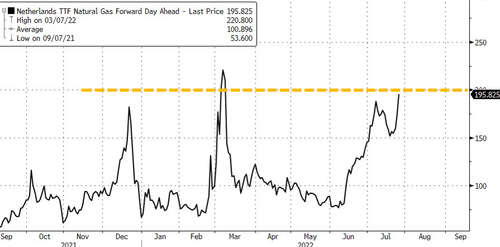
EU Natgas prices are trading at an oil-barrel-equivalent price of $333….
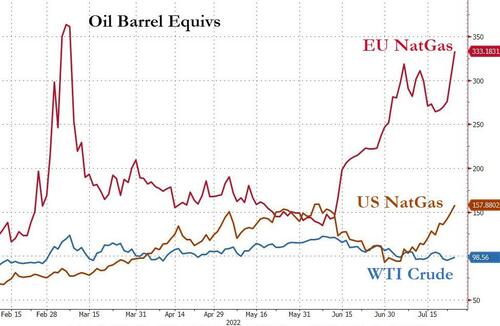
Across the Atlantic, US NatGas futures extended gains, up more than 10% to $9.62, a 14-year high, amid concerns about hot weather and tight supplies.
“Although the magnitude and speed of recent natural gas price gains point to contributing non-fundamental market dynamics, supportive fundamentals are nonetheless the primary driver,” EBW Analytics Group wrote in a note to clients.
“Fundamentally, scorching hot weather is the predominant bullish driver,” the firm added.
There’s also reason to believe that tighter European supplies would result in more US LNG exports abroad.
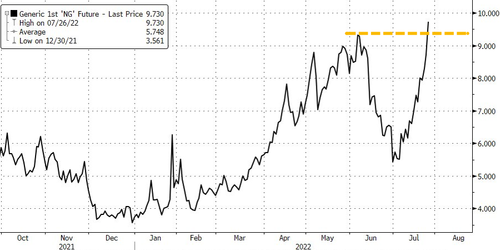
For more context, European NatGas 1m forward is trading at a massive $48 spread over front-month US NatGas futures – almost 5x its historical peak…

Europe’s energy crisis continues to worsen, and there is no immediate relief in sight as this coming winter could be a cold one.
“This is not the end of Russia’s weaponization of natural gas flows, in our view, and there remain few near-term alternatives for even current reduced flows to the EU – lending [to] ongoing upside price risks,” RBC wrote last week in a note to clients.
July 26, 2022
New Home Sales Update
New Home Sales & Prices Plunged In June As Pulte Admits Order Cancellations Are Soaring
by Tyler DurdenTuesday, Jul 26, 2022 – 10:06 AM
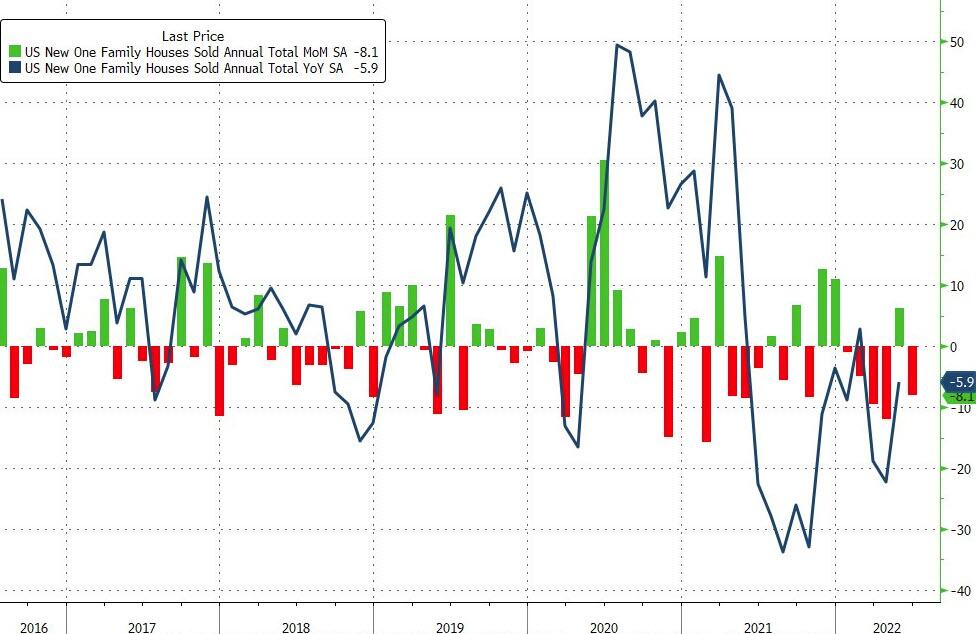
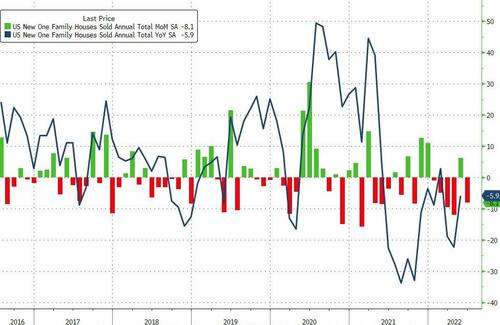
Amid a plunge in homebuilder confidence, record low affordability, tumbling single-family starts and permits, and multi-decade lows in mortgage applications, it is no surprise that analysts expected a 5.9% MoM plunge in new home sales in June (especially after the surprise 10.7% MoM panic-buying surge in May). The consensus was right in direction but off in magnitude as new home sales plunged 8.1% MoM in June and the 10.7% surge in May was revised down to just +6.3% MoM…
Source: Bloomberg
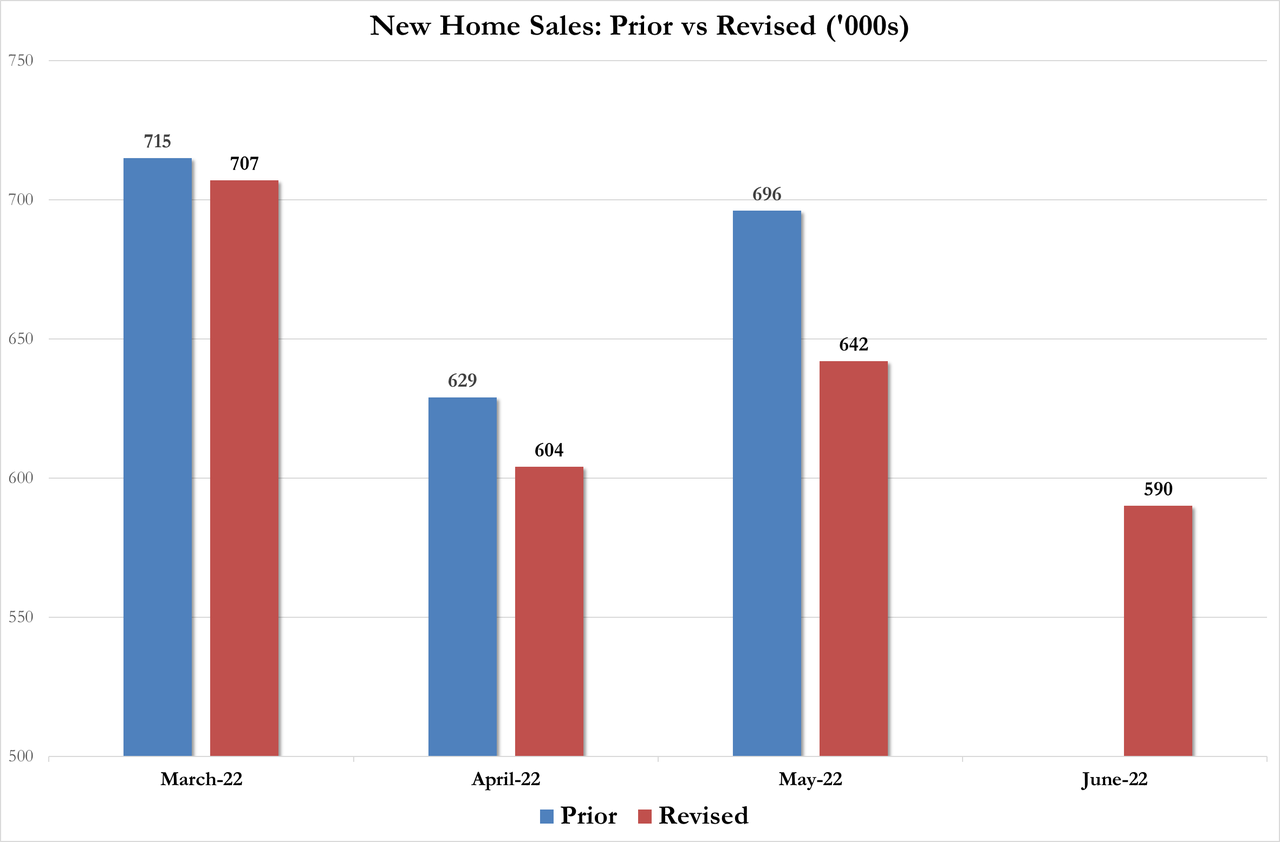
New Home Sales have fallen for 5 of the last 6 months and the last few months have seen a one-way street of downwards revisions…

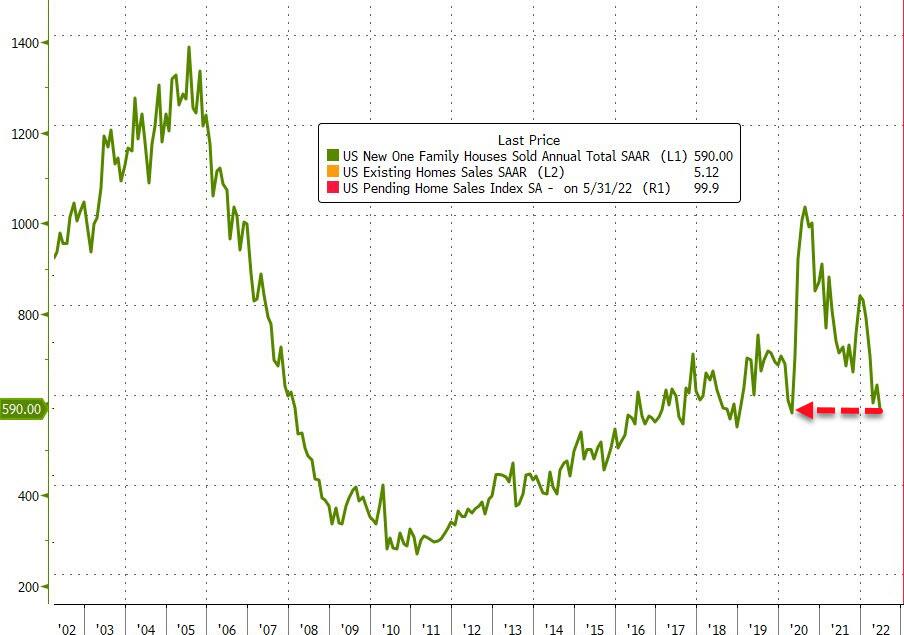
The New Home Sales SAAR has tumbled to its lowest since the nadir of the COVID lockdowns in April 2020…

Source: Bloomberg
A potential silver lining is that inventory is finally on the rise with 9.3 months of supply seen in June, up from 8.4 in the prior month.
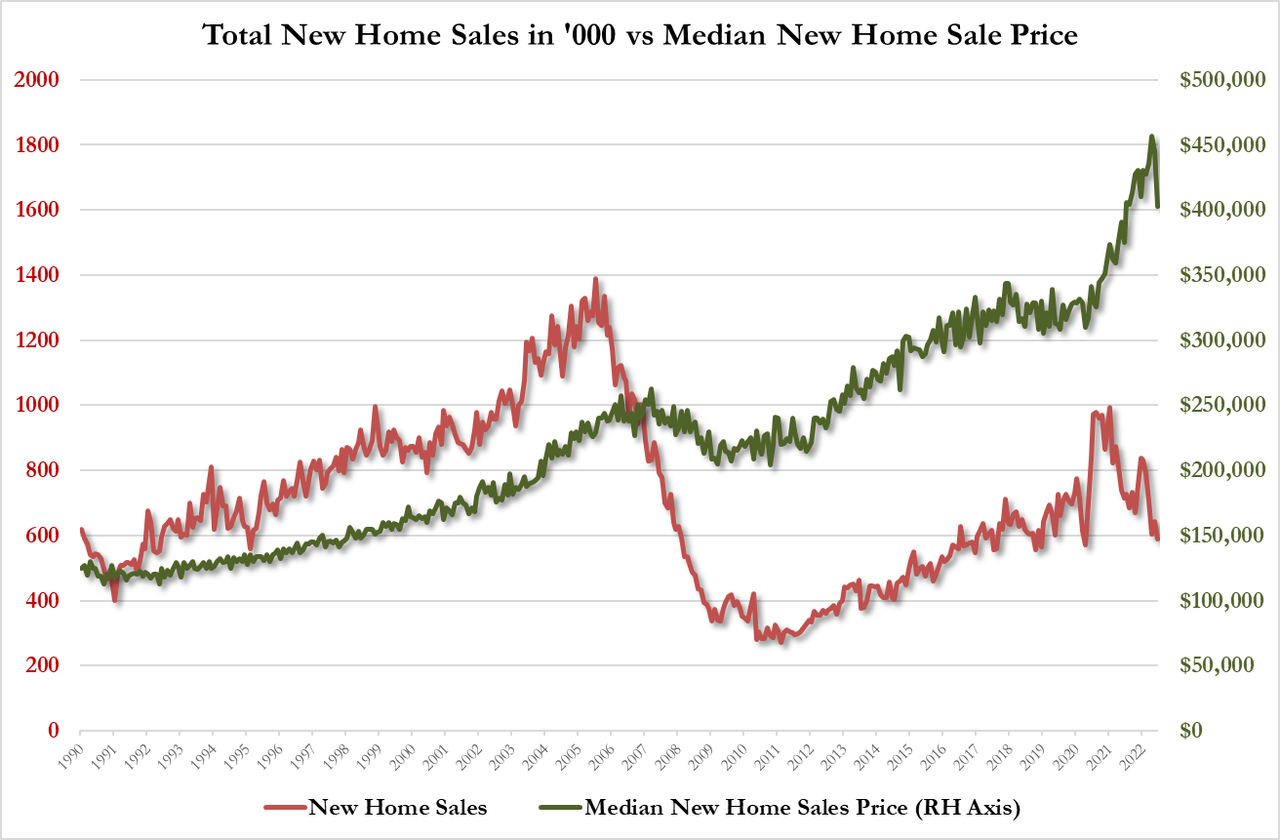
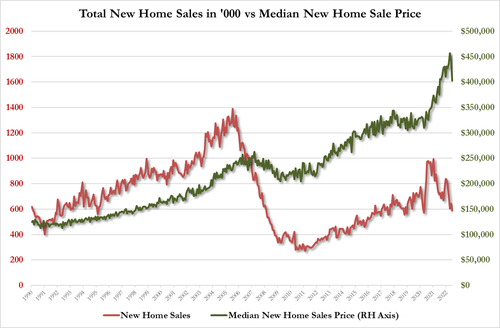
And the best news of all – the median new home price tumbled 9.5% MoM to $402,400…
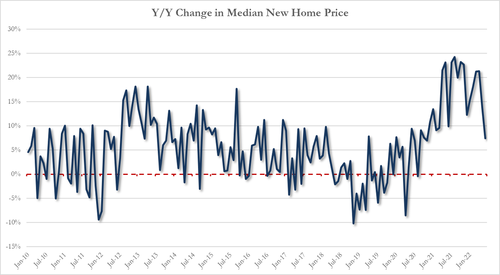
With median home price gains slowing dramatically YoY…
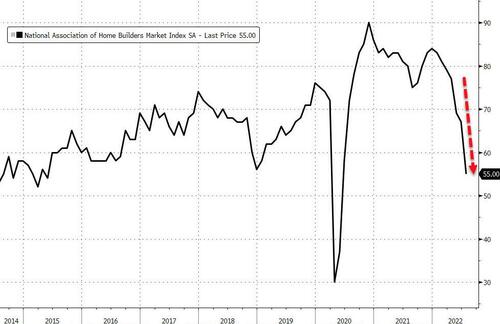
This new home sales print comes on the day that Pulte Homes admits buyers have hit a wall and is “dialling back” its spec-home-starts, noting that the homebuilder’s cancellation rate more than doubled to 15% in Q2 from 7% in the year-ago quarter, as soaring home prices and mortgage rates hinder affordability.
“The recent 200-basis point increase in mortgage rates has impacted affordability, but we continue to believe the desire for homeownership is high and the long-term outlook for housing remains positive,” said CEO and President Ryan Marshall.
Source: Bloomberg
Most notably perhaps was Marshall’s admission that the uptick in cancellations has been in the last 30-60 days, perhaps mirroring the plunge in homebuilder confidence (and Walmart) as the ‘strong American consumer’ appears to have pulled back into its shell.
July 26, 2022
New Home Sales Update
New Home Sales & Prices Plunged In June As Pulte Admits Order Cancellations Are Soaring
by Tyler DurdenTuesday, Jul 26, 2022 – 10:06 AM
Amid a plunge in homebuilder confidence, record low affordability, tumbling single-family starts and permits, and multi-decade lows in mortgage applications, it is no surprise that analysts expected a 5.9% MoM plunge in new home sales in June (especially after the surprise 10.7% MoM panic-buying surge in May). The consensus was right in direction but off in magnitude as new home sales plunged 8.1% MoM in June and the 10.7% surge in May was revised down to just +6.3% MoM…
Source: Bloomberg
New Home Sales have fallen for 5 of the last 6 months and the last few months have seen a one-way street of downwards revisions…
The New Home Sales SAAR has tumbled to its lowest since the nadir of the COVID lockdowns in April 2020…
Source: Bloomberg
A potential silver lining is that inventory is finally on the rise with 9.3 months of supply seen in June, up from 8.4 in the prior month.
And the best news of all – the median new home price tumbled 9.5% MoM to $402,400…
With median home price gains slowing dramatically YoY…
This new home sales print comes on the day that Pulte Homes admits buyers have hit a wall and is “dialling back” its spec-home-starts, noting that the homebuilder’s cancellation rate more than doubled to 15% in Q2 from 7% in the year-ago quarter, as soaring home prices and mortgage rates hinder affordability.
“The recent 200-basis point increase in mortgage rates has impacted affordability, but we continue to believe the desire for homeownership is high and the long-term outlook for housing remains positive,” said CEO and President Ryan Marshall.
Source: Bloomberg
Most notably perhaps was Marshall’s admission that the uptick in cancellations has been in the last 30-60 days, perhaps mirroring the plunge in homebuilder confidence (and Walmart) as the ‘strong American consumer’ appears to have pulled back into its shell.
July 18, 2022
Water Level on the Rhine
Germany’s Energy Crisis About To Get Even Worse As Rhine Water Levels Plummet
by Tyler DurdenMonday, Jul 18, 2022 – 06:55 AM
What has already been a year from hell for Germany, which is suffering energy hyperinflation as a result of Europe’s sanctions on Russia, and which is “facing the biggest crisis the country has every had” according to the president of the German employers association, is about to get even worse as the declining water level of the Rhine river, which has historically been a key infrastructure transit artery across Germany, continues to fall and as it does, the flow of commodities to inland Europe is starting to buckle threatening to make an already historic crisis even worse.
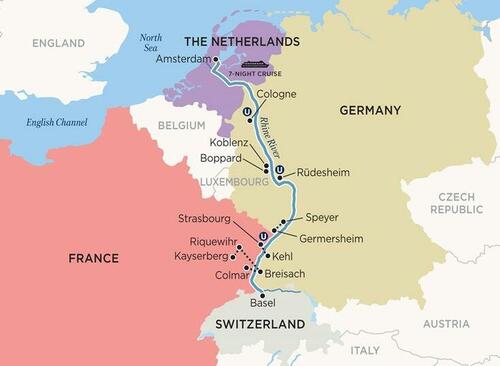
The alarming lack of water is contributing to oil product supply problems in Switzerland and preventing at least two power plants in Germany from getting all the coal they need, and what’s more, the continent’s sizzling summer temperatures are forecast to climb even higher in the coming week, leading to even lower water levels.
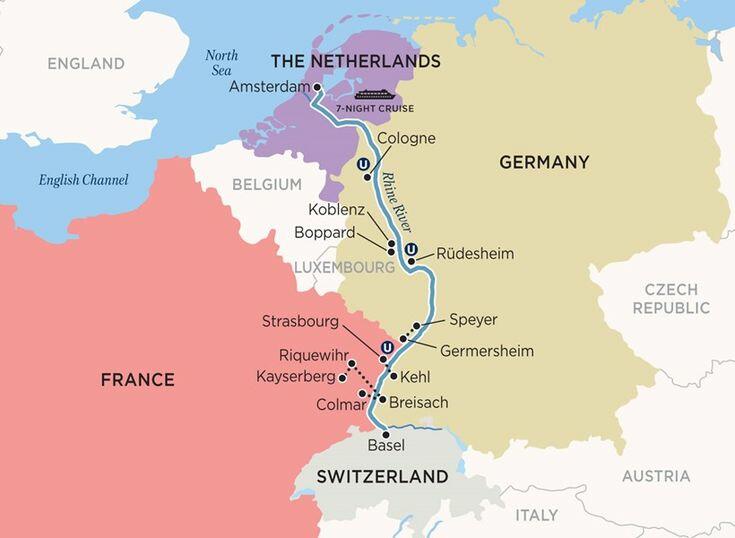
The 800-mile (1,288-kilometer) Rhine river runs from Switzerland all the way to the North Sea and is used to transport tens of millions of tons of commodities through inland Europe. But with water levels at their lowest for the time of year in 15 years, there is a limit how much fuel, coal and other vital cargo that barges can carry up and down the river.
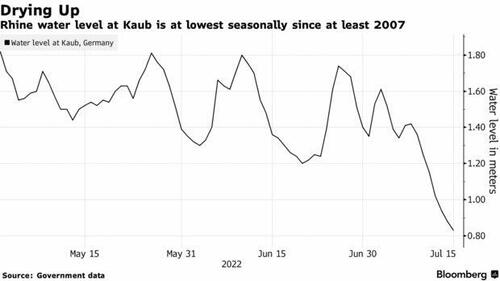
Low water levels on the Rhine River mean that barges hauling middle distillate-type oil products – typically gasoil/diesel – past Kaub in Germany, are limited to loading about 30% of capacity, according to maritime brokerage services firm Riverlake.
A barge loading in the energy hub of Amsterdam-Rotterdam-Antwerp (or ARA), which can haul 2.5k tons when fully laden, is restricted to taking on about 800 tons if sailing to destinations beyond Kaub. As shown below, the water level at Kaub has fallen in recent days and is at its lowest on a seasonal basis since at least 2007. According to Riverlake, further decreases in loading volumes for barges hauling middle distillates from ARA to inland destinations beyond Kaub are expected in coming days.
This – coupled with capacity issues on German railways – has meant that Switzerland is struggling with supplies of oil products, mainly diesel/heating oil, according to Avenergy Suisse, the landlocked country’s organization for fuel importers.
Low Rhine water level combined with capacity problems on German railways are the reasons, managing director Roland Bilang told Bloomberg, adding that supply problems mainly concern diesel/heating oil.
“It has happened from time to time in the past that temporarily not enough mineral oil products could be transported to Switzerland and therefore the compulsory stocks had to be tapped.” Biland recommends private households fill their heating oil tanks early.
Meanwhile, Bloomberg reports that power plants at Mannheim and Karlsruhe in Germany, operated by Grosskraftwerk Mannheim and EnBW, have been struggling to source coal because of the shallow water – just as the country frets that Russia won’t restart flows on a key gas pipeline. The companies said their generation operations aren’t currently affected.
Because of the tight coal market and low Rhine levels making it hard to deliver the fuel, only 65% of Germany’s coal capacity will be available in coming months, according to S&P Global Commodity Insights analyst Sabrina Kernbichler. This is bad news for a country whose biggest energy utilities are starting to drain natgas reserves as a result of the halt in Nord Stream 1 shipments, jeopardising millions of Germans with freezing should the country fail to restock fully ahead of the winter.
Germany also imports oil products up the Rhine, including fuel and heating oil. There’s currently no shortage of gasoline or diesel in the country, according to Herbert Rabl, spokesman for Tankstellen-Interessenverband e.V., which represents fuel station leaseholders and owners in Germany.
Shell – which owns the Wesseling and Godorf refineries along the Rhine – is monitoring the situation, according to a spokesperson.
https://www.zerohedge.com/markets/germanys-crisis-about-get-even-worse-rhine-water-levels-plummet
July 18, 2022
Water Level on the Rhine
Germany’s Energy Crisis About To Get Even Worse As Rhine Water Levels Plummet
by Tyler DurdenMonday, Jul 18, 2022 – 06:55 AM
What has already been a year from hell for Germany, which is suffering energy hyperinflation as a result of Europe’s sanctions on Russia, and which is “facing the biggest crisis the country has every had” according to the president of the German employers association, is about to get even worse as the declining water level of the Rhine river, which has historically been a key infrastructure transit artery across Germany, continues to fall and as it does, the flow of commodities to inland Europe is starting to buckle threatening to make an already historic crisis even worse.
The alarming lack of water is contributing to oil product supply problems in Switzerland and preventing at least two power plants in Germany from getting all the coal they need, and what’s more, the continent’s sizzling summer temperatures are forecast to climb even higher in the coming week, leading to even lower water levels.
The 800-mile (1,288-kilometer) Rhine river runs from Switzerland all the way to the North Sea and is used to transport tens of millions of tons of commodities through inland Europe. But with water levels at their lowest for the time of year in 15 years, there is a limit how much fuel, coal and other vital cargo that barges can carry up and down the river.
Low water levels on the Rhine River mean that barges hauling middle distillate-type oil products – typically gasoil/diesel – past Kaub in Germany, are limited to loading about 30% of capacity, according to maritime brokerage services firm Riverlake.
A barge loading in the energy hub of Amsterdam-Rotterdam-Antwerp (or ARA), which can haul 2.5k tons when fully laden, is restricted to taking on about 800 tons if sailing to destinations beyond Kaub. As shown below, the water level at Kaub has fallen in recent days and is at its lowest on a seasonal basis since at least 2007. According to Riverlake, further decreases in loading volumes for barges hauling middle distillates from ARA to inland destinations beyond Kaub are expected in coming days.
This – coupled with capacity issues on German railways – has meant that Switzerland is struggling with supplies of oil products, mainly diesel/heating oil, according to Avenergy Suisse, the landlocked country’s organization for fuel importers.
Low Rhine water level combined with capacity problems on German railways are the reasons, managing director Roland Bilang told Bloomberg, adding that supply problems mainly concern diesel/heating oil.
“It has happened from time to time in the past that temporarily not enough mineral oil products could be transported to Switzerland and therefore the compulsory stocks had to be tapped.” Biland recommends private households fill their heating oil tanks early.
Meanwhile, Bloomberg reports that power plants at Mannheim and Karlsruhe in Germany, operated by Grosskraftwerk Mannheim and EnBW, have been struggling to source coal because of the shallow water – just as the country frets that Russia won’t restart flows on a key gas pipeline. The companies said their generation operations aren’t currently affected.
Because of the tight coal market and low Rhine levels making it hard to deliver the fuel, only 65% of Germany’s coal capacity will be available in coming months, according to S&P Global Commodity Insights analyst Sabrina Kernbichler. This is bad news for a country whose biggest energy utilities are starting to drain natgas reserves as a result of the halt in Nord Stream 1 shipments, jeopardising millions of Germans with freezing should the country fail to restock fully ahead of the winter.
Germany also imports oil products up the Rhine, including fuel and heating oil. There’s currently no shortage of gasoline or diesel in the country, according to Herbert Rabl, spokesman for Tankstellen-Interessenverband e.V., which represents fuel station leaseholders and owners in Germany.
Shell – which owns the Wesseling and Godorf refineries along the Rhine – is monitoring the situation, according to a spokesperson.
https://www.zerohedge.com/markets/germanys-crisis-about-get-even-worse-rhine-water-levels-plummet
 Everchem Updates Archive
 Sign Up for Email Updates