Government Regulation

January 20, 2020

EPA Clean Trucks Initiative

EPA Kickstarts ‘50-State’ Clean Trucks Initiative to Improve Air Quality

Agency says initiative would cut nitrogen oxide, modernize truck engines, and set standards without hurting U.S. economy
30 Comments January 20, 2020 Updated: January 20, 2020
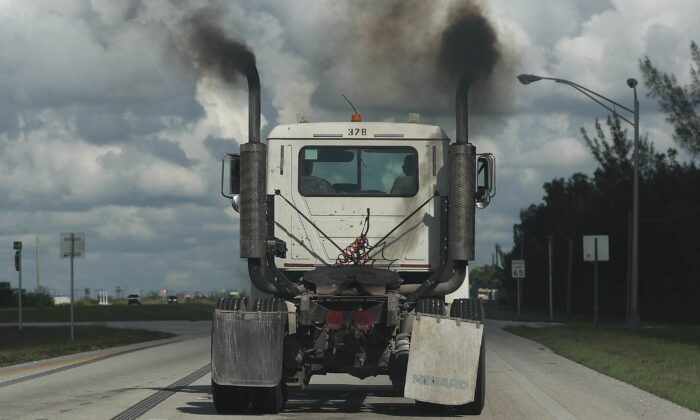
Smoke pours from the exhaust pipes on a truck in Miami, Florida, on Nov. 5, 2019. (Joe Raedle/Getty Images)

U.S. Environmental Protection Agency (EPA) Regional Administrator Pete Lopez visited New Jersey’s Port Elizabeth last week to outline the steps the EPA is taking to advance the Cleaner Trucks Initiative (CTI). The new rules for truck engines will focus on reducing pollutants from heavy-duty engines that cause asthma and even lung cancer. Lopez said the EPA is now seeking pre-proposal comments (pdf) from the public and interested stakeholders on the matter.

The EPA’s Clean Trucks Initiative, however, takes a markedly different approach to the “Multi-State Medium- and Heavy-Duty Zero Emission Vehicle Initiative” (pdf) proposed in December by a group of 8 states and the District of Colombia. The multi-state initiative focuses much more heavily on decarbonization and combating climate change through the introduction of heavy-duty zero-emission vehicles or ZEVs, such as battery- or hydrogen-powered trucks. The recurring theme of the EPA’s CTI, in contrast, is to secure improvements in human health through incremental improvements in existing technologies and research into new ones—without forcing a revolution in trucking technology.

The CTI’s Advance Notice of Proposed Rulemaking (pdf) stretches to some 97 pages as it outlines the EPA’s approach. Over the course of those 97 pages, “carbon” is mentioned three times, but “climate,” “climate change” or “global warming” cannot be found. Instead, the terms “health” or “healthy” feature 19 times in all. The Multi-State ZEV initiative put forward by California, Oregon, New Jersey, Rhode Island,  Connecticut, Massachusetts, Maine, Vermont, and the District of Colombia comes to approximately one page of text. It mentions “climate crisis,” “climate change” or “climate action” four times, but “health” only once.

EPA Administrator Andrew Wheeler launched the CTI officially in mid-November. According to Wheeler, “This initiative will help modernize heavy-duty truck engines, improving their efficiency and providing cleaner air for all Americans.” Wheeler said the new rules “will establish updated standards to address nitrogen oxide emissions from heavy-duty trucks. We will do this in a manner that improves air quality and protects public health without jeopardizing the historic economic growth we’ve achieved under President Trump.”

Wheeler stated, “Thanks largely to innovation and technology, the U.S. has made big reductions in NOx emissions over the past several decades. Since 2000, NOx emissions in the U.S. have been reduced by 52 percent. However, it is estimated that heavy-duty trucks will be responsible for one-third of NOx emissions from transportation in 2025, and it’s been nearly 20 years since the EPA last set NOx emissions standards for heavy duty trucks.”

He also spoke to the Trump Administration policy of deregulation and cutting regulatory costs and red tape. “Part of this initiative will also be to cut unnecessary red tape while simplifying certification and compliance requirements for heavy-duty vehicles,” said Wheeler. “For the past two decades, additional regulatory requirements have been added to on-highway heavy duty vehicles in a piecemeal fashion. This has resulted in some overly complex and costly requirements that do little to actually improve the environment.” He said the EPA will review current requirements and root out inefficiencies while ensuring “a common-sense, 50-state approach” to regulation.

The War on Nitrogen Oxide

NYCDEP states that “Nitrogen oxides are gases produced by fuel combustion. They include nitric oxide (NO), which is rapidly converted to nitrogen dioxide (NO2) after emission from vehicles and other sources. Exposures have been associated with lung irritation, emergency department visits and hospital admissions for respiratory conditions. Nitrogen oxides also contribute to the formation of ozone.” According to the American Lung Association, “Ozone is an air pollutant that causes essentially a ‘sunburn’ in the lungs and can be deadly.”

According to the EPA, “Short-term exposures to NO2 (an oxide of nitrogen) can aggravate respiratory diseases, particularly asthma, leading to respiratory symptoms, hospital admissions and emergency department visits. Long-term exposures to NO2 have been shown to contribute to asthma development and may also increase susceptibility to respiratory infections. Ozone exposure reduces lung function and causes respiratory symptoms, such as coughing and shortness of breath. Ozone exposure also aggravates asthma and lung diseases such as emphysema, leading to increased medication use, hospital admissions, and emergency department visits.”

According to New York City’s Department of Environmental Protection (NYCDEP), “Despite significant improvements in recent years, air pollution in New York City is still a significant environmental threat,” with trucks and cars producing a range of substances harmful for human health—including particulate matter (PM), NOx gases, sulfur dioxide, and ozone.

The California Air Resources Board (CARB) states that fuels such as gasoline and diesel consumed for transportation cause around 80 percent of the NOx gases that form ozone. Ozone is a primary component of smog, which continues to plague cities such as Los Angeles.

According to the U.S. Energy Information Administration (EIA), gasoline made up 54 percent of transportation fossil fuels consumed in 2018 (including cars and light trucks), while distillates such as diesel constituted some 23 percent, with diesel favored for engines in heavy trucks due to its stability and particularly high energy density. The EPA states that “Gasoline-fueled engines … tend to be lighter and less expensive than diesel engines although less durable and less fuel efficient.”

According to the EPA’s Advance Notice of the Proposed Rule (pdf), “NOx emissions in the U.S. have dropped by more than 40 percent over the past decade,” though the EPA projects that heavy-duty vehicles will “continue to be one of the largest contributors to the mobile source NOx inventory in 2028.” According to American Trucking Association (ATA) Executive Vice President of Advocacy, Bill Sullivan, “Since 1985, newly manufactured trucks have reduced NOx emissions by over 98%, but our work is not yet done.”

The 50-State Solution

Due to the continued contribution of heavy-duty trucks to the NOx inventory, more than 20 organizations, including state and local air agencies from across the country, petitioned the EPA to develop more stringent NOx emission standards for on-road heavy-duty engines. According to the EPA, “It became clear that there is broad support for federal action in collaboration with the California Air Resources Board (CARB). So-called ’50-state’ standards enable technology suppliers and manufacturers to efficiently produce a single set of reliable and compliant products.”

Furthermore, the “EPA and CARB often cooperate during the implementation of highway heavy-duty standards. Thus, for many years the regulated industry has been able to design a single product line of engines and vehicles which can be certified to both EPA and CARB emission standards (which have been the same) and sold in all 50 states.”

The EPA is thus seeking to harmonize efforts to lower NOx emission standards, while also focusing on issues such as implementing real-world testing protocols, ensuring the longer useful life of any regulations, considering future engine rebuilds, and introducing “incentives to encourage the transition to current- and next-generation cleaner technologies as soon as possible.” This will be done by reducing in-use emissions (rather than those measured on stationary testing apparatus), considering cost impacts on an industry pressed by higher wage and insurance costs, encouraging innovation and early compliance and ensuring a coordinated 50-state program.

Real-World Testing

The EPA says that “Current heavy-duty engine emission standards reduced PM and NOx tailpipe emissions by over 90 percent for emissions measured using the specified test procedures, but their impact on in-use emissions during real-world operation is less clear.” Among the reasons for this are that “NOx emissions can be significantly higher during engine warm-up, idling, and certain other types of operation that result in low load on the engine or transitioning from low to high loads.”

The EPA states that modern diesel engines rely heavily upon catalytic aftertreatment to meet emission standards, with oxidation catalysts reducing hydrocarbons (HC) and carbon monoxide (CO), diesel particle filters (DPFs) reducing PM, and selective catalytic reduction (SCR) catalysts reducing NOx. Current designs typically include the diesel oxidation catalyst (DOC) function as part of the broader DPF/SCR system. However, SCR systems (including the DOC function) are effective only when the exhaust temperature is sufficiently high. All three types of aftertreatment also have the potential to lose effectiveness if the catalysts degrade.

Truck engine manufacturers will be encouraged to find innovative solutions to reduce real-world emissions, including during lower-temperature operations such as when idling, warming the engine after starting, and driving downhill or on deadhead trips. According to the EPA, “We have also observed an industry trend toward engine down-speeding—that is, designing engines to do more of their work at lower engine speeds where frictional losses are lower.”

Lower speeds, however, normally result in lower operating temperatures, and some technologies are then quite ineffective. “Review of in-use data has indicated that SCR-based emission controls systems for diesel engines are not functional over a significant fraction of real-world operation due to low aftertreatment temperatures, which are often the result of extended time at low load and idle operation.”

Industry Approval

According to a statement (pdf) from Jed Mandel, president of the Truck & Engine Manufacturers Association, which includes industry giants such as Cummins, Navistar, Caterpillar, AGCO, GM and Ford,  the EPA’s Cleaner Trucks Initiative provides the opportunity to move from a prescriptive-based compliance program to one that is performance-based. “By doing so, we can achieve real-world NOx reductions, implement modern in-use compliance protocols, and streamline current redundant regulations,” Mandel explained. “We need to work together to make those changes while preserving the necessary diversity of the commercial vehicle marketplace and protecting the needs of our customers for fuel-efficient, durable, and reliable products.”

https://www.theepochtimes.com/epa-kickstarts-50-state-clean-trucks-initiative-to-improve-air-quality_3203959.html
January 15, 2020

China Trade Deal Phase I

Here Is The Full Text Of The “Phase One” US-China Trade Deal

The full text of the 94-page US-China “Phase One” Trade deal is below, and here, courtesy of Bloomberg, are some of the top highlights:

Agriculture details:

  • China Purchases to Include Oilseeds, Meat, Cereals, Cotton
  • China to Buy Add’l $19.5B U.S. Agriculture Products in 2021
  • China to Buy Add’l $12.5B U.S. Agriculture Products in 2020
  • China to Approve Pending Applications for U.S. Bond Raters

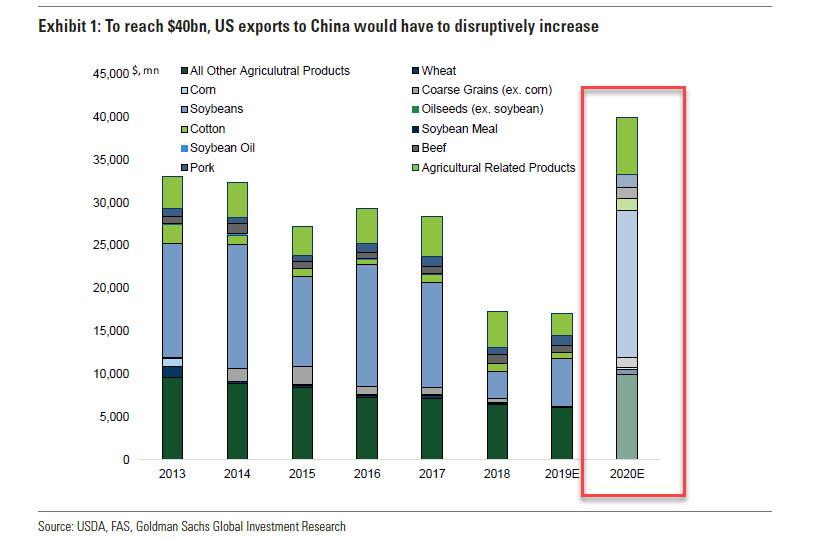
As Bloomberg notes, China is committing to buying about $32 billion in additional U.S. farm products over the next two years, that’s coming on top of levels seen in 2017 (pre-trade war). Specifically, China committed to importing at least $12.5 billion more agricultural goods this year than in 2017, rising to $19.5 billion next year. It’s unclear just how this will happen without China’s destroying existing supply chains. China will also “strive” to purchase an additional $5 billion a year in farm products.

Energy details:

  • China to Buy Add’l $33.9B U.S. Energy Products in 2021
  • China to Buy More U.S. Nuclear Power Equipment in Trade Deal
  • China Energy Purchases to Include LNG, Oil, Products, Coal
  • China to Buy Add’l $18.5B U.S. Energy Products in 2020

Chinese Purchases

  • During the two-year period from January 1, 2020 through December 31, 2021, China shall ensure that purchases and imports into China from the U.S. of the manufactured goods, agricultural goods, energy products, and services identified in Annex 6.1 exceed the corresponding 2017 baseline amount by no less than $200 billion.

Intellectual Property

  • The U.S. recognizes the importance of intellectual property protection. China recognizes the importance of establishing and implementing a comprehensive legal system of intellectual property protection and enforcement as it transforms from a major intellectual property consumer to a major intellectual property producer. China believes that enhancing intellectual property protection and enforcement is in the interest of building an innovative country, growing innovation-driven enterprises, and promoting high quality economic growth.

Tech Transfer

  • The Parties affirm the importance of ensuring that the transfer of technology occurs on voluntary, market-based terms and recognize that forced technology transfer is a significant concern. The Parties further recognize the importance of undertaking steps to address these issues, in light of the profound impact of technology and technological change on the world economy.

Currency, Competitive Devaluation And Enforcement Mechanism

The text contains agreements not to engage in competitive devaluation, to respect one another’s monetary policy and to maintain transparency. Much of that, though, could probably have been inferred from what the U.S. Treasury said the other day in the FX report that saw it remove the tag of currency manipulator from China.

The big questions revolve around the enforcement mechanism. The FX section says points of contention can be referred to a new dispute resolution arrangement that’s being established by the agreement, and if that doesn’t work, the IMF can be called in.

  • 1. Issues related to exchange rate policy or transparency shall be referred by either the U.S. Secretary of the Treasury or the Governor of the People’s Bank of China to the Bilateral Evaluation and Dispute Resolution Arrangement established in Chapter 7 (Bilateral Evaluation and Dispute Resolution).
  • 2. If there is failure to arrive at a mutually satisfactory resolution under the Bilateral Evaluation and Dispute Resolution Arrangement, the U.S. Secretary of the Treasury or the Governor of the People’s Bank of China may also request that the IMF, consistent with its mandate: (a) undertake rigorous surveillance of the macroeconomic and exchange rate policies and data transparency and reporting policies of the requested Party; or (b) initiate formal consultations and provide input, as appropriate.”

The dispute arrangement itself is outlined in chapter 7, where some of the key sections appear to be as follows:

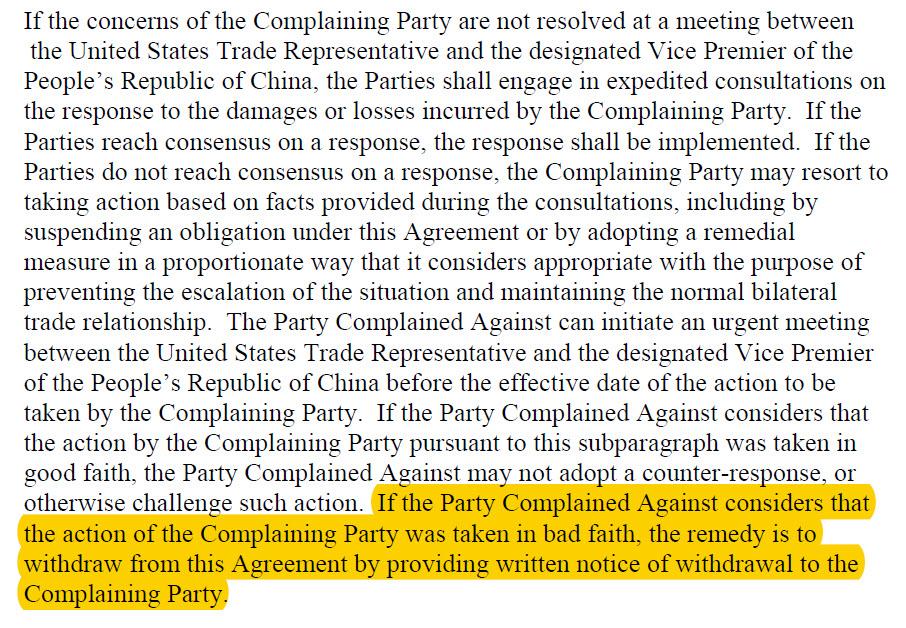
  • If the Parties do not reach consensus on a response, the Complaining Party may resort to taking action based on facts provided during the consultations, including by suspending an obligation under this Agreement or by adopting a remedial measure in a proportionate way that it considers appropriate with the purpose of preventing the escalation of the situation and maintaining the normal bilateral trade relationship.
  • If the Party Complained Against considers that the action of the Complaining Party was taken in bad faith, the remedy is to withdraw from this Agreement by providing written notice of withdrawal to the Complaining Party.

Financial Services

  • China shall allow U.S. financial services suppliers to apply for asset management company licenses that would permit them to acquire non-performing loans directly from Chinese banks, beginning with provincial licenses. When additional national licenses are granted, China shall treat U.S. financial services suppliers on a non-discriminatory basis with Chinese suppliers, including with respect to the granting of such licenses.
  • No later than April 1, 2020, China shall remove the foreign equity cap in the life, pension, and health insurance sectors and allow wholly U.S.-owned insurance companies to participate in these sectors. China affirms that there are no restrictions on the ability of U.S.-owned insurance companies established in China to wholly own insurance asset management companies in China.
  • “No later than April 1, 2020, China shall eliminate foreign equity limits and allow wholly U.S.-owned services suppliers to participate in the securities, fund management, and futures sectors.
  • China affirms that a wholly U.S.-owned credit rating services supplier has been allowed to rate domestic bonds sold to domestic and international investors, including for the interbank market. China commits that it shall continue to allow U.S. service suppliers, including wholly U.S.-owned credit rating services suppliers, to rate all types of domestic bonds sold to domestic and international investors. Within three months after the date of entry into force of this Agreement, China shall review and approve any pending license applications of U.S. service suppliers to provide credit rating services.
  • Each Party shall allow a supplier of credit rating services of the other Party to acquire a majority ownership stake in the supplier’s existing joint venture.”

Full deal text: (pdf link)

https://www.zerohedge.com/economics/here-full-text-phase-one-us-china-trade-deal


January 14, 2020

REACH Impacts Epoxies

The far-reaching consequences of REACH

As the EU REACH legislation enters its final phase, the financial, administrative, occupational health and safety, and R&D challenges for companies in the electrical manufacturing industry are greater than ever before. EEIM secretary Norbert Rudat and epoxy resins expert Ulrich Maßen share their view.

2016 05 18 113910

First introduced in 2007, REACH (the registration, evaluation and authorisation of chemicals) is arguably the most important EU legislation in the last 25 years, affecting all producers, importers and downstream users of chemicals in industries as diverse as automotive and textiles manufacturing. The legislation aims to protect human health and the environment and encourage innovation in the chemicals industry through the replacement of hazardous chemicals with safer new ones – but comes at considerable cost. The European Commission estimated that it would cost the chemicals industry a maximum of 5.2 billion euros over 11 years. Other authorities placed the figure as high as 12.8 billion.

Under REACH, all chemicals produced and imported in the EU must undergo comprehensive testing, such as for carcinogenic, mutagenic or reprotoxic effects, and be registered with the European Chemicals Agency (ECHA) in Helsinki. This process can take several years and requires all businesses registering the same substance to share data to limit animal testing and compensate each other financially. During the first registration phase in 2010 for chemicals produced or imported in quantities above 1,000 tonnes per annum, 3,400 substances were registered accompanied by 20,000 dossiers. In 2018, when chemicals with a quantity of 1 to 100 tonnes per annum must be registered, it is expected that applications will be made for 25,000 substances accompanied by 70,000 dossiers.

“This volume of work represents a huge financial and administrative burden for the chemicals industry but also many of our members in the European Electrical Insulation Manufacturers association, who import chemicals and produce their own formulations, as well as manufacturing electrical insulation products,” says Dipl. Ing. Norbert Rudat, EEIM secretary. “It may be that many companies, especially smaller ones, go out of business simply due to the cost involved.”

For electrical insulation manufacturers and their customers – including manufacturers of electric motors, generators, transformers, white goods and consumer electronics – there is also a concern over materials availability. “Depending on whether certain authorisations are granted and timescales are met, we might not have our regular materials available to us and alternatives will need to be found,” he says.

Vital materials under threat 

Hexahydrophthalic anhydride (HHPA) and methylhexahydrophthalic anhydride (MHHPA), two hardeners widely used in epoxy resin, for example, may soon become illegal in electrical manufacturing. Following a report brought to ECHA by the Dutch chemicals authority in 2012, ECHA has proposed that these anhydrides be placed on the REACH authorisation list as Substances of Very High Concern (SVHC) (annex XIV) due to their potential as respiratory sensitisers. The proposal was made in November 2015 and three months were given for the industry to comment. A final decision will be taken in the autumn.

“This proposal has been like an earthquake in the epoxy electrical insulation industry,” says Dr. Ulrich Maßen, founder of UM Thermoset Consulting and former chairman of the EEIM polymers group. “I support REACH and the safe handling of chemicals but pretty much the entire industry feels this proposal is unjustified. The industry has been handling these anhydrides for more than 50 years and the effect has been known for decades. Extreme caution is taken with them and to my knowledge in Europe there is not a single person with lowered respiratory functionality related to the work with anhydrides since 10 years. Several companies are working in closed systems so the risk of inhalation is almost zero in this case. I also do not believe they should be placed in the same category as substances that can kill or cause life-limiting conditions. If a person were to become sensitised, they would need to be withdrawn from the factory but otherwise their life would continue as normal.”

A number of the electrical manufacturing industry’s biggest names have formed a taskforce to oppose ECHA’s classification of HHPA and MHHPA as SVHC. Alternatives are also being investigated.

“One option is to find alternative curing agents while maintaining the epoxies. Another is to change the chemistry entirely, replacing epoxies with polyesters, polyurethanes or silicones. But for some applications there are no alternatives and there is a high probability that manufacturing will move to Asia with the finished product coming back to Europe. Passing risk onto workers in other parts of the world – with possibly lower safety standards – is not at all intended by REACH,” he says.

Staying legal

As well as materials availability, occupational health and safety compliance is also an important issue for the entire supply chain. Even if companies do not need to register chemicals themselves, they need to ensure that their suppliers have provided all the necessary paperwork and that their operations comply with the exposition scenarios detailed.

“Safety data sheets used to be quite brief – just five pages or so. Now they can contain as many as 300 pages with specific scenarios and conditions of how each chemical has to be used. You cannot use them however you like or you will be breaking the law,” Rudat says.

Outside of REACH, any companies handling chemicals must also comply with the EU CLP (classification, labelling and packaging) legislation, which replaced the Dangerous Substances and Dangerous Preparations Directives repealed in June 2015, as well as the IED (Industrial Emissions Directive), which governs emissions from factories. Companies may need to make significant investments to ensure operations are legal and that employees and the environment are sufficiently protected.

“The entire supply chain needs to take regulation very seriously and have trained people in-house or use expertise from third party consultants. It’s not only important for staying legal but for also the development and launch of profitable new products. R&D teams need to consider whether a component material will require costly authorization, whether it might become unavailable, or whether it requires special measures and investments to handle it. These are decisions that can spell success or failure for a business,” Rudat concludes

http://www.processindustrymatch.com/technology/2819-the-far-reaching-consequences-of-reach