The Urethane Blog
October 3, 2023
Mon, Oct 2, 4:40 PM (17 hours ago) to me 

A Special Event At PFA’s Fall Meeting New FPF Hall Of Fame Honorees 
PFA is pleased to announce that the its Executive Committee has voted to induct two longtime industry professionals into the Flexible Polyurethane Foam Hall of Fame. The induction ceremony will take place during PFA’s General Business Meeting on the morning of Thursday, November 2.
Our honorees are Bill Gollnitz of Plastomer Corporation and Dr. Hamdy Khalil of The Woodbridge Group. Most of you know these two individuals, and many of you have worked with them (or have been mentored by them) in their decades of service.
Gollnitz has spent the past 20 years of his career as technical director at Plastomer Corporation, a family owned and operated business founded in 1954 by Walter Baughman, one of PFA’s founders and also a member of the Flexible Polyurethane Foam Hall of Fame.
Prior to Plastomer, Gollnitz spent seven years in business group management positions with ARCO Chemical and seven years with Olin Corporation. He began his career in the foam industry with Firestone Foam. He holds a B.A. in chemistry from Lipscomb University in Tennessee, and an MBA from Bryant University in Rhode Island.
He is a Past President of PFA and subsequently served on the Executive Committee.
Dr. Khalil is the Senior Global Director for Advanced Technologies Research and Product Development and Innovation for the Woodbridge Foam Corporation, a major manufacturer of flexible molded polyurethane foam for the global automotive industry. Dr. Khalil pioneered the introduction and commercialization of renewable materials into the polyurethane chemistry used in interior automotive parts manufacturing. Under his guidance, Woodbridge became one of the early adopters of green technologies using biobased polyols. Khalil also played a leading role in ongoing efforts to harmonize OEM specifications for VOC emissions from plastics in auto interiors.
Dr. Khalil served on the Board of Directors of Ontario Bio Auto Council, and the Center for Research and Innovation in the Bio Economy ( CRiBE). He acted as an advisor to the National Research Council of Canada on renewable and sustainable materials technology. Dr. Khalil received the Outstanding Leadership From the Center For the Polyurethane Industry (CPI), and the Technical Leadership Award from The Nano Division of the Technical Association for the Pulp and Paper Industry (TAPPI). He was selected to the Advisory Panel For Arbora Nano for the Advancement of Lignocellulosic Products. Dr. Khalil received the “Le Sueur Memorial Award” from the Society of Chemical Industry for Outstanding Industrial Contribution.
His passion is to mentor the new generation of scientists and engineers.
Prior to Woodbridge, Dr. Khalil held positions at Labatt’s in the pharmaceutical Division, for PolySar Corporation as analytical laboratory supervisor and as Senior Technical Manager for BFGoodrich.
He holds a BSc with majors in chemistry and physics from the University of Alexandria in Egypt, an MSc in Nutritional Biochemistry from Cairo University in Egypt and a PhD from Windsor University. He has long served on PFA’s Executive Committee and taken on other roles in the association.
Please join us on Thursday morning to honor these two legends of our industry.
RSVP for Events And Register for Fall Meeting Here Deadline To Make Hotel Reservations At PFA Preferred Rate: October 6
IMPORTANT: If you haven’t made your room reservations yet, please do so before October 6, when PFA’s room bloc (and special rate) expires. (Note: on the Omni website, room rates are in Canadian dollars.)
Meeting and Room Registration: https://www.pfa.org/2023-fall-meetingPFA Fall Meeting Social/Networking Events 
Be sure to RSVP for our networking events (free to meeting participants). Note: the Distillery Tour is limited to 30 people, so sign up soon.
RSVP for Events And Register for Fall Meeting Here
October 2, 2023
PCC makes progress on plan for Oxyalkylates production in the USA
Duisburg, September 15, 2023. PCC is making progress on its plan to establish an Oxyalkylates production in the USA, thereby advancing the expansion of the PCC Group’s core business areas in the important US market. PCC has now reached a milestone at the possible location in Bay City, Matagorda County, Texas, on the Gulf of Mexico. On September 15, 2023, the project company PCC Chemicals Corporation signed a terminable lease agreement with the Port of Bay City for a property in the immediate vicinity of the port there. Although the site selection and final investment decision is far from over, the contract with the port ensures that PCC Chemicals Corporation has the opportunity to intensively examine an investment at this location as part of due diligence.
“Working with the Port of Bay City and fellow entities over these past two years have been a most enjoyable experience,” said Dr. Peter Wenzel, CEO of PCC SE, and emphasized: “We still have many several project milestones to achieve and will require additional partnerships for the economic development of the project.”

Contract signing between PCC and Port of Bay City on September 15, 2023. Dr. Peter Wenzel, CEO of PCC SE (3rd from left), Waldemar Preussner, Chairman of the Supervisory Board of PCC SE (6th from left), and Peter Berger, Head of Legal Department (7th from left), together with representatives from Bay City.
Bay City Port Director George Harrison said: “This is a proud day for Matagorda County. We’ve been pursuing PCC Chemicals Corporation for two years and it feels good to secure their lease agreement.”
The region at the port of Bay City on the Gulf of Mexico is a possible location for a planned new production of Oxyalkylates (special non-ionic surfactants and polyether polyols) in the USA. In 2022, PCC SE founded the project company PCC Chemicals Corporation which is examining the development and construction of petrochemical production plants in the USA. PCC is currently setting up an Oxyalkylates production in Malaysia in a joint venture with PETRONAS Chemicals Group Berhad to cover the Asian market. The planned project in the USA would further advance the expansion of the PCC´s core business in the Group segments Polyols & Derivatives and Surfactants & Derivatives in the US market, too.

Contract signing between PCC and Port of Bay City on September 15, 2023. Dr. Peter Wenzel, CEO of PCC SE (3rd from left), Waldemar Preussner, Chairman of the Supervisory Board of PCC SE (2nd from left), and Peter Berger, Head of Legal Department (left), together with representatives from Bay City.
Profile of PCC SE
Headquartered in Duisburg, Germany, PCC SE is the parent and investment holding company of the globally active PCC Group with its approx. 3,400 employees. Its Group companies have core competencies in the production of chemical feedstocks and specialty chemicals, silicon and silicon derivatives, and in container logistics. An investor committed to the longer term, PCC SE concentrates on continuously increasing the enterprise value of its portfolio companies through sustainable investments and the ongoing creation of new value. The largest chemical producers of the PCC Group are PCC Rokita SA, a major chlorine manufacturer and Eastern Europe’s leading producer of polyols, and PCC Exol SA, one of Europe’s most advanced surfactant manufacturers. PCC BakkiSilicon hf. operates in Iceland one of the world’s most modern and climate-friendly silicon production facilities. PCC was founded in 1993 by Waldemar Preussner, sole shareholder of PCC SE, who today holds the position of Chairman of the Supervisory Board. The PCC Group generated consolidated sales of around € 1.3 billion and earnings before interest/financial result, taxes, depreciation and amortization (EBITDA) of some € 292.0 million in fiscal 2022, with capital expenditures in the same year amounting to around € 116.3 million.
October 1, 2023
These Are The World’s Largest Oil Producers
by Tyler Durden
Saturday, Sep 30, 2023 – 07:35 AM
In 2022 oil prices peaked at more than $100 per barrel, hitting an eight-year high, after a full year of turmoil in the energy markets in the wake of the Russian invasion of Ukraine.
Oil companies doubled their profits and the economies of the biggest oil producers in the world got a major boost.
But which countries are responsible for most of the world’s oil supply? Using data from the Statistical Review of World Energy by the Energy Institute, Visual Capitalist’s Pallavi Rao and Christina Kostandi visualized and ranked the world’s biggest oil producers.
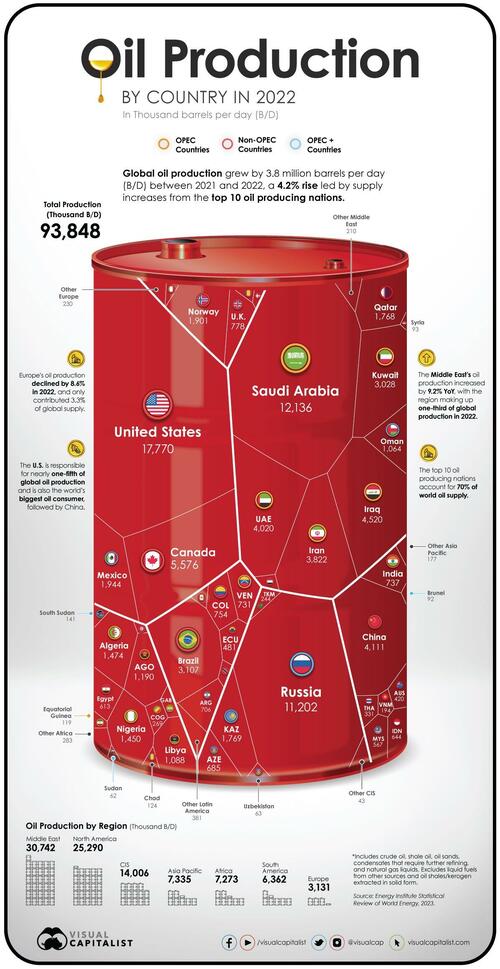
Ranked: Oil Production By Country, in 2022
The U.S. has been the world’s biggest oil producer since 2018 and continued its dominance in 2022 by producing close to 18 million barrels per day (B/D). This accounted for nearly one-fifth of the world’s oil supply.
Almost three-fourths of the country’s oil production is centered around five states: Texas, New Mexico, North Dakota, Alaska, and Colorado.
We rank the other major oil producers in the world below.
| Rank | Country | 2022 Production (Thousand B/D) | YoY Change | Share of World Supply |
|---|---|---|---|---|
| 1 | 🇺🇸 U.S. | 17,770 | +6.5% | 18.9% |
| 2 | 🇸🇦 Saudi Arabia | 12,136 | +10.8% | 12.9% |
| 3 | 🇷🇺 Russia | 11,202 | +1.8% | 11.9% |
| 4 | 🇨🇦 Canada | 5,576 | +3.0% | 5.9% |
| 5 | 🇮🇶 Iraq | 4,520 | +10.2% | 4.8% |
| 6 | 🇨🇳 China | 4,111 | +2.9% | 4.4% |
| 7 | 🇦🇪 UAE | 4,020 | +10.4% | 4.3% |
| 8 | 🇮🇷 Iran | 3,822 | +4.6% | 4.1% |
| 9 | 🇧🇷 Brazil | 3,107 | +3.9% | 3.3% |
| 10 | 🇰🇼 Kuwait | 3,028 | +12.0% | 3.2% |
| 11 | 🇲🇽 Mexico | 1,944 | +0.9% | 2.1% |
| 12 | 🇳🇴 Norway | 1,901 | -6.3% | 2.0% |
| 13 | 🇰🇿 Kazakhstan | 1,769 | -2.0% | 1.9% |
| 14 | 🇶🇦 Qatar | 1,768 | +1.8% | 1.9% |
| 15 | 🇩🇿 Algeria | 1,474 | +8.9% | 1.6% |
| 16 | 🇳🇬 Nigeria | 1,450 | -11.2% | 1.5% |
| 17 | 🇦🇴 Angola | 1,190 | +1.1% | 1.3% |
| 18 | 🇱🇾 Libya | 1,088 | -14.3% | 1.2% |
| 19 | 🇴🇲 Oman | 1,064 | +9.6% | 1.1% |
| 20 | 🇬🇧 UK | 778 | -11.0% | 0.8% |
| 21 | 🇨🇴 Colombia | 754 | +2.4% | 0.8% |
| 22 | 🇮🇳 India | 737 | -3.8% | 0.8% |
| 23 | 🇻🇪 Venezuela | 731 | +8.1% | 0.8% |
| 24 | 🇦🇷 Argentina | 706 | +12.4% | 0.8% |
| 25 | 🇦🇿 Azerbaijan | 685 | -5.6% | 0.7% |
| 26 | 🇮🇩 Indonesia | 644 | -6.9% | 0.7% |
| 27 | 🇪🇬 Egypt | 613 | +0.8% | 0.7% |
| 28 | 🇲🇾 Malaysia | 567 | -1.7% | 0.6% |
| 29 | 🇪🇨 Ecuador | 481 | +1.7% | 0.5% |
| 30 | 🇦🇺 Australia | 420 | -5.2% | 0.4% |
| 31 | 🇹🇭 Thailand | 331 | -17.5% | 0.4% |
| 32 | 🇨🇩 Congo | 269 | -1.7% | 0.3% |
| 33 | 🇹🇲 Turkmenistan | 244 | +1.0% | 0.3% |
| 34 | 🇻🇳 Vietnam | 194 | -1.2% | 0.2% |
| 35 | 🇬🇦 Gabon | 191 | +5.4% | 0.2% |
| 36 | 🇸🇸 South Sudan | 141 | -7.6% | 0.2% |
| 37 | 🇵🇪 Peru | 128 | +0.5% | 0.1% |
| 38 | 🇹🇩 Chad | 124 | +6.2% | 0.1% |
| 39 | 🇬🇶 Equatorial Guinea | 119 | -9.2% | 0.1% |
| 40 | 🇸🇾 Syria | 93 | -2.7% | 0.1% |
| 41 | 🇮🇹 Italy | 92 | -7.9% | 0.1% |
| 42 | 🇧🇳 Brunei | 92 | -13.8% | 0.1% |
| 43 | 🇾🇪 Yemen | 81 | -2.4% | 0.1% |
| 44 | 🇹🇹 Trinidad & Tobago | 74 | -3.6% | 0.1% |
| 45 | 🇷🇴 Romania | 65 | -6.2% | 0.1% |
| 46 | 🇩🇰 Denmark | 65 | -1.6% | 0.1% |
| 47 | 🇺🇿 Uzbekistan | 63 | -0.9% | 0.1% |
| 48 | 🇸🇩 Sudan | 62 | -3.3% | 0.1% |
| 49 | 🇹🇳 Tunisia | 40 | -12.9% | 0.0% |
| 50 | Other CIS | 43 | +4.4% | 0.0% |
| 51 | Other Middle East | 210 | +1.2% | 0.2% |
| 52 | Other Africa | 283 | -3.4% | 0.3% |
| 53 | Other Europe | 230 | -20.5% | 0.2% |
| 54 | Other Asia Pacific | 177 | -10.6% | 0.2% |
| 55 | Other S. & Cent. America | 381 | +68.5% | 0.4% |
| Total World | 93,848 | +4.2% | 100.0% |
Behind America’s considerable lead in oil production, Saudi Arabia (ranked 2nd) produced 12 million B/D, accounting for about 13% of global supply.
Russia came in third with 11 million B/D in 2022. Together, these top three oil producing behemoths, along with Canada (4th) and Iraq (5th), make up more than half of the entire world’s oil supply.
Meanwhile, the top 10 oil producers, including those ranked 6th to 10th—China, UAE, Iran, Brazil, and Kuwait—are responsible for more than 70% of the world’s oil production.
Notably, all top 10 oil giants increased their production between 2021–2022, and as a result, global output rose 4.2% year-on-year.
Major Oil Producing Regions in 2022
The Middle East accounts for one-third of global oil production and North America makes up almost another one-third of production. The Commonwealth of Independent States—an organization of post-Soviet Union countries—is another major regional producer of oil, with a 15% share of world production.
| Region | 2022 Production (Thousand B/D) | YoY Change | Share of World Supply |
|---|---|---|---|
| Middle East | 30,743 | +9.2% | 32.8% |
| North America | 25,290 | +5.3% | 27.0% |
| CIS | 14,006 | +0.9% | 14.9% |
| Africa | 7,043 | -3.5% | 7.5% |
| Asia Pacific | 7,273 | -1.4% | 7.8% |
| South & Central America | 6,361 | 7.2% | 6.8% |
| Europe | 3,131 | -8.6% | 3.3% |
What’s starkly apparent in the data however is Europe’s declining share of oil production, now at 3% of the world’s supply. In the last 20 years the EU’s oil output has dropped by more than 50% due to a variety of factors, including stricter environmental regulations and a shift to natural gas.
Another lens to look at regional production is through OPEC members, which control about 35% of the world’s oil output and about 70% of the world’s oil reserves.
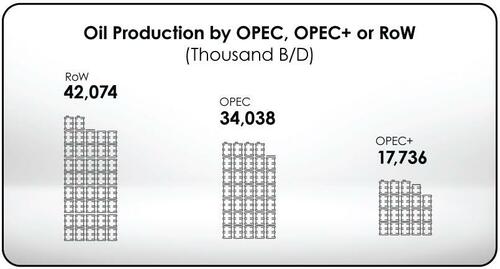
When taking into account the group of 10 oil exporting countries OPEC has relationships with, known as OPEC+, the share of oil production increases to more than half of the world’s supply.
Oil’s Big Balancing Act
Since it’s the very lifeblood of the modern economy, the countries that control significant amounts of oil production also reap immense political and economic benefits. Entire regions have been catapulted into prosperity and wars have been fought over the control of the resource.
At the same time, the ongoing effort to pivot to renewable energy is pushing many major oil exporters to diversify their economies. A notable example is Saudi Arabia, whose sovereign wealth fund has invested in companies like Uber and WeWork.
However, the world still needs oil, as it supplies nearly one-third of global energy demand.
https://www.zerohedge.com/energy/these-are-worlds-largest-oil-producers
September 28, 2023
Shepherd’s Exclusive Partnership with Everchem
As a leading global metal chemistry manufacturer, Shepherd relies on key partnerships to help boost product awareness and sales. Everchem is one such partner, deserving not only recognition but gratitude for its commitment to marketing Shepherd’s BiCAT polyurethane catalyst product line to customers in need of catalysts for polyurethanes, spray foam, coatings and more.
Everchem is an exclusive partner for Shepherd’s BiCAT® polyurethane catalyst product line in United States and Canada. The partnership provides downstream customers with access to the broad range of BiCAT® products, an array of packaging options, closer-to-market customer service, and an unmatched level of expertise within the polyurethane market that only Everchem provides.
At its core, Everchem is a sales, marketing, and technology driven company that operates within the North American marketplace. Its core markets served include urethanes, epoxy, UV curing, and industrial chemical raw materials. Everchem prides itself on providing invaluable market intel and superior service which creates mutual benefit and value to customers and suppliers alike. The company’s lean business model and strong supplier relationships increase its responsiveness to customer needs with lower costs and less bureaucracy than many larger organizations can offer.
The Future of BiCAT Polyurethane Catalysts is Bright
Shepherd is considered a market leader when it comes to current and next-generation polyurethane catalysts. It was the first to develop hydrolytically stable bismuth carboxylate chemistry for use in HFO blowing agents, which reduces VOC’s and improves curing rates amongst other enhancements. This technological breakthrough earned Shepherd the 2016 CPI (The Center for The Polyurethanes Industry) Polyurethane Innovation Award.
Shepherd has experienced healthy growth in the sales of its BiCAT® product line through Everchem since our partnership was announced in September 2019. Through this arrangement, BiCAT® products are finding new markets, new customers, and new applications which only enhance the historically strong Shepherd brand.
Our Shared Philosophy
The mutually shared philosophy upon which Everchem and Shepherd respectively and collectively do business is a strategic difference maker when it comes to serving customers. We work together on a platform of transparency, which has yielded fantastic results for both companies since the inception of the partnership.
Everchem a wonderful steward of the Shepherd brand and our confidence in their capability and reliability is second to none. The future only provides additional opportunity for further strengthening of this relationship between the two companies.
If you’re in the market for BiCAT polyurethane catalysts, we’d love to work with you. Please contact us online or by calling 513-731-1110.
www.shepchem.com/news
September 28, 2023
Trucking sees ‘green shoot’ in August
But capacity growth in private fleets could slow recovery, ACT says
· Wednesday, September 27, 2023

FreightWaves
Trucking sees ‘green shoot’ in August
4 min
A Wednesday report from ACT Research showed the trucking cycle may be “approaching [a] turning point.” All five components of ACT’s For-Hire Trucking Index showed improvement from a carrier’s perspective during August, with volumes logging a large turnaround.
ACT’s volume index jumped 12.3 percentage points to 54.4 on a seasonally adjusted basis from July to August.
A reading above 50 indicates growth while one below 50 implies contraction. The report was quick to caution that the measure is one of breadth, with a large number of fleets seeing an increase but not necessarily a pronounced one.
“So, we wouldn’t suggest this means the freight downturn is over, but it is a considerable ‘green shoot’ that suggests the retail inventory destock is playing out,” said Tim Denoyer, vice president and senior analyst at ACT.
August produced the highest reading for the volume index since early 2022 and a level well above the mid-30s to mid-40s readings displayed throughout the spring. Inventory levels approaching a better balance and a reduction in import declines to the West Coast were cited as contributors.
“Additionally, consumers remain a surprising economic upside, even in the face of sustained high, if moderating, inflation, and are reverting to more goods spending after the service spending boom coming out of the pandemic,” Denoyer said. “Though, still-high inflation and decreasing savings are headwinds to future consumer spending.”
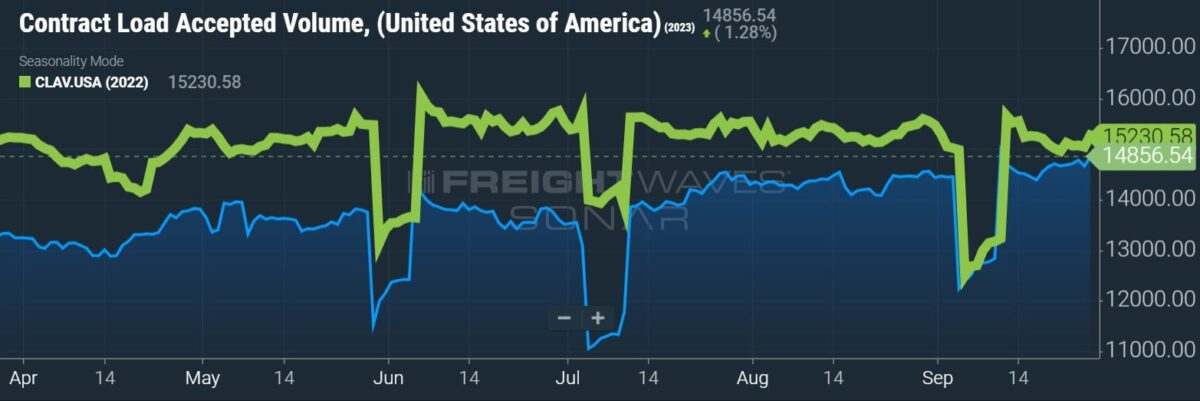
ACT’s capacity index was in modest contraction territory for a second straight month at 48.9. The data set was down one point seasonally adjusted from July.
Those surveyed included mostly large, for-hire fleets. However, the report noted that Class 8 tractor sales remain near all-time highs, which is indicative of capacity being added by private fleets as well as small carriers buying secondhand equipment from larger fleets.
With better volumes and a modest contraction in capacity, the supply-demand balance index jumped 13.4 points to 55.6 in August on a seasonally adjusted comparison. This was the first reading above 50 in 18 months.
Truck pricing remained under pressure during the month at 39.3. The report noted a “less worse” trend as the index improved 2 points from July and continued to improve from the record low of 30.5 in April. ACT expects a soft pricing environment to linger in the near term.
“Though growth in private fleets may be delaying the recovery in rates, the trucking market appears to be past the nadir, and the improved supply/demand balance this month suggests more less worse results to come,” Denoyer said.
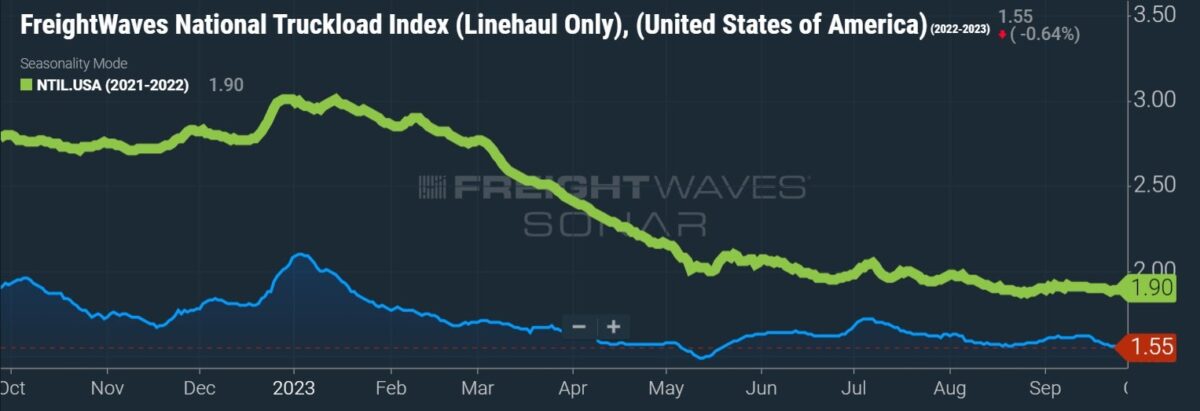
Other findings from the report showed fleet productivity (measured as miles per tractor) increased 6.1 points seasonally adjusted to 53.6 in August. However, 56.4% of survey respondents said they would be buying new equipment in the next three months, which could weigh on the metric. Buying intentions were roughly 7 points below the prior-year level as many of the big, for-hire fleets have largely caught up on their replacement cycles, which were extended during the pandemic.
“We expect fleet ordering intentions to subdue as contract rates are under severe pressure and pent-up demand is fading following capacity constraints the last two years,” Denoyer said.
The driver availability index remained elevated at 59.5 during August. The loosening in the driver labor market was in part credited to spot-market-dependent operators leaving for more stable working conditions at larger fleets.
“Driver availability also remains extraordinarily good for the diverse group of for-hire fleets in our survey,” Denoyer said. “In our view, this probably isn’t enough yet to turn the tide in the spot market, but the market rebalancing is progressing and this should be a good leading indicator of better times ahead.”
 Everchem Updates Archive
 Sign Up for Email Updates