The Urethane Blog
June 10, 2022
Wanhua Chemical Will Launch Two New Projects and Increase the Layout of New Materials!
ECHEMI 2022-06-10
On June 6, Wanhua Chemical announced on its official website the draft environmental impact reports of two projects, one for the special isocyanate project and the other for the project with an annual output of 30,000 tons of emollients.
Special Isocyanate Project
Project Name: Special Isocyanate Project of Wanhua Chemical Group Co., Ltd.
Project site: Wanhua Yantai Industrial Park, Yantai Chemical Industrial Park, Economic and Technological Development Zone, Yantai City, Shandong Province
Project Overview: The main production units of this project include HMDA/BAC units (HMDA and 1,3-BAC can be switched for production), XDI/H6XDI units (XDI and H6XDI can be switched between production), HMDI Phase II units and For the exhaust gas decomposition and absorption device, the corresponding public works, auxiliary works, storage and transportation works and environmental protection works are built.
HMDA is hexamethylene diamine. In addition to reacting with adipic acid to synthesize nylon 66, hexamethylene diamine can also be used as an intermediate to synthesize HDI;
1,3-BAC is 1,3-cyclohexanedimethylamine;
XDI is m-xylylene isocyanate, which is an ADI (aliphatic isocyanate) containing a benzene ring;
H6XDI is hydrogenated xylylene diisocyanate, which belongs to a kind of ADI;
HMDI is 4,4′-dicyclohexylmethane diisocyanate.
Project with an annual output of 30,000 tons of emollients
Project name: Wanhua Chemical (Penglai) Co., Ltd. project with an annual output of 30,000 tons of emollients
Project site: Penglai Chemical Industry Park, Beigou Town, Penglai District, Yantai City, Shandong Province
Project Overview: This project mainly builds a 40,000-ton/year acetaldehyde plant and a 30,000-ton/year 1,3-butanediol plant, supporting auxiliary projects, storage and transportation projects, environmental protection projects, etc.; main public works And some environmental protection projects rely on existing ones.
High-performance new material integration and supporting projects
It is reported that the 30,000 tons/year emollient is part of the high-performance new material integration and supporting project of Wanhua Chemical Penglai Industrial Park.
On April 8, 2022, Wanhua Chemical announced that in order to realize the deep extension of the company’s chemical industry chain, undertake the transformation of independent research and development innovation achievements, and build a first-class integrated manufacturing base for green low-carbon high-end fine chemicals and new materials, the company plans to Through the holding subsidiary Wanhua Chemical (Penglai) Co., Ltd. to build a high-performance new material integration and supporting project in Wanhua Chemical Penglai Industrial Park.
Specifically, the planned project plans to cover an area of about 3,310 mu, mainly constructing 900,000 tons/year propane dehydrogenation, 500,000 tons/year polyether, 400,000 tons/year POCHP, 300,000 tons/year polypropylene, 300,000 tons/year polypropylene, 300,000 tons/year /year EO, 300,000 tons/year EOD, acrylic acid and ester (160,000 tons/year acrylic acid, 160,000 tons/year butyl acrylate, 20,000 tons/year octyl acrylate), 200,000 tons/year carbonate ester, 3 10,000 tons/year of emollient, air separation and other devices, as well as supporting public works and auxiliary facilities, etc.
The project plans to invest 1.5 billion yuan in 2022, which has been included in the company’s overall investment plan for 2022. The construction period of the project is planned from 2022 to 2025, and it is expected to start production in June 2024.
Wanhua Chemical actively deploys new materials
“Environmental protection is related to the living environment of human beings in the future, and the whole world is paying attention. There will be a large market for new materials and new technologies required by the environmental protection industry.” said Liao Zengtai, Secretary of the Party Committee and Chairman of Wanhua Chemical Group, in the past three years, Wanhua has invested more resources in the field of new materials.
In terms of polyurethane materials, continue to promote the upgrading of MDI technology and the stable and orderly development of the industry, expand the variety of polyurethane materials, and actively explore the market demand in new downstream areas of polyurethane, and increase the use of polyurethane in building insulation, pavement materials, wood-based panels and other new applications. development efforts to meet the needs of consumption upgrades.
In terms of new chemical materials, carry out research on high-end polyolefins, high-performance engineering plastics, high-performance film materials, degradable plastics, electronic chemicals and other products, and provide key materials for strategic emerging industries such as new energy, new infrastructure, and high-end equipment manufacturing. support. During the “14th Five-Year Plan” period, focus on promoting the research and development of POE complete sets of engineering technology, the industrialization process of nylon 12, the development of high-refractive, bio-based and other special PC manufacturing technologies, the research on the trinity of key raw materials, technology and performance of degradable plastics, and high-end separation membrane materials Key technology research, the implementation of large-scale industrialization.
In terms of fine chemicals, develop water-based surface materials, promote the water-based process of polymer surface materials in my country in various fields such as building materials, industrial coatings, adhesives, and nursing, and promote the transformation and upgrading of traditional industries; carry out research on the utilization of biomass resources, From corn starch, biological waste and natural oils as starting materials, various bio-based chemicals are prepared through chemical transformation and biological fermentation technology.
In 2021, Wanhua Chemical will invest 3.168 billion yuan in research and development, mainly focusing on high-end chemical new materials and solutions, emerging materials and other new business sectors technology incubation investment, such as carbon neutralization related technologies, polyurethane foam degradation and recycling, new energy energy storage And battery materials, separation and purification and other research and development projects. In the field of polyurethane, the sixth-generation MDI technology was successfully applied in Yantai MDI plant, achieving a stable operation of 1.1 million tons per year.
In the future, Wanhua Chemical will continue to increase investment in olefins and downstream industrial chains by taking advantage of the integrated industrial chain of existing industrial parks, vigorously develop Wanhua’s high-performance polyolefin material platform, and promote the transformation and upgrading of China’s polyolefin industrial chain. Relying on the olefin industry chain platform, we will further strengthen and expand the modified plastics business, expand the high-end application downstream of the material business, and continue to develop and advance in the field of new materials.
June 10, 2022
Trade Association Coalition Completes Quarterly Market Index Survey for Reroofing
Trade Association Coalition Completes Quarterly Market Index Survey for Reroofing
Arlington, VA (May 11, 2022) – A coalition of industry trade associations representing contractors, consultants and manufacturers in the U.S. and Canada has completed its Q1 2022 Market Index Survey for Reroofing. The survey takes the pulse of the reroofing industry on a quarterly basis and serves as a regular barometer of the industry’s business conditions.
One hundred ninety-five respondents completed the eight-question survey during a two-week period in April 2022 with approximately 90 percent of responses coming from roofing contractors and 10 percent coming from roof consultants. Approximately 86 percent of respondents indicated that their business is primarily low slope or a blend between low slope and steep slope while 15 percent of respondents are engaged in steep slope only.
The survey results indicate steady or generally improving market conditions for the reroofing industry. Some topline excerpts of the survey are (total may not equal 100 due to rounding):
- Customer Inquiries: Forty-six percent of respondents indicated their customer inquiries increased during the first quarter of 2022 compared with the same quarter in 2021. Twenty percent of respondents reported a decrease in customer inquiries during the same period, and 36 percent indicated no change in activity.
- Project Contacts: Forty-six percent of respondents reported an increase in project contracts during the first quarter of 2022 compared with the same quarter in 2021. Twenty-two percent of respondents reported a decrease in project contracts during the same period, and 32 percent indicated no change in activity.
- Project Backlog: Forty-six percent of all respondents reported a project backlog of three months or longer as of April 2022 compared to 51 percent of respondents that reported a similar backlog in January 2022.
- Customer Inquiries Index: The Customer Inquiries Index for the total industry dropped slightly to 62.8 for Q1 2022 compared to 63.8 for Q4 2021. The index is based on a 0 to 100 scale. A score of 50 or higher suggests expansion or optimism, while a value below 50 indicates contraction or pessimism.
Project Contracts Index: The Project Contracts Index for the total industry rose to 62.1 for Q1 2022 compared to 61.1 for Q4 2021. The index is based on a 0 to 100 scale. A score of 50 or higher suggests expansion or optimism, while a value below 50 indicates contraction or pessimism.
The complete results of the Quarterly Market Index Survey for Reroofing are available to those who participate in the survey via an online dashboard that enables users to filter results by region and other metrics. Any contractor or consultant who wants to participate in next quarter’s brief survey can sign up for a notification at http://bit.ly/37ank7D.
For media inquiries contact Mittie Rooney.
https://www.polyiso.org/page/Q1MarketIndexSurveyforReroofing
June 10, 2022
“The Demand For Random Crap Suddenly Vanished, Taking Everyone By Surprise”
by Tyler DurdenThursday, Jun 09, 2022 – 07:00 PM
By Rachel Premack of FreightWaves
At the beginning of 2022, things were economically pretty peachy. Too peachy, one could argue: People were buying so much stuff that our ports and terminals could barely handle the massive import volume. Companies were desperate for someone, anyone, to come work for them. And movie theaters, offices, planes and other locales many eschewed during the pandemic were poised to bounce back; the omicron wave appeared mild compared to previous bouts of the coronavirus.
The vibes were good. Now, the vibes are completely terrible.
More and more spooky recession signs are cropping up seemingly every day, ranging from cooling housing starts to meek GDP growth, all amid the Fed tightening rates. Record-setting inflation – particularly for gas – is only adding to the premonitions, as Vox’s Emily Stewart wrote Wednesday in a piece aptly titled “The bad vibes economy.” But even as things feel bad, many still cast doubt that we’re headed for a recession this year, pointing out persistently low unemployment and the fact that certain indicators, while not as strong as the beginning of this year, are still unusually healthy.
No one is shocked that what goes up must go down. What’s shocking us all is how quickly the situation changed.
Glum transportation indicators confirm the bad vibes
A downturn, if not a full-on recession, is clear in the transportation world. While the rest of the economy debates whether things are that bad, it’s been clear for months to logistics providers that the situation has worsened — and the velocity of that change is still stunning.
The cost to move a container from Asia to a major port in North America or Europe has sunk by 23% since the beginning of this year, according to maritime research firm Drewry. Spot rates have plummeted even faster; marketplace Freightos said rates from China to the West Coast are down 38% month-over-month. FreightWaves forecast this week that ocean shipping volumes will “drop off a cliff” by this summer, based on slumping bookings out of China.
Spot van rates in trucking are down 31% since the beginning of this year, with some truck drivers reporting that rising diesel and plummeting rates have already harmed their business.
Even our mighty railroads are reporting a 3% year-to-date decline in volumes across the board, with only carloads of coal, chemicals and “stone, sand and gravel” (aka, frac sand) increasing.

The pullback in transports has been quicker and swifter than anyone imagined. In the ocean world, carriers have deployed more vessels than ever before, according to research firm Sea-Intelligence. In March, Sea-Intelligence forecast carriers to increase their capacity following Chinese New Year by 20% over 2019 levels. Asia-East Coast services were forecast to grow an eye-popping 40%.
And in trucking, small carriers flooded the market. Since the beginning of the pandemic, the number of trucks available to haul a load is up 10%.
Transporters built up record capacity to move loads that are suddenly shrinking. Even if volumes merely settled to pre-pandemic marks, rather than collapsing to a 2008-like recessionary volume, carriers would still be in trouble.
And this isn’t a trend that’s exclusive to transportation.
Retailers are a little embarrassed right now
Walmart, Amazon, Home Depot, Best Buy and most every other retailer are having their own mismatch of supply and demand. They stocked up too much this past year. Now they’re struggling with something called “inventory bloat.” It is even more painful than regular bloating, I imagine, if you are a shareholder in a large retail firm.
While we were buying more and more crap, seemingly without any regard for our dwindling savings, our favorite retailers were doing anything to get more product in.
At some point this year, though, the thirst for buying stuff finally quenched. Some of us got spooked by inflation, others got hit by a hefty tax bill and still others decided to spend their apparently boundless cash on trips abroad and fine dining. Or some weird combination of the three.
The retailers weren’t aware that we were all going to stop ravenously buying this quarter, apparently. They quietly kept amassing their own inventories, many of which were still depleted from 2020 and 2021. And concern over another black swan after years of oddities – trade wars, the pandemic and so on – probably drove many transportation managers to keep ordering stuff. Just in case.
Retailers realized this spring that they built up too much. Amazon said in an April call to investors that it had to scale back after doubling its warehouse footprint. Bloomberg reported weeks later that the mega-retailer was quietly trying to end or sublease at least 10 million square feet of warehouse space. It was a stunning about-face for the company that many investors believed had not only endless growth but an unmatchable logistics machine.
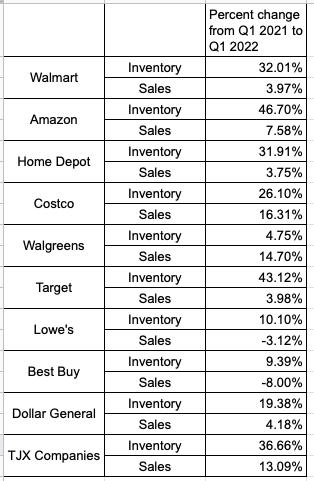
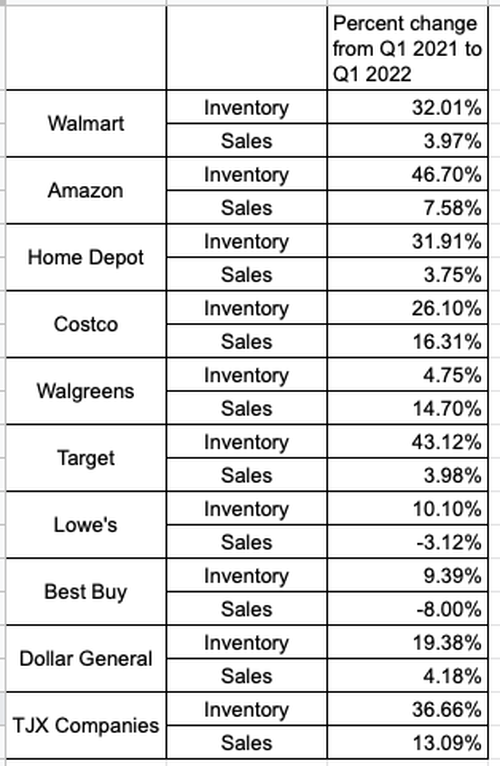
It’s not just warehouse space that Amazon loaded up on – it’s the stuff in the warehouses. According to federal filings concerning the first three months of 2022, the value of Amazon’s total inventories increased 47% compared to the same period last year. But its North America net sales only popped 8%.
Amazon was hardly alone in its uncomfortable first-quarter report. Walmart’s inventory jumped 32% from the previous year, compared to a 4% increase in sales. Best Buy’s inventories increased 9%, while sales declined by 8%.
Target really wants you to buy a bunch of televisions and lawn chairs
America’s top retailers messed up – particularly the ones that focus on durable goods rather than groceries. Most of them released their earnings reports last month, saw shares take a beating and moved on.
Target followed that at first. Its earnings report on May 18 fell short of investor expectations, with an anticipated profit margin of 5.3%. Over-the-top inventories of kitchen appliances and electronics were the top culprit. Its stock sank by 25%.
Then, the mega-retailer did something no one was expecting. On Tuesday, Target told investors it anticipated a profit margin more around 2%. It would slash prices on certain goods and cancel incoming orders. It’s highly unusual for a company to slash its profit expectations within weeks of its earnings report.
Target said in its Tuesday press release that the profit slash comes from a need to “right-size” inventories. People aren’t buying items like televisions, outdoor furniture and kitchen appliances like they were last year. Those are some of the delicate, bulky items Target paid dearly to bring over from Asia in 2021, amid record-high shipping rates.
It’s all leading to what Forbes’ Madeline Halpert called “markdown mania,” and not just at Target. Gap is hawking $60 leggings for just $12. Target is selling televisions for 25% off and patio sets at a 52% markdown. In total, shares in consumer staples stocks have tumbled by about 9% from mid-April highs, while consumer discretionary shares are down by about 20% over the same period.
Few of us in the logistics world were surprised. After all, if trucks and ships are moving less stuff, it’s a sign that consumers aren’t buying as much and that manufacturers have curtailed their output.
Sometimes it can be hard for us who toil in logistics to get the attention of lofty economists and traders. Even though I write about the companies that move everything we eat, wear, drink and most any other verb you could think of, I’m still told that I cover a niche industry. The ongoing downturn in trucking seems like it would only affect truckers – never mind the fact that a trucking recession has preceded nearly every recession since the 1970s, per research from freight brokerage Convoy.
The demand for random crap suddenly vanished, taking everyone by surprise
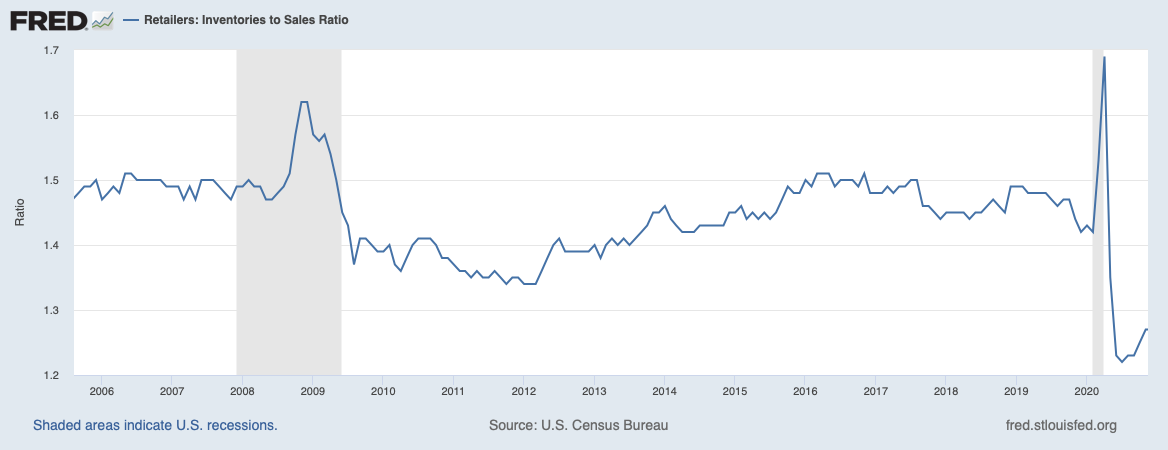
As my colleague Mark Solomon wrote last month on this “inventory bloat,” it’s challenging to forecast demand – even if you’re one of the biggest retailers in the world. We can return to that key metric of inventories-to-sales ratios, which, conveniently, the federal government tracks.
We generally don’t like an inventories-to-sales ratio that’s too high – it indicates that people don’t have the cash to buy stuff. But if it’s too low, like it was through much of 2020 and 2021, it means that there isn’t any stuff to buy. See: The “everything shortage” that dominated headlines last year.

As you can see, the inventories-to-sales ratio is still very low, even if it is creeping up from the nadir of last year. That gives credence to some who argue that a recession isn’t in the cards for this year and could explain why the National Retail Federation declared on Wednesday that it expected port volume to roughly match the crazy numbers seen in 2021. (FreightWaves’ own research, which JPMorgan analysts lent credence to in a Wednesday note to investors, counters that.)
The ratio is more marked when you look at the major consumer goods, as Solomon reported (emphasis mine):
Furniture, home furnishings and appliances, building materials and garden equipment, and a category known as “other general merchandise,” which includes Walmart and Target, among others, reported higher inventory-to-sales ratios, according to government data analyzed by Michigan State.
For the latter sectors, the change has happened fast, according to Jason Miller, logistics professor at MSU’s Eli Broad College of Business. As of November, inventory-to-sales ratios were at pre-COVID levels, Miller said. They have since exploded upward.
To end, I’d like to emphasize that the vibes are abruptly off and no one really knows what’s happening. My colleagues who went to the Gartner supply chain conference in Florida this week found that executives were confused and not feeling very zesty. Transportation managers canceled orders in early 2020 predicting a recession, then found their hastiness left shelves empty and consumers furious. Now that they’ve built back up, customers aren’t buying anymore and their balance sheets are destroyed.
The whiplash is baffling.
https://www.zerohedge.com/markets/demand-random-crap-suddenly-vanished-taking-everyone-surprise
June 10, 2022
“The Demand For Random Crap Suddenly Vanished, Taking Everyone By Surprise”
by Tyler DurdenThursday, Jun 09, 2022 – 07:00 PM
By Rachel Premack of FreightWaves
At the beginning of 2022, things were economically pretty peachy. Too peachy, one could argue: People were buying so much stuff that our ports and terminals could barely handle the massive import volume. Companies were desperate for someone, anyone, to come work for them. And movie theaters, offices, planes and other locales many eschewed during the pandemic were poised to bounce back; the omicron wave appeared mild compared to previous bouts of the coronavirus.
The vibes were good. Now, the vibes are completely terrible.
More and more spooky recession signs are cropping up seemingly every day, ranging from cooling housing starts to meek GDP growth, all amid the Fed tightening rates. Record-setting inflation – particularly for gas – is only adding to the premonitions, as Vox’s Emily Stewart wrote Wednesday in a piece aptly titled “The bad vibes economy.” But even as things feel bad, many still cast doubt that we’re headed for a recession this year, pointing out persistently low unemployment and the fact that certain indicators, while not as strong as the beginning of this year, are still unusually healthy.
No one is shocked that what goes up must go down. What’s shocking us all is how quickly the situation changed.
Glum transportation indicators confirm the bad vibes
A downturn, if not a full-on recession, is clear in the transportation world. While the rest of the economy debates whether things are that bad, it’s been clear for months to logistics providers that the situation has worsened — and the velocity of that change is still stunning.
The cost to move a container from Asia to a major port in North America or Europe has sunk by 23% since the beginning of this year, according to maritime research firm Drewry. Spot rates have plummeted even faster; marketplace Freightos said rates from China to the West Coast are down 38% month-over-month. FreightWaves forecast this week that ocean shipping volumes will “drop off a cliff” by this summer, based on slumping bookings out of China.
Spot van rates in trucking are down 31% since the beginning of this year, with some truck drivers reporting that rising diesel and plummeting rates have already harmed their business.
Even our mighty railroads are reporting a 3% year-to-date decline in volumes across the board, with only carloads of coal, chemicals and “stone, sand and gravel” (aka, frac sand) increasing.
The pullback in transports has been quicker and swifter than anyone imagined. In the ocean world, carriers have deployed more vessels than ever before, according to research firm Sea-Intelligence. In March, Sea-Intelligence forecast carriers to increase their capacity following Chinese New Year by 20% over 2019 levels. Asia-East Coast services were forecast to grow an eye-popping 40%.
And in trucking, small carriers flooded the market. Since the beginning of the pandemic, the number of trucks available to haul a load is up 10%.
Transporters built up record capacity to move loads that are suddenly shrinking. Even if volumes merely settled to pre-pandemic marks, rather than collapsing to a 2008-like recessionary volume, carriers would still be in trouble.
And this isn’t a trend that’s exclusive to transportation.
Retailers are a little embarrassed right now
Walmart, Amazon, Home Depot, Best Buy and most every other retailer are having their own mismatch of supply and demand. They stocked up too much this past year. Now they’re struggling with something called “inventory bloat.” It is even more painful than regular bloating, I imagine, if you are a shareholder in a large retail firm.
While we were buying more and more crap, seemingly without any regard for our dwindling savings, our favorite retailers were doing anything to get more product in.
At some point this year, though, the thirst for buying stuff finally quenched. Some of us got spooked by inflation, others got hit by a hefty tax bill and still others decided to spend their apparently boundless cash on trips abroad and fine dining. Or some weird combination of the three.
The retailers weren’t aware that we were all going to stop ravenously buying this quarter, apparently. They quietly kept amassing their own inventories, many of which were still depleted from 2020 and 2021. And concern over another black swan after years of oddities – trade wars, the pandemic and so on – probably drove many transportation managers to keep ordering stuff. Just in case.
Retailers realized this spring that they built up too much. Amazon said in an April call to investors that it had to scale back after doubling its warehouse footprint. Bloomberg reported weeks later that the mega-retailer was quietly trying to end or sublease at least 10 million square feet of warehouse space. It was a stunning about-face for the company that many investors believed had not only endless growth but an unmatchable logistics machine.
It’s not just warehouse space that Amazon loaded up on – it’s the stuff in the warehouses. According to federal filings concerning the first three months of 2022, the value of Amazon’s total inventories increased 47% compared to the same period last year. But its North America net sales only popped 8%.
Amazon was hardly alone in its uncomfortable first-quarter report. Walmart’s inventory jumped 32% from the previous year, compared to a 4% increase in sales. Best Buy’s inventories increased 9%, while sales declined by 8%.
Target really wants you to buy a bunch of televisions and lawn chairs
America’s top retailers messed up – particularly the ones that focus on durable goods rather than groceries. Most of them released their earnings reports last month, saw shares take a beating and moved on.
Target followed that at first. Its earnings report on May 18 fell short of investor expectations, with an anticipated profit margin of 5.3%. Over-the-top inventories of kitchen appliances and electronics were the top culprit. Its stock sank by 25%.
Then, the mega-retailer did something no one was expecting. On Tuesday, Target told investors it anticipated a profit margin more around 2%. It would slash prices on certain goods and cancel incoming orders. It’s highly unusual for a company to slash its profit expectations within weeks of its earnings report.
Target said in its Tuesday press release that the profit slash comes from a need to “right-size” inventories. People aren’t buying items like televisions, outdoor furniture and kitchen appliances like they were last year. Those are some of the delicate, bulky items Target paid dearly to bring over from Asia in 2021, amid record-high shipping rates.
It’s all leading to what Forbes’ Madeline Halpert called “markdown mania,” and not just at Target. Gap is hawking $60 leggings for just $12. Target is selling televisions for 25% off and patio sets at a 52% markdown. In total, shares in consumer staples stocks have tumbled by about 9% from mid-April highs, while consumer discretionary shares are down by about 20% over the same period.
Few of us in the logistics world were surprised. After all, if trucks and ships are moving less stuff, it’s a sign that consumers aren’t buying as much and that manufacturers have curtailed their output.
Sometimes it can be hard for us who toil in logistics to get the attention of lofty economists and traders. Even though I write about the companies that move everything we eat, wear, drink and most any other verb you could think of, I’m still told that I cover a niche industry. The ongoing downturn in trucking seems like it would only affect truckers – never mind the fact that a trucking recession has preceded nearly every recession since the 1970s, per research from freight brokerage Convoy.
The demand for random crap suddenly vanished, taking everyone by surprise
As my colleague Mark Solomon wrote last month on this “inventory bloat,” it’s challenging to forecast demand – even if you’re one of the biggest retailers in the world. We can return to that key metric of inventories-to-sales ratios, which, conveniently, the federal government tracks.
We generally don’t like an inventories-to-sales ratio that’s too high – it indicates that people don’t have the cash to buy stuff. But if it’s too low, like it was through much of 2020 and 2021, it means that there isn’t any stuff to buy. See: The “everything shortage” that dominated headlines last year.
As you can see, the inventories-to-sales ratio is still very low, even if it is creeping up from the nadir of last year. That gives credence to some who argue that a recession isn’t in the cards for this year and could explain why the National Retail Federation declared on Wednesday that it expected port volume to roughly match the crazy numbers seen in 2021. (FreightWaves’ own research, which JPMorgan analysts lent credence to in a Wednesday note to investors, counters that.)
The ratio is more marked when you look at the major consumer goods, as Solomon reported (emphasis mine):
Furniture, home furnishings and appliances, building materials and garden equipment, and a category known as “other general merchandise,” which includes Walmart and Target, among others, reported higher inventory-to-sales ratios, according to government data analyzed by Michigan State.
For the latter sectors, the change has happened fast, according to Jason Miller, logistics professor at MSU’s Eli Broad College of Business. As of November, inventory-to-sales ratios were at pre-COVID levels, Miller said. They have since exploded upward.
To end, I’d like to emphasize that the vibes are abruptly off and no one really knows what’s happening. My colleagues who went to the Gartner supply chain conference in Florida this week found that executives were confused and not feeling very zesty. Transportation managers canceled orders in early 2020 predicting a recession, then found their hastiness left shelves empty and consumers furious. Now that they’ve built back up, customers aren’t buying anymore and their balance sheets are destroyed.
The whiplash is baffling.
https://www.zerohedge.com/markets/demand-random-crap-suddenly-vanished-taking-everyone-surprise
 Everchem Updates Archive
 Sign Up for Email Updates