
The Urethane Blog
March 24, 2026
Stepan Announces Increases
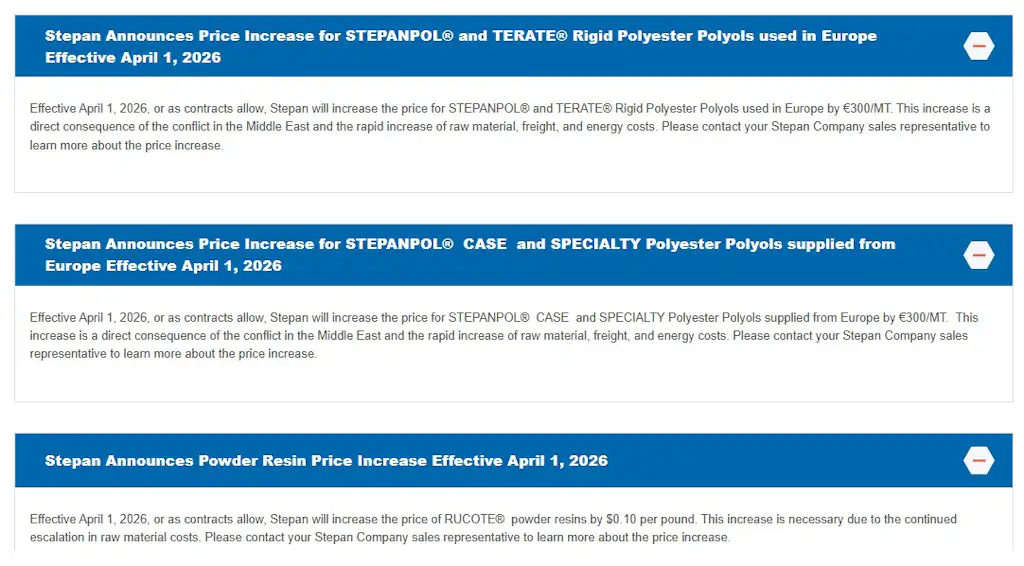
https://www.stepan.com/content/stepan-dot-com/en/news-events/pricing-announcements.html
March 23, 2026
National trucking capacity is about to tighten significantly
· Sunday, March 22, 2026

The freight market momentum is building at a rapid clip. National dry van spot rates — tracked via the SONAR National Truckload Index (NTI.USA), the 7-day moving average of booked rates including fuel — have broken out to a new cycle high of $2.89 per mile. This represents the strongest level since 2022 and confirms the market’s shift toward carriers is gaining real traction.

Chart: SONAR National Truckload Rate Index (NTI.USA) GoSONAR.com
Even more telling: rates jumped $0.12 per mile in the past week alone. That’s a sharp weekly gain that underscores accelerating tightness and carrier pricing power. Spot rates have now recaptured roughly $0.50–$0.60 per mile net of fuel over recent months, climbing from the low $2.00s that defined much of 2023–2024. We’re witnessing 20–25% year-over-year recovery in key lanes and metrics, with volumes holding at multi-year highs reminiscent of late 2022.
This isn’t isolated noise — it’s driven by fundamentals. The return of industrial demand remains the core engine, with stronger manufacturing signals, flatbed activity, and overall domestic freight resilience putting sustained pressure on a shrunken truckload supply. Multi-year carrier attrition (exits, driver regulations, and structural challenges) has left capacity thin, making the market highly responsive to any demand pickup. National tender rejection rates sit stubbornly in the low-to-mid teens (around 13–14% recently), with the Midwest still leading above 18% and tightness now spreading more broadly.
Seasonal layers are piling on:
- Produce season is ramping in major growing regions.
- Construction is accelerating as weather improves.
- Gardening and home improvement demand is building.
- Beverage season is gearing up for warmer months.
These verticals compound the industrial rebound, further squeezing available trucks.
The West Coast awakening adds a powerful pull. Chinese New Year landed later this year (February 17, 2026, vs. earlier in prior cycles), prolonging the post-CNY slowdown and keeping Southern California unusually loose into early March (outbound rejections below 5%). But the rebound is hitting hard now: inbound containers are surging, outbound tenders are recovering, and rejections are set to rise meaningfully.

This creates a classic “magnet” for capacity. Long-haul carriers chase West-to-East port loads for their superior length of haul (1,500–2,000+ miles per move) versus shorter eastern runs that demand multiple loads for equivalent paid miles. As trucks reposition westward from Midwest/Southeast corridors (along I-35 and parallels) to capture higher-paying outbound freight via I-20 and I-40, interior markets face no relief — expect even tighter conditions back east. The Midwest’s industrial strength and elevated rejections mean any capacity drain will intensify pressure, not ease it.
Broader indicators align:
- Tender rejection rates remain high nationally, with seasonal builds accelerating the spread.
- Dry van spot rates continue rising on resilient volumes and persistent constraints.
- Ocean bookings are starting to recover sharply from Chinese New Year
The bottom line: Spring 2026 is igniting hotter and earlier than recent years. The $2.89 cycle high — fueled by a $0.12 weekly jump — reflects tightening capacity, resurgent industrial demand, seasonal verticals firing up, and the delayed-but-powerful post-CNY import surge creating synchronized tightness. Shippers unprepared for higher costs are under immediate strain, with routing guides tested early. Carriers positioned for West Coast outbound, industrial, and seasonal lanes are capturing the gains as capacity reallocates — but back east, conditions are set to tighten further as carriers shift their focus towards the West to East longhaul.
Monitor SONAR outbound rejections and spot rates from Southern California over the next 2–4 weeks, alongside Midwest/Southeast trends. The speed of this spread will show how broad and sustained the impact becomes.
The spring shipping season is just getting started — and it’s going to be a hot one.
March 23, 2026
BorsodChem Announced Price Increase for All MDI Products Supplied April 2026 Onward
March 20, 2026 1 min read
On March 19, 2026, BorsodChem announced a price increase of €500/MT for all MDI products, effective immediately or as contract terms allow. The price adjustment is necessitated by recent developments in the Middle East, which have caused sharp increases in European natural gas and other raw material costs. Despite the company’s efforts to manage this situation responsibly, it is unable to absorb the escalating costs.
March 23, 2026
China Polyether Polyols Reprice Ahead of VAT Rebate Removal as Near-Term Cost Pressures Build
March 20, 2026 3 min read

With less than two weeks remaining before the formal cancellation of the 13% export VAT rebate on April 1, 2026, China’s polyether polyol market has already entered a phase of pronounced structural repricing. Although the policy has yet to take effect, the majority of Chinese suppliers have proactively adjusted export offers to incorporate the anticipated cost impact. Current market behavior indicates that FOB quotations are now widely inclusive of the full 13% rebate removal, effectively passing through the policy impact downstream ahead of implementation.
Logistics Uncertainty Drives Shift Toward “Non-Rebate” Pricing
The primary driver behind this early repricing lies in widespread uncertainty surrounding shipment timelines and customs clearance. Ongoing global logistics disruptions and vessel tightness have raised concerns over whether recently booked cargoes can complete export clearance before the April 1 deadline. Under the policy framework, only shipments cleared prior to implementation remain eligible for the rebate, while those cleared afterward will not.
To mitigate the financial risks associated with timing mismatches, suppliers are increasingly adopting a more conservative pricing approach, standardizing export offers on a non-rebate basis. While a limited number of suppliers continue to provide rebate-inclusive pricing (i.e., without the 13% adjustment), such offers are rapidly diminishing and are expected to disappear in the near term. As a result, the market has effectively transitioned into a new pricing regime ahead of schedule, with most transactions now concluded at elevated, adjusted price levels.
Stable Domestic Pricing Highlights Structural Shift in Export Mechanism
In contrast to the evolving export pricing landscape, China’s domestic polyether polyol market remains largely stable. Domestic prices inherently include the 13% VAT and are not directly impacted by the rebate cancellation policy. As such, the policy primarily alters export pricing mechanisms rather than underlying production costs.
Against this backdrop, domestic market prices serve as a key benchmark for assessing export cost positioning.
Table: Indicative FOB China Export Prices and Domestic Market Levels
| Grade | Incl. Rebate FOB (USD/MT) | Excl. Rebate FOB (USD/MT) | DEL China (CNY/MT) |
| Flexible Slabstock Polyol 3000MW | 1630 – 1680 | 1840 – 1900 | 11,100 – 11,600 |
| Polymer Polyols 42–45% | 1690 – 1740 | 1910 – 1960 | 12,000 – 12,800 |
| Rigid Polyols | 1560 – 1610 | 1760 – 1820 | 10,300 – 10,600 |
Note: FOB prices are indicative offers from multiple suppliers across different regions in China, on drum basis. DEL China prices refer to East China region, on bulk basis.
Buyer Strategy Shifts Toward Execution Certainty
Chinese suppliers are actively raising export prices ahead of the April 1 policy change, effectively establishing a higher baseline for upcoming negotiations. Amid persistent logistics constraints and vessel tightness, the likelihood of securing pre-deadline customs clearance remains uncertain, accelerating the withdrawal of rebate-inclusive offers.
For buyers, procurement strategies are increasingly driven by execution visibility. While shipments cleared before the policy takes effect may still offer short-term cost advantages, the risks associated with timing uncertainty remain significant. As a result, decision-making is shifting toward prioritizing supply assurance over opportunistic cost savings.
Regional Competitive Dynamics: China’s Dominance Remains Intact
In the near term, the price competitiveness of Chinese polyether polyols in regional markets is likely to face some pressure, as margin compression encourages suppliers to adopt more disciplined pricing and sales strategies. At the same time, producers in other regions—particularly Europe—may attempt to expand their presence in import-dependent markets such as India and Southeast Asia.
However, elevated energy and feedstock costs continue to constrain their ability to capitalize on this opportunity. Given China’s scale, production capacity, and entrenched market share, substitution risks remain limited. As such, regional markets are expected to remain structurally reliant on Chinese supply in the near term.
Overall, the market is entering a phase of structurally firmer pricing. Procurement strategies are increasingly shifting away from short-term cost optimization toward a stronger emphasis on execution certainty and supply security, reflecting a more cautious and risk-aware market environment.
March 22, 2026
China vows more open economy in bid to boost confidence
ByLiam Mo and Ryan Woo
March 22 2026 – 8:00am

China has faced tensions with major trading partners over its record $A1.7 trillion trade surplus. Photo: EPA PHOTO
Chinese Premier Li Qiang has pledged to further open up the economy and fully implement national treatment for foreign enterprises as the country seeks to reassure the outside world amid rising global trade tensions.
China will import more high-quality foreign goods and work with all parties to promote optimised and balanced trade development and expand the global trade pie, Li told the China Development Forum in Beijing, state media reported on Sunday.
The annual two-day forum, which concludes on Monday, allows Beijing to lay out its economic vision and investment opportunities to foreign business leaders, Chinese officials, economists and academics.
This year’s gathering comes as the world’s second-largest economy faces rising tensions with major trading partners over 2025’s record $US1.2 ($A1.7) trillion trade surplus.

Premier Li Qiang says China is committed to being a “harbour of stability” for the world economy. (EPA PHOTO)
Challenges for Beijing are aplenty, including deflecting concerns from an increasing number of global capitals about China’s trade practices and overcapacity, as well as their overreliance on key Chinese products.
While Li’s speech did not appear to directly mention the surplus, his pledges indicate an awareness that the issue could disrupt international relations at a time when China has reached a temporary truce with the US on trade.
US President Donald Trump last week postponed a trip to Beijing to meet with Chinese President Xi Jinping due to the Iran war, delaying an effort to ease tensions between the world’s two biggest economies.
In a separate speech at the forum, China’s central bank governor Pan Gongsheng also sought to alleviate concerns surrounding the trade surplus.
“Analysing global economic imbalances requires looking not only at trade in goods but also services, and not only at the current account but also the financial account,” Pan said, according to a transcript of his speech published by the People’s Bank of China, adding that China is the country with the largest goods surplus but also the largest services deficit.
China has no need and no intention to gain trade competitive advantage through currency depreciation, Pan said.
Senior executives attending include those from Apple, Samsung Electronics, Volkswagen, chipmaker Broadcom Inc, industrial conglomerate Siemens, chemical producer BASF and pharmaceutical firm Novartis.
There were no Japanese company executives on the guest list on the forum’s website.
said foreign firms would be treated in the same way as domestic ones, allowing enterprises from all countries to develop with confidence and realise their ambitions in China.
In a separate meeting, Commerce Minister Wang Wentao told business leaders from a US pharmaceutical trade group and executives from five major multinational drug companies that China would strengthen intellectual property protection and improve policy transparency.
Australian Associated Press
 Everchem Updates Archive
 Sign Up for Email Updates