
The Urethane Blog
November 11, 2021
Evonik develops new chemical recycling process for polyurethane foam
By Mary Page Bailey | November 11, 2021
Evonik Industries AG (Essen, Germany) announced that it has developsx an efficient chemical recycling process for converting flexible polyurethane (PU) foams back to the original polyol raw material. Evonik’s new hydrolysis recycling process has the potential to achieve circularity in the flexible PU foam industry.
As the next phase of the development, Evonik will scale-up trials of its new process, which has been further strengthened by its partnership with The Vita Group, a leading provider of value-added and differentiated flexible PU foam products. The Vita Group has trialled the recycled polyols from Evonik’s hydrolysis process in several of its flexible foam applications.
According to the latest report from EUROPUR (European association of flexible polyurethane foam blocks manufacturers), some 40 million mattresses are discarded each year in Europe alone, with the majority ending up as landfill creating the equivalent of 600 kilotons of waste: including more than
300 kilotons of PU foam. With the potential to recycle the main component materials used in flexible PU foams and PU foam-based mattresses, Evonik’s process offers significantly higher use levels of the recycled polyol compared with existing commercialized technologies.
Evonik’s solution will contribute to the global flexible PU industry’s sustainability expectations of reducing waste and increasing the use of renewable raw materials in the production of its products. This enables Evonik to expand its position as a leading solutions provider for the PU industry and supports the entire Evonik Group’s objectives of establishing a fully functioning circular economy.
“It’s only by recycling products back to their raw materials and reusing them over and over again that we will enable a fully circular economy,” said Ralph Marquardt, Head of Evonik’s polyurethane additives business. “Our new hydrolysis process delivers recyclates of a quality and performance similar to that of virgin raw materials. Thus, innovative foam producers like our partner The Vita Group can meet their own sustainability targets, while continuing to deliver high-quality PU products.”
“The Vita Group is renowned for our long-history of innovation in sustainability and investing in circular economy products. We recycle and rebond over 30,000 tons of trim each year, as part of our dynamic sustainability agenda,” said Ian W. Robb, Group CEO for The Vita Group. “Sustainability and innovation are central principles of every aspect of our business. We see it as our responsibility to be at the vanguard of the development of eco-friendly technology within our industry. This hugely exciting partnership represents a key milestone on our journey to achieving the circular economy we are all striving for, and we look forward to working closely together with Evonik.”
November 11, 2021
GM Says It’s Getting A “Better Flow” Of Semis and That All Plants In North America Are Operating Regularly
by Tyler DurdenWednesday, Nov 10, 2021 – 07:05 PM
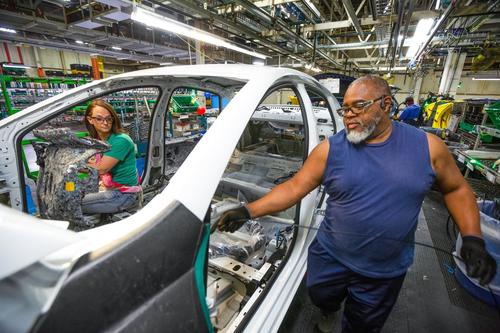
General Motors is out on Wednesday with surprising commentary on the ongoing semiconductor shortage: namely, the auto giant says that it is seeing a “better flow” of semiconductors.
Additionally, GM says that “most of its assembly plants in North America are now back to running regular production,” according to a report by Reuters.
A spokesperson from GM said: “In fact, the week of November 1 represented the first time since February that none of our North American assembly plants were idled due to the chip shortage.”
Recall, at the end of October we asked whether or not the shortage may end early, prompted by surprising disclosures by U.S. Steel.
At the time, US Steel CEO David Burritt said toward the end of his prepared remarks on the company’s conference call that the worst may be passing.
Discussing the demand picture heading into Q4 and the new year, Burritt said that he was “delighted to hear from multiple auto customers, who are foreshadowing that the trough of the chip shortage could be behind us. They’re beginning to add to the fourth quarter and first quarter build schedules, and indicating to us, increasing usage rates, starting as early as next week.“
To us, it was surprise that former JPMorgan news aggregation maven and current publisher of VitalKnowledge Media, Adam Crisafulli, called US Steel’s observation “the most important (macro) comment from any earnings call this morning.”
It wasn’t (and still isn’t) clear what specific macro economic shift may have catalyzed this improvement: after all, West Coast port logjams are about the worst they have ever been.
Given GM’s latest statement, it is now starting to look like what we predicted in late October may have been accurate: “…if US Steel’s channel checks are accurate and automakers are indeed ramping up production, then one of the biggest supply chain bottlenecks may indeed now be behind us (even if there is still a long way to go before the bigger picture renormalizes).”
November 11, 2021
GM Says It’s Getting A “Better Flow” Of Semis and That All Plants In North America Are Operating Regularly
by Tyler DurdenWednesday, Nov 10, 2021 – 07:05 PM
General Motors is out on Wednesday with surprising commentary on the ongoing semiconductor shortage: namely, the auto giant says that it is seeing a “better flow” of semiconductors.
Additionally, GM says that “most of its assembly plants in North America are now back to running regular production,” according to a report by Reuters.
A spokesperson from GM said: “In fact, the week of November 1 represented the first time since February that none of our North American assembly plants were idled due to the chip shortage.”
Recall, at the end of October we asked whether or not the shortage may end early, prompted by surprising disclosures by U.S. Steel.
At the time, US Steel CEO David Burritt said toward the end of his prepared remarks on the company’s conference call that the worst may be passing.
Discussing the demand picture heading into Q4 and the new year, Burritt said that he was “delighted to hear from multiple auto customers, who are foreshadowing that the trough of the chip shortage could be behind us. They’re beginning to add to the fourth quarter and first quarter build schedules, and indicating to us, increasing usage rates, starting as early as next week.“
To us, it was surprise that former JPMorgan news aggregation maven and current publisher of VitalKnowledge Media, Adam Crisafulli, called US Steel’s observation “the most important (macro) comment from any earnings call this morning.”
It wasn’t (and still isn’t) clear what specific macro economic shift may have catalyzed this improvement: after all, West Coast port logjams are about the worst they have ever been.
Given GM’s latest statement, it is now starting to look like what we predicted in late October may have been accurate: “…if US Steel’s channel checks are accurate and automakers are indeed ramping up production, then one of the biggest supply chain bottlenecks may indeed now be behind us (even if there is still a long way to go before the bigger picture renormalizes).”

 Everchem Updates Archive
 Sign Up for Email Updates