
The Urethane Blog
March 12, 2021
Furniture industry ‘decimated’ by foam shortage after Texas storm, NC manufacturers say
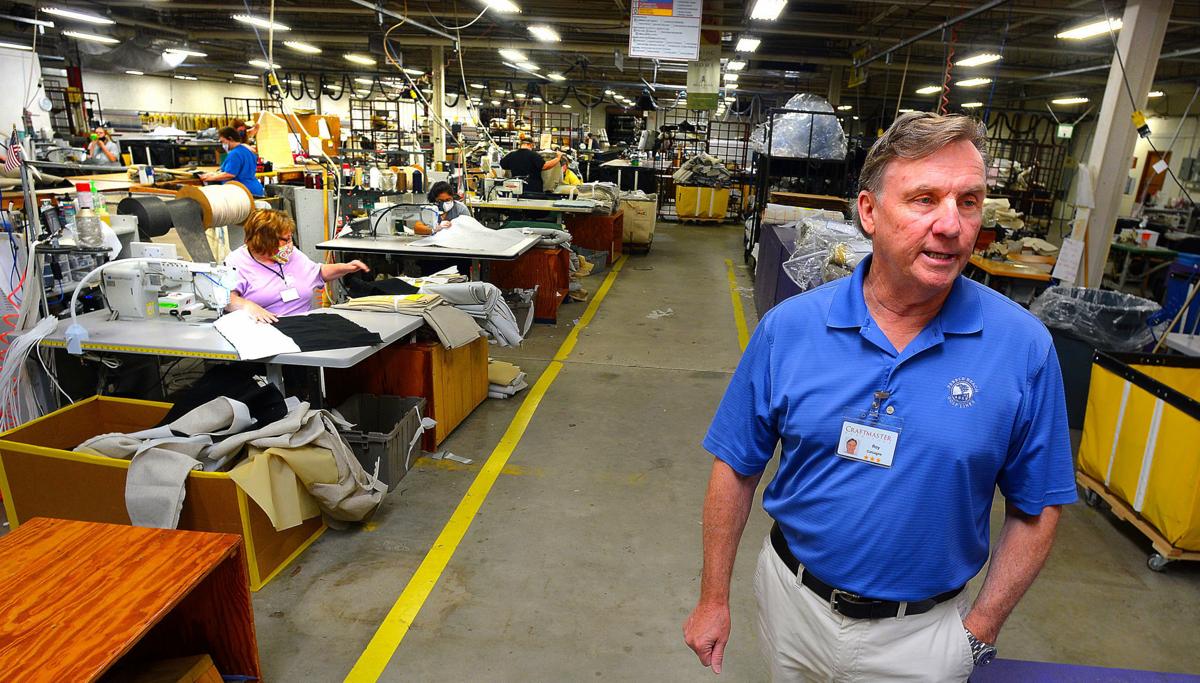
A February storm that pummeled Texas and Louisiana led to a shortage of foam used to pad the arms and backs of furniture. That shortage is being felt in manufacturing plants in North Carolina.
Roy Calcagne, the CEO for Craftmaster in Hickory offered a succinct assessment of the situation: “It’s terrible.”
The severe winter storm knocked out foam manufacturing plants for days. Among those plants were producers of the two chemicals required to make flexible foam used in upholstered furniture, Calcagne said.
The chemical polyol is made in several manufacturing facilities across the U.S., but the majority are located around the Gulf of Mexico, according to EverChem Specialty Chemicals, a chemical marketing and sales company and one of Calcagne’s sources of information on the situation.
The second chemical, toluene diisocyanate (TDI), is made in the U.S. at only two plants — one in Texas and one in Louisiana — according to EverChem. Both were hit by the storm.
“Because of the ice storms and power outages, these companies were slow to come back online,” Calcagne said.
Foam manufacturers, which use the chemicals to create foam for furniture manufacturers, don’t keep a large supply of the chemicals on hand, according to EverChem. With the chemicals rolling out slowly from the source, foam manufacturers are limited in their production. That means furniture companies are receiving about half of what they normally get, Calcagne said.
The shortage affects foam and furniture makers across the United States, Calcagne said.
“It’s pretty much decimated our industry,” he said.
With no foam to fill furniture, Craftmaster was forced to cut production to three days a week, Calcagne said. The company chose to pay workers for an extra day to help them get by.
Century Furniture in Hickory is also feeling the effects. Since early March, production hours in some departments have been cut by a half day or a full day each week. CEO Alex Shuford said he expects more cuts in late March and April.
“It’s a pretty bad situation,” Shuford said. “It looks like shortages are going to last for a while, and it’s definitely going to impact almost all the factories in the upholstery industry around here in their ability to operate.”
Shuford expects Century’s production to be down 30 to 40% in March and for that slowdown to last into April. The foam allocations Century is getting have slowly gotten smaller since foam was first limited in early March, Shuford said.
Shuford said he expects the shortage to add two weeks to Century’s production time. “The situation is far from stable and so our predictions are changing weekly,” Shuford said.
Calcagne said the foam shortage comes on top of growing orders. Business has boomed since late 2020 after a dip during the initial months of the COVID-19 pandemic. Craftmaster saw 70% growth in its business from June to March, Calcagne said. Even before the decrease in foam supply, they couldn’t keep up with the orders.
He added that the slowdown, “puts us further behind with our customers.”
March 12, 2021
Technical Innovation Centre launched by MP

It has been a Budget Week like no other with a big focus on kick-starting the economy and ‘building back better’. At The Vita Group, we continue to invest in the future, ensuring we’re able to sustainably deliver the very best products and solutions for our customers for generations to come. As part of this mission, we are proud to unveil our fourth innovation hub with the launch of Vita’s new Innovation Centre in Accrington, Lancashire.
The Accrington Technical Innovation Centre will work in partnership with employees and customers across our European footprint to lead research, development, and collaboration on highly engineered and customized polyurethane foam, including driving forward sustainable solutions through the use of biopolyols.
Vita’s four state-of-the-art innovation centres in Accrington, Corby, Middleton and Lithuania collectively represent a £1.3m investment for the Group, 80% of which has been allocated to its sites in the North West.
The centre was officially opened by Sara Britcliffe MP for Hyndburn & Haslingden, at a virtual launch event hosted from the site in Accrington. It offered guests a virtual tour of the new facility, as well as an overview of the site from Group CEO Ian Robb and Technical MD Stuart Roby.
Joining via video link, Sara Britcliffe MP said: “The Innovation Centre is a fantastic example of the type of investment needed in our area to help make the vision of a levelling up agenda a reality. As we start to ease restrictions, I am eager to put Hyndburn & Haslingden firmly back on the map, and work with local businesses like The Vita Group to make our area an innovation hub for the entire region, bringing forward more exciting projects like this, driving jobs and growing the next generation of innovative businesses and facilities.”
A huge congratulations to all involved and welcome to our new colleagues who will help to make this new facility a world-class centre of excellence, combining Vita’s technical expertise in foam chemistry with the latest state-of-the-art testing equipment and systems.
March 12, 2021
Technical Innovation Centre launched by MP
It has been a Budget Week like no other with a big focus on kick-starting the economy and ‘building back better’. At The Vita Group, we continue to invest in the future, ensuring we’re able to sustainably deliver the very best products and solutions for our customers for generations to come. As part of this mission, we are proud to unveil our fourth innovation hub with the launch of Vita’s new Innovation Centre in Accrington, Lancashire.
The Accrington Technical Innovation Centre will work in partnership with employees and customers across our European footprint to lead research, development, and collaboration on highly engineered and customized polyurethane foam, including driving forward sustainable solutions through the use of biopolyols.
Vita’s four state-of-the-art innovation centres in Accrington, Corby, Middleton and Lithuania collectively represent a £1.3m investment for the Group, 80% of which has been allocated to its sites in the North West.
The centre was officially opened by Sara Britcliffe MP for Hyndburn & Haslingden, at a virtual launch event hosted from the site in Accrington. It offered guests a virtual tour of the new facility, as well as an overview of the site from Group CEO Ian Robb and Technical MD Stuart Roby.
Joining via video link, Sara Britcliffe MP said: “The Innovation Centre is a fantastic example of the type of investment needed in our area to help make the vision of a levelling up agenda a reality. As we start to ease restrictions, I am eager to put Hyndburn & Haslingden firmly back on the map, and work with local businesses like The Vita Group to make our area an innovation hub for the entire region, bringing forward more exciting projects like this, driving jobs and growing the next generation of innovative businesses and facilities.”
A huge congratulations to all involved and welcome to our new colleagues who will help to make this new facility a world-class centre of excellence, combining Vita’s technical expertise in foam chemistry with the latest state-of-the-art testing equipment and systems.
March 11, 2021
US BDO ‘on brink of being completely out of control’, contributing to auto supply chain crunch
Author: Antoinette Smith
2021/03/10
HOUSTON (ICIS)–Supply of US butanediol (BDO) and derivatives is severely short, and among other issues is contributing to production constraints in the key automotive sector.
In particular, US supply of BDO derivative polytetramethylene ether glycol (PTMEG) is critically short, with an unanticipated government order requiring precedence over contract customers, according to numerous market sources.
PTMEG can be used to make spandex fibres and polyurethanes, such as thermoplastic polyurethane (TPU) elastomers, and urethane adhesives, sealants and surface coatings.
BDO derivative tetrahydrofuran (THF), a precursor to PTMEG, also may be subject to a separate government contract, according to sources, further tightening supply.
THF is the biggest outlet for BDO, in 2020 consuming more than 40% of US BDO production, according to the ICIS Supply and Demand Database.
For 2021 that share is projected to drop to 30%, as a result of the closure of producer Lycra (Shandong Ruyi) in late 2020, which reduced US BDO capacity by about 30%.
Global supply of BDO is extremely tight, with China’s average run rates reaching almost 75%, well above the balance point of 60%, and leading to lower run rates for downstream polybutylene terephthalate (PBT) in the region.
“Demand is incredibly high, and every pound that goes out is going to go somewhere,” said one US seller.
“We’re at the brink of being completely out of control,” said another, describing the fragile market balance.
Shortages of BDO as well as co-feedstock isocyanates and other chemicals could lead downstream plants to go idle.
One downstream plant was running out of BDO, said a buyer, while another was “limping along” due to lack of isocyanates.
The BDO scarcity and strong demand have led to hefty price increase nominations for Q2 contracts of 45-60 cents/lb.
OUTLOOK
The concurrent shortage of isocyanates could limit demand for BDO, and help the market rebalance more quickly.
Supply should soon increase, with the restart of LyondellBasell’s upstream propylene oxide/styrene monomer (PO/SM) plant in Channelview, Texas, following planned maintenance and a winter storm.
The company also produces BDO at the site.
The two other US producers were physically unaffected by the storm, but logistics – loadings and transportation – are causing problems, due to driver and truck shortages.
“You can be sitting on material but no one is able to get there” to deliver it, a producer said.
ICIS senior analyst Rob Peacock said the current supply situation for polyurethanes (PU) feedstocks – which include BDO – could well contribute to production disruptions in the auto industry.
“Auto supply chains will struggle with other polymers and plastics, as well as microchips and other bits, but definitely will with PU chemicals as the volume out is relatively large, and the rest of the world has tightened up,” Peacock said.
AUTOMOTIVE SUPPLY CHAIN TIGHTENS
Shortages throughout the supply chain are forcing automotive plants to lower production and furlough workers, and could even spill into Q2, according to industry experts LMC Automotive.
The impact could be that global production makes only a limited recovery in 2021 compared with 2020, say Jincy Varghese, ICIS demand analyst, and Rhian O’Connor, ICIS senior analyst.
A semiconductor shortage as a result of increased pandemic-related demand for gaming consoles, laptop computers and other technology has slowed automotive production.
The US is among the worst hit by these shortages, as inventory levels are thin, say Varghese and O’Connor.
Ford, FCA, Volkswagen, General Motors, and Honda have all announced temporary factory closures over Q1 across the US, Canada and Mexico.
Oxford Economics estimates this will result in a 230,000-unit hit in the region for Q1.
The automotive industry has contributed to the US economic recovery, though to a lesser degree than the construction sector.
US January auto sales were up by 2.5% month on month, but remained lower year on year, according to US Bureau of Economic Analysis (BEA) data.
US passenger car production also slumped month on month in December, where data lags by a month, falling by more than 10% from the previous month. Year on year, US passenger car production is down by 9.3%, the BEA said.
BDO is a chemical intermediate used in the production of polymers, solvents and fine chemicals.
US BDO producers are Ashland, BASF and LyondellBasell.
March 11, 2021
US BDO ‘on brink of being completely out of control’, contributing to auto supply chain crunch
Author: Antoinette Smith
2021/03/10
HOUSTON (ICIS)–Supply of US butanediol (BDO) and derivatives is severely short, and among other issues is contributing to production constraints in the key automotive sector.
In particular, US supply of BDO derivative polytetramethylene ether glycol (PTMEG) is critically short, with an unanticipated government order requiring precedence over contract customers, according to numerous market sources.
PTMEG can be used to make spandex fibres and polyurethanes, such as thermoplastic polyurethane (TPU) elastomers, and urethane adhesives, sealants and surface coatings.
BDO derivative tetrahydrofuran (THF), a precursor to PTMEG, also may be subject to a separate government contract, according to sources, further tightening supply.
THF is the biggest outlet for BDO, in 2020 consuming more than 40% of US BDO production, according to the ICIS Supply and Demand Database.
For 2021 that share is projected to drop to 30%, as a result of the closure of producer Lycra (Shandong Ruyi) in late 2020, which reduced US BDO capacity by about 30%.
Global supply of BDO is extremely tight, with China’s average run rates reaching almost 75%, well above the balance point of 60%, and leading to lower run rates for downstream polybutylene terephthalate (PBT) in the region.
“Demand is incredibly high, and every pound that goes out is going to go somewhere,” said one US seller.
“We’re at the brink of being completely out of control,” said another, describing the fragile market balance.
Shortages of BDO as well as co-feedstock isocyanates and other chemicals could lead downstream plants to go idle.
One downstream plant was running out of BDO, said a buyer, while another was “limping along” due to lack of isocyanates.
The BDO scarcity and strong demand have led to hefty price increase nominations for Q2 contracts of 45-60 cents/lb.
OUTLOOK
The concurrent shortage of isocyanates could limit demand for BDO, and help the market rebalance more quickly.
Supply should soon increase, with the restart of LyondellBasell’s upstream propylene oxide/styrene monomer (PO/SM) plant in Channelview, Texas, following planned maintenance and a winter storm.
The company also produces BDO at the site.
The two other US producers were physically unaffected by the storm, but logistics – loadings and transportation – are causing problems, due to driver and truck shortages.
“You can be sitting on material but no one is able to get there” to deliver it, a producer said.
ICIS senior analyst Rob Peacock said the current supply situation for polyurethanes (PU) feedstocks – which include BDO – could well contribute to production disruptions in the auto industry.
“Auto supply chains will struggle with other polymers and plastics, as well as microchips and other bits, but definitely will with PU chemicals as the volume out is relatively large, and the rest of the world has tightened up,” Peacock said.
AUTOMOTIVE SUPPLY CHAIN TIGHTENS
Shortages throughout the supply chain are forcing automotive plants to lower production and furlough workers, and could even spill into Q2, according to industry experts LMC Automotive.
The impact could be that global production makes only a limited recovery in 2021 compared with 2020, say Jincy Varghese, ICIS demand analyst, and Rhian O’Connor, ICIS senior analyst.
A semiconductor shortage as a result of increased pandemic-related demand for gaming consoles, laptop computers and other technology has slowed automotive production.
The US is among the worst hit by these shortages, as inventory levels are thin, say Varghese and O’Connor.
Ford, FCA, Volkswagen, General Motors, and Honda have all announced temporary factory closures over Q1 across the US, Canada and Mexico.
Oxford Economics estimates this will result in a 230,000-unit hit in the region for Q1.
The automotive industry has contributed to the US economic recovery, though to a lesser degree than the construction sector.
US January auto sales were up by 2.5% month on month, but remained lower year on year, according to US Bureau of Economic Analysis (BEA) data.
US passenger car production also slumped month on month in December, where data lags by a month, falling by more than 10% from the previous month. Year on year, US passenger car production is down by 9.3%, the BEA said.
BDO is a chemical intermediate used in the production of polymers, solvents and fine chemicals.
US BDO producers are Ashland, BASF and LyondellBasell.
 Everchem Updates Archive
  Sign Up for Email Updates