
The Urethane Blog
November 4, 2020
German automotive improves but recovery may stall as second wave hits
Author: Morgan Condon
2020/11/04
LONDON (ICIS)–The German automotive sector performed better in October but the pace of recovery could stall before the end of the year, according to data from the Ifo Institute.
Newly imposed lockdowns in major European economies, including Germany, caused automotive industry’s expectations to decline for the fourth consecutive month as the restrictions could weigh heavily on economic activity.
However, current sentiment among automotive players increased to -0.2 points in October, up sharply from -20.4 points in September.
Both figures are up from the record low of -86.2 points posted in April.
Capacity utilisation rose to 86% in October, rising significantly from levels of 73% in July.
Companies are still planning to increase production, although at a more modest rate than in September.
Increased demand from the automotive sector has led to improved sentiment across various chemicals markets.
An upward tick in demand has provided some buoyancy for markets including polyethylene (PE), polymethyl methacrylate (PMMA), caprolactam (capro), methylene chloride (MEC), nylon, and toluene diisocyanate (TDI).
This has given some traction to chemicals producers; Germany’s Evonik said this week September demand for its materials, including from automotive, had been healthy.
“Replacement products like silica for tyres have led the way in the recovery but also nylon 6,6 has shown improving trends towards the end of the third quarter,” said Evonik’s CEO Christian Kullmann in a call with analysts.
The strength of automotive manufacturing was key in boosting sales in the specialty producer’s Smart Materials business unit.
Equity chemicals analysts at Baader Bank said Evonik’s Smart Materials division had “demonstrated stability” in inorganics such as hydrogen peroxide (H2)2) or catalysts.
“And [Evonik] benefited from improving trends in the automotive-related businesses.” said analyst Markus Mayer.
DRIVING FORCE
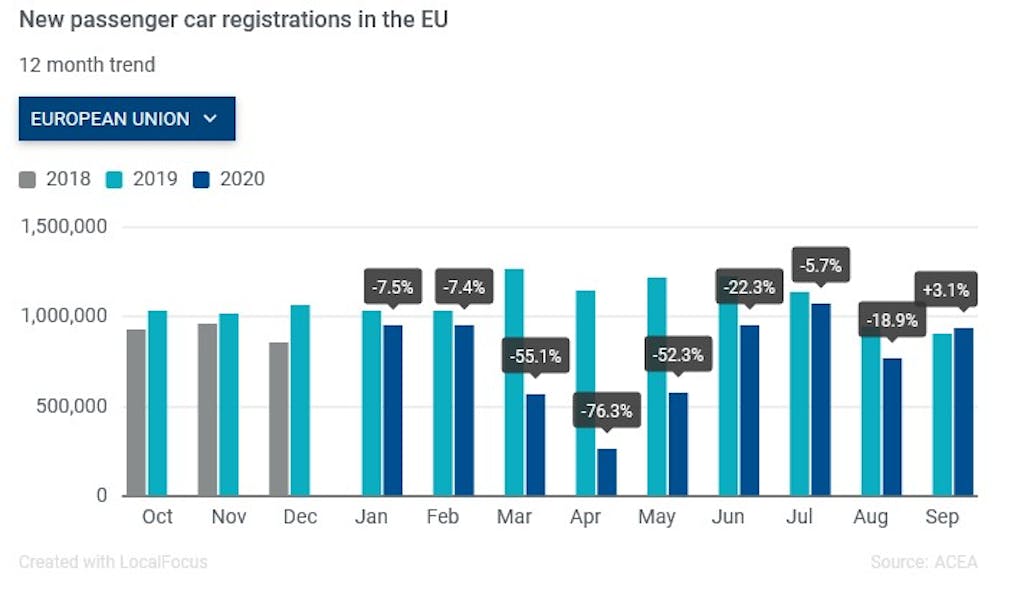
According to data from the European Automobile Manufacturers’ Association (ACEA), September was the first month to stem losses on the previous year, with an 8.4% increase compared to the same time a year prior.
Newly registered cars in Germany increased 5% in September, compared to the previous year, but this was not a boon to domestic industry as it was driven by demand for hybrid and electric vehicles (EVs).
While German manufacturers have some models available, there is a wider range from producers based in other countries.
Expectations declined for the fourth consecutive month in October, down sharply from 27.6 points in September to 17.7 points as new mobility restrictions kick in across Europe.
Order backlogs also shrank from September’s unusually high level of 51.5 points, down to 29.2 points in October.
Ifo’s research showed automobile manufacturers in Germany are looking to make further staff reductions.
CHANGING LANES
Although the domestic market may be suffering, Germany’s automotive industry is mainly reliant on exports.
Ifo said 74.8% of vehicles produced in 2019 were exported.
Dynamics for the export market are also expected to soften in coming months, falling from 31.3 points to 23.2 points in October.
Export demand already dropped 34% in January-September, year on year, with further losses prevented by more solid demand for German vehicles in China.
In 2019, China was the third largest export market for German producers, behind the UK and the US.
However, the course of the pandemic, hitting both the UK and the US hard, may erode the recovery.
“While the main European customer countries the UK, France, Italy or Spain, and also the US, are still firmly in the grip of the corona pandemic, the demand for German cars in China is picking up again noticeably,” said Ifo’s head for industrial organisation Oliver Falck.
Despite the challenges facing the automotive industry, German – and indeed European – chemicals makers could feel less impact as they are not confined to selling automotive materials and parts to domestic markets.
Buoyant demand in China and gradual recoveries in other regions could keep the automotive industry on stable ground to close off 2020.
However, as the pandemic can change course quickly, uncertainty is set to be the reigning trend for the time being.
Front page picture: Assembly line at a Volkswagen plant in Zwickau, east Germany
Source: Jens Meyer/AP/Shutterstock
Focus article by Morgan Condon
November 4, 2020
Karl Glassman
Good morning and thank you for joining us today. First and foremost, I would like to thank our employees for their continued commitment to keeping each other safe and healthy while serving our customers. We are pleased to deliver strong third quarter results in these uncertain times and this could not have happened without the dedication and hard work of our people.
As we reported yesterday, third quarter earnings per share were a quarterly record of $0.77; this included $6 million of restructuring charges incurred primarily from pandemic-related cost reductions. Third quarter 2019 EPS was $0.74 and included $0.02 per share of restructuring-related charges. Excluding these items, third quarter adjusted earnings of $0.80 were up $0.04 from adjusted 2019 third quarter earnings.
Third quarter EBIT was a quarterly record $147 million. EBIT increased in the quarter versus third quarter last year primarily due to lower fixed cost, partially offset by lower volume and a change in LIFO impact. EBIT margin increased 60 basis points to 12.2%, while adjusted EBIT margin increased 80 basis points to 12.7% and adjusted EBITDA margins increased 80 basis points to 16.6%.
Third quarter sales were $1.208 billion, down 3% versus third quarter of 2019. Continued strong demand in residential end markets was more than offset by weaknesses in Aerospace and Work Furniture. Operating cash flow in the quarter was a record $261 million. Adjusted working capital as a percent of annualized sales for the quarter improved to a notable 8.7% versus 10.7% in the third quarter of 2019. As we also reported yesterday, our Board of Directors declared a $0.40 per share fourth quarter dividend. At an annual dividend of $1.60 per share, we have increased our annual dividend for 49 consecutive years. We remain committed to our position as a Dividend Aristocrat.
At the end of October, we received positive news related to the US mattress industries anti-dumping petition on mattress importers from seven countries including Vietnam, Indonesia and Cambodia. The Department of Commerce made a preliminary determination that mattresses were being sold at prices that violate the US trade laws and imposed preliminary duties that range from 3% to 990%. Also, in the quarter, the Department of Commerce imposed preliminary countervailing duties of 98% on China. We anticipate final determinations in these investigations in 2021 likely during second quarter. This should allow domestic mattress producers to compete on a more level playing field.
The Company remains well positioned both competitively and financially to capitalize on long-term opportunities in various end markets. Our enduring long-term fundamentals give us confidence in our ability to continue to create value for our shareholders.
Mitch Dolloff
While challenges remain in most of these areas, we continue to make headway and will provide more detail as we discuss each segment. Sales in our Bedding Products segment were down 2% in the third quarter. Strong demand throughout the quarter in the bedding market drove sales growth in ECS, US Spring, and European Spring. This growth was more than offset by lower volume in Adjustable bed and exited volume in Fashion Bed and Drawn Wire. We continue to increase production while managing supply challenges with non-woven fabrics and labor shortages. We found some alternatives for our non-woven fabrics, but they are less efficient and constrained production and are higher cost. We also incurred significant additional cost to air freight non-woven materials in an effort to better meet demand.
In our US Spring business, staffing is above the pre-COVID levels and we continue adding employees in response to strong demand. During the quarter, we also began to face supply constraints on TDI, a chemical used in the production of foam. Producers of TDI declared force majeure and significantly reduced supply of the chemical. While the supply constraints have relaxed to a degree, we expect to see reduced supply through at least the end of the year. Within the last month, we have also seen shortages of polyols and MDI, chemical more widely used in our specialty foams. Producers have pointed to equipment outages and hurricanes in the Gulf as well as raw material availability as impediments to production. We anticipate a tight supply of these chemicals through mid-2021. Our supply chains have also been hampered by congested ports, especially on the West Coast of the US. We are working diligently to address these issues and increase production so that we can better meet growing levels of market demand.
Keith Hughes
Thank you. A couple of questions. First, your Specialty Foam sales were up as you noted in the slides. Given some of these force majeure on various chemicals, is growth going to deteriorate during the fourth quarter as a result of the actions that occurred?
Karl Glassman
Mitch, do you want to handle it, It’s to be determined based on chemical availability, it’s going to be tight. But Mitch, do you want to elaborate?
Mitch Dolloff
Yes, I mean I think that’s the best way to answer it, Karl. We are on allocation under all — of all those chemicals under force majeure. There has been a number of issues that have popped up from mechanical issues to availability of raw materials, to hurricanes and tropical storms that have all impacted these things. So we are — I think we’re getting by but it’s tight and it’s hard to predict how long this will last. So I think at this point, I wouldn’t be — I wouldn’t put a negative spin on the fourth quarter, but it’s going to be tight.
Keith Hughes
Okay. And if we switch over to Home Furniture, it was up 4% in the quarter, that’s another area where you’ve heard kind of surging sales. Is there — were there operational issues there or production issues there or where do you think you stand versus market growth?
Karl Glassman
Yes, why don’t I start and then Steve, if you want to pile on that. Remember, if you look at the whole segment of FF&T, through the first three weeks of July, we told you that sales were up 7% and then they ended up being 1%. And I don’t want anyone to think that’s a call on Home Furniture in that Home Furniture was up strongly in early July because in 2020, the Home Furniture producers in the United States produced as opposed to taking our normal, always the July 4 week and sometimes two weeks of July. So the comp was exceeded significantly. Home Furniture demand subsequent to those first three weeks of the quarter continued to be strong. Our customers have been somewhat impacted by labor availability issues, so have we to a lesser degree. They have been impacted by the TDI issue that was most acute in September that Mitch made reference to. So furniture demand is strong, we have — we are very comfortable with our market share position and the position that the industry holds. Said differently, there is a backlog in Home Furniture that is consistent with the backlog in Bedding. So all is well on Home Furniture. But Steve, I’ve jumped in front of you.
November 3, 2020
October chemical grade propylene settled on the 28th up 0.5 cents/lb to $0.35/lb.

November 3, 2020
October chemical grade propylene settled on the 28th up 0.5 cents/lb to $0.35/lb.
 Everchem Updates Archive
 Sign Up for Email Updates