The Urethane Blog
September 18, 2020
Apollo Said to Weigh Deal for $10 Billion Plastics Firm Covestro
Ed Hammond, Eyk Henning and Dinesh Nair, Bloomberg News
- (Bloomberg) — Apollo Global Management Inc., the buyout firm led by billionaire Leon Black, is exploring a takeover of German plastics maker Covestro AG, according to people with knowledge of the matter.
The New York-based investment firm contacted Covestro in recent weeks, said the people, who asked not to be identified as the information is private.
Covestro was spun out of the drugmaker Bayer AG in an initial public offering in October 2015. While the company’s shares have risen 68% since then, they have more than halved in price from a high in early 2018, giving it a market value of 8.2 billion euros ($9.7 billion).
Deliberations are at an early stage, and there’s no certainty they will result in a transaction, the people said. A representative for Apollo couldn’t immediately comment. A representative for Covestro declined to comment.
Apollo has broad experience in the plastics industry. Its prior investment in plastics-maker LyondellBasell Industries NV is still held up as a textbook model for a start-to-finish private equity transaction. Last year, it unsuccessfully targeted plastic-packaging maker RPC Group Plc.
Buying Covestro would mean the private equity firm once again enters highly-competitive markets like polycarbonates, used widely in the building and automotive industries. Leverkusen-based Covestro also manufacturers the more technically-challenging methylene diphenyl diisocyanate, or MDI, used to make polyurethanes for insulation. Its competitors include Huntsman Corp.
September 15, 2020

September 15th, 2020
Dear Valued Customer,
Effective October 1st, 2020 or as contracts allow, COIM USA will increase the prices for its polyester polyol grades listed below in the US and Canada.
Diexter-G TF-52 US $0.03/lb.
Diexter-G CF-60 US $0.03/lb.
Diexter-G 1100-225 US $0.03/lb.
We appreciate the business and partnership between our companies, and your account manager will contact you shortly to discuss the specifics of this increase.
September 15, 2020
US Railroad Traffic Posts First Annual Jump Since The Start Of 2020
by Tyler Durden Tue, 09/15/2020 – 05:30
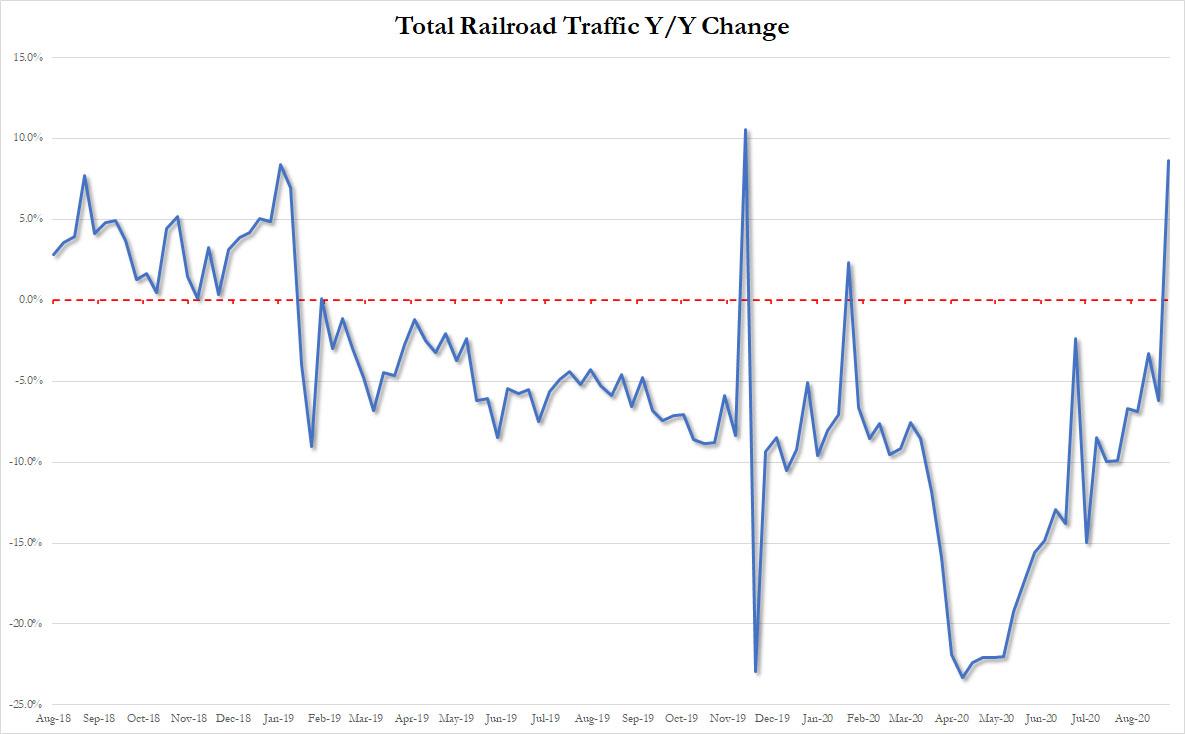
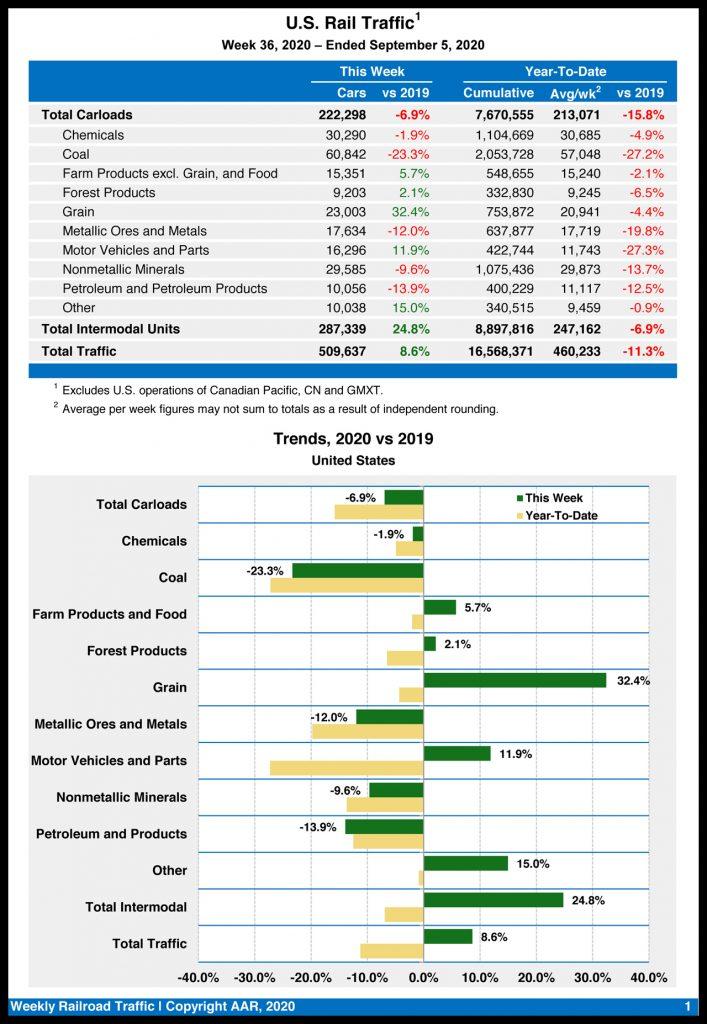
U.S. railroads just posted their first annual traffic gain in a very long time: according to Railway Age, for the week ending September 5, 2020, a surge of nearly 25% y/y in intermodal loadings more than offset a 7% decline in carload traffic, creating an overall annual gain of nearly 9%, the Association of American Railroads (AAR) reported Sept. 9.
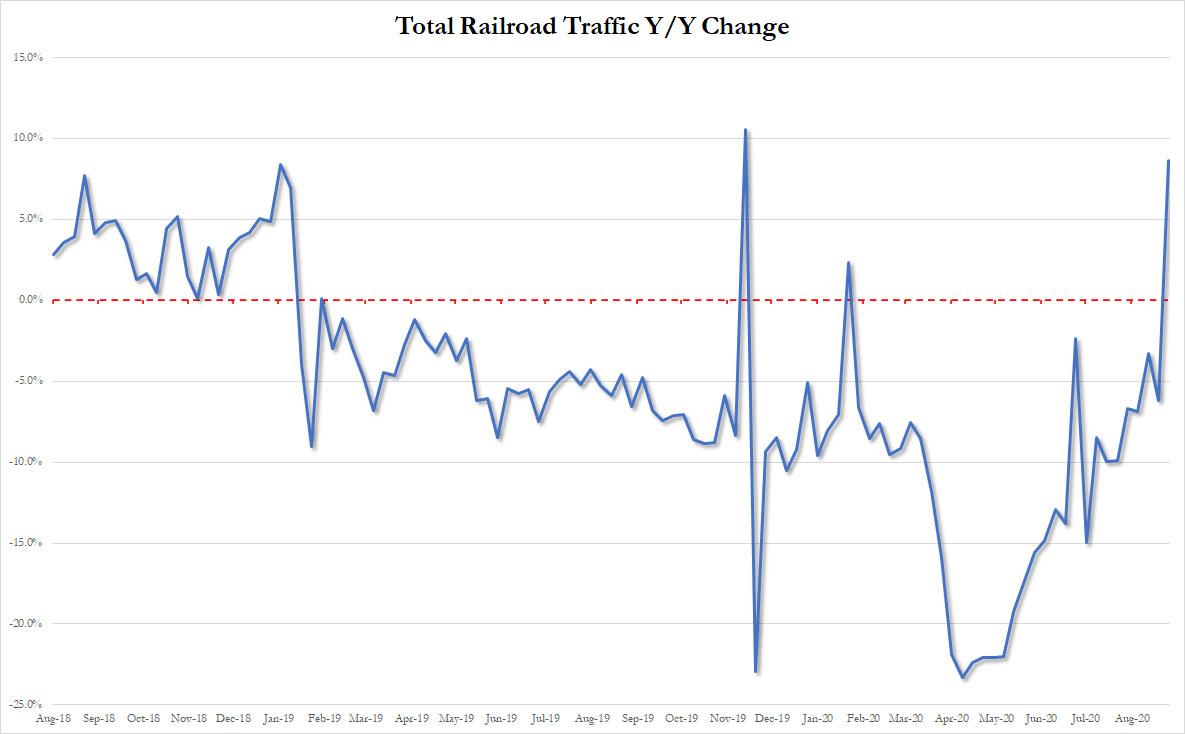
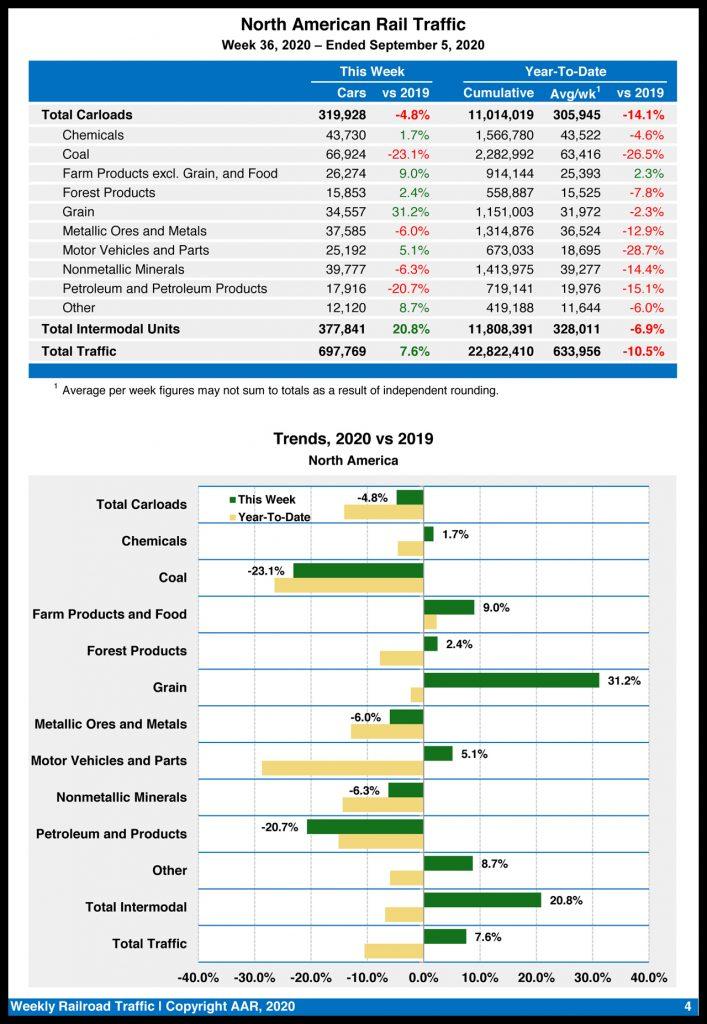
Canadian and Mexican intermodal volumes also rose, driving a North American gain of nearly 21%.
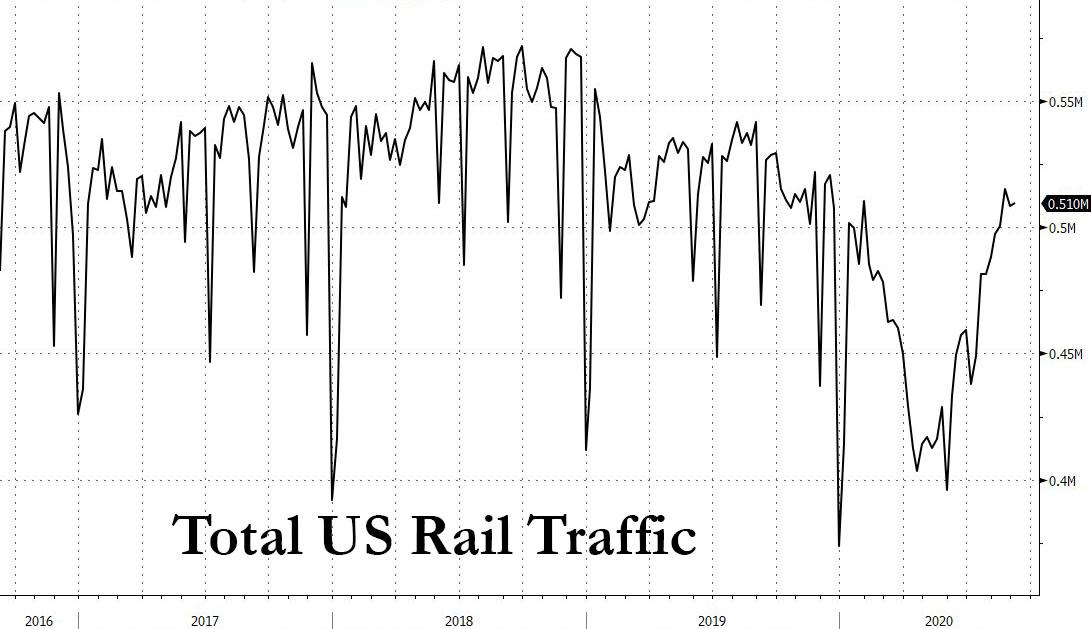
Total U.S. rail traffic for the week ending Sept. 5 was 509,637 carloads and intermodal units, up 8.6% compared with the same week last year.
It’s unclear what prompted the 32% Y/Y surge in grain traffic which was the primary driver behind the week’s jump in intermodal, it’s also unclear if the traffic jump is sustainable but as the chart below shows, we are now entering a period where simply due to the base effect, rail traffic will soon be consistently stronger compared to late 2019 and early 2020.
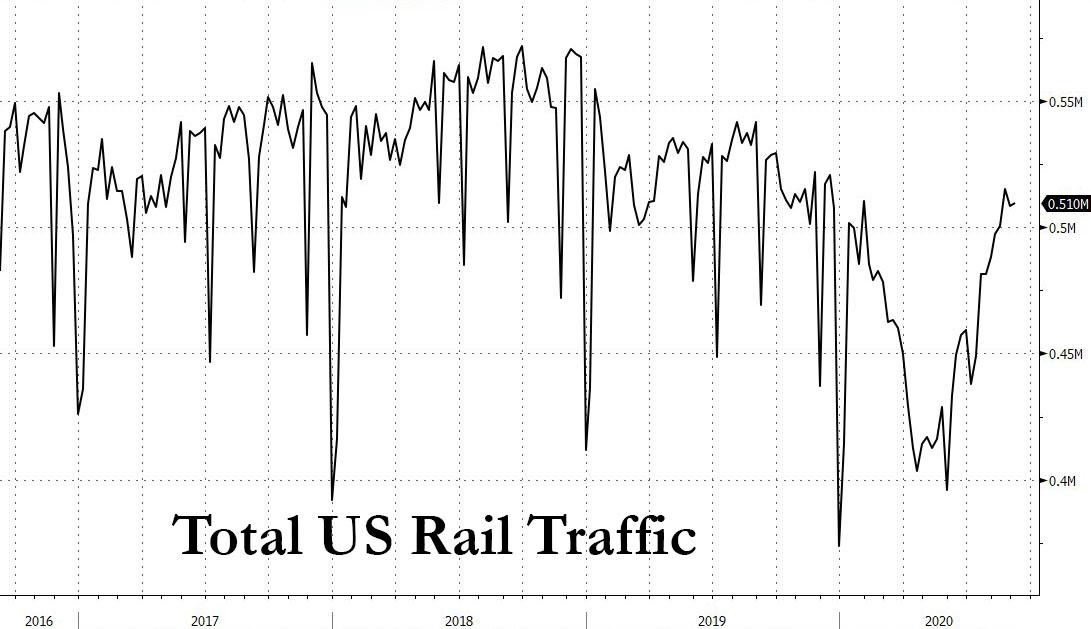
Total carloads were 222,298, down 6.9% compared with the same week in 2019, but weekly intermodal volume was 287,339 containers and trailers, up 24.8%.
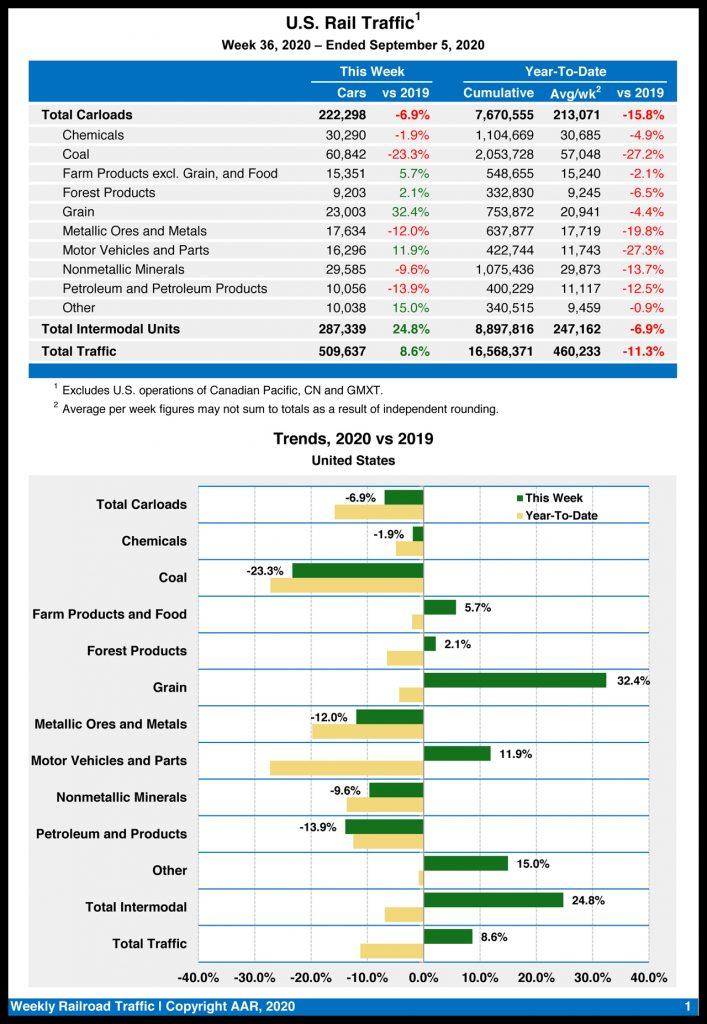
Five of the 10 carload commodity groups posted an increase compared with the same week in 2019. They included grain, up 5,630 carloads, to 23,003; motor vehicles and parts, up 1,729 carloads, to 16,296; and miscellaneous carloads, up 1,306 carloads, to 10,038. Commodity groups that posted decreases compared with the same week in 2019 included coal, down 18,495 carloads, to 60,842; nonmetallic minerals, down 3,159 carloads, to 29,585; and metallic ores and metals, down 2,396 carloads, to 17,634.
For the first 36 weeks of 2020, U.S. railroads reported cumulative volume of 7,670,555 carloads, down 15.8% from the same point last year; and 8,897,816 intermodal units, down 6.9% from last year. Total combined U.S. traffic for the first 36 weeks of 2020 was 16,568,371 carloads and intermodal units, a decrease of 11.3% compared to last year.
Total North American rail volume for the week on 12 reporting U.S., Canadian and Mexican railroads totaled 319,928 carloads, down 4.8% compared with the same week last year, and 377,841 intermodal units, up 20.8% compared with last year. Total combined weekly rail traffic in North America was 697,769 carloads and intermodal units, up 7.6%. North American rail volume for the first 36 weeks of 2020 was 22,822,410 carloads and intermodal units, down 10.5% compared with 2019.
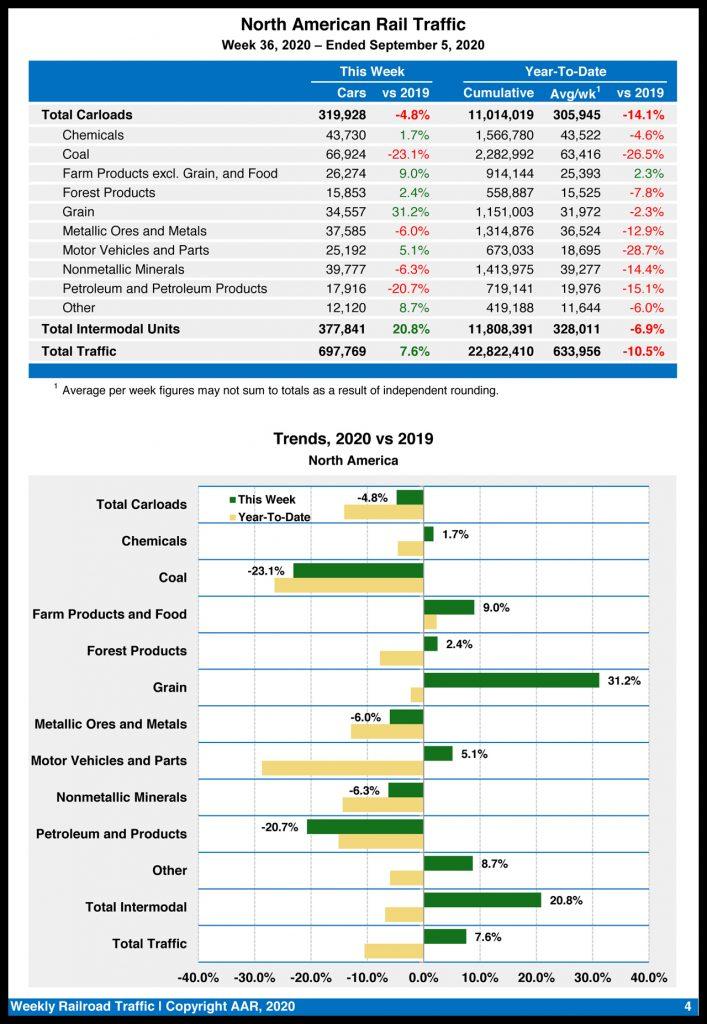
Canadian railroads reported 78,580 carloads for the week, up 0.7%, and 73,558 intermodal units, up 11.3% compared with the same week in 2019. For the first 36 weeks of 2020, Canadian railroads reported cumulative rail traffic volume of 5,011,733 carloads, containers and trailers, down 8.2%.
Mexican railroads reported 19,050 carloads for the week, down 0.9% compared with the same week last year, and 16,944 intermodal units, up 4%. Cumulative volume on Mexican railroads for the first 36 weeks of 2020 was 1,242,306 carloads and intermodal containers and trailers, down 9.5% from the same point last year.
 Everchem Updates Archive
 Sign Up for Email Updates