
The Urethane Blog
July 7, 2020
ACC: Spray Foam Coalition responds to California DTSC’s notice on SPF Abridged AA Report
The California Department of Toxic Substances Control (DTSC) on 30 June 2020 issued a “notice of deficiency” on the Abridged Alternative Analysis Report on Two-component Low- and High-pressure Spray Polyurethane Foam Systems Containing Unreacted Methylene Diphenyl Diisocyanates (MDI).

The American Chemistry Council (ACC) issued the following statement in response, which may be attributed to Lee Salamone, Senior Director, ACC Center for the Polyurethanes Industry (CPI).
“ACC is disappointed by DTSC’s decision to issue a ‘notice of deficiency’ on the Abridged Alternative Analysis Report (the Report). The Report concludes that there are no technically or economically feasible alternatives to spray polyurethane foam (SPF) systems containing unreacted MDI — a position that the industry has maintained since this process started in 2014. It is important to note that a ‘notice of deficiency’ represents another step in the regulatory process and is not a final decision on the safety of SPF or on the Report. Accordingly, the ACC Spray Foam Coalition (SFC) will coordinate with regulated entities as they revise their company-specific reports and resubmit for consideration. Californians can continue to rely on SPF to meet their energy efficiency needs.
“Health and safety are top priorities for the SPF industry. SPF insulation is well-studied and is subject to robust regulatory controls and stewardship programs. It is an effective and proven building material with a 40-year track record of success when installed by a trained professional contractor.
“SPF insulation offers exceptional thermal insulation and air sealing performance. California is a leader in climate policy and should promote SPF as one solution to climate change. Using SPF to insulate and air seal buildings can help California meet its energy efficiency and climate change goals, as well as move the state forward on its strategic plan for zero net energy buildings.”
July 7, 2020
BASF advances chemical polyurethane recycling
by Craig Bettenhausen
July 4, 2020 | APPEARED IN VOLUME 98, ISSUE 26
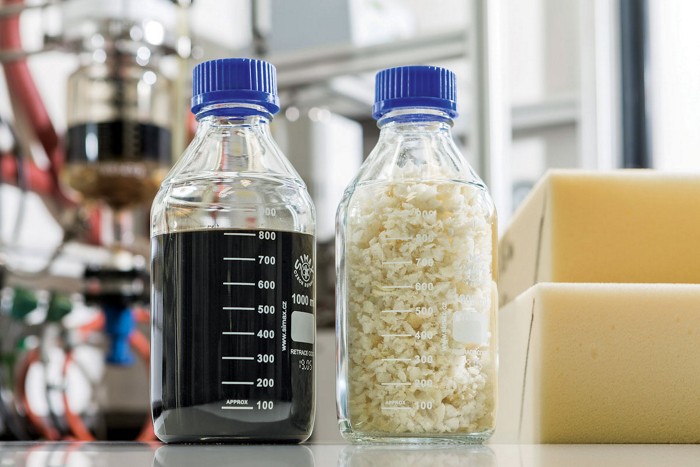 Credit: BASF BASF plans to convert polyurethane foam mattresses back into the polyol (brown bottle, left) from which they’re made.
In a lab in Brandenburg, Germany, BASF researchers are turning polyurethane mattress foam back into its polyol starting materials. It’s easy to sort mattresses out of waste streams but not to recycle them. That combination makes mattresses an attractive target for BASF’s drive toward circular supply chains, says technical project manager Arno Volkmann. The firm expects to have pilot quantities of recycled polyol later this year. BASF says it is also working to recover diisocyanate, the other major foam component.
July 7, 2020
BASF advances chemical polyurethane recycling
by Craig Bettenhausen
July 4, 2020 | APPEARED IN VOLUME 98, ISSUE 26
Credit: BASF BASF plans to convert polyurethane foam mattresses back into the polyol (brown bottle, left) from which they’re made.
In a lab in Brandenburg, Germany, BASF researchers are turning polyurethane mattress foam back into its polyol starting materials. It’s easy to sort mattresses out of waste streams but not to recycle them. That combination makes mattresses an attractive target for BASF’s drive toward circular supply chains, says technical project manager Arno Volkmann. The firm expects to have pilot quantities of recycled polyol later this year. BASF says it is also working to recover diisocyanate, the other major foam component.
July 1, 2020
US propylene contracts see first price increase in nine months: sources
June 29, 2020 0 5
Highlights
June PGP contract settles at 26.5 cents/lb, up 0.5 cent
Contract prices linger at 11-year lows
Houston —
June US propylene contract prices settled a half-cent higher than May contract prices June 29, trade participants said.
The settlement marks the first price increase since September 2019, S&P Global Platts data showed.
The increase brought the US June polymer-grade propylene contract price to 26.5 cents/lb and chemical-grade propylene contract price to 25 cents/lb, the sources said.
The settlement was in line with market expectations of a price increase.
PGP and CGP contract prices remain at an 11-year low, however, and were last lower January 2009 at 22 cents/lb and 20.50 cents/lb, respectively, according to Platts data.
The increase comes as spot propylene prices have climbed 27% month-on-month June 29 and more than 50% since the year-to-date low of 18.625 cents/lb March 23.
US spot PGP was assessed June 29 at 28 cents/lb, up 1.125 cents from June 26.
 Everchem Updates Archive
 Sign Up for Email Updates