
The Urethane Blog
June 19, 2020

National Survey Findings Confirm Consumers Are More Likely to Buy a Mattress Containing CertiPUR-US®-Certified Foam
According to benchmark research conducted through an independent, nationally recognized SurveyGizmo consumer panel for the CertiPUR-US® program, 9 out of 10 recent or upcoming mattress buyers were more likely to purchase a mattress that contains CertiPUR-US®-certified flexible polyurethane foam.
More than 90 percent said they were willing to pay more to ensure the foam was certified. Forty-six percent said they were willing to pay $50 or more; 30 percent would pay more than $75 extra.
The online survey respondents, randomly selected from a SurveyGizmo consumer panel, were limited to those who had purchased a mattress within the past 12 months or were planning to in the next 12 months. Among the survey’s goals were to gauge buyers’ receptivity to the concept of certified foam for those not aware of it and discover their propensity to purchase a mattress containing certified foam.
Other findings include:
Factors preventing a good night’s sleep. An uncomfortable mattress was the second most cited answer when respondents were asked what was the biggest factor on nights when they had trouble sleeping. Temperature—being too hot or too cold—was the No. 1 reason. Aches and pains, general life stress and screen time also ranked high. Only 4 percent said they usually didn’t have trouble sleeping.
Mattresses matter. Nearly all respondents (99 percent) said the quality of their mattress was important to getting a good night’s sleep, with 84 percent of those saying it was very important.
Materials used in mattresses matter, too. When asked to rank what mattered most when deciding to purchase a mattress, not surprisingly, comfort was the top answer (1), followed by price (2). “Materials the mattress is made of” ranked third (3), followed by warranty (4), brand name (5), appearance of mattress (6), customer/user reviews (7), made without chemicals of concern (8), return policy (9) and delivery speed (10).
Buyers are becoming savvy. More than half of recent and future mattress buyers (55 percent) considered themselves very knowledgeable or knowledgeable about mattress materials. Forty-five percent admitted they were not knowledgeable.
Where buyers learn. The top three places, in order, cited by respondents about where they learn about mattress materials were: manufacturer or retailer websites; health/consumer/home websites; and tied for third, information on mattresses/labels at point of purchase and past experience.
Where buyers purchase. For those respondents who had purchased a mattress online in the past year, top answers were department store website (31 percent), site that sells only mattresses (22 percent), and Amazon (19 percent). For those purchasing in store, top answers were mattress specialty store (43 percent), department store (21 percent), furniture store (15 percent) and big box store (15 percent).
Consumers rely on knowledgeable salespersons. Ninety-five percent of respondents agree it was important or very important for the salesperson they were working with to be knowledgeable about the foam in the mattress.
Satisfaction is high. Nearly all (96 percent) of the recent mattress buyers surveyed said they were very satisfied or satisfied with their mattress.
CertiPUR-US name recognition is significant. More respondents (41 percent) said they were aware of CertiPUR-US certification, far outpacing other certification program options presented. By comparison, GreenGuard was ranked at 26 percent, Green Bear 10 percent, and Oeko Tex
6 percent.
Mattress shoppers value certified foam. At the conclusion of the survey and after reading a short description about the CertiPUR-US program, mattress shoppers’ receptivity about foam certification increased significantly, with 88 percent saying it would be important or very important to purchase a mattress containing CertiPUR-US certified foam. More than 90 percent said they were willing to pay more to ensure the foam was certified. Forty-six percent said they were willing to pay $50 or more; 30 percent would pay more than $75 extra for a mattress containing certified foam.
“It’s clear that consumers feel that a quality mattress is key to a good night’s sleep, but this survey also shows they value certified foam—and are willing to pay more for it,” says Michael Crowell, executive director of the nonprofit CertiPUR-US® program.
CertiPUR-US is a certification program for flexible polyurethane foam used in bedding and upholstered furniture that is administered by a nonprofit organization. Certified foams meet CertiPUR-US standards for content, emissions and durability, and are analyzed by independent, accredited laboratories.
Download the consumer survey report, including charts of data, at www.certipur.us/survey
www.certipur.us
June 19, 2020
BASF says would challenge any takeover attempt, activist investor
Jun. 18, 2020 11:31 AM ET|About: BASF SE (BASFY)|By: Carl Surran, SA News Editor
BASF (OTCQX:BASFY +2.4%) is aware of the risk of an unsolicited takeover approach or an attack from activist investors and is ready to react, CEO Martin Brudermueller said at the company’s virtual annual shareholders meeting.
The CEO said he could not rule out unwanted attempts to take control of the company, given the decline in its market value.
BASF also reiterates it sees Q2 operating profit in the low triple-digit millions of euros and that it will not provide full-year guidance; the company sees business improvement during 2020 but no full recovery.
June 19, 2020
Polyurethane feedstocks
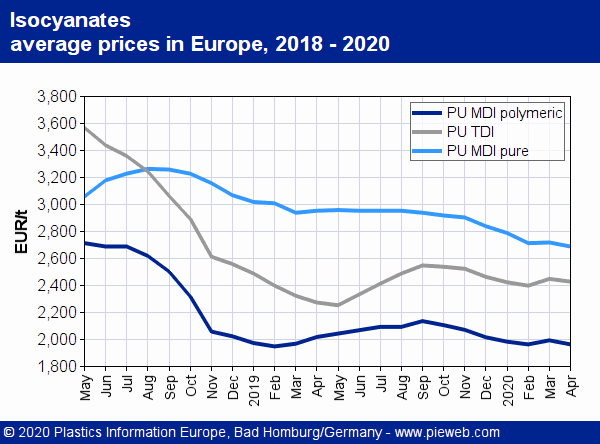
April 2020: Isocyanates little changed / Decreases on the horizon / Foam product demand sinks by a third / Rigid polyols precursors compete with disinfectants
With relatively few contracts signed up to mid-April, the price rounds for isocyanates in Western Europe were accompanied by heated discussions. By standing firm, producers were able to limit rebates for polymeric MDI to EUR 30/t, despite the dramatic EUR 400/t drop in the benzene contract and the substantial price declines that were observed in Asia and the Middle East as well. TDI buyers did only slightly better, gaining rebates of EUR 20/t. Producers were able to widen margins considerably, even though demand collapsed – for which reason most isocyanate plants were operated below capacity. Notations for both types of polyols gave way noticeably.
With many plants closed or operating below capacity due to the Covid-19 pandemic, output of foam products fell to about half or at least a third of the normal level. This applied mainly to facilities in Southern Europe, with Northern Europe less severely affected, according to the industry association Europur – see PIEWeb of 08.04.2020. Rigid foam for insulation and technical applications fared somewhat better than flexible foam.
How the situation develops going forward will depend on how strict the limitations on business operation continue to be. If the coronavirus lockdown seen in various forms in European countries over the past few weeks continues – as is expected – until the beginning of May, it could have additional repercussions for order volume and put further downward pressure on notations for all polyurethane starting materials. Products for insulation and technical applications should continue to perform better than flexible foam for the bedding and automotive sector. A very slight improvement in demand from the automotive industry is possible if assembly lines are ramped up again from the end of April as expected.
Along the ethylene chain, producers of rigid polyols are now having to compete with manufacturers of disinfectant products to be supplied, and this could act to support prices.
 |
Feedstock
| Prices in EUR/t | ||||||
| March 2020 | April 2020 | |||||
| Type | Price | Change | Market | Price | Change | Market |
| Benzene contract | 595.00 | -147.00 | balanced (long) | 171.00 | -424.00 | long |
Feedstock: Benzene contractMarch 2020Price: EUR 595.00/t
Change against previous month: EUR -147.00/t
The high volatility of benzene notations is continuing. Cost reductions in the oil chain and a surplus in supply are creating price pressure.
Supply: normal
Declining demand led to oversupply.
Demand: low
The extended outage of a phenol facility lowered demand noticeably.April 2020Price: EUR 171.00/t
Change against previous month: EUR -424.00/t
The drop in oil prices, associated glut of supply and exceptionally weak demand caused the benzene reference to plummet to a record low – surpassing the previous low in January 2009.
Supply: high
With order activity subdued, inventories swelled significantly.
Demand: very low
Demand from downstream customers weakened noticeably due to the effects from the coronavirus situation. For example, key styrene production in France is only operating at the lowest level.
Polymers
| Polymer prices in EUR/t | ||||||
| April 2020 | May 2020 | |||||
| Type | Price | Change | Range | Market | Price trend | Market |
| PU MDI polymeric | 1,960.00 | -30.00 | 1,920.00 – 2,000.00 | long | decreasing | balanced (long) |
| PU MDI pure | 2,685.00 | -30.00 | 2,650.00 – 2,720.00 | long | decreasing | balanced (long) |
| PU TDI | 2,425.00 | -20.00 | 2,340.00 – 2,510.00 | long | decreasing | balanced (long) |
| PU polyols flexible | 1,910.00 | -55.00 | 1,820.00 – 2,000.00 | long | decreasing | balanced (long) |
| PU polyols rigid | 2,250.00 | -50.00 | 2,180.00 – 2,320.00 | long | little change | balanced (long) |
PU MDI polymericApril 2020Price: EUR 1,960.00/t
Change against previous month: EUR -30.00/t
The price rounds for isocyanates were accompanied by heated discussions. By standing firm, producers were able to limit rebates for polymeric MDI to EUR 30/t, despite the dramatic EUR 400/t drop in the benzene contract and the substantial price declines that were observed in Asia and the Middle East. As a result, margins improved substantially, even if demand was only about a third of the usual level.
Supply: normal
BASF appears to have completed its maintenance turnround, and the outage at Huntsman did not seem to be a topic, so that it must have been business as usual in April. With demand on a low flame, most isocyanate plants were operated at greatly reduced capacity.
Demand: very low
With many plants closed or operating below capacity, output of foam products fell to about a third of the normal level. This applied mainly to facilities in Southern Europe, with Northern Europe less severely affected. Foam for insulation or technical applications fared better.Outlook May 2020Price trend: decreasing
As expected, rigid foam for insulation and technical applications fared somewhat better than flexible foam, but demand began pointing downward. Plant shutdowns in Germany and Italy will continue, although many voices are calling for the coronavirus-related lockdowns to be lifted. Against this backdrop, demand for isocyanates should sink further. It is conceivable that producers could be forced to shutter plants due to a lack of storage capacity. The more likely this scenario appears, the more likely it seems that buyers will be able to gain price concessions.
Supply: low
Producers will continue to run their plants well below capacity. An improvement in the current demand situation is not yet in sight.
Demand: very low
How the situation develops will depend on how strict the limitations on business operation continue to be. If the lockdown seen in various forms in European countries over the past few weeks continues – as is expected – until the beginning of May, it could have additional repercussions for order volume and put further downward pressure on notations for all polyurethane starting materials. Products for insulation and technical applications should continue to perform better than flexible foam for the bedding and automotive sector. A very slight improvement in demand from the automotive industry is possible if assembly lines are ramped up again from the end of April as expected.
Further Details…
PU MDI pureApril 2020Price: EUR 2,685.00/t
Change against previous month: EUR -30.00/t
As was the case for the polymeric grade, contract prices rolled over or were settled at rebates of as much as EUR 60/t.
Supply: normal
BASF appears to have completed its maintenance turnround, and the outage at Huntsman did not seem to be a topic, so that it must have been business as usual in April. With demand on a low flame, most isocyanate plants were operated at greatly reduced capacity.
Demand: very low
Packaging applications bucked the general trend. In contrast, with many plants closed or operating below capacity, output of foam products fell to about a third of the normal level. This applied mainly to facilities in Southern Europe, with Northern Europe less severely affected.Outlook May 2020Price trend: decreasing
As expected, rigid foam for insulation and technical applications fared somewhat better than flexible foam, but demand began pointing downward. Plant shutdowns in Germany and Italy will continue, although many voices are calling for the coronavirus-related lockdowns to be lifted. Against this backdrop, demand for isocyanates should sink further. It is conceivable that producers could be forced to shutter plants due to a lack of storage capacity. The more likely this scenario appears, the more likely it seems that buyers will be able to gain price concessions.
Supply: low
Producers will continue to run their plants well below capacity. An improvement in the current demand situation is not yet in sight.
Demand: very low
How the situation develops will depend on how strict the limitations on business operation continue to be. If the lockdown seen in various forms in European countries over the past few weeks continues – as is expected – until the beginning of May, it could have additional repercussions for order volume and put further downward pressure on notations for all polyurethane starting materials. Products for insulation and technical applications should continue to perform better than flexible foam for the bedding and automotive sector. A very slight improvement in demand from the automotive industry is possible if assembly lines are ramped up again from the end of April as expected.
Further Details…
PU TDIApril 2020Price: EUR 2,425.00/t
Change against previous month: EUR -20.00/t
Up to now, rebates were relatively minor, in the range of up to EUR 35/t, despite the EUR 275/t plunge in the toluene price and the almost complete lack of demand. Large accounts sometimes paid less than EUR 1,600/t.
Supply: normal
Most isocyanates plants are now running at severely reduced capacity. However, there have been no reports of complete shutdowns.
Demand: very low
Demand from the bedding and automotive sectors has nearly collapsed. Production of flexible foam in Europe sank to less than half the normal level in April due to numerous plant shutdowns and curbs on capacity generally. Facilities in Southern Europe were the most severely affected, with Northern Europe hit slightly less hard.Outlook May 2020Price trend: decreasing
Price deterioration for TDI has been relatively minor up to now, but this could change in view of the steep declines seen farther up the production chain. Plant shutdowns in Germany and Italy will continue, although many voices are calling for the coronavirus-related lockdowns to be lifted. This means that order volume for isocyanates could sink more sharply. It is conceivable that producers could be forced to shutter their plants due to a lack of storage capacity. The more likely this scenario appears, the more likely it seems that buyers will be able to gain price concessions.
Supply: low
Producers will continue to run their plants well below capacity. An improvement in the current demand situation is not yet in sight.
Demand: very low
How the situation develops will depend on how strict the limitations on business operation continue to be. If the lockdown seen in various forms in European countries over the past few weeks continues – as is expected – until the beginning of May, it could have additional repercussions for order volume and put further downward pressure on notations for all polyurethane starting materials. Products for insulation and technical applications should continue to perform better than flexible foam for the bedding and automotive sector. A very slight improvement in demand from the automotive industry is possible if assembly lines are ramped up again from the end of April as expected.
Further Details…
PU polyols flexibleApril 2020Price: EUR 1,910.00/t
Change against previous month: EUR -55.00/t
The plunge in the propylene contract price, which is factored into the propylene oxide price one-to-one, as well as the collapse in demand from the bedding and automotive sectors, led demand for flexible polyols to shrink. Price concessions spanned a wide range, averaging up to EUR 100/t.
Supply: normal
Few outages were registered but most plants were operating well below capacity.
Demand: very low
Demand from the bedding and automotive sectors has nearly collapsed. Production of flexible foam in Europe sank to less than half the normal level in April due to numerous plant shutdowns and curbs on capacity generally. Facilities in Southern Europe were the most severely affected, with Northern Europe hit slightly less hard.Outlook May 2020Price trend: decreasing
Plant shutdowns in Germany and Italy will continue, although many voices are calling for the coronavirus-related lockdowns to be lifted. It is conceivable that producers could be forced to make capacity cuts or even shutter their plants due to a lack of storage capacity or a shortage of C3 feedstock. Despite these two diverse scenarios, buyers are likely to gain additional price concessions.
Supply: low
Producers will continue to run their plants well below capacity. An improvement in the current demand situation is not yet in sight.
Demand: very low
How the situation develops will depend on how strict the limitations on business operation continue to be. If the lockdown seen in various forms in European countries over the past few weeks continues – as is expected – until the beginning of May, it could have additional repercussions for order volume and put further downward pressure on notations for all polyurethane starting materials. Products for insulation and technical applications should continue to perform better than flexible foam for the bedding and automotive sector. A very slight improvement in demand from the automotive industry is possible if assembly lines are ramped up again from the end of April as expected.
Further Details…
PU polyols rigidApril 2020Price: EUR 2,250.00/t
Change against previous month: EUR -50.00/t
Rigid polyols saw slightly less price pressure than flexible polyols. Rebates granted were of a rather similar dimension on average, though without such pronounced swings in either direction.
Supply: normal
Few outages were registered but most plants were operating well below capacity.
Demand: very low
With many plants closed or operating below capacity, output of foam products fell to about a third of the normal level. This applied mainly to facilities in Southern Europe, with Northern Europe less severely affected. Foam for insulation or technical applications fared better.Outlook May 2020Price trend: little change
Insulation and technical foam applications should continue to perform better than flexible foam applications. However, the market in general can be expected to deteriorate. Along the ethylene chain, rigid polyol producers are now having to compete with manufacturers of disinfectant products for feedstock supply, and this could act to support prices.
Supply: low
Producers will continue to run their plants well below capacity. An improvement in the current demand situation is not yet in sight.
Demand: very low
How the situation develops will depend on how strict the limitations on business operation continue to be. If the lockdown seen in various forms in European countries over the past few weeks continues – as is expected – until the beginning of May, it could have additional repercussions for order volume and put further downward pressure on notations for all polyurethane starting materials. Products for insulation and technical applications should continue to perform better than flexible foam for the bedding and automotive sector. A very slight improvement in demand from the automotive industry is possible if assembly lines are ramped up again from the end of April as expected.
June 19, 2020
Polyurethane feedstocks
April 2020: Isocyanates little changed / Decreases on the horizon / Foam product demand sinks by a third / Rigid polyols precursors compete with disinfectants
With relatively few contracts signed up to mid-April, the price rounds for isocyanates in Western Europe were accompanied by heated discussions. By standing firm, producers were able to limit rebates for polymeric MDI to EUR 30/t, despite the dramatic EUR 400/t drop in the benzene contract and the substantial price declines that were observed in Asia and the Middle East as well. TDI buyers did only slightly better, gaining rebates of EUR 20/t. Producers were able to widen margins considerably, even though demand collapsed – for which reason most isocyanate plants were operated below capacity. Notations for both types of polyols gave way noticeably.
With many plants closed or operating below capacity due to the Covid-19 pandemic, output of foam products fell to about half or at least a third of the normal level. This applied mainly to facilities in Southern Europe, with Northern Europe less severely affected, according to the industry association Europur – see PIEWeb of 08.04.2020. Rigid foam for insulation and technical applications fared somewhat better than flexible foam.
How the situation develops going forward will depend on how strict the limitations on business operation continue to be. If the coronavirus lockdown seen in various forms in European countries over the past few weeks continues – as is expected – until the beginning of May, it could have additional repercussions for order volume and put further downward pressure on notations for all polyurethane starting materials. Products for insulation and technical applications should continue to perform better than flexible foam for the bedding and automotive sector. A very slight improvement in demand from the automotive industry is possible if assembly lines are ramped up again from the end of April as expected.
Along the ethylene chain, producers of rigid polyols are now having to compete with manufacturers of disinfectant products to be supplied, and this could act to support prices.
|
Feedstock
| Prices in EUR/t | ||||||
| March 2020 | April 2020 | |||||
| Type | Price | Change | Market | Price | Change | Market |
| Benzene contract | 595.00 | -147.00 | balanced (long) | 171.00 | -424.00 | long |
Feedstock: Benzene contractMarch 2020Price: EUR 595.00/t
Change against previous month: EUR -147.00/t
The high volatility of benzene notations is continuing. Cost reductions in the oil chain and a surplus in supply are creating price pressure.
Supply: normal
Declining demand led to oversupply.
Demand: low
The extended outage of a phenol facility lowered demand noticeably.April 2020Price: EUR 171.00/t
Change against previous month: EUR -424.00/t
The drop in oil prices, associated glut of supply and exceptionally weak demand caused the benzene reference to plummet to a record low – surpassing the previous low in January 2009.
Supply: high
With order activity subdued, inventories swelled significantly.
Demand: very low
Demand from downstream customers weakened noticeably due to the effects from the coronavirus situation. For example, key styrene production in France is only operating at the lowest level.
Polymers
| Polymer prices in EUR/t | ||||||
| April 2020 | May 2020 | |||||
| Type | Price | Change | Range | Market | Price trend | Market |
| PU MDI polymeric | 1,960.00 | -30.00 | 1,920.00 – 2,000.00 | long | decreasing | balanced (long) |
| PU MDI pure | 2,685.00 | -30.00 | 2,650.00 – 2,720.00 | long | decreasing | balanced (long) |
| PU TDI | 2,425.00 | -20.00 | 2,340.00 – 2,510.00 | long | decreasing | balanced (long) |
| PU polyols flexible | 1,910.00 | -55.00 | 1,820.00 – 2,000.00 | long | decreasing | balanced (long) |
| PU polyols rigid | 2,250.00 | -50.00 | 2,180.00 – 2,320.00 | long | little change | balanced (long) |
PU MDI polymericApril 2020Price: EUR 1,960.00/t
Change against previous month: EUR -30.00/t
The price rounds for isocyanates were accompanied by heated discussions. By standing firm, producers were able to limit rebates for polymeric MDI to EUR 30/t, despite the dramatic EUR 400/t drop in the benzene contract and the substantial price declines that were observed in Asia and the Middle East. As a result, margins improved substantially, even if demand was only about a third of the usual level.
Supply: normal
BASF appears to have completed its maintenance turnround, and the outage at Huntsman did not seem to be a topic, so that it must have been business as usual in April. With demand on a low flame, most isocyanate plants were operated at greatly reduced capacity.
Demand: very low
With many plants closed or operating below capacity, output of foam products fell to about a third of the normal level. This applied mainly to facilities in Southern Europe, with Northern Europe less severely affected. Foam for insulation or technical applications fared better.Outlook May 2020Price trend: decreasing
As expected, rigid foam for insulation and technical applications fared somewhat better than flexible foam, but demand began pointing downward. Plant shutdowns in Germany and Italy will continue, although many voices are calling for the coronavirus-related lockdowns to be lifted. Against this backdrop, demand for isocyanates should sink further. It is conceivable that producers could be forced to shutter plants due to a lack of storage capacity. The more likely this scenario appears, the more likely it seems that buyers will be able to gain price concessions.
Supply: low
Producers will continue to run their plants well below capacity. An improvement in the current demand situation is not yet in sight.
Demand: very low
How the situation develops will depend on how strict the limitations on business operation continue to be. If the lockdown seen in various forms in European countries over the past few weeks continues – as is expected – until the beginning of May, it could have additional repercussions for order volume and put further downward pressure on notations for all polyurethane starting materials. Products for insulation and technical applications should continue to perform better than flexible foam for the bedding and automotive sector. A very slight improvement in demand from the automotive industry is possible if assembly lines are ramped up again from the end of April as expected.
Further Details…
PU MDI pureApril 2020Price: EUR 2,685.00/t
Change against previous month: EUR -30.00/t
As was the case for the polymeric grade, contract prices rolled over or were settled at rebates of as much as EUR 60/t.
Supply: normal
BASF appears to have completed its maintenance turnround, and the outage at Huntsman did not seem to be a topic, so that it must have been business as usual in April. With demand on a low flame, most isocyanate plants were operated at greatly reduced capacity.
Demand: very low
Packaging applications bucked the general trend. In contrast, with many plants closed or operating below capacity, output of foam products fell to about a third of the normal level. This applied mainly to facilities in Southern Europe, with Northern Europe less severely affected.Outlook May 2020Price trend: decreasing
As expected, rigid foam for insulation and technical applications fared somewhat better than flexible foam, but demand began pointing downward. Plant shutdowns in Germany and Italy will continue, although many voices are calling for the coronavirus-related lockdowns to be lifted. Against this backdrop, demand for isocyanates should sink further. It is conceivable that producers could be forced to shutter plants due to a lack of storage capacity. The more likely this scenario appears, the more likely it seems that buyers will be able to gain price concessions.
Supply: low
Producers will continue to run their plants well below capacity. An improvement in the current demand situation is not yet in sight.
Demand: very low
How the situation develops will depend on how strict the limitations on business operation continue to be. If the lockdown seen in various forms in European countries over the past few weeks continues – as is expected – until the beginning of May, it could have additional repercussions for order volume and put further downward pressure on notations for all polyurethane starting materials. Products for insulation and technical applications should continue to perform better than flexible foam for the bedding and automotive sector. A very slight improvement in demand from the automotive industry is possible if assembly lines are ramped up again from the end of April as expected.
Further Details…
PU TDIApril 2020Price: EUR 2,425.00/t
Change against previous month: EUR -20.00/t
Up to now, rebates were relatively minor, in the range of up to EUR 35/t, despite the EUR 275/t plunge in the toluene price and the almost complete lack of demand. Large accounts sometimes paid less than EUR 1,600/t.
Supply: normal
Most isocyanates plants are now running at severely reduced capacity. However, there have been no reports of complete shutdowns.
Demand: very low
Demand from the bedding and automotive sectors has nearly collapsed. Production of flexible foam in Europe sank to less than half the normal level in April due to numerous plant shutdowns and curbs on capacity generally. Facilities in Southern Europe were the most severely affected, with Northern Europe hit slightly less hard.Outlook May 2020Price trend: decreasing
Price deterioration for TDI has been relatively minor up to now, but this could change in view of the steep declines seen farther up the production chain. Plant shutdowns in Germany and Italy will continue, although many voices are calling for the coronavirus-related lockdowns to be lifted. This means that order volume for isocyanates could sink more sharply. It is conceivable that producers could be forced to shutter their plants due to a lack of storage capacity. The more likely this scenario appears, the more likely it seems that buyers will be able to gain price concessions.
Supply: low
Producers will continue to run their plants well below capacity. An improvement in the current demand situation is not yet in sight.
Demand: very low
How the situation develops will depend on how strict the limitations on business operation continue to be. If the lockdown seen in various forms in European countries over the past few weeks continues – as is expected – until the beginning of May, it could have additional repercussions for order volume and put further downward pressure on notations for all polyurethane starting materials. Products for insulation and technical applications should continue to perform better than flexible foam for the bedding and automotive sector. A very slight improvement in demand from the automotive industry is possible if assembly lines are ramped up again from the end of April as expected.
Further Details…
PU polyols flexibleApril 2020Price: EUR 1,910.00/t
Change against previous month: EUR -55.00/t
The plunge in the propylene contract price, which is factored into the propylene oxide price one-to-one, as well as the collapse in demand from the bedding and automotive sectors, led demand for flexible polyols to shrink. Price concessions spanned a wide range, averaging up to EUR 100/t.
Supply: normal
Few outages were registered but most plants were operating well below capacity.
Demand: very low
Demand from the bedding and automotive sectors has nearly collapsed. Production of flexible foam in Europe sank to less than half the normal level in April due to numerous plant shutdowns and curbs on capacity generally. Facilities in Southern Europe were the most severely affected, with Northern Europe hit slightly less hard.Outlook May 2020Price trend: decreasing
Plant shutdowns in Germany and Italy will continue, although many voices are calling for the coronavirus-related lockdowns to be lifted. It is conceivable that producers could be forced to make capacity cuts or even shutter their plants due to a lack of storage capacity or a shortage of C3 feedstock. Despite these two diverse scenarios, buyers are likely to gain additional price concessions.
Supply: low
Producers will continue to run their plants well below capacity. An improvement in the current demand situation is not yet in sight.
Demand: very low
How the situation develops will depend on how strict the limitations on business operation continue to be. If the lockdown seen in various forms in European countries over the past few weeks continues – as is expected – until the beginning of May, it could have additional repercussions for order volume and put further downward pressure on notations for all polyurethane starting materials. Products for insulation and technical applications should continue to perform better than flexible foam for the bedding and automotive sector. A very slight improvement in demand from the automotive industry is possible if assembly lines are ramped up again from the end of April as expected.
Further Details…
PU polyols rigidApril 2020Price: EUR 2,250.00/t
Change against previous month: EUR -50.00/t
Rigid polyols saw slightly less price pressure than flexible polyols. Rebates granted were of a rather similar dimension on average, though without such pronounced swings in either direction.
Supply: normal
Few outages were registered but most plants were operating well below capacity.
Demand: very low
With many plants closed or operating below capacity, output of foam products fell to about a third of the normal level. This applied mainly to facilities in Southern Europe, with Northern Europe less severely affected. Foam for insulation or technical applications fared better.Outlook May 2020Price trend: little change
Insulation and technical foam applications should continue to perform better than flexible foam applications. However, the market in general can be expected to deteriorate. Along the ethylene chain, rigid polyol producers are now having to compete with manufacturers of disinfectant products for feedstock supply, and this could act to support prices.
Supply: low
Producers will continue to run their plants well below capacity. An improvement in the current demand situation is not yet in sight.
Demand: very low
How the situation develops will depend on how strict the limitations on business operation continue to be. If the lockdown seen in various forms in European countries over the past few weeks continues – as is expected – until the beginning of May, it could have additional repercussions for order volume and put further downward pressure on notations for all polyurethane starting materials. Products for insulation and technical applications should continue to perform better than flexible foam for the bedding and automotive sector. A very slight improvement in demand from the automotive industry is possible if assembly lines are ramped up again from the end of April as expected.
 Everchem Updates Archive
 Sign Up for Email Updates