
For Americans, European furniture might mean a sleek Italian sofa or a sculptural Danish chair. Far fewer would think of Poland. Yet the Central European country is poised to become the continent’s furniture powerhouse. According to one estimate, every second sofa in Europe is made in Poland. With growing confidence, Polish furniture producers are eyeing more distant markets, including the U.S. Their timing couldn’t be better: With President Trump’s trade war, China has become a less viable option for many U.S. furniture companies who will continue to face 25% tariffs, in spite of a tentative U.S.–China trade deal reached last week. Polish exporters are eager to step in.
The Urethane Blog
January 15, 2020
Is Poland Europe’s New Furniture-Making Powerhouse?
With continued uncertainty hovering over U.S.–China trade relations, manufacturers are searching for alternatives—and Poland is poised to step in

This is not the first time Poland has seized such opportunities. In the 1960s, for example, IKEA’s founder Ingvar Kamprad opted to shift manufacturing from Sweden to Poland, after Swedish furniture dealers tried to shut him out of the industry. Almost 60 years later, Poland is the largest producer of IKEA furniture, employing some 10,000 people across 16 plants, which manufacture popular items from HEMNES bedroom furniture to LACK coffee tables. Yet today, Polish manufacturing is not limited to flat-pack and has come to include work with more high-end companies such as office brands Lammhults and Bene, as well as Danish companies Hay and Fritz Hansen. The latter company’s iconic Egg lounge chair, designed by Arne Jacobsen, is made entirely in Poland.
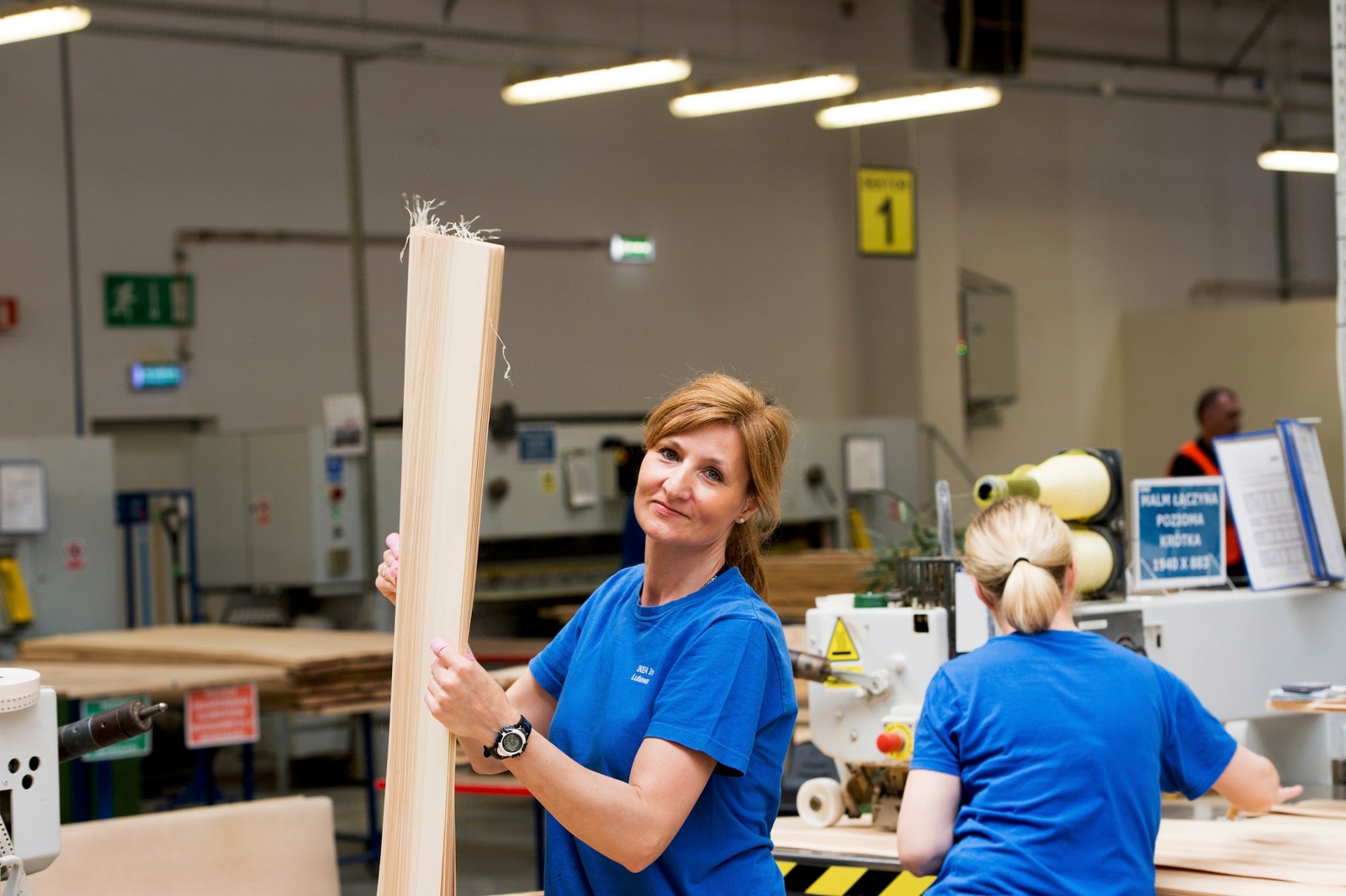
Image courtesy IKEA
Poland is already the world’s third-largest exporter of furniture, after China and Germany, with nearly 90% of its furniture production sent abroad. For now, a relatively small percentage of those goods are going to the U.S., which was the sixth-largest destination for Polish furniture last year, but the market share has been growing. Since 2010, it has almost doubled from 200.7 million euros ($223 million) to 384 euros ($427 million) in 2018, according to B+R Studio, which analyzes the Polish furniture market.
This uptick can be attributed in part to Poland’s hunger to reach new markets. “If we want ‘made in Poland’ furniture to be high-margin, it must be a recognizable brand all over the world,” said Jadwiga Emilewicz, the country’s former minister for entrepreneurship and technology, earlier this year. Indeed, the Polish consulate in New York has hosted events to promote the country’s furniture industry and Polish brands are a growing presence at U.S. trade shows including High Point Market.
Historically, distance and large customs duties made the American market difficult to penetrate, says Milena Dorozińska, an analyst at B+R Studio. But now, thanks to the U.S.’s recent trade war with China, she says that “Polish furniture manufacturers intend to take advantage of the situation.”

Photo courtesy Ole Konsrtantyner/Fritz Hansen
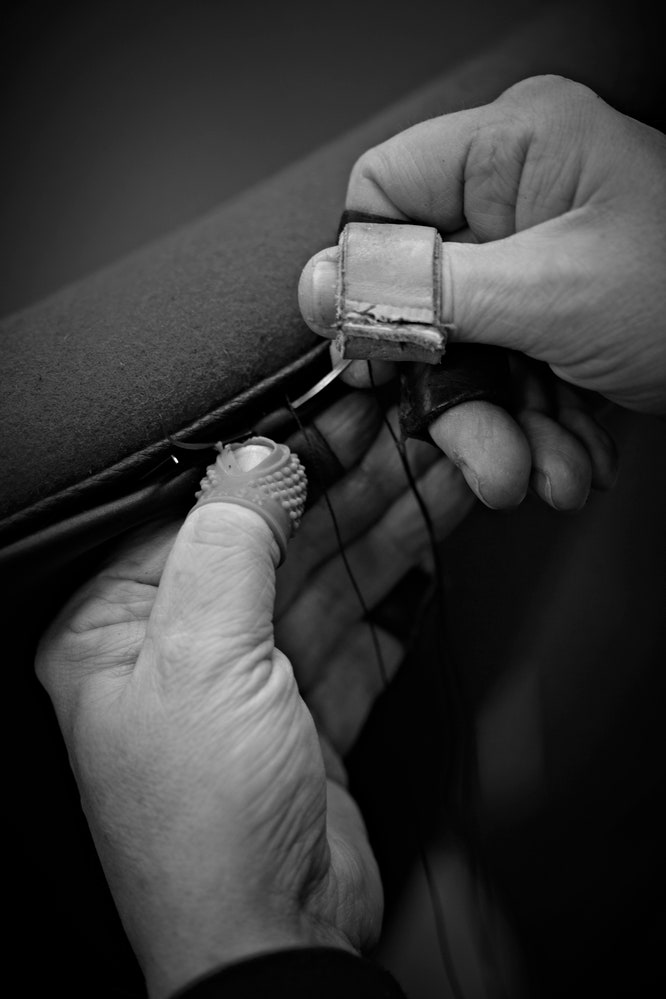
Photo courtesy Ole Konstantyner/Fritz Hansen
Some American companies have already caught on, drawn by the quality workmanship and competitive prices compared to Western Europe. One such company is Skyline, a family-owned and operated wholesaler based outside Chicago.“Tariffs were not the initial reason we began to source product, but they did accelerate our efforts to move our existing production from China,” says Meganne Wecker, the company’s president and CCO. By helping Polish partners implement innovative techniques, the company plans to enhance their supply chain for e-commerce, she adds.
In Poland, people in the furniture business have noticed this shift. “There is growing trust in Polish producers. Americans increasingly realize that a lot of furniture from Germany with the label ‘Made in Europe’ comes from Poland,” says Jarek Zajac, head of MIP Furniture, a company that connects Polish furniture manufacturers with customers in the U.S., often for big projects like hotels or condo buildings.
Still, there are a few hurdles for U.S. companies wanting to partner with Polish firms. One roadblock Skyline has encountered is synching up Polish and U.S. furniture testing standards. “Each retailer has different testing protocols they require for their product, and there are only a few labs which are versed in these protocols and will guarantee this type of testing,” Wecker says.
Polish producers face their own challenges, especially a labor shortage despite an influx of workers from neighboring Ukraine. But if Polish companies can maintain their advantage, based not only on price, but also on skill and quality, the country could become the next furniture manufacturing hub for the U.S. where most of the country is, in Zajac’s words, “undiscovered territory.”
https://www.architecturaldigest.com/story/poland-furniture-manufacturing
January 15, 2020
Is Poland Europe’s New Furniture-Making Powerhouse?
With continued uncertainty hovering over U.S.–China trade relations, manufacturers are searching for alternatives—and Poland is poised to step in
For Americans, European furniture might mean a sleek Italian sofa or a sculptural Danish chair. Far fewer would think of Poland. Yet the Central European country is poised to become the continent’s furniture powerhouse. According to one estimate, every second sofa in Europe is made in Poland. With growing confidence, Polish furniture producers are eyeing more distant markets, including the U.S. Their timing couldn’t be better: With President Trump’s trade war, China has become a less viable option for many U.S. furniture companies who will continue to face 25% tariffs, in spite of a tentative U.S.–China trade deal reached last week. Polish exporters are eager to step in.
This is not the first time Poland has seized such opportunities. In the 1960s, for example, IKEA’s founder Ingvar Kamprad opted to shift manufacturing from Sweden to Poland, after Swedish furniture dealers tried to shut him out of the industry. Almost 60 years later, Poland is the largest producer of IKEA furniture, employing some 10,000 people across 16 plants, which manufacture popular items from HEMNES bedroom furniture to LACK coffee tables. Yet today, Polish manufacturing is not limited to flat-pack and has come to include work with more high-end companies such as office brands Lammhults and Bene, as well as Danish companies Hay and Fritz Hansen. The latter company’s iconic Egg lounge chair, designed by Arne Jacobsen, is made entirely in Poland.
Image courtesy IKEA
Poland is already the world’s third-largest exporter of furniture, after China and Germany, with nearly 90% of its furniture production sent abroad. For now, a relatively small percentage of those goods are going to the U.S., which was the sixth-largest destination for Polish furniture last year, but the market share has been growing. Since 2010, it has almost doubled from 200.7 million euros ($223 million) to 384 euros ($427 million) in 2018, according to B+R Studio, which analyzes the Polish furniture market.
This uptick can be attributed in part to Poland’s hunger to reach new markets. “If we want ‘made in Poland’ furniture to be high-margin, it must be a recognizable brand all over the world,” said Jadwiga Emilewicz, the country’s former minister for entrepreneurship and technology, earlier this year. Indeed, the Polish consulate in New York has hosted events to promote the country’s furniture industry and Polish brands are a growing presence at U.S. trade shows including High Point Market.
Historically, distance and large customs duties made the American market difficult to penetrate, says Milena Dorozińska, an analyst at B+R Studio. But now, thanks to the U.S.’s recent trade war with China, she says that “Polish furniture manufacturers intend to take advantage of the situation.”
Photo courtesy Ole Konsrtantyner/Fritz Hansen
Photo courtesy Ole Konstantyner/Fritz Hansen
Some American companies have already caught on, drawn by the quality workmanship and competitive prices compared to Western Europe. One such company is Skyline, a family-owned and operated wholesaler based outside Chicago.“Tariffs were not the initial reason we began to source product, but they did accelerate our efforts to move our existing production from China,” says Meganne Wecker, the company’s president and CCO. By helping Polish partners implement innovative techniques, the company plans to enhance their supply chain for e-commerce, she adds.
In Poland, people in the furniture business have noticed this shift. “There is growing trust in Polish producers. Americans increasingly realize that a lot of furniture from Germany with the label ‘Made in Europe’ comes from Poland,” says Jarek Zajac, head of MIP Furniture, a company that connects Polish furniture manufacturers with customers in the U.S., often for big projects like hotels or condo buildings.
Still, there are a few hurdles for U.S. companies wanting to partner with Polish firms. One roadblock Skyline has encountered is synching up Polish and U.S. furniture testing standards. “Each retailer has different testing protocols they require for their product, and there are only a few labs which are versed in these protocols and will guarantee this type of testing,” Wecker says.
Polish producers face their own challenges, especially a labor shortage despite an influx of workers from neighboring Ukraine. But if Polish companies can maintain their advantage, based not only on price, but also on skill and quality, the country could become the next furniture manufacturing hub for the U.S. where most of the country is, in Zajac’s words, “undiscovered territory.”
https://www.architecturaldigest.com/story/poland-furniture-manufacturing
January 15, 2020
Palmer Holland Converts to Employee Stock Ownership Plan
Commitment to Employees, Principals and Independence Leads Company to Evolve
Cleveland, Ohio, Jan. 10, 2020 — Palmer Holland, a North American specialty chemical and ingredient distributor of raw materials, converted to a privately held Employee Stock Ownership Plan (ESOP) with an ownership team made entirely of employees.
While Palmer Holland was a private company prior to the transition, this move solidified the organization’s goal to remain an independent specialty chemical and ingredient distributor for the long term. While others in the sector have sold to multinational, publicly-traded companies or reorganized, Palmer Holland has doubled down on the model, its people and its independence.
An ESOP, similar to a profit-sharing plan, lets a company set up a trust fund and contribute new shares of its stock as a retirement benefit to employees. This change will make Palmer Holland more independent and even more dependable in order to further live up to its commitment to customer excellence and unique commercial offerings to global chemical manufacturers.
“The conversion to an ESOP allows Palmer Holland to benefit employees and principals, live up to our core values in excellence, and evolve and grow,” said Bryn Irvine, CEO. “It has always been our goal to remain independent even in this climate where others are selling. Our ESOP allows us to retain our culture and unparalleled way of doing business.”
The move to an ESOP will not change day-to-day function and visibility in relationships with current customers or principals. This is not a new management or organizational structure; the only change is that its partners now get to connect with owners at every interaction.
The ESOP structure also provides another tool in recruiting and retaining top talent and adds a significant component to the employee benefit plan.
For more information about Palmer Holland, please visit palmerholland.com.
About Palmer Holland
Established in 1925 as Palmer Supplies Company, today Palmer Holland is a North American specialty chemical and ingredient distributor of raw materials headquartered in Cleveland, Ohio with over 40 account managers and ingredient consultants stationed throughout the United States and Canada. Palmer Holland is a private, employee-owned company which allows us greater flexibility in the marketplace and a dedicated platform for long-term success. This flexibility enables Palmer Holland to provide our customers and principals with the most effective and efficient solutions. These partners are rooted in the areas of Agriculture, CASE (coatings, adhesives, sealants, elastomers), Health and Nutrition, Lubricants and Plastics. For more information about Palmer Holland, visit our website at www.palmerholland.com.
https://news.thomasnet.com/companystory/palmer-holland-converts-to-employee-stock-ownership-plan-40032862
January 15, 2020
Here Is The Full Text Of The “Phase One” US-China Trade Deal
The full text of the 94-page US-China “Phase One” Trade deal is below, and here, courtesy of Bloomberg, are some of the top highlights:
Agriculture details:
- China Purchases to Include Oilseeds, Meat, Cereals, Cotton
- China to Buy Add’l $19.5B U.S. Agriculture Products in 2021
- China to Buy Add’l $12.5B U.S. Agriculture Products in 2020
- China to Approve Pending Applications for U.S. Bond Raters
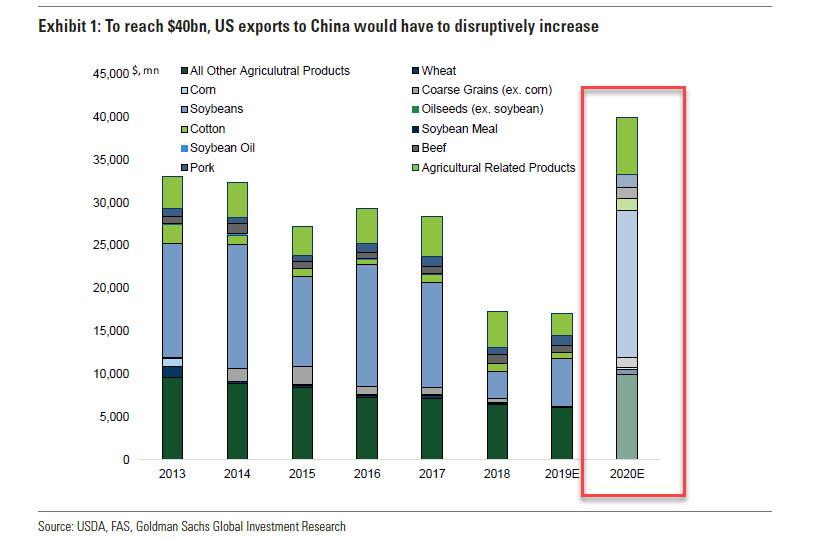
As Bloomberg notes, China is committing to buying about $32 billion in additional U.S. farm products over the next two years, that’s coming on top of levels seen in 2017 (pre-trade war). Specifically, China committed to importing at least $12.5 billion more agricultural goods this year than in 2017, rising to $19.5 billion next year. It’s unclear just how this will happen without China’s destroying existing supply chains. China will also “strive” to purchase an additional $5 billion a year in farm products.
Energy details:
- China to Buy Add’l $33.9B U.S. Energy Products in 2021
- China to Buy More U.S. Nuclear Power Equipment in Trade Deal
- China Energy Purchases to Include LNG, Oil, Products, Coal
- China to Buy Add’l $18.5B U.S. Energy Products in 2020
Chinese Purchases
- During the two-year period from January 1, 2020 through December 31, 2021, China shall ensure that purchases and imports into China from the U.S. of the manufactured goods, agricultural goods, energy products, and services identified in Annex 6.1 exceed the corresponding 2017 baseline amount by no less than $200 billion.
Intellectual Property
- The U.S. recognizes the importance of intellectual property protection. China recognizes the importance of establishing and implementing a comprehensive legal system of intellectual property protection and enforcement as it transforms from a major intellectual property consumer to a major intellectual property producer. China believes that enhancing intellectual property protection and enforcement is in the interest of building an innovative country, growing innovation-driven enterprises, and promoting high quality economic growth.
Tech Transfer
- The Parties affirm the importance of ensuring that the transfer of technology occurs on voluntary, market-based terms and recognize that forced technology transfer is a significant concern. The Parties further recognize the importance of undertaking steps to address these issues, in light of the profound impact of technology and technological change on the world economy.
Currency, Competitive Devaluation And Enforcement Mechanism
The text contains agreements not to engage in competitive devaluation, to respect one another’s monetary policy and to maintain transparency. Much of that, though, could probably have been inferred from what the U.S. Treasury said the other day in the FX report that saw it remove the tag of currency manipulator from China.
The big questions revolve around the enforcement mechanism. The FX section says points of contention can be referred to a new dispute resolution arrangement that’s being established by the agreement, and if that doesn’t work, the IMF can be called in.
- 1. Issues related to exchange rate policy or transparency shall be referred by either the U.S. Secretary of the Treasury or the Governor of the People’s Bank of China to the Bilateral Evaluation and Dispute Resolution Arrangement established in Chapter 7 (Bilateral Evaluation and Dispute Resolution).
- 2. If there is failure to arrive at a mutually satisfactory resolution under the Bilateral Evaluation and Dispute Resolution Arrangement, the U.S. Secretary of the Treasury or the Governor of the People’s Bank of China may also request that the IMF, consistent with its mandate: (a) undertake rigorous surveillance of the macroeconomic and exchange rate policies and data transparency and reporting policies of the requested Party; or (b) initiate formal consultations and provide input, as appropriate.”
The dispute arrangement itself is outlined in chapter 7, where some of the key sections appear to be as follows:
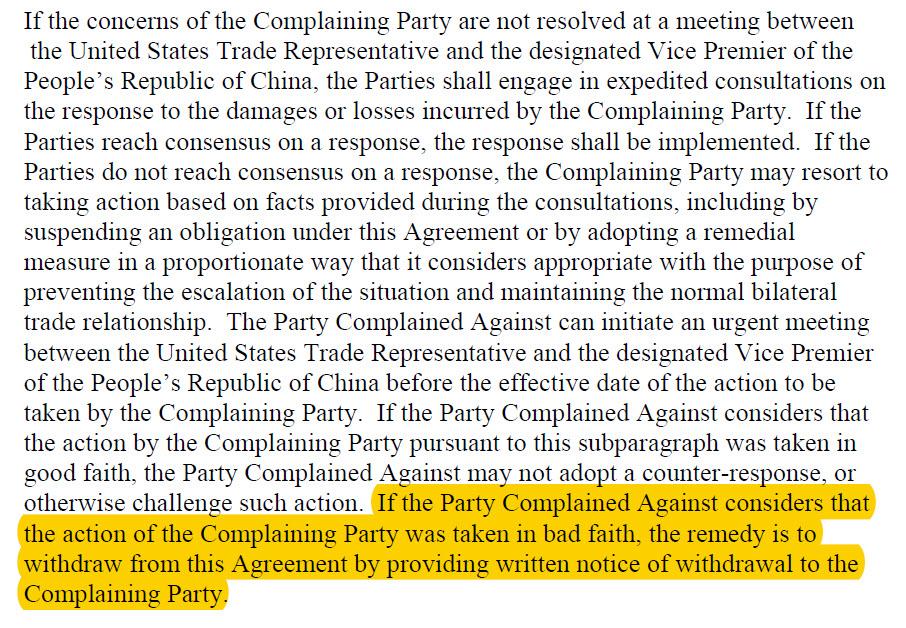
- If the Parties do not reach consensus on a response, the Complaining Party may resort to taking action based on facts provided during the consultations, including by suspending an obligation under this Agreement or by adopting a remedial measure in a proportionate way that it considers appropriate with the purpose of preventing the escalation of the situation and maintaining the normal bilateral trade relationship.
- If the Party Complained Against considers that the action of the Complaining Party was taken in bad faith, the remedy is to withdraw from this Agreement by providing written notice of withdrawal to the Complaining Party.
Financial Services
- China shall allow U.S. financial services suppliers to apply for asset management company licenses that would permit them to acquire non-performing loans directly from Chinese banks, beginning with provincial licenses. When additional national licenses are granted, China shall treat U.S. financial services suppliers on a non-discriminatory basis with Chinese suppliers, including with respect to the granting of such licenses.
- No later than April 1, 2020, China shall remove the foreign equity cap in the life, pension, and health insurance sectors and allow wholly U.S.-owned insurance companies to participate in these sectors. China affirms that there are no restrictions on the ability of U.S.-owned insurance companies established in China to wholly own insurance asset management companies in China.
- “No later than April 1, 2020, China shall eliminate foreign equity limits and allow wholly U.S.-owned services suppliers to participate in the securities, fund management, and futures sectors.
- China affirms that a wholly U.S.-owned credit rating services supplier has been allowed to rate domestic bonds sold to domestic and international investors, including for the interbank market. China commits that it shall continue to allow U.S. service suppliers, including wholly U.S.-owned credit rating services suppliers, to rate all types of domestic bonds sold to domestic and international investors. Within three months after the date of entry into force of this Agreement, China shall review and approve any pending license applications of U.S. service suppliers to provide credit rating services.
- Each Party shall allow a supplier of credit rating services of the other Party to acquire a majority ownership stake in the supplier’s existing joint venture.”
Full deal text: (pdf link)
https://www.zerohedge.com/economics/here-full-text-phase-one-us-china-trade-deal
 Everchem Updates Archive
 Sign Up for Email Updates