
The Urethane Blog
August 12, 2019
Humans are intelligent beings capable of innovating their way out of shortages.
Rare Earths Crisis in Retrospect

On April 10, a team of 21 Japanese scientists discovered a 16 million ton patch of mineral-rich deep sea mud near Minami-Tori Island, which lies 790 miles off the coast of Japan. The patch appears to contain a wealth of rare earth elements, including 780 years’ worth of yttrium, 620 years’ worth of europium, 420 years’ worth of terbium and 730 years’ worth of dysprosium. This find, the scientists concluded, “has the potential to supply these materials on a semi-infinite basis to the world.”
The happy discovery provides us with an opportunity to revisit the last crisis over the availability of natural resources and recall the ingenuous ways in which humanity tackled that particular problem.
In September 2010, a Chinese fishing trawler and a Japanese coast guard vessel collided in waters disputed by the two countries. The Japanese detained the captain of the Chinese vessel and China responded by halting all shipments of rare earths to Japan. The latter used the imported metals in a number of high-tech industries, including production of magnets and Toyota Priuses. At the time of the embargo, China accounted for 97 percent of rare earths production and a large part of the processing business. Predictably, global panic ensued.
In the United States, which uses the rare elements in its defense systems, wind turbines and electric cars, the great and the good rang the alarm bells. Writing in The New York Times, the Nobel Prize-winning economist Paul Krugman opined,
“You really have to wonder why nobody raised an alarm while this was happening, if only on national security grounds. But policy makers simply stood by as the U.S. rare earth industry shut down…. The result was a monopoly position exceeding the wildest dreams of Middle Eastern oil-fueled tyrants. Couple the rare earth story with China’s behavior on other fronts — the state subsidies that help firms gain key contracts, the pressure on foreign companies to move production to China and, above all, that exchange-rate policy — and what you have is a portrait of a rogue economic superpower, unwilling to play by the rules. And the question is what the rest of us are going to do about it.”
The U.S. Congress convened a hearing on “China’s monopoly on rare earths: Implications for U.S. foreign and security policy,” with Rep. Donald Manzullo (R-IL) declaring, “China’s actions against Japan fundamentally transformed the rare earths market for the worse. As a result, manufacturers can no longer expect a steady supply of these elements, and the pricing uncertainty created by this action threatens tens of thousands of American jobs.” Rep. Brad Sherman (D-CA) argued that “Chinese control over rare earth elements gives them one more argument as to why we should kowtow to China,” while a report by the Government Accountability Office warned that “rebuilding a U.S. rare earth supply chain may take up to 15 years.”
So, what really happened?
In a 2014 Council on Foreign Relations report, Eugene Gholz, an associate professor of public affairs at the University of Texas at Austin, revisited the crisis and found that the Chinese embargo proved to be a bit of a dud. Some Chinese exporters got around the embargo by using legal loopholes, such as selling rare earths after combining them with other alloys. Others smuggled the elements out of China outright. Some companies found ways to make their products using smaller amounts of the elements while others “remembered that they did not need the high performance of specialized rare earth[s] … they were merely using them because, at least until the 2010 episode, they were relatively inexpensive and convenient.” Third, companies around the world started raising money for new mining projects, ramped up the existing plant capacities and accelerated plans to recycle rare earths.

The market response, then, diffused the immediate crisis when prices of rare earths, which spiked in 2011, came down again. In the long run, as the Minami-Tori find suggests, future supply of rare earths seems promising.
The broader lesson from the rare earths episode is this: human beings are intelligent animals who innovate their way out of shortages, real and imagined. We have done so many times before. In some cases, we have relied on greater efficiency. An aluminum can, for example, weighed about 3 ounces in 1959. Today, it weighs less than half an ounce. In other cases, we have replaced hard to come by resources with those that are more plentiful. Instead of killing whales for lamp oil, for instance, we burn coal, oil and gas. Finally, we have gotten better at identifying natural resource deposits. Thus, contrary to a century of predictions, our known resources of fossil fuels are higher than ever.
As such, there is no a priori reason why human ingenuity and market incentives should not be able to handle future shortages as well.
https://humanprogress.org/article.php?p=1268
August 12, 2019
Humans are intelligent beings capable of innovating their way out of shortages.
Rare Earths Crisis in Retrospect
On April 10, a team of 21 Japanese scientists discovered a 16 million ton patch of mineral-rich deep sea mud near Minami-Tori Island, which lies 790 miles off the coast of Japan. The patch appears to contain a wealth of rare earth elements, including 780 years’ worth of yttrium, 620 years’ worth of europium, 420 years’ worth of terbium and 730 years’ worth of dysprosium. This find, the scientists concluded, “has the potential to supply these materials on a semi-infinite basis to the world.”
The happy discovery provides us with an opportunity to revisit the last crisis over the availability of natural resources and recall the ingenuous ways in which humanity tackled that particular problem.
In September 2010, a Chinese fishing trawler and a Japanese coast guard vessel collided in waters disputed by the two countries. The Japanese detained the captain of the Chinese vessel and China responded by halting all shipments of rare earths to Japan. The latter used the imported metals in a number of high-tech industries, including production of magnets and Toyota Priuses. At the time of the embargo, China accounted for 97 percent of rare earths production and a large part of the processing business. Predictably, global panic ensued.
In the United States, which uses the rare elements in its defense systems, wind turbines and electric cars, the great and the good rang the alarm bells. Writing in The New York Times, the Nobel Prize-winning economist Paul Krugman opined,
“You really have to wonder why nobody raised an alarm while this was happening, if only on national security grounds. But policy makers simply stood by as the U.S. rare earth industry shut down…. The result was a monopoly position exceeding the wildest dreams of Middle Eastern oil-fueled tyrants. Couple the rare earth story with China’s behavior on other fronts — the state subsidies that help firms gain key contracts, the pressure on foreign companies to move production to China and, above all, that exchange-rate policy — and what you have is a portrait of a rogue economic superpower, unwilling to play by the rules. And the question is what the rest of us are going to do about it.”
The U.S. Congress convened a hearing on “China’s monopoly on rare earths: Implications for U.S. foreign and security policy,” with Rep. Donald Manzullo (R-IL) declaring, “China’s actions against Japan fundamentally transformed the rare earths market for the worse. As a result, manufacturers can no longer expect a steady supply of these elements, and the pricing uncertainty created by this action threatens tens of thousands of American jobs.” Rep. Brad Sherman (D-CA) argued that “Chinese control over rare earth elements gives them one more argument as to why we should kowtow to China,” while a report by the Government Accountability Office warned that “rebuilding a U.S. rare earth supply chain may take up to 15 years.”
So, what really happened?
In a 2014 Council on Foreign Relations report, Eugene Gholz, an associate professor of public affairs at the University of Texas at Austin, revisited the crisis and found that the Chinese embargo proved to be a bit of a dud. Some Chinese exporters got around the embargo by using legal loopholes, such as selling rare earths after combining them with other alloys. Others smuggled the elements out of China outright. Some companies found ways to make their products using smaller amounts of the elements while others “remembered that they did not need the high performance of specialized rare earth[s] … they were merely using them because, at least until the 2010 episode, they were relatively inexpensive and convenient.” Third, companies around the world started raising money for new mining projects, ramped up the existing plant capacities and accelerated plans to recycle rare earths.
The market response, then, diffused the immediate crisis when prices of rare earths, which spiked in 2011, came down again. In the long run, as the Minami-Tori find suggests, future supply of rare earths seems promising.
The broader lesson from the rare earths episode is this: human beings are intelligent animals who innovate their way out of shortages, real and imagined. We have done so many times before. In some cases, we have relied on greater efficiency. An aluminum can, for example, weighed about 3 ounces in 1959. Today, it weighs less than half an ounce. In other cases, we have replaced hard to come by resources with those that are more plentiful. Instead of killing whales for lamp oil, for instance, we burn coal, oil and gas. Finally, we have gotten better at identifying natural resource deposits. Thus, contrary to a century of predictions, our known resources of fossil fuels are higher than ever.
As such, there is no a priori reason why human ingenuity and market incentives should not be able to handle future shortages as well.
https://humanprogress.org/article.php?p=1268
August 12, 2019
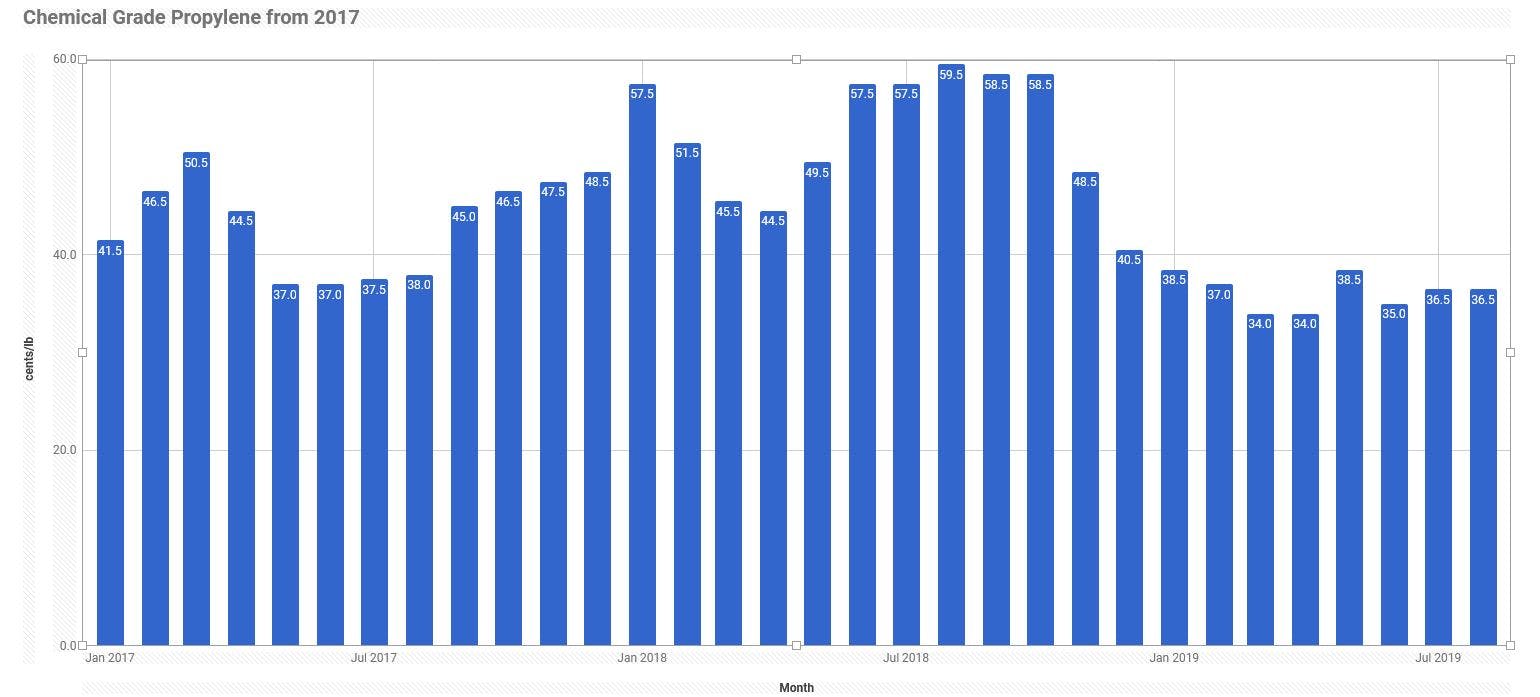
https://www.eia.gov/dnav/pet/hist/LeafHandler.ashx?n=PET&s=WPLSTUS1&f=W
August 12, 2019
https://www.eia.gov/dnav/pet/hist/LeafHandler.ashx?n=PET&s=WPLSTUS1&f=W
August 9, 2019
St. James Parish council sends chemical plant’s land use permit back to planning commission
5th August 2019 · 0 Comments
By Meghan Holmes
Contributing Writer
On July 24, the St. James Parish council voted unanimously to return a previously approved land use permit for Wanhua Chemical’s new $1.25 billion plastic manufacturing facility back to the parish planning commission.
Initially approved in a 5-3 vote, local residents and advocacy groups, represented by the Tulane Environmental Law Clinic, filed an appeal in May to reverse the decision and stop the plant’s construction, arguing, among other things, that residents less than a mile away could be exposed to harmful phosgene emissions.
Subsequent public records requests on the part of the Tulane Environmental Law Clinic exposed unannounced meetings between parish officials and Wanhua executives in the days prior to the planning commission vote, leading residents to sue the parish for violation of Louisiana’s Open Meetings Law.
“There’s been a lot of communication between the company and the parish and state government,” said Anne Rolfes with the Louisiana Bucket Brigade. “They got this permit through the planning commission and now they want federal tariff exemptions in a foreign trade zone. This shouldn’t be happening after they’ve already received land use approval; everything should have been on the table.”
About a month ago, St. James Parish officials received notice from the Port of South Louisiana that Wanhua had applied to seek exemptions from federal trade tariffs. A proposed Foreign Trade Zone for the complex could also mean exemption from inventory taxes as well as sales tax, both of which parish officials considered part of their initial deal with the company. Parish council members sent Wanhua’s permit back to the planning commission at the appeal hearing while local officials and company executives work to resolve the tax dispute in the time before the permit’s next review.
Parish officials told The Advocate that the company has promised to waive any sovereign immunity and commit to pay sales and inventory taxes, and in a June 18 letter to the parish, Alex Liu, chief executive officer of Wanhua Chemical’s U.S. operations, said the company regretted any miscommunication with the parish about the trade zone.
Last November, Wanhua applied for at least 60 exemptions from federal trade tariffs, some of which have been denied, and some of which are still pending. “This request to the Port of South Louisiana for a foreign trade zone designation could be a way to still get around tariffs even though some of their exclusion requests have been denied,” said Kimberly Terrell, director of community outreach with the Tulane Environmental Law Clinic. “The exemption requests are for different chemicals and pieces of equipment.”
Some of the products Wanhua requested to be tariff-exempt are part of China’s “Made in China 2025” program, a strategic effort on the part of the country to strengthen and upgrade their manufacturing capabilities. “The tariff exemption of some chemicals was denied because they’re strategic to this program,” Terrell said. “This initiative supports Chinese-based industry and subsidizes certain products to help make them global leaders.”
Wanhua’s U.S. operations are overseen by Wanhua China, which is ultimately controlled by a municipality in eastern China. “Municipal governments in China have no real political power,” Terrell said. “The ultimate controlling party is the central government of China, and executives within the company serve on committees dedicated to developing and maintaining ties to the Communist party.”
Local residents opposed to the plant and advocacy groups argue that the Wanhua’s ties to mainland China “make accountability and enforceability an issue,” said Lisa Jordan, director and supervising attorney with the Tulane Environmental Law Clinic. “If this company violates a law, will they say, ‘Sorry, but we are a sovereign nation,’ when it comes time for enforcement? This is something that we know our clients and parish officials are concerned about.”
Residents have also expressed concern about the cumulative impact of another plant in the area, with Mosaic, Occidental Chemical, and Raven Energy all nearby. “We don’t want anymore chemical plants in this area,” said District Four resident Myrtle Felton. “The chemicals are already making people sick, and they want to keep building more plants.”
During the recent parish council meeting, several representatives from the chemical industry voiced support for the plant, touting the jobs and revenue it would bring to the parish. Opponents argue that jobs typically go to people outside the immediately impacted communities, comprised primarily of low-income people of color.
“For our clients, the concern is at several levels,” Jordan said. “At the base level, they’re already inundated with pollution and there has been an explosion of new facilities in the area. It’s one thing when they’re U.S. companies. Now, we have governments from other countries picking this low-income, minority community to come in and dump on, and enough is enough.”
The St. James Parish planning commission will review Wanhua’s land use permit again in late August. In the meantime, there will be a public hearing where local residents and advocates plan to speak. “We were not part of the process at all,” Felton said. “When we started trying to find things out, the parish said it was too late, but I don’t think it’s ever too late to stop something.”
This article originally published in the August 5, 2019 print edition of The Louisiana Weekly newspaper.
St. James Parish council sends chemical plant’s land use permit back to planning commission
 Everchem Updates Archive
 Sign Up for Email Updates