The Urethane Blog

May 22, 2019

Roadcheck

The CVSA International Roadcheck will take place from June 4-6 this year, with an emphasis on an important topic: steering and suspension.

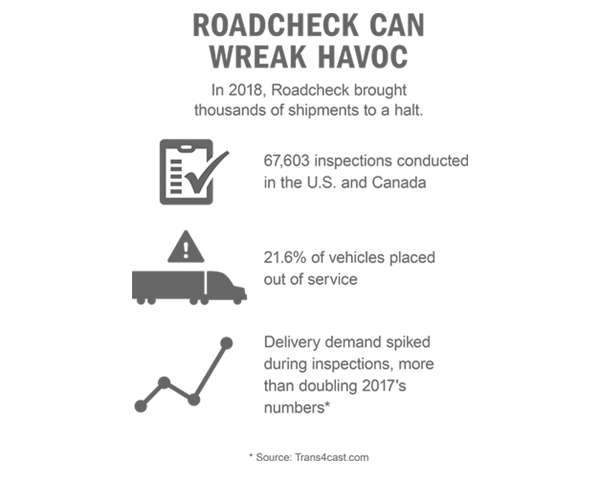
During this time, the CVSA will be inspecting commercial motor vehicles and drivers across North America for both driver operating requirements and vehicle mechanical fitness. Below you will see that during last year’s Roadcheck more than 21% of the 67,603 vehicles inspected were placed out of service. View the full infographic.
I want to remind you how important it is to plan your freight ahead for Roadcheck week. Due to increased scrutiny, a number of carriers and drivers choose not to operate the week of the event and our data shows that each year there is a significant drop in overall available capacity in the marketplace. Reduced capacity or delays caused by non-compliant drivers or faulty equipment will add days to your supply chain.
http://s1392407584.t.en25.com/e/es?s=1392407584&e=27103&elqTrackId=0835ad748d6a4b29b602eaa6ee5bf011&elq=7262554ac4ad4dd49cada8de32a94b80&elqaid=1361&elqat=1

Middle East polyether polyols prices may mark further declines

Source: ICIS News

2019/05/21

SINGAPORE (ICIS)–Spot import prices of polyether polyols in the Middle East declined and further weakness could be on the cards as some producers could offer discount to entice buying interest amid worries about the impact of the China-US trade war on downstream polyurethane foam demand.

Khor Fakkan port in Dubai, UAE (Photo by Deedee Degelia Brent Winebrenner Degelia/Mood Board/REX/Shutterstock)In the week ended 16 May, import prices of 10-13.5% polymer polyols (POP) drummed cargoes in the Middle East were lowered by $50/tonne to $1,650-1,700/tonne CFR (cost & freight) Middle East, after three straight weeks of stable pricing.

Meanwhile, import prices for conventional polyether polyols also fell by $50/tonne to $1,550-1,600/tonne CFR Middle East.

There were limited offers for conventional grade polyols to the Middle East and these matched the high end of the week’s range. One supplier indicated it had run out of conventional polyols for sale to the spot market in May.

For POP, the bulk of offers were within that $1,650-1,700/tonne CFR Middle East range but buying interest at these price levels was still generally muted.

ICIS Editorial Chart goes here

One reason behind this was the fear that the escalating US-China trade tensions could eventually snuff out any recovery in demand for co-component toluene diisocyanate (TDI), which is used together with polyols in the manufacture of flexible foam products like mattresses.

But China suppliers this week were able to reduce their prices quite substantially because recent declines in the prices of feedstock propylene oxide (PO) in China had given these suppliers some flexibility to lower their prices without affecting their margins. Even so, the reduced prices generated limited demand from buyers.

Other Asian suppliers said they were facing persistently weak demand conditions and stiff pricing competition for polyols imports into the Middle East region.

“For polyols, our business is not doing so good – the demand is very slow,” said one Asian supplier.

A producer has reduced operating rates at its polyols plant to lower operating costs in the face of sluggish demand.

The Muslim fasting month of Ramadan, which started in early May, also further dampened market activity, according to market sources.

In Asia, polyols prices last week were assessed mostly lower as offers for certain grades softened on the back of poor cargo uptake from southeast Asian buyers.

ICIS Editorial Chart goes here

The chart above shows the spread between feedstock PO import prices in China and POP prices in the Middle East. It shows the correlation between feedstock PO and prices of POP in the Middle East and indicates POP prices are likely to continue tracking PO.

Focus article by Izham Ahmad

https://www.icis.com/explore/resources/news/2019/05/21/10366213/middle-east-polyether-polyols-prices-may-mark-further-declines

May 20, 2019

More Olin History

OLIN – 103 YEARS OF SERVING THE INDUSTRY  (1996 Company Presentation)


In 1892, Franklin W. Olin founded the Equitable Powder Company, a predecessor of Olin Industries at E. Alton, III., to supply blasting powder to Midwestern coal fields. In 1898, the company expanded into small arms ammunition forming the Western Cartridge Company.

During World War I, Western built a brass mill to supply the great demand for brass for military cartridges. After the war, Western turned to “tailor-made” brass and other copper alloys to absorb excess production capacity.

In 1931, Western purchased Winchester Repeating Arms Co. which was founded in New Haven, CT in 1866. During World War II Western manufactured 15 billion rounds of ammunition and also developed the U.S. carbine and M-I rifle. By the end of the war, Western employed 62,000 people.

In 1944, the various Olin businesses were brought together under the corporate name of Olin Industries and management transferred from Franklin Olin to his sons, John and Spencer.

In 1949, Olin entered the cellophane business and in a related move acquired the properties of Frost Lumber Industries of Louisiana and Arkansas, including 440,000 acres of timberland, in 1951. In addition, Olin acquired Ecusta Paper Corp at Pisgah Forest, NC – a leading producer of cigarette paper and other fine paper products. In 1954, Olin merged with Mathieson Chemical Corp. to form Olin-Mathieson, a 500 million dollar company. Mathieson Chemical Corp. was founded in 1892 as Mathieson Alkali Works of Saltville, VA.

In 1949, Mathieson expanded into industrial and agricultural chemicals when it became a producer of sulfuric acid, fertilizers and pesticides. In 1950, it built a plant at Brandenburg, KY to process natural gas into organic chemicals – the current site of Olin flexible polyols production.

In 1952, Mathieson acquired E. R. Squibb & Sons. Ultimately it was spun off by Olin Corporation in 1968.

The first acquisition of Olin-Mathieson was in 1955 when Blockson Chemical Co. of Joliet, I11., a manufacturer of industrial phosphates, was acquired. It was recently transferred to Albright & Wilson Company.

In 1960, Olin entered the urethanes business manufacturing propylene oxide and polyols at Brandenburg and later TDI at Ashtabula, OH. In 1962, anew plant was built at Charleston, TN for the production of chlorine and caustic soda and HTH. Today Olin is the fourth largest Chlor-Alkali producer in the U.S. and a world leader in pool chemicals production.

In 1971, groundbreaking occured on a new TDI plant in Lake Charles, LA. Today the Lake Charles chemical complex is Olin’s largest and our TDI plant there is among the largest in the world. Olin since has exited production of TDI at Ashtabula and Moundsville, WV.

In 1981, Olin sold its sporting arms business but retained the Winchester ammunition business which today is a major Olin business. In 1985, Olin sold its Ecusta Paper and cellophane businesses. In 1984, Olin entered the electronic chemicals business with the acquisition of Philip A. Hunt Chemical. Portions of that business were coupled with Ciba-Geigy’s photoresist business in a joint venture forming another of Olin’s successful businesses today.

In recent years, Olin has eliminated various chemicals businesses that were not strategic growth businesses for us and has concentrated on growing the core businesses that have become the basis for the growth of the Corporation. This includes globally growing Olin businesses such as urethanes, biocides and pool chemicals.

Through our Total Quality Management program and ISO 9000 approval of all chemical plants, Olin is dedicated to meeting our customer’s expectations of product quality, service and safety as we grow into our third century.


Thanks to John Meehan for forwarding this from his files . . .