
The Urethane Blog
October 1, 2024
Abu Dhabi’s ADNOC to buy German chemicals firm Covestro for $16 bln
By Ludwig Burger and Yousef Saba

October 1, 20249:44 AM EDTUpdated 5 hours ago
- Summary
- Companies
- ADNOC to pay 62 euros per Covestro share, take on 3 bln in debt
- To buy additional 1.2 bln euros worth of new shares in Covestro
- Covestro shares jump 3.7% to a three-year high
- Deal could fuel debate over foreign takeovers of German firms
BERLIN/DUBAI Oct 1 (Reuters) – Abu Dhabi’s ADNOC has struck a deal to buy German chemicals maker Covestro (1COV.DE)
, opens new tab for 14.7 billion euros ($16.3 billion), including debt, in the energy giant’s biggest ever acquisition.
The deal is one of the largest foreign takeovers by a Gulf state as countries in the region seek to reduce their dependence on oil amid the global switch to cleaner energy.
It also comes at a sensitive time in Germany for foreign acquisitions, as Commerzbank and the government seek to fend off interest in the bank from Italy’s UniCredit.
The 62 euros-per-share cash deal, which will also see ADNOC take on about 3 billion euros in debt, follows protracted negotiations and is a cornerstone of the energy giant’s drive to grow in petrochemicals along with gas and renewable energy.
ADNOC said that when the transaction closes it would also buy 1.17 billion euros worth of new shares in Covestro to improve funding at the former Bayer (BAYGn.DE)
, opens new tab unit.
“We believe that the fundamentals of chemicals are strong,” Khaled Salmeen, ADNOC head of downstream, marketing, and trading, told Reuters, adding he saw Covestro as a platform for growth.
“This sector, and specifically Covestro’s space in the sector, will grow higher than GDP from now to 2050,” he added.
Shares in Covestro, which makes plastics and chemicals for the automotive, construction, and engineering sectors, jumped 3.7% to a three-year high of 58 euros.
ADNOC has also been in talks with Austria’s OMV to merge their petrochemical joint ventures Borealis and Borouge. ADNOC took a 24.9% stake in OMV from Abu Dhabi sovereign fund Mubadala in February.
Covestro was created in 2015 after being spun off from Bayer. It opened its books to ADNOC in June – a year after ADNOC’s initial interest was reported.
The takeover offer will be subject to a minimum acceptance threshold of 50% plus one share of Covestro’s capital.
“The long negotiations have paid off – both for Covestro and for the shareholders. The deal is well structured and now has a good chance of coming to a successful conclusion,” said Arne Rautenberg, a fund manager at Union Investment, one of Covestro’s top-15 shareholders.
LIMITS TO CONTROL
The deal could stoke a debate in Germany about foreign takeovers of blue-chip companies amid a weak economy.
ADNOC, however, granted some autonomy to Covestro.
Covestro said that half of the seats on its supervisory board would continue to be held by labour representatives, as is the norm at German listed companies, and two members of the board’s shareholder representatives would be independent of ADNOC.
ADNOC pledged not to sell, close or significantly reduce Covestro’s business activities and to protect its technology and intellectual property, Covestro said.
The German company added its management board would stay in charge of management and strategic direction, and Covestro CEO Markus Steilemann told Reuters he planned to serve out his contract running until 2028.
“I believe this is the right step not only to keep Covestro on a growth path but also to move it to the fast lane,” Steilemann said of the deal.
Covestro reported a net loss of 72 million euros in the first six months of the year, versus a 46 million euro profit a year earlier.
The agreement highlights an increase in dealmaking between the Middle East and Europe as Gulf investors are drawn to company valuations that lag those in the United States, as well as an easier regulatory backdrop for buyers and a generally warmer welcome because of investment needs, advisers and analysts have told Reuters.
It is the Middle East’s second biggest acquisition after Israel’s Teva Pharmaceuticals’ purchase of Allergan’s generic drugs business for around $40 billion in 2015, according to Dealogic data.
The deal also follows several failed bids by Emirati companies to buy foreign targets.
Abu Dhabi utility TAQA’s $22 billion attempt to buy Spain’s Naturgy collapsed earlier this year, partly over disagreements on governance, people with direct knowledge of the talks said.
Britain also blocked an Abu Dhabi-backed group’s plan to buy the Telegraph newspaper, and only cleared Abu Dhabi state-controlled telecoms firm e&’s purchase of a 14.6% stake in Vodafone after ordering the UK company to take steps to manage national security risks that the government said the deal posed.
Covestro said its management board was advised by investment banks Goldman Sachs (GS.N), opens new tab and Perella Weinberg (PWP.O)
, opens new tab as well as by law firm Linklaters. Its supervisory board was advised by Rothschild & Co and Macquarie Capital as well as by law firm SZA Schilling, Zutt & Anschuetz.
ADNOC said Morgan Stanley (MS.N), opens new tab exclusively provided financial advice while Freshfields Bruckhaus Deringer was its legal adviser.
September 30, 2024
Here’s What America Moved By Rail Last Year
by Tyler Durden
Friday, Sep 27, 2024 – 06:55 AM
Rail freight is the backbone of U.S. infrastructure, moving millions of tons of various materials and linking the nation’s numerous ports and cities to facilitate domestic and international trade.
But what material did U.S. rail move the most in 2023?
For this graphic, Visual Capitalist partnered with The Greenbrier Companies to answer this question and dive into what makes rail vital to the U.S. economy.
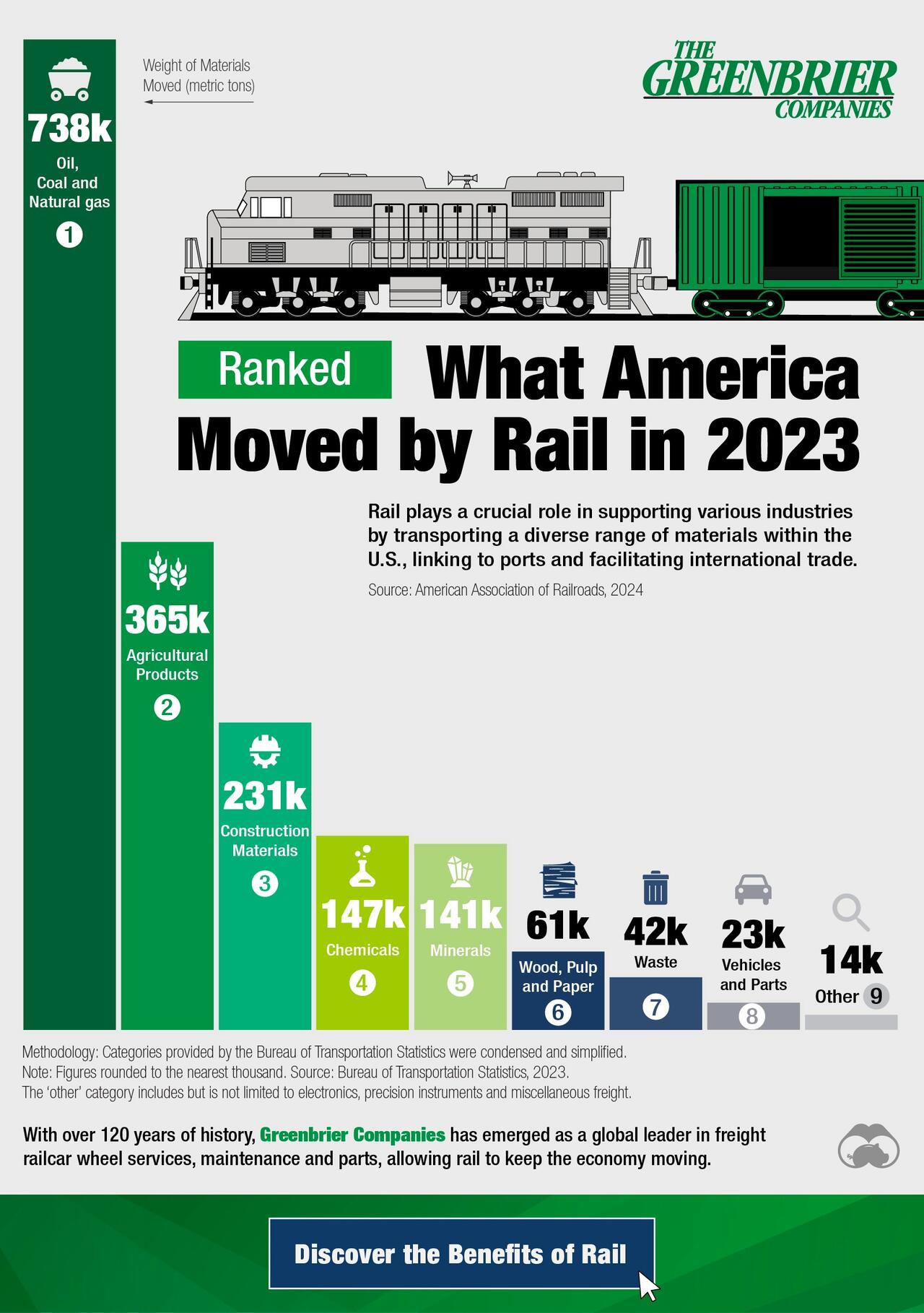
What Does U.S. Rail Freight Move?
Versatility is one of rail’s greatest strengths. In 2023, rail freight moved nearly 1.8 million metric tons of a wide variety of materials around the nations 140,000 mile rail network—everything from wood and chemicals to vehicle parts and waste products.
However, energy products, particularly coal, oil, and natural gas, were the most common materials moved.
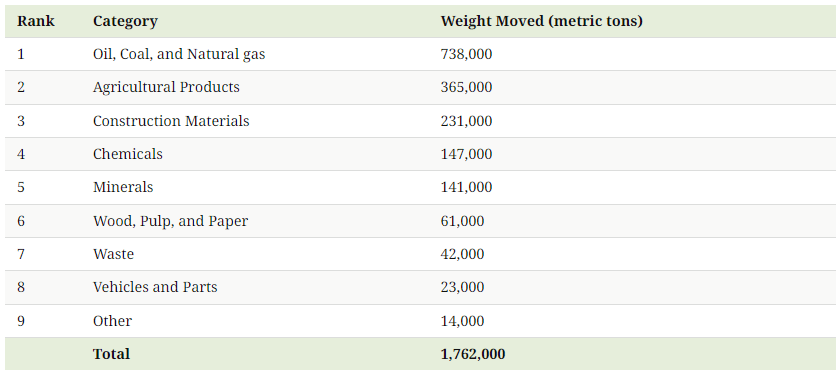
Methodology: Categories provided by the Bureau of Transportation Statistics were condensed and simplified. Note: Figures rounded to the nearest thousand. The ‘other’ category includes but is not limited to electronics, precision instruments, and miscellaneous freight.
Why Choose Rail?
Rail is an incredibly versatile mode of transport, facilitating a wide range of industries and the U.S. economy as a whole by, amongst many other reasons, acting as a point of connection between trucking and shipping.
However, rail’s history of safety and sustainability makes it stand out.
According to the Federal Railroad Administration, rail accident rates are down 27%, and rail accidents where hazardous materials are transported are down 75% since 2000.
Rail also contributes just 1.8% of U.S. transports greenhouse gases despite moving 40% of all long-distance freight. Rail can do this as it is a highly fuel efficient form of transport and is becoming more efficient every year.
In fact, in 2023, U.S. rail consumed 709 million fewer gallons of fuel than it did in 2000.
Moving What Matters
Rail is critical in supporting many U.S. industries by transporting diverse materials within the nation, linking to ports, and facilitating international trade.
With over 120 years of history, Greenbrier Companies has emerged as a global leader in freight railcar wheel services, maintenance, and parts, allowing rail to keep the economy moving.
Are you interested in learning more about how rail could serve your business?
Discover the Benefits of Rail
https://www.zerohedge.com/commodities/heres-what-america-moved-rail-last-year
September 29, 2024
New home sales fall as buyers await anticipated rate cut
By Dakota Smith
September 25, 2024 | 10:36 am CDT

WASHINGTON — Expectations of the Federal Reserve beginning the first in a series of rate reductions kept potential home buyers in a holding pattern in August.
- Sales of newly built, single-family homes in August fell 4.7% after an unusually strong July, according to newly released data from the U.S. Department of Housing and Urban Development and the U.S. Census Bureau.
- August new home sales registered a 716,000 seasonally adjusted annual rate, after an upwardly revised estimate of 751,000 for July.
- Despite the slip in August, the three-month moving average for new home sales is at its highest level since March of 2022. New home sales are up 4% on a year-to-date basis through August.
“Builder sentiment and future sales expectations are improving as the Federal Reserve begins a credit easing cycle,” said Carl Harris, chairman of the National Association of Home Builders (NAHB). “However, due to the mortgage interest lock-in effect, declining interest rates will mean rising existing home inventories and some additional new competition for home builders.”
“While a 7.8 months’ supply may be considered elevated in normal market conditions, there is currently only a 4.1 months’ supply of existing single-family homes on the market,” said NAHB chief economist Robert Dietz. “Combined, new and existing total months’ supply remains below historic norms at approximately 4.7, although this measure is expected to increase as more home sellers test the market in the months ahead.”
A new home sale occurs when a sales contract is signed, or a deposit is accepted. The home can be in any stage of construction: not yet started, under construction, or completed. In addition to adjusting for seasonal effects, the August reading of 716,000 units is the number of homes that would sell if this pace continued for the next 12 months.
New single-family home inventory increased 1.7% to 467,000 in August, a 7.8-month supply at the current sales pace. Completed, ready-to-occupy inventory increased to 105,000 homes, which is the highest level since 2009. However, this share makes up only 22% of new home inventory.
Median new home price fell back to $420,600, down 4.6% from a year ago due to builder price incentives amid multidecade highs for housing affordability challenges. The Census data reveals a gain for new home sales priced below $300,000, which made up 18% of new home sales in August compared to 12% a year ago.
Regionally, on a year-to-date basis, new home sales are up in all four regions, rising 2.1% in the Northeast, 21.9% in the Midwest, 0.8% in the South and 4.7% in the West.
September 27, 2024
STRIKE ENDS: New Union Contract Reached For Approximately 120 Monument Chemical Workers
Berry Craig
03 Sep, 2024

32BJ SEIU Members ratified a contract that ensures better wages, job security, and safe working conditions
(Brandenburg, KY) – On Friday, 32BJ SEIU and representatives with Monument Chemical reached an agreement for a new contract. A weeklong strike of 120 Monument Chemical Workers ended this morning, after reaching a historic deal that protects workers’ jobs and safe working conditions while also raising their wages.
The three year contract includes:
- Historic wage increases of 9% over the course of the contract.
- Protection against workforce changes that would pull skilled workers from their primary functions.
- Protection of seniority benefits at the plant including workers’ schedules.
- Mediated labor management meetings so that workers can provide direct input on their working conditions.
- An increase in eligible holiday pay from 8 hours to 12 hours.
“I’m glad to see the members get back to work and get a fair contract, but we wish it didn’t have to get to this point,” said Kevin Duke, a Monument Chemical Shipper. “This deal means that the shifts and wage increases that many of us have worked decades to earn will remain intact.”
“Getting a fair deal done for our members was crucial to this community because they are such an enormous part of Meade County,” said Robert Smith, Kentucky State Director of 32BJ SEIU. “This agreement ensures that experienced workers will continue to handle these potentially dangerous chemicals, ensuring the plant’s safety. They are happy to get back to work with a contract that reflects the importance and excellence of what they do.”
“We are thankful to everyone who honked, brought food, and supported us throughout this difficult week,” said Larry Houglan, a Monument Chemical Operator. “We were able to negotiate something that was beneficial for both sides. This deal will help the company with retention and morale around the plant. When you have long time employees it shows it is somewhere worth working and growing at.”
The workers are vital to the safe and efficient operation of the plant and include Plant Operators, Polychem Specialists, Shippers, Lab Technicians, Wastewater Treatment workers, and others. They handle dangerous chemicals – such as carbide and ethylene oxide – maintain the boiler system, and manage wastewater, among other duties, ensuring compliance with environmental and safety standards. The workers will return to their duties Saturday.
https://ky.aflcio.org/news/strike-ends-new-union-contract-reached-approximately-120-monument
September 26, 2024
Steelcase results flat as big customer orders falter
By Larry Adams
September 24, 2024 | 3:32 pm CDT

Photo By Steelcase
GRAND RAPIDS, Mich. — Steelcase achieved flat revenue in the second quarter and reported that order growth in the Americas was primarily driven by government, education, and healthcare customers, while orders from large corporate customers declined compared to the prior year after several quarters of strong year-over-year growth.
“Our business continued to improve this quarter as our adjusted earnings grew 26% and we drove 3% order growth in the Americas,” said Sara Armbruster, president and CEO. “Our education business had especially strong results this quarter, which reflected the benefits of our strategy to diversify the customers and markets we serve. In the Americas, our strategy to lead the workplace transformation continued to gain traction as we have increased our market share over the past year based on available industry data through July. We expect order patterns from our largest corporate customers to return to growth in the second half of the year.”
The company, which ranks #4 on the FDMC 300 list, reported second quarter revenue of $855.8 million, net income of $63.1 million, or $0.53 per share, and adjusted earnings per share of $0.39. In the prior year, Steelcase reported revenue of $854.6 million, net income of $27.5 million, or $0.23 per share, and adjusted earnings per share of $0.31.
Revenue was approximately flat in the second quarter compared to the prior year, with a 1 percent increase in the Americas and a 4 percent decrease in International. On an organic basis, revenue grew 2 percent, with 3 percent growth in the Americas and a 4 percent decline in International. The Americas growth was driven by higher volume from large corporate, education, and government customers, while the International decline was primarily driven by continued weakness in China.
Operating income of $90.0 million in the second quarter represented an increase of $49.0 million compared to the prior year, driven by a $27.9 million benefit from a gain on the sale of land (net of related variable compensation expense), $5.7 million of lower restructuring costs, gross margin improvement in the Americas and lower operating expenses in International. The gain recorded during the quarter related to the sale of approximately 315 acres of unused land for net proceeds of $44.2 million. Adjusted operating income of $68.5 million in the second quarter represented an increase of $15.2 million compared to the prior year.
“The Americas delivered an 11% adjusted operating margin this quarter, driven by the seasonal strength of our education business and the continued progress of our profitability improvement initiatives,” said Dave Sylvester, senior vice president and CFO. “Our International segment drove $2.4 million of year-over-year improved adjusted operating results, despite the soft demand environment, and expects to be profitable in the third quarter.”
Gross margin of 34.5 percent in the second quarter represented an improvement of 130 basis points compared to the prior year driven by favorable business mix and benefits from operational performance and cost reduction initiatives.
Operating expenses of $205.1 million in the second quarter represented a decrease of $30.8 million compared to the prior year. The current year reflected a $42.1 million benefit from a gain on sale of land, a $4.3 million decrease from a divestiture, $3.7 million of lower spending and employee costs in International, $9.8 million of higher variable compensation expense (driven by the gain on the sale of land) and $2.2 million of higher information technology costs primarily related to the company’s business transformation initiative. The prior year reflected $5.1 million of gains related to the sale of an aircraft and other aviation assets.
Total liquidity, which is comprised of cash and cash equivalents, short-term investments, and the cash surrender value of company-owned life insurance, aggregated to $507.1 million at the end of the second quarter and represented an increase of $192.6 million compared to the prior year. Total debt was $446.7 million. Trailing four-quarter adjusted EBITDA of $285.3 million (or 9.1 percent of revenue) represented an increase of 16 percent compared to the prior year.
The Board of Directors has declared a quarterly cash dividend of $0.10 per share, to be paid on or before October 15, 2024, to shareholders of record as of September 30, 2024.
Outlook
At the end of the second quarter, the company’s backlog was approximately $680 million, which was approximately flat compared to the prior year and contained a higher percentage of orders expected to ship within ninety days compared to the prior year. The company expects third-quarter fiscal 2025 revenue to be in the range of $785 to $810 million. The company reported revenue of $777.9 million in the third quarter of fiscal 2024. The projected revenue range translates to growth of 1 to 4 percent compared to the prior year, or 1 to 5 percent on an organic basis.
The company expects to report earnings per share of between $0.18 to $0.22 for the third quarter of fiscal 2025 and adjusted earnings per share of between $0.21 to $0.25. The company reported earnings per share of $0.26 and had adjusted earnings per share of $0.29 in the third quarter of fiscal 2024 which benefited by approximately $0.09 related to the reversal of an accrued earnout liability and gains from the sale of fixed assets.
The third quarter estimates include:
- gross margin of approximately 32.5 to 33.0 percent,
- projected operating expenses of between $225 to $230 million, which includes $4.3 million of amortization of purchased intangible assets,
- projected interest expense, net of investment income and other income, net, of approximately $2 million, and
- projected effective tax rate of approximately 27 percent.
“Based on our results through the first half of the year and our third quarter outlook, we continue to have confidence of potentially achieving the higher end of the range of our fiscal 2025 target for adjusted earnings per share of between $0.85 to $1.00,” said Dave Sylvester.
“We are pleased with our results through the first half of fiscal 2025 in which our adjusted earnings per share increased by nearly 40% compared to the prior year,” said Armbruster. “We continue to focus on developing innovative solutions to help our customers transform their workplaces and diversify the customer and market segments we serve.”
 Everchem Updates Archive
 Sign Up for Email Updates

