
The Urethane Blog
July 8, 2024
China’s Rapid Renewables Rollout Hits Grid Limits
by Tyler Durden
Monday, Jul 08, 2024 – 02:45 AM
By John Kemp, senior energy analyst at Reuters
China’s record-breaking deployment of wind and solar capacity has worsened regional power imbalances, forcing the country to idle increasing amounts of renewable generation when it overwhelms local consumption.
New government regulations aim to reduce the amount of renewable generation that has to be abandoned by increasing long-distance transmission links and better coordinating generation plans across provinces.
Since the end of 2018, China’s total generating capacity has increased by 1.137 billion kilowatts (kW), compound annual growth of 9%, according to data from the National Bureau of statistics (NBS).
Thermal capacity, mainly from coal-fired plants but some from gas-fired generators, rose by 257 million kW or 4% per year (“China statistical yearbook”, NBS, 2023).
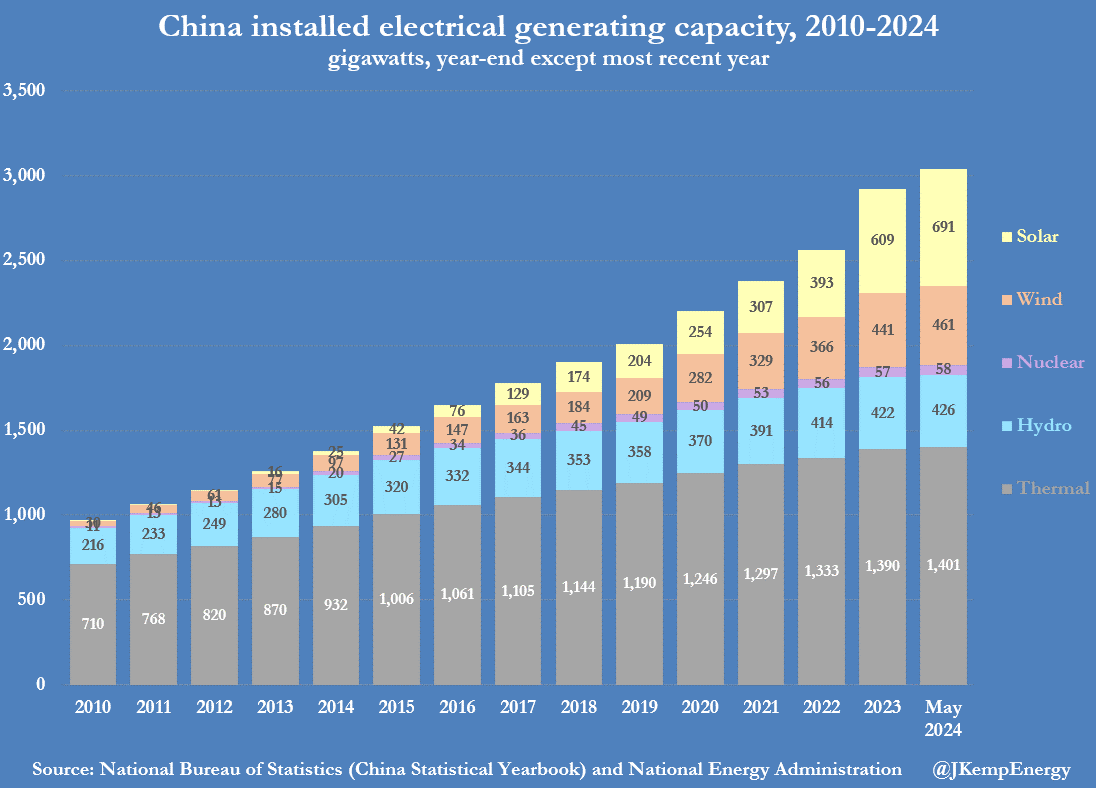
Most capacity additions, however, have come from what the government calls “new energy sources” – wind farms (277 million kW, 19% per year) and solar generators (517 million kW, 29% per year). Increased penetration of intermittent renewables is making it harder to manage a nationwide transmission system that was already struggling with large regional imbalances between generation and load.
The solution to variable wind and solar output is to smooth out fluctuations across a larger number of generators spread over much larger areas of the country, which will require more transmission and better scheduling.
Long-Distance Transmission
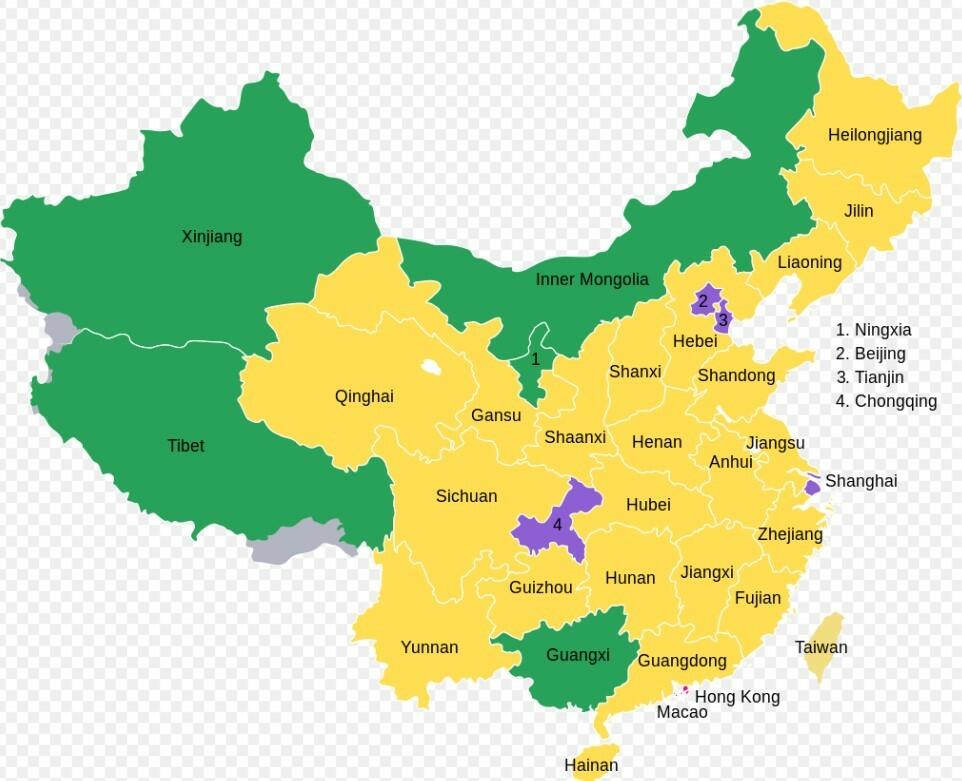
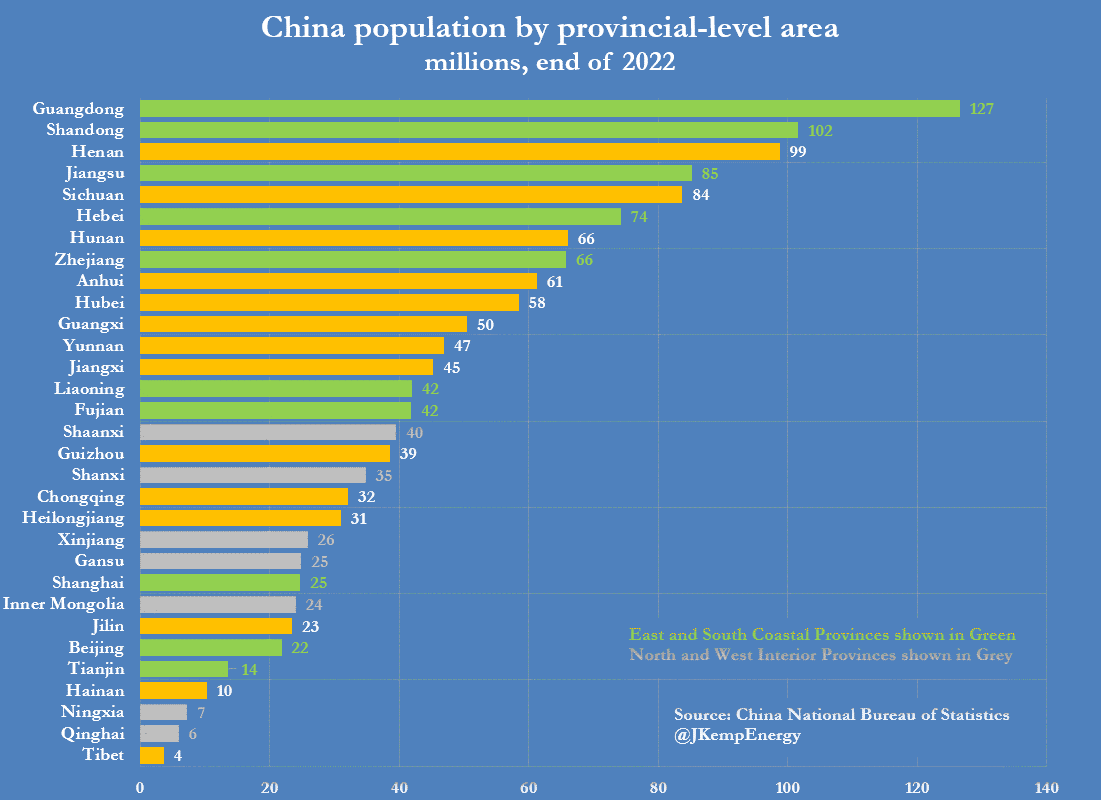
For decades, the country has been characterized by massive west-to-east electricity transfers from interior areas with surplus generation to the massive load centres on the east and south coasts. Ten provincial-level areas in the east and south (Liaoning, Hebei, Beijing, Tianjin, Shandong, Jiangsu, Shanghai, Zhejiang, Fujian and Guangdong) accounted for 50% of national consumption but only 40% of generation in 2022.
By contrast, six remote and sparsely populated northern and western areas (Inner Mongolia, Xinjiang, Shanxi, Shaanxi, Gansu and Ningxia) accounted for 18% of consumption but 25% of generation.
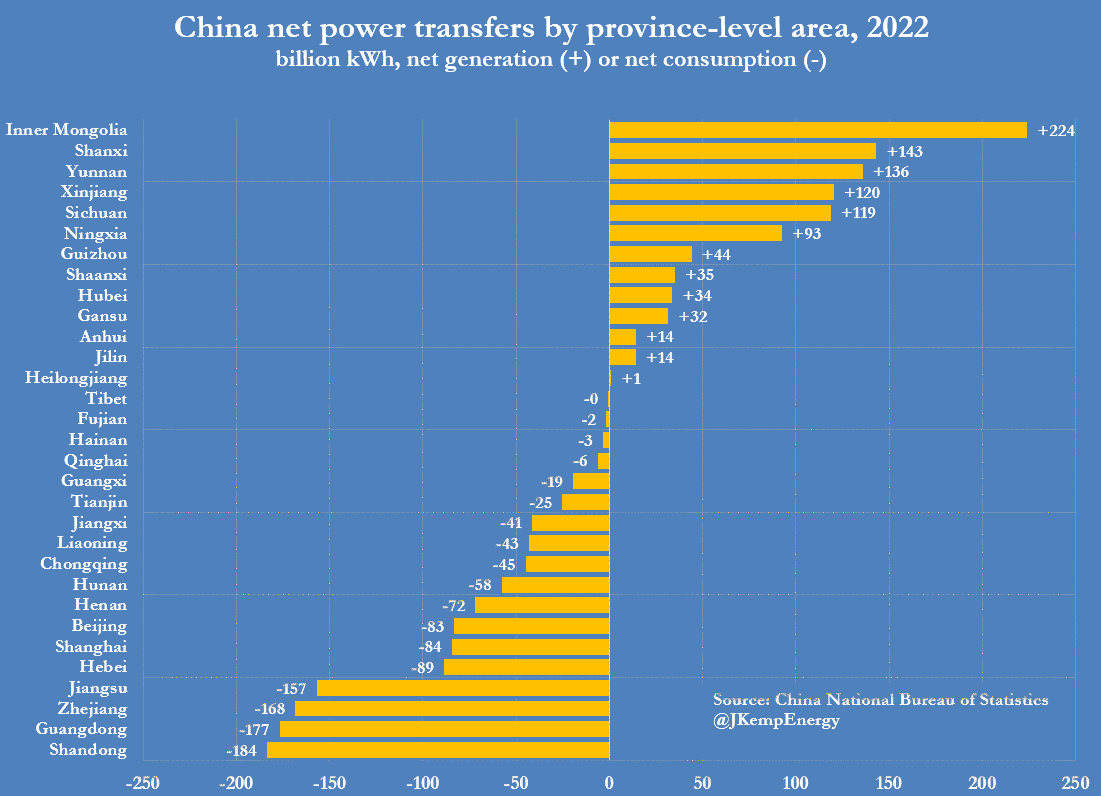
Chartbook: China regional electricity transfers
In response, China’s State Grid Corporation has constructed a network of ultra-high voltage transmission lines to move power thousands of kilometres from surplus areas in the west and north to deficit areas in the east and south.
In the process, China has become the world leader in ultra-high voltage transmission to move electricity over long distances while minimising line losses and is exporting its expertise around the world.
Inner Asia’s Energy Abundance
China’s northern and western areas are some of the least populated and poorest parts of the country, but rich in energy resources, traditionally coal but now increasingly gas and renewables.
The north and west contains the country’s most important coal deposits and has become a major centre of pit-head generation, with some electricity used locally by heavy industry, and the rest transmitted east and south.
Inner Mongolia, Shanxi, Shaanxi and Xinjiang alone accounted for 81% of coal mine production and 25% of all thermal generation in 2022, according to data from the NBS.
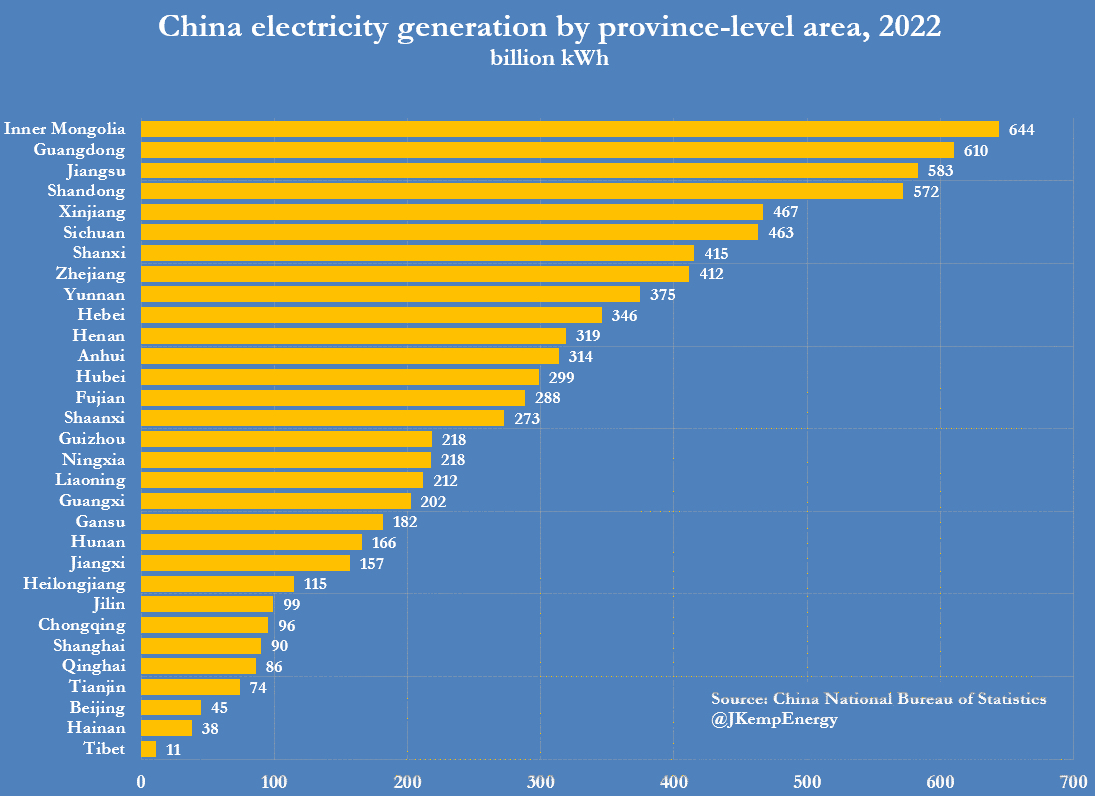
In a quirk of fate, the arid and windswept northern and western plains and deserts are also the best sites for giant wind farms and solar parks.
Inner Mongolia, Shanxi, Shaanxi and Xinjiang together with neighbouring Gansu, Ningxia and Qinghai accounted for 42% of all wind and solar generation last year.
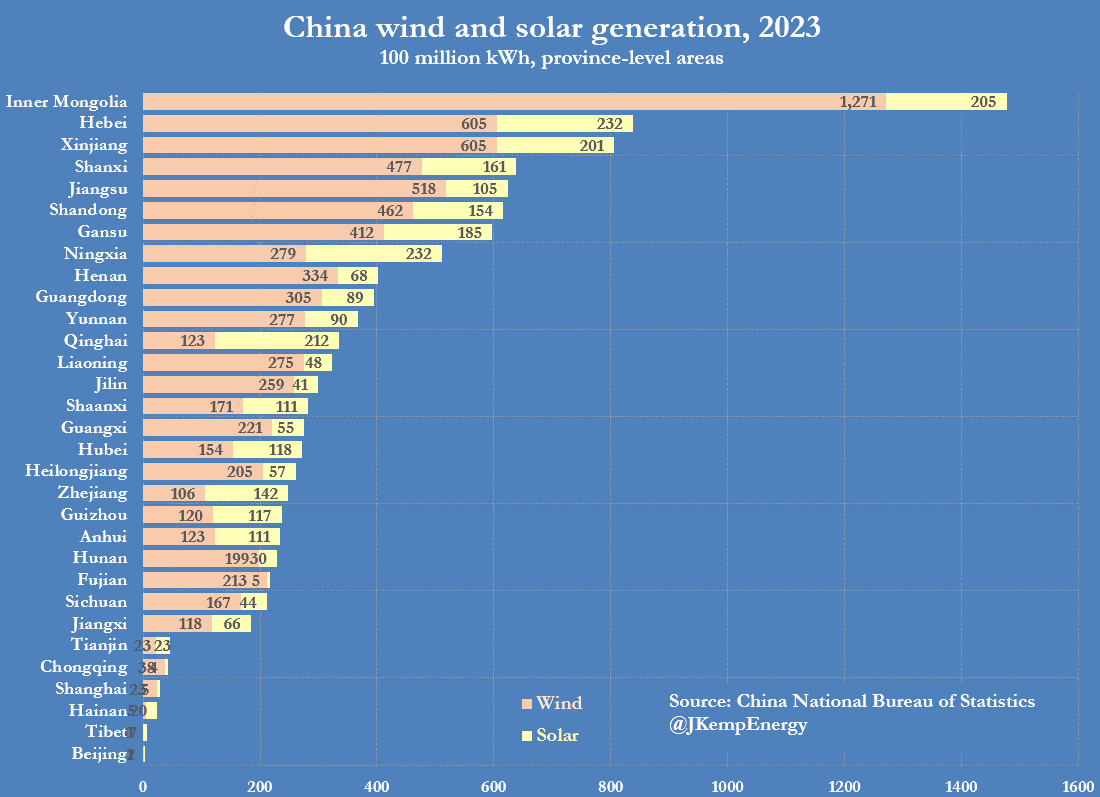
But the addition of so much wind and solar generation in a region already saturated with coal-fired power threatens to overwhelm the transmission system.
During peak periods of wind and solar generation, there is not enough population and industry in these areas to absorb all the output, and not enough long-distance transmission capacity to move the surplus east and south.
More Transmission And Planning
In 2016, the national utilisation rate for new energy sources fell to a record low of 84%, prompting the central government to launch a “Clean Energy Absorption Action Plan” to reduce the waste of renewable resources. The plan focused on improvements in local distribution, long-distance inter-provincial transmission, and energy trading to reduce the curtailment of new energy generation.
By 2023, the utilisation rate for wind power had climbed to a remarkable 97.3% and solar had reached 98%, according to the state-run news agency Xinhua.
With rapid deployment of renewable capacity, however, the problem of abandonment is re-emerging, with wind utilisation down to 96.1% and solar down to 96% in the first five months of 2024. Sliding utilisation has prompted an alert from the National New Energy Consumption Monitoring and Early Warning Center (“Solving the pain points and difficulties of new energy consumption”, Xinhua, July 1, 2024).
The response is likely to be similar, with renewed emphasis on integrating renewables at local level and more transmission capacity to move surplus power across provincial boundaries. In the last two years, central government policy statements have repeatedly focused on the need for better coordination of transmission and generation between provinces.
Creating A Truly National System
In a sign of the importance attached to the issue, the Communist Party’s Politburo held a group study session on new energy technology and energy security on February 29, 2024. The session, bringing together top central and regional leaders, included a discussion on boosting “the grid’s capacity capability to integrate, distribute and regulate clean energy.”
President Xi Jinping stressed need for “coordinated development of the energy sector” (“Xi stresses high-quality development of new energy”, CPC International Department, March 2, 2024).
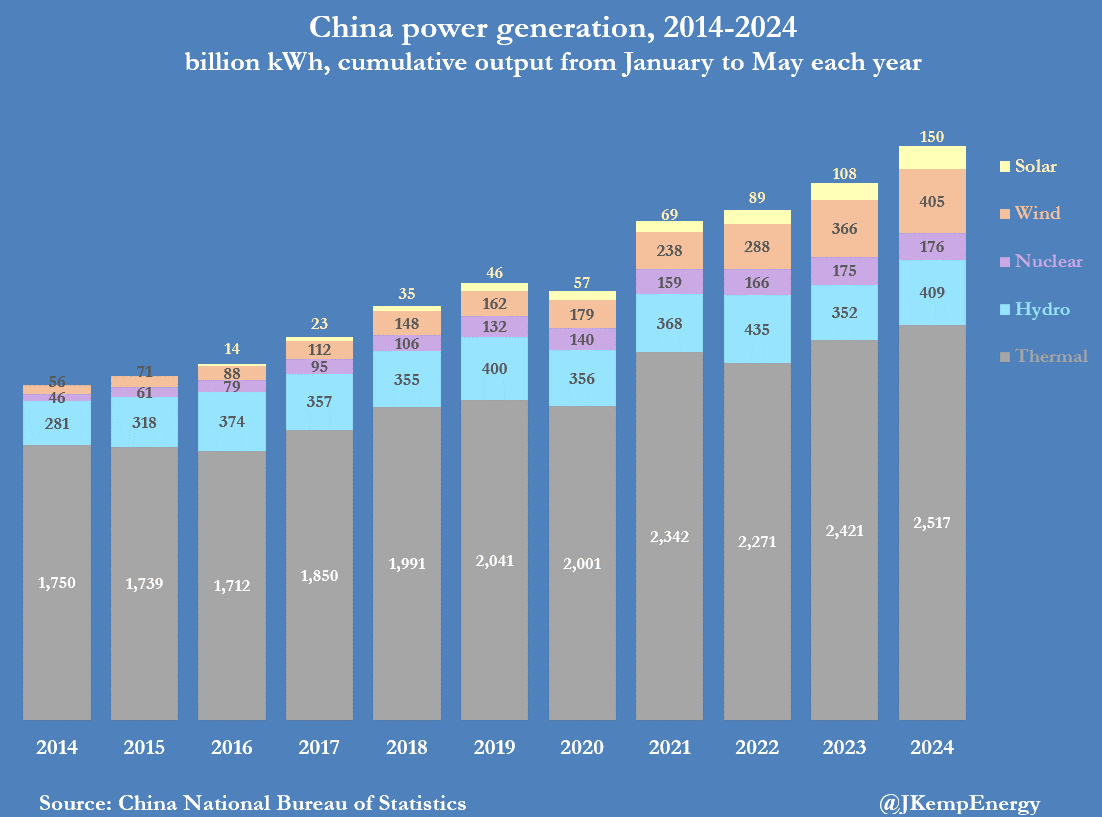
In many ways, China’s long-distance ultra-high voltage transmission system is an extraordinary engineering achievement, likely to be copied in other parts of the world as more and more renewables are connected to grids. It has enabled a remarkable penetration of intermittent renewables, as well as hydroelectric generation, into the national power system while maintaining or improving reliability. As a result, wind and solar producers supplied 15% of all generation in the first five months of 2024, up from 7% in the same period in 2019.
In some ways, however, China is still struggling to forge a truly integrated nationwide system from fragmented provincial-level utilities that pursue their own priorities. If government plans to achieve even higher renewables penetration are to be achieved, there will have to be much closer links and more coordination between different types of generators and across far wider areas.
https://www.zerohedge.com/markets/chinas-rapid-renewables-rollout-hits-grid-limits
July 3, 2024
BASF Pulls Plug on Potential Chile Investments Amid Lithium Rout
Wilfried Eckl-Dorna and James Attwood, Bloomberg News
(Bloomberg) — German chemicals giant BASF SE has abandoned plans to invest in lithium mining assets in Chile as a slowdown in electric-vehicle adoption worldwide drags down battery metal prices.
BASF withdrew from initial talks with Wealth Minerals Ltd., the Vancouver-based firm that has exploration projects in Chile, the German company said in an email to Bloomberg Tuesday.
A potential arrangement had included possible funding and offtake if Wealth obtained production contracts in Chile. BASF also was exploring the possibility of building a plant in Chile to turn lithium into the cathode that goes into electric-vehicle batteries.
“No collaboration between BASF and Wealth Materials materialized in the end,” BASF wrote. The company didn’t give a reason for ending the talks or mention the proposed cathode plant.
The withdrawal follows BASF’s announcement last week that it scrapped plans for a $2.6 billion nickel-cobalt refinery in Indonesia. Slowing EV sales growth has pushed down prices of key inputs, with lithium at three-year lows after surging to a record in late 2022. BASF now plans to bolster raw-materials supply for European operations via a new battery recycling plant in Germany, due to start operations later this year.
While the German company’s involvement in Chile was at a very early stage, it’s withdrawal is a blow to European authorities’ push for companies to secure deals with key battery metals suppliers.
It’s also a setback for Wealth as it grapples with a strategy being implemented in Chile to open new areas to lithium extraction. One of the company’s projects is in an area deemed of strategic importance, meaning it would have to take on a state-owned company as a majority partner.
Wealth Chief Executive Officer Henk van Alphen declined to comment on BASF’s exit. He said implementation of the government’s lithium strategy has been slow though progress is being made. Authorities next week are scheduled to announce details of firms interested in new contracts in nonstrategic salt flats.
July 3, 2024
Ocean Shipping Prices Are Pushing Toward Pandemic-Era Highs as Congestion Swells
Date: Monday, June 24, 2024
Source: The Wall Street Journal
Ship backups that plagued seaports during the Covid pandemic are making a comeback, as vessel diversions because of attacks in the Red Sea trigger gridlock and soaring costs at the start of the peak shipping season.
Flotillas of containerships and bulk carriers are growing off the coasts of Singapore, Malaysia, South Korea and China while ports in Spain and other parts of Europe look to dig out from container piles.
Houthi rebel attacks on commercial shipping in the Red Sea, which have effectively closed the Suez Canal since the end of last year, are being felt at faraway ports as the disruptions extend voyage times, throw ships off schedule and strand sea containers.
The snags are complicating logistics for retail and manufactured goods, but importers and exporters say they are most concerned that the backups could expand as demand picks up in the coming months heading into the busy peak shipping season. That could drive already-resurgent freight rates close to levels seen during the pandemic, when companies vied for scarce space on ships and spot-market prices for shipping a 40-foot container surged past $20,000.
The average worldwide cost of shipping a 40-foot container hit $4,119 the week ending June 14, according to Freightos, more than triple the cost in June last year and the highest rate since September 2022.
“We have not seen those $20,000 rates for a container as it was in the pandemic, but we are looking at $7,000 per box from Asia to the U.S. East Coast rates versus the normal rate of about $3,500,” said Michael Murray, who runs DeSales Trading, a threads and yarns wholesaler in Burlington, N.C.
“As an importer there is nothing worse than getting stuck with inventory having inflated freight costs like what happened in 2022,” he said
The disruptions come as a range of other events are adding to supply-chain challenges.
Some U.S. importers are pulling orders forward ahead of new tariffs on Chinese goods. The Panama Canal has been limiting ship movements because of a drought that only recently showed signs of abating. In the U.S., retailers and manufacturers are worried about recent dockworker warnings that they might strike at U.S. East Coast and Gulf Coast ports in October.
Freight specialists say the congestion could get worse if more importers bring in goods early to avoid higher costs and further delays later in the year.
“What we are seeing is a surge in cargo, as shippers book earlier and perhaps more containers than normal,” said Jonathan Roach, a container shipping analyst at London-based Braemer. “This is an attempt to front-load inventory and mitigate longer transit times and potential delays.”
“If the congestion worsens, we may see even more front-loaded cargo bookings, which could make the situation even worse,” he said.
The impact already shows signs of reaching the earnings of importing companies.
Mark Webb, chief financial officer of Quincy, Mass.-based J. Jill, said on a recent earnings call that the apparel retailer used “very costly” airfreight to rush in items ahead of Mother’s Day in May.
British retailer DFS Furniture this month slashed its profit outlook by half, largely because “Red Sea routing issues have persisted, resulting in delays to customer deliveries and higher freight costs.” The company said nearly $18 million of its goods were delayed because of the Red Sea-related disruptions.
Houthi rebels effectively closed the canal to most commercial shipping last fall when they started hijacking and attacking vessels in support of Palestinians in Gaza. They have captured, damaged and sunk vessels, killing several sailors.
Ocean carriers were initially able to cope with the re-routings around the Cape of Good Hope in southern Africa, which added 10 days or more to sailings. But global shipping networks started to buckle in May as retailers and manufacturers ramped up orders in an apparently early start to the peak shipping season.
The diversions around Africa knocked ships off schedule, causing ocean carriers to cancel some sailings and to divert vessels from other parts of the world to fill gaps in service. The disruptions also stranded containers in ports around the world and led to a shortage in export hubs like China.
The Port of Singapore, a global hub for container lines, has been swamped, leading to long wait times for a berth and increased shipping costs.
Average time in port at Singapore increased 15% between mid-April and mid-June to almost 40 days, according to S&P Global Market Intelligence’s Port Performance data.
Meanwhile, brokers, port operators and ship owners said ports like Barcelona in Spain and Antwerp in Belgium have been heavily congested in recent weeks as ships skip Mediterranean distribution hubs like Piraeus in Greece and Marseille in France and sail across Europe’s Atlantic coastline.
The cost of leasing sea containers has also skyrocketed at some gateways because so many boxes are tied up on the longer voyages around Africa’s Cape of Good Hope and stuck in the cargo snarls in Asia and Europe.
Container xChange, an online marketplace for sea containers, says the average price for a shipping container in Singapore in May was up 26% from October, before the Houthi attacks on commercial vessels began. Leasing prices for boxes from Shanghai to Los Angeles and Long Beach in May were about double the rate of last November.
The fast-rising shipping prices have been a boon to container lines. Danish shipping major A.P. Moller-Maersk this month raised its full-year guidance for the second time in roughly a month, projecting a $3 billion improvement in free cash flow for the year over its previous forecast.
“Trade flows will eventually return to normal when the Gaza conflict is resolved and ships return to the Red Sea,” said Nils Haupt, the chief spokesman for German boxship operator Hapag-Lloyd. “Freight rates will fall, because there is no escaping that there is a lot of extra capacity at sea.”
July 3, 2024
Furniture up in June as overall economy struggles
By Larry Adams
July 2, 2024 | 1:03 pm CDT

Economic activity in the manufacturing sector contracted in June for the third consecutive month and the 19th time in the last 20 months, say the nation’s supply executives in the latest Manufacturing ISM Report On Business.
Furniture & Related Products was one of eight industry categories that reported growth in June, coming in as the fourth highest growth industry behind printing, petroleum, and primary metals.
The report was issued today by Timothy R. Fiore, CPSM, C.P.M., Chair of the Institute for Supply Management (ISM) Manufacturing Business Survey Committee:
“The Manufacturing PMI registered 48.5 percent in June, down 0.2 percentage point from the 48.7 percent recorded in May. The overall economy continued in expansion for the 50th month after one month of contraction in April 2020. (A Manufacturing PMI above 42.5 percent, over a period of time, generally indicates an expansion of the overall economy.) The New Orders Index remained in contraction territory, registering 49.3 percent, 3.9 percentage points higher than the 45.4 percent recorded in May. The June reading of the Production Index (48.5 percent) is 1.7 percentage points lower than May’s figure of 50.2 percent. The Prices Index registered 52.1 percent, down 4.9 percentage points compared to the reading of 57 percent in May. The Backlog of Orders Index registered 41.7 percent, down 0.7 percentage point compared to the 42.4 percent recorded in May. The Employment Index registered 49.3 percent, down 1.8 percentage points from May’s figure of 51.1 percent.

“The Supplier Deliveries Index remained in ‘faster’ territory, registering 49.8 percent, 0.9 percentage point higher than the 48.9 percent recorded in May. (Supplier Deliveries is the only ISM Report On Business index that is inversed; a reading of above 50 percent indicates slower deliveries, which is typical as the economy improves and customer demand increases.) The Inventories Index registered 45.4 percent, down 2.5 percentage points compared to May’s reading of 47.9 percent.
“The New Export Orders Index reading of 48.8 percent is 1.8 percentage points lower than the 50.6 percent registered in May. The Imports Index dropped into contraction territory, registering 48.5 percent, 2.6 percentage point lower than the 51.1 percent reported in May.”
Fiore continues, “U.S. manufacturing activity continued in contraction at the close of the second quarter. Demand was weak again, output declined, and inputs stayed accommodative. Demand slowing was reflected by the (1) New Orders Index improving to marginal contraction, (2) New Export Orders Index returning to contraction, (3) Backlog of Orders Index dropping into stronger contraction territory, and (4) Customers’ Inventories Index moving into the low side of the ‘just right’ range, neutral for future production. Output (measured by the Production and Employment indexes) declined compared to May, with a combined 3.5-percentage point downward impact on the Manufacturing PMI calculation. Panelists’ companies reduced production levels month over month as head count reductions continued in June. Inputs — defined as supplier deliveries, inventories, prices and imports — continued to accommodate future demand growth. The Prices Index eased but remained in expansion (or ‘increasing’) territory; the index registered its second month of cooling increases.
“Demand remains subdued, as companies demonstrate an unwillingness to invest in capital and inventory due to current monetary policy and other conditions. Production execution was down compared to the previous month, likely causing revenue declines, putting pressure on profitability. Suppliers continue to have capacity, with lead times improving and shortages not as severe. Sixty-two percent of manufacturing gross domestic product (GDP) contracted in June, up from 55 percent in May. More concerning is the share of sector GDP registering a composite PMI calculation at or below 45 percent — a good barometer of overall manufacturing weakness — was 14 percent in June, 10 percentage points higher than the 4 percent reported in May,” says Fiore.
The eight manufacturing industries reporting growth in June — in order — are: Printing & Related Support Activities; Petroleum & Coal Products; Primary Metals; Furniture & Related Products; Paper Products; Chemical Products; Miscellaneous Manufacturing; and Nonmetallic Mineral Products. The nine industries reporting contraction in June — in the following order — are: Textile Mills; Machinery; Fabricated Metal Products; Wood Products; Transportation Equipment; Plastics & Rubber Products; Food, Beverage & Tobacco Products; Electrical Equipment, Appliances & Components; and Computer & Electronic Products.
July 2, 2024
C.H. Robinson slashes over 50% of US sales team, sources say
Brokerage disputes number of workers recently laid off
· Monday, July 01, 2024

Truck brokerage giant C.H. Robinson Worldwide laid off around 80 members of its remaining 150 sales representatives in the U.S. on Thursday, according to sources familiar with the cuts.
The source said the sales division of the publicly traded brokerage has slashed U.S. sales jobs by around 89% over the past six years as it turned its focus from its people to embracing technology.
“We once had about 650 sales reps in the U.S. divisions, but that number dropped as C.H. Robinson’s focus switched from training and retaining talented people to its focus on technology,” the source, who asked to remain anonymous for fear of retaliation, told FreightWaves.
He estimates the current number of C.H. Robinson’s sales reps, whose jobs are solely to sell the brokerage’s services, as around 70 nationwide after Thursday’s job cuts. He clarified that some legacy brokerages count business development and account management positions that may overlap with the sales division as part of their total sales headcount. C.H. Robinson doesn’t.
In a statement, a spokesperson for Eden, Minnesota-based C.H. Robinson (NASDAQ: CHRW) disputed the number of sales representatives affected by the recent cuts but declined to provide a breakdown of the number of sales positions C.H. Robinson eliminated in the U.S. last week.
While the source said he was only aware of the job cuts in the U.S., a company spokesperson said C.H. Robinson doesn’t break down the number of laid off workers by country as the brokerage also has offices in Canada and Mexico.
In a statement provided to FreightWaves, the company said that “less than 2% of NAST [North American Surface Transportation] roles were impacted in June as a part of a restructuring to ignite growth and provide greater opportunity for our sales employees.”
“We are getting fit, fast and focused as a part of our enterprise strategy and new operating model geared at delivering exceptional and high-value service to customers and carriers,” the company said.
Despite rumors that major changes were coming to the largest freight brokerage, the source said few expected that more than half of the U.S. sales group would be gutted.
“You can’t cut your sales team, which is the heart of your organization, and think that’s going to get you better results in the long run,” the source told FreightWaves. “I think if the leadership knew what these salespeople brought to the table and how hard it is to train a salesperson, I think they would regret what they did Thursday, because it’s going to take C.H. Robinson a decade to recover from this decision.”
Another source, who asked to remain anonymous for fear of retaliation, formerly worked at C.H. Robinson. He said most of the sales reps who were let go worked with the brokerage’s smaller accounts but that management told them they weren’t being terminated for performance issues as most were meeting or exceeding sales goals.
“It’s just sad that C.H. Robinson is prioritizing technology over people,” the source told FreightWaves.
Tech takes center stage?
A C.H. Robinson employee said the brokerage used to value and invest in its people over technology until Bob Biesterfeld, the former president and CEO of the freight brokerage, announced the company was investing $1 billion in technology in 2019 in an effort to protect its market share. FreightWaves reported that Biesterfield stepped down from his executive position and resigned from C.H. Robinson’s Board in early January 2023.
On Feb. 3, 2022, FreightWaves reported that C.H. Robinson delayed the launch of Project Infinity a day before its Q4 2021 earnings report because of ongoing computer glitches as it tested updates to its Navisphere platform that forced carriers to book freight online instead of dealing with their long-term carrier representatives.
Since 2022, the company has slashed more than 2,400 employees across all its divisions worldwide, according to C.H. Robinson’s quarterly earnings reports. As of March 31, the company had nearly 15,000 employees, down from nearly 17,400 employees it had two years earlier.
Read related article: C.H. Robinson lays off 300 employees
More about layoffs
An employee, who did not want to be named for fear of retaliation, said C.H. Robinson management individually called several members from a sales team Thursday, informing them they no longer had positions with the brokerage.
The source said some had worked for the company for more than 15 years and were considered top performers among their group. He said he heard that some may have been offered different roles, including business development jobs within the brokerage, but didn’t know how many. The source acknowledged that some in the group had been struggling lately with meeting their goals because of the tight freight environment.
Read related article here: Over the past decade, C.H. Robinson lost its moat to innovation and competition
However, C.H. Robinson said it’s still hiring for new sales roles.
“As we continue to adapt to an ever-changing freight market, we are actively hiring for a range of new sales roles, portfolio executives and sales development team members. A winning business model is critical to ensuring growth and opportunities for our employees and the company over the long term,” the brokerage said of its hiring plans.
Following the layoffs, a source said most of the terminated sales reps’ business was divided among the company’s account managers, who also perform dual roles, including some sales functions, but added he worries about their being able to handle the extra workload on top of their own customers when the freight market improves.
“C.H. Robinson gave the freight community a gift when they fired these extremely talented and knowledgeable sales representatives,” the source said. “These good people that know the business will make an impact working for our competitors, for sure.”
 Everchem Updates Archive
 Sign Up for Email Updates


