
Company News
June 28, 2019
BASF Reorganization Plans
BASF SE plans to cut 6,000 jobs worldwide in the face of a slowdown in demand for chemicals, unveiling the headcount reduction on the same day as Ford Motor Co. said it would eliminate a fifth of its workforce in Europe.
BASF’s trimming of about 5% of the payroll — half at home in Germany — will generate savings of 300 million euros ($341 million), the Ludwigshafen-based company said in a statement on Thursday. The shares gained 1.6% in Frankfurt.
The overhaul at BASF came on the heels of Ford’s announcement of job cuts aimed at tackling falling sales in the region and weak profitability. The moves underscore a drop in June of Euro-area economic confidence to its lowest level since 2016 as deepening trade tensions and a more cautious outlook for the global economy weigh on business and consumer sentiment.
BASF’s decision also comes at a time when demand for chemicals is falling at a range of industries from cars to electronics. Earnings at chemical producers including HB Fuller Co. and LyondellBasell Industries NV have already revealed weaknesses in sectors like coatings and plastics.
The BASF job cuts are part of Chief Executive Officer Martin Brudermueller’s plan to boost earnings by 2 billion euros through a simplification of the world’s biggest chemicals company. He also plans to sell more higher-margin products rather than simply delivering barrels of basic chemicals.
Changing Culture
In addition to the cuts, BASF also plans to make 29,000 jobs more flexible through the deployment of engineers, digital experts and other employees to different sites or business units when needed. The modification represents a sweeping change to BASF’s work culture, where personnel have traditionally been assigned to specific units.
Talks on a labor deal at BASF’s flagship chemical complex in Ludwigshafen will get underway earlier than planned, the company said. German engineering giant Siemens AG is also eliminating jobs in the country at its power division, having undertaken months of negotiations with labor unions to hammer out a deal.
https://www.bloomberg.com/news/articles/2019-06-27/basf-to-cut-6-000-jobs-to-drive-down-costs-amid-slowdown
June 28, 2019
BASF Reorganization Plans
BASF SE plans to cut 6,000 jobs worldwide in the face of a slowdown in demand for chemicals, unveiling the headcount reduction on the same day as Ford Motor Co. said it would eliminate a fifth of its workforce in Europe.
BASF’s trimming of about 5% of the payroll — half at home in Germany — will generate savings of 300 million euros ($341 million), the Ludwigshafen-based company said in a statement on Thursday. The shares gained 1.6% in Frankfurt.
The overhaul at BASF came on the heels of Ford’s announcement of job cuts aimed at tackling falling sales in the region and weak profitability. The moves underscore a drop in June of Euro-area economic confidence to its lowest level since 2016 as deepening trade tensions and a more cautious outlook for the global economy weigh on business and consumer sentiment.
BASF’s decision also comes at a time when demand for chemicals is falling at a range of industries from cars to electronics. Earnings at chemical producers including HB Fuller Co. and LyondellBasell Industries NV have already revealed weaknesses in sectors like coatings and plastics.
The BASF job cuts are part of Chief Executive Officer Martin Brudermueller’s plan to boost earnings by 2 billion euros through a simplification of the world’s biggest chemicals company. He also plans to sell more higher-margin products rather than simply delivering barrels of basic chemicals.
Changing Culture
In addition to the cuts, BASF also plans to make 29,000 jobs more flexible through the deployment of engineers, digital experts and other employees to different sites or business units when needed. The modification represents a sweeping change to BASF’s work culture, where personnel have traditionally been assigned to specific units.
Talks on a labor deal at BASF’s flagship chemical complex in Ludwigshafen will get underway earlier than planned, the company said. German engineering giant Siemens AG is also eliminating jobs in the country at its power division, having undertaken months of negotiations with labor unions to hammer out a deal.
https://www.bloomberg.com/news/articles/2019-06-27/basf-to-cut-6-000-jobs-to-drive-down-costs-amid-slowdown
June 24, 2019
Covestro Celebrates 3MM Tons of TDI
Via Google Translate . . .
Monday – June 24, 2019
Covestro writes a Dormagener success story:
Three million tons of TDI!
Soft foam component for mattresses and car seats / 55 years of experience in the Dormagen TDI production / TDI system went into operation in 2014

Three million TDI: Covestro site manager in Dormagen Rob Eek congratulated TDI operations manager Andreas Rausch and the entire operations team.
It is a real tongue twister: tolylene diisocyanate, short TDI. Behind the complex name is a liquid raw material from which flexible polyurethane foams are produced. Covestro has been producing TDI in Dormagen for 55 years and has now produced the three millionth tonne.
The daily production of the TDI plant in Chempark Dormagen alone is sufficient today to produce 200,000 mattresses. Given such amounts, even the princess would sleep comfortably on the pea. But the high-tech material not only ensures sweet dreams. Much of the production goes into the automotive industry to make car seats. The special isocyanate also sets trends in fashion: as a shoulder pad or in bra cups, it cuts a fine figure.
“The production of TDI is one of our focal points here in Dormagen. At the same time, the TDI plant is a milestone in terms of efficiency and environmental compatibility. Thanks to state-of-the-art plant technology, we are able to produce the important raw material for flexible foams in a resource-saving and environmentally friendly manner, “says production manager in Dormagen. Rob Eek’s TDI production in Dormagen.
55-year track record in TDI production
The Dormagener success story began in 1964 in the western part of the site. TDI production started at a rate of 24,000 tons per year and grew steadily to 75,000 tons capacity. In 2014, today’s world-scale plant with 300,000 tonnes went into operation in Ostwerk and took over production. It fits perfectly into the fabric of the site: the starting product toluenediamine (TDA) comes from the neighboring plant. Raw materials such as toluene, hydrogen and nitric acid are also produced in Dormagen.
“The new plant is one of three Covestro production sites for TDI worldwide,” explains Dr. Andreas Rausch, head of the TDI plant in Dormagen. “Sister plants are located in southern China’s Caojing and Baytown, USA. The Dormagener operation is the youngest and has the most modern technology “, continues Rausch. The technical know-how of the employees from the old plant ensured continuity in production. In its predecessor business, among other things, GPP technology (gas phase phosgenation) was developed in 2004, which consumes 80 percent less solvent and up to 60 percent less energy than conventional liquid phosgenation to date.
Another special feature from the history: The shipping company, which takes care of the storage, filling and shipping of the TDI, has remained old – in the Westwerk. The TDI enters the storage tank of the shipping company via a pipeline, is then filled up and transported to the customer. They make flexible foams for a wide variety of applications.
How is foam made of TDI?
Foam is formed by the addition of polyols, which combine in a so-called polyaddition reaction with the TDI. The mixing ratio varies depending on the type of polyol and the nature of the foam. For a mattress, for example, there are usually two parts of polyol on one part of TDI. The addition of water produces gaseous carbon dioxide in the reaction, which can no longer escape from the viscous mass and forms bubbles. The volume increases many times over.
The applications are diverse and constantly evolving. The basic idea is more than 70 years old. Otto Bayer, the inventor of polyurethane chemistry, was already looking for a raw material for fully synthetic fibers in the late 1930s – similar to nylon. A failed attempt in 1941 produced a mass that was completely blistered. The birth of the foam!
Andreas Rausch, head of the TDI plant in Dormagen
https://presse.covestro.de/news.nsf/id/Drei-Millionen-Tonnen-TDI
June 24, 2019
Covestro Celebrates 3MM Tons of TDI
Via Google Translate . . .
Monday – June 24, 2019
Covestro writes a Dormagener success story:
Three million tons of TDI!
Soft foam component for mattresses and car seats / 55 years of experience in the Dormagen TDI production / TDI system went into operation in 2014
Three million TDI: Covestro site manager in Dormagen Rob Eek congratulated TDI operations manager Andreas Rausch and the entire operations team.
It is a real tongue twister: tolylene diisocyanate, short TDI. Behind the complex name is a liquid raw material from which flexible polyurethane foams are produced. Covestro has been producing TDI in Dormagen for 55 years and has now produced the three millionth tonne.
The daily production of the TDI plant in Chempark Dormagen alone is sufficient today to produce 200,000 mattresses. Given such amounts, even the princess would sleep comfortably on the pea. But the high-tech material not only ensures sweet dreams. Much of the production goes into the automotive industry to make car seats. The special isocyanate also sets trends in fashion: as a shoulder pad or in bra cups, it cuts a fine figure.
“The production of TDI is one of our focal points here in Dormagen. At the same time, the TDI plant is a milestone in terms of efficiency and environmental compatibility. Thanks to state-of-the-art plant technology, we are able to produce the important raw material for flexible foams in a resource-saving and environmentally friendly manner, “says production manager in Dormagen. Rob Eek’s TDI production in Dormagen.
55-year track record in TDI production
The Dormagener success story began in 1964 in the western part of the site. TDI production started at a rate of 24,000 tons per year and grew steadily to 75,000 tons capacity. In 2014, today’s world-scale plant with 300,000 tonnes went into operation in Ostwerk and took over production. It fits perfectly into the fabric of the site: the starting product toluenediamine (TDA) comes from the neighboring plant. Raw materials such as toluene, hydrogen and nitric acid are also produced in Dormagen.
“The new plant is one of three Covestro production sites for TDI worldwide,” explains Dr. Andreas Rausch, head of the TDI plant in Dormagen. “Sister plants are located in southern China’s Caojing and Baytown, USA. The Dormagener operation is the youngest and has the most modern technology “, continues Rausch. The technical know-how of the employees from the old plant ensured continuity in production. In its predecessor business, among other things, GPP technology (gas phase phosgenation) was developed in 2004, which consumes 80 percent less solvent and up to 60 percent less energy than conventional liquid phosgenation to date.
Another special feature from the history: The shipping company, which takes care of the storage, filling and shipping of the TDI, has remained old – in the Westwerk. The TDI enters the storage tank of the shipping company via a pipeline, is then filled up and transported to the customer. They make flexible foams for a wide variety of applications.
How is foam made of TDI?
Foam is formed by the addition of polyols, which combine in a so-called polyaddition reaction with the TDI. The mixing ratio varies depending on the type of polyol and the nature of the foam. For a mattress, for example, there are usually two parts of polyol on one part of TDI. The addition of water produces gaseous carbon dioxide in the reaction, which can no longer escape from the viscous mass and forms bubbles. The volume increases many times over.
The applications are diverse and constantly evolving. The basic idea is more than 70 years old. Otto Bayer, the inventor of polyurethane chemistry, was already looking for a raw material for fully synthetic fibers in the late 1930s – similar to nylon. A failed attempt in 1941 produced a mass that was completely blistered. The birth of the foam!
Andreas Rausch, head of the TDI plant in Dormagen
https://presse.covestro.de/news.nsf/id/Drei-Millionen-Tonnen-TDI
June 24, 2019
Emery Oleochemicals Donation
Emery Oleochemicals Supports Great Oaks Career Campuses with One-of-a-Kind, Concept Car Donation
Unique, custom-built vehicle will be showcased as part of automotive technology program
CINCINNATI, OH, USA (June 24, 2019) – What was once a vehicle built for use at exhibitions to showcase how EMEROX® and INFIGREEN® Eco-Friendly Polyols can be effectively utilized in the creation of foam for multiple components of an automobile, Emery Oleochemicals’ CASP R2 Car (Concepts for Advanced Sustainability in Polyurethanes for Renewable and Recycled solutions) is getting a second life as a training platform for future automotive technicians and mechanics.
Emery Oleochemicals, a leading global manufacturer of natural-based specialty chemicals that was founded in Cincinnati, Ohio in 1840, had the CASP R2 Car custom-built in 2014. The full-sized sedan was recently retired from use and it has found a new home through Emery’s generous donation of the car to the Great Oaks Career Campuses, which specializes in career and technical education for both high school students and adults throughout the Cincinnati area through its four campuses.
“After being an eye-catching display for many years, we decided that the best use for this vehicle now would be to provide a local school that has automotive-related programs with an invaluable training resource,” said Mark Kinkelaar, Eco-Friendly Polyols Global Business Head at Emery Oleochemicals. “Over our nearly 180 years in Cincinnati, local universities, community colleges and career centers have been important resources for hiring qualified employees who are critical to the ongoing success of Emery’s business. Therefore, it is fitting that we find a way to give back to the local community.”
Eric Morris, Instrumentation & Electrical Supervisor, North America, who oversees a department of 14 employees at Emery’s Cincinnati Plant, contributes his current success in part to his early studies at Great Oaks. “I studied industrial electronics at the Diamond Oaks Campus before computers were used to control processes. The control systems we used then transformed into the digital controls of today but still use the basic building blocks. In my field of work, technology is always changing. Learning every day keeps you ahead and informed,” said Morris. “Technical schools are the fast track to good employment opportunities. Skilled trades have high paying wages and are always in demand,” Morris added.
Andy McCool, Dean of Instruction at the Great Oaks Diamond Oaks Campus, accepted the car on behalf of the school where it will be utilized to help instruct current students as part of their automotive technology program.
“We appreciate the generosity of Emery Oleochemicals for their donation of this unique vehicle to our Great Oaks Diamond Oaks campus. Our automotive program has been looking for a car to be able to physically show our students the inner workings and this full-size cutaway model is ideal for that purpose once we build it out with an engine and other relevant working components,” said Mr. McCool. “It’s also an impressive looking display that we hope will inspire future generations to want to study at our campus.”
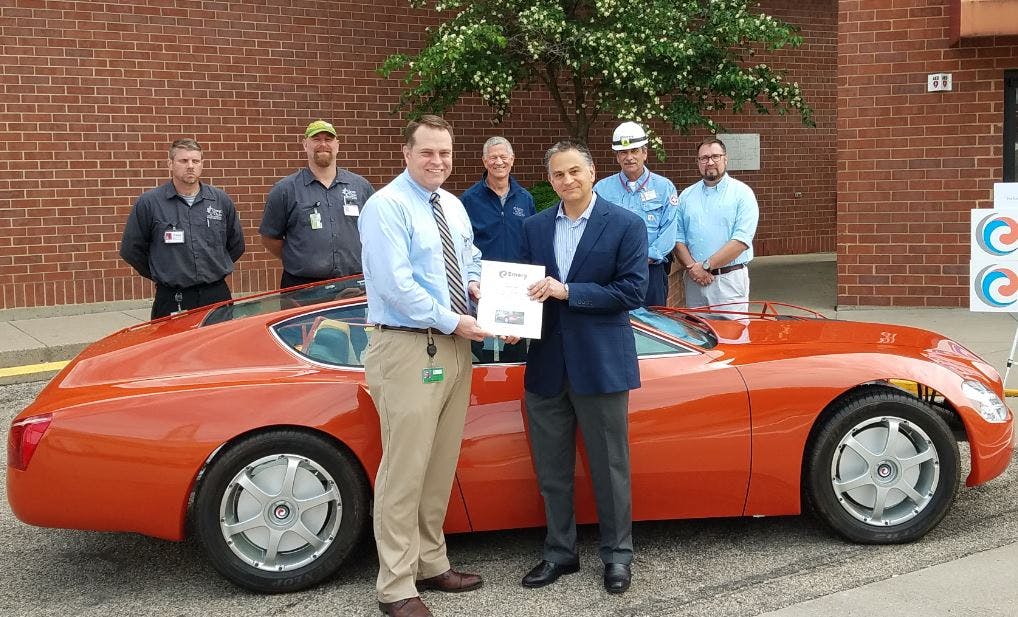
Andy McCool (front left) accepts the CASP R2 Car donation from Mark Kinkelaar (front right)
Since its founding in 1840 as a candle and lamp oil manufacturer in downtown Cincinnati, Ohio, USA, Emery Oleochemicals has grown into a leading global manufacturer of natural-based specialty chemicals. At its production, sales and research & technology development site located in Cincinnati, the company employs over 330 people from the Greater Cincinnati area which includes southwest Ohio, northern Kentucky and southeast Indiana.
 Everchem Updates Archive
  Sign Up for Email Updates