
Company News
June 5, 2024
CalFibre Seeking Funding to Restart MDF Plant
CalFibre raising funds to restart rice-straw MDF plant
By Larry Adams
June 4, 2024 | 9:52 am CDT

CalPlant was the manufacturer of Eureka MDF, the world’s first no-added-formaldehyde rice straw-based MDF. In 2023, it liquidated its assets. The original inventor of the material has put together a group that is looking to restart the plant.
Photo By CalFibre
WILLOWS, Calif. — CalFibre, a California-based bio-material company, is seeking $75 million in funding to acquire and reopen a factory to produce 300,000 tons per year of tree-free boards.
The factory, strategically located in Willows, at the heart of the Californian rice growing region, spans 276-acre and at one point was the world’s first commercial-scale producer of annually renewable, rice straw-base MDF.
Last year, in May, CalPlant I Holdco LLC, the original owner of the facility, focused on creating a no-added-formaldehyde, rice straw-based medium-density fiberboard, Eureka MDF, liquidated its assets. In October 2021, CalPlant entered into a plan support agreement with its senior bondholders, while pursuing a sale of the company. To facilitate the sale process, CalPlant voluntarily filed for Chapter 11 protection in the U.S. Bankruptcy Court for the District of Delaware.
It took California rice farmer Jerry Uhland 20 years, 8 months, and 17 days to raise $325 million to achieve his mission to convert rice straw, a residue of rice farming, historically burned after each harvest, into the MDF product, a common construction material conventionally made of wood, and used for a variety of interior purposes like cabinets, doors, floors, and molding.
It took so long to convince funders to support his first-of-its-kind rice straw board plant because the raw material supply, the manufacturing plan, and the markets all had to be perfect. “I had 20-year contracts with fellow farmers and balers for 400,000 tons of rice straw, a full guarantee from the equipment-maker to make my technology work at scale, and a 20-year purchase contract for 100% of the production from the plant,” said Uhland.
Construction was completed on the plant in 2020, and beginning in early 2021, hundreds of truckloads of formaldehyde-free and tree-free 100% rice straw fiber boards started reaching the marketplace. Uhland said, “the buyers loved getting a product with our substantial green credentials, and at the same quality and price as their everyday wood-based boards.”
Hard luck all around
But, the production and distribution of products were fraught with problems. According to Uhland, first it was about a $100 million “laundry list of bad luck.”
There were the major construction costs over-runs from an over-promising and under-delivering contractor. The Federal Aviation Administration demanded the company lower the height and move one of its major installations, a dryer tower. Then came Covid shutdowns, and if that wasn’t enough, a dry lightning storm caused a fire and burned 50,000 tons of stored straw. After construction completed, the final financial blow came when a small but critical part of the guaranteed equipment line didn’t work properly, causing the plant to only reach 40% of the designed manufacturing capacity.
“The creditors carried us through the hard times during the challenges of the construction phase with additional investments, but the expense of a long shutdown to solve that one process issue exceeded what they were willing to invest. They were then forced to choose bankruptcy and asset liquidation,” according to Uhland.
CalFibre to the rescue
Uhland joined forces with several industry allies to form CalFibre LLC. CalFibre is currently seeking investors for a capital raise of $75 million to acquire, repair, restart, and operate the distressed asset. There have been numerous bids on the asset, according to Uhland, but none of the potential buyers have committed to restart the plant using local crop residues as the raw material, and the intention of some is to disassemble the mill and ship out the pieces.
“CalFibre has all the elements for success in hand: 150,000 tons of rice straw at the plant site and 400,000 tons per year of ongoing straw contracts; a guaranteed equipment fix; a full turnaround team from line workers to the CEO; unwavering support of the local community, and buyers lined up for our MDF products,” he said. “Once CalFibre is up and running, we have a ready-made solution for the rest of the world to save trees, to reduce greenhouse gas, to reduce harmful construction chemicals, and to demonstrate the potential of the bio economy and circular economy.”
June 3, 2024
Mattress Factory Tour
How mattresses are made: An inside look at an American mattress factory
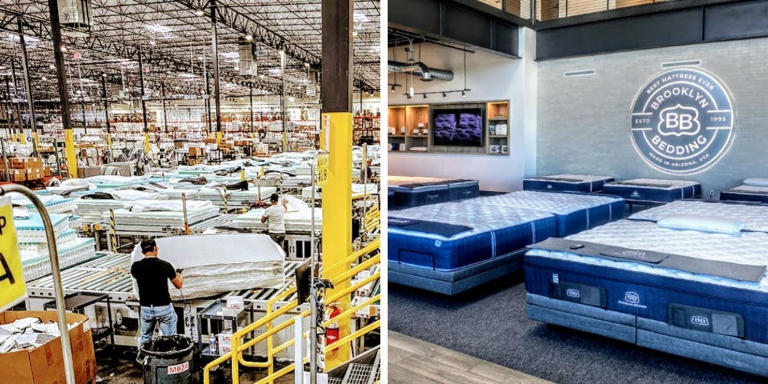
3Z Brands, makers of Brooklyn Bedding, Leesa and more, manufactures 2,200 mattresses daily in its Arizona factory. Jaclyn Turner/Business Insider
Many steps go into making the modern mattress. Most include a complex combination of foam, metal, and fabric assembled just right to ensure you sleep great. We recently got an in-depth look at how mattresses were made on a tour of the 3Z Brands factory in Glendale, Arizona. This 650,000-square-foot vertically integrated manufacturing plant enables 3Z, to oversee the entire mattress-making process from materials to packaging.
The 3Z Brands portfolio includes Helix, Leesa, Brooklyn Bedding, Nolah, Bear, and Birch mattresses and specializes in bed-in-a-box mattresses that ship free straight to your door. Several of these mattresses are featured in our best mattress guides. 3Z manufactures about 2,200 mattresses daily in its factory and has the capacity to make 4,000. With the extra capacity, 3Z Brands also makes mattresses for other companies, including Nectar, GhostBed, Allswell, and Nest Bedding.
Here’s a detailed account of our tour of the 3Z Brands factory and a look into how mattresses are made, from sewing to packaging.
Making the foam
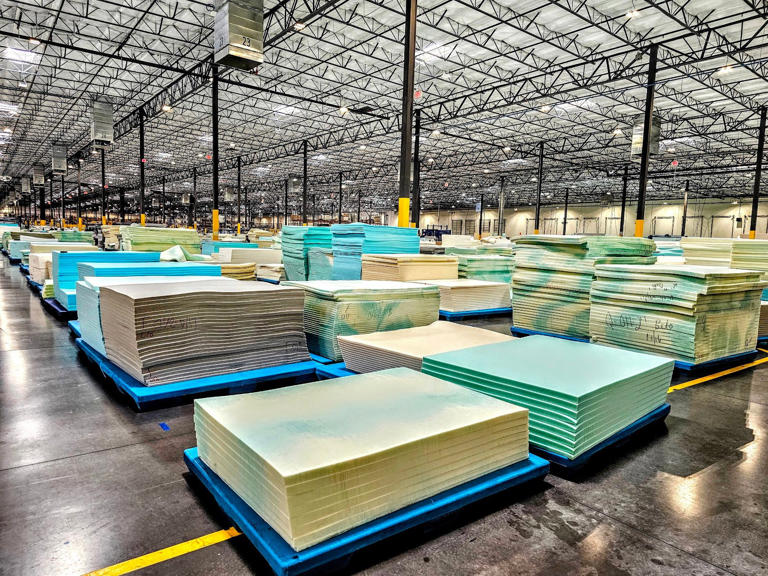
Finished layers of foam are ready for assembly. Different colors help differentiate the foams. James Brains/Business Insider
Before 3Z Brands can assemble their mattresses, they must fabricate the various parts. As of 2023, 3Z makes all of its foams in-house, meaning they control the entire foam-making process from recipe development to cutting. Foam is one of the most important parts; it takes the longest to prepare. Unfortunately, the only area we couldn’t photograph or record was one of my favorite parts to watch: the foam pouring. This was done to protect trade secrets.
Since I can’t lean on the “thousand words” of a photo, I’ll do my best to describe what I saw. The foam pouring machine is roughly 40 feet long, 10 feet wide, and rises 20 feet. The foam’s chemicals are mixed before entering a long metal bar. The concoction is forced through hundreds of holes in the bar to get more air into the foam.
As the foam sets, a plastic-covered conveyer belt slowly moves the massive foam block forward. The foam is poured into 100-foot-long blocks about 4 feet deep and maybe 7 feet wide. A huge elevator moves the blocks to a spot in the warehouse for curing in the dry Arizona heat for 24 to 72 hours.
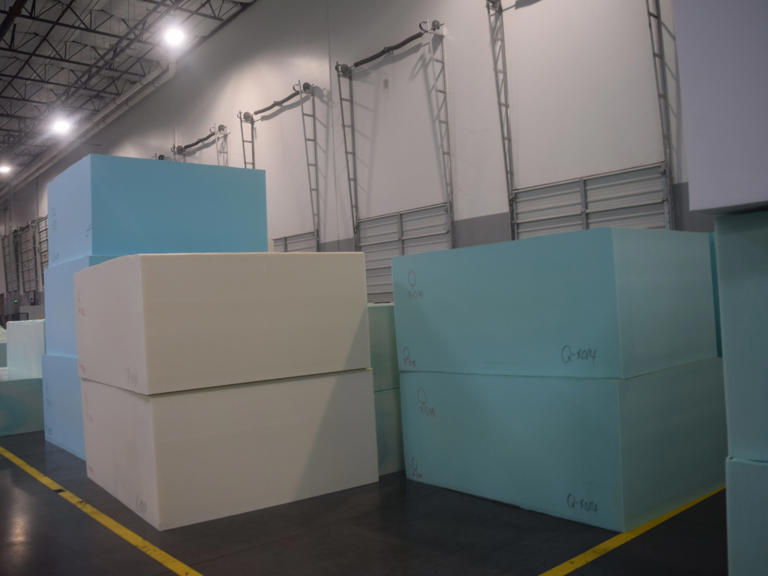
Cured blocks of foam that are the dimensions of a bed before being sliced down to layers. Jaclyn Turner/Business Insider
Pouring foam is dangerous, so most companies outsource this step. If you get the formula wrong, the internal temperature of the foam block will rise too high and could start a fire. The foam temperature at the 3Z factory reaches 280 degrees Fahrenheit.
Once it has cured long enough, it’s time to cut the foam blocks down to size. First, it’s cut vertically to match the dimensions of a mattress, as shown above. Then, it’s cut horizontally using a machine I like to call “the Decapitator.”
At this point, the foam layers are ready for the mattress. Leftover scraps are put to good use, such as filling pillows.
Constructing the pocket coils
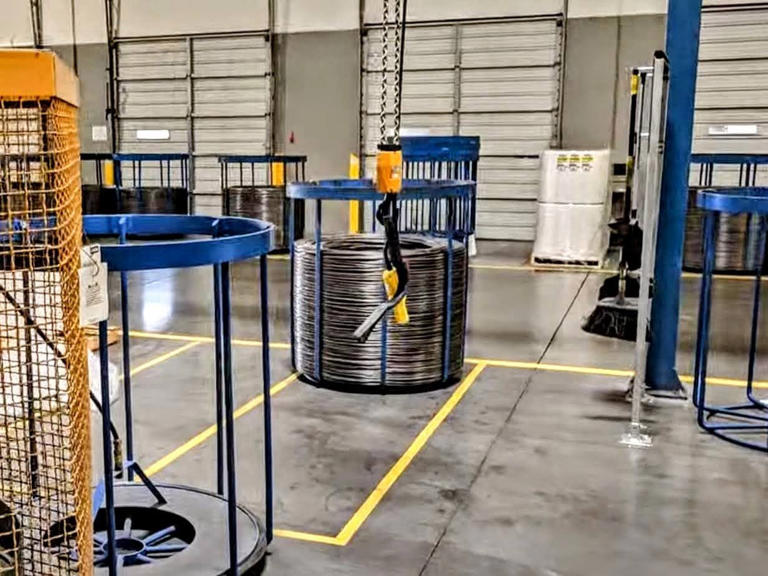
The pocket springs found in hybrid mattresses arrive at the factory in huge coils. James Brains/Business Insider
Pocket springs, or coils, are a signature feature of hybrid mattresses. They provide durability, support, and airflow. The springs arrive at the factory as a giant coil. The end of the coil is fed into a machine that turns the long steel “thread” into smaller springs appropriate for a mattress.
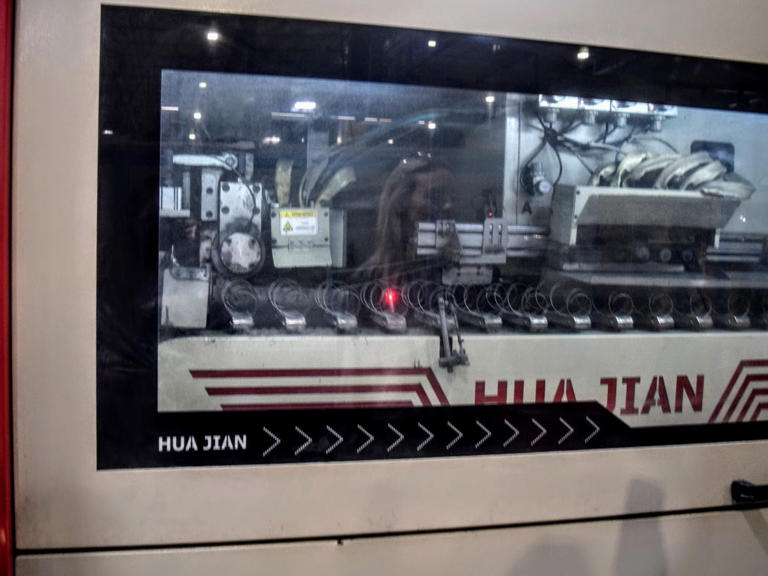
The “thread” of steel is fed into the machine from the top right. Then, faster than the eye can see, the machine coils and cuts it to make springs. Jaclyn Turner/Business Insider
The spring assembly line is wrapped in fabric to make individual “pockets.” Unlike traditional spring mattresses, the springs in hybrids are usually separated to assist with motion isolation.
Narrower, denser coils are used for the edges to help with edge support.
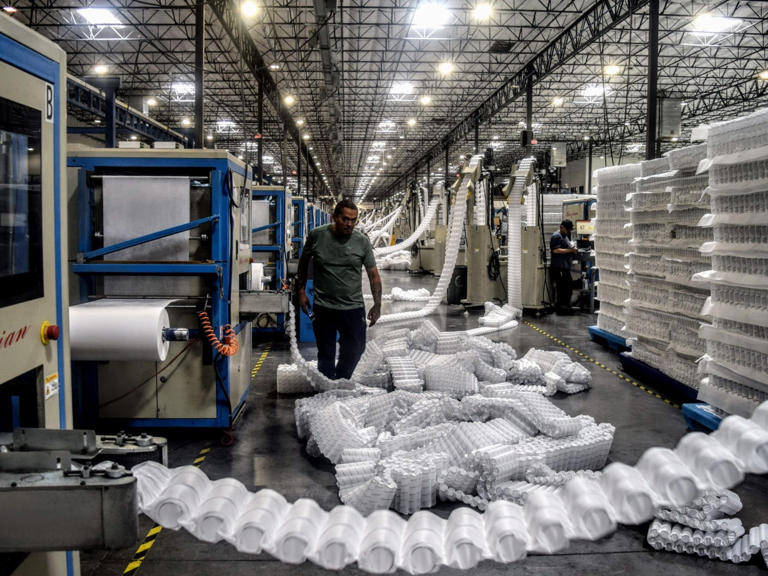
Several machines work nonstop making pocket springs of different sizes. The pile of narrow springs on the floor will be used on the edges to provide edge support. Jaclyn Turner/Business Insider
The springs are put together in a single layer to be layered and assembled into a mattress.
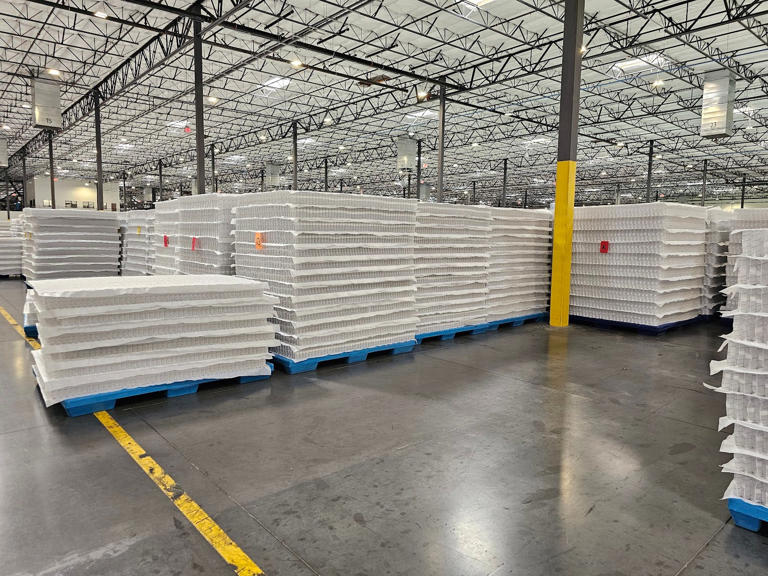
The pocket spring layers await the mattress assembly process. While it varies significantly, hybrid mattresses often have around 1,000 pocket springs. James Brains/Business Insider
Sewing the cover
Between the quilting, borders, and handles, a lot of work goes into sewing a mattress cover, and each step requires a specialized machine. 3Z employs a team of mechanics to maintain the equipment and ensure everything keeps running smoothly.
The machine below just makes the mattress borders. It features 65 sewing needles and makes eight border rolls at a time.
Some borders feature vertical stitching, which requires a whole other machine.
And you better believe there’s a separate device for adhering handles to the borders.
The same machine that creates the borders is also used to quilt and combine the mattress top, which combines fabric, foam, and a flame-retardant layer. The manufacturer can program the design and materials based on their desired model and size.
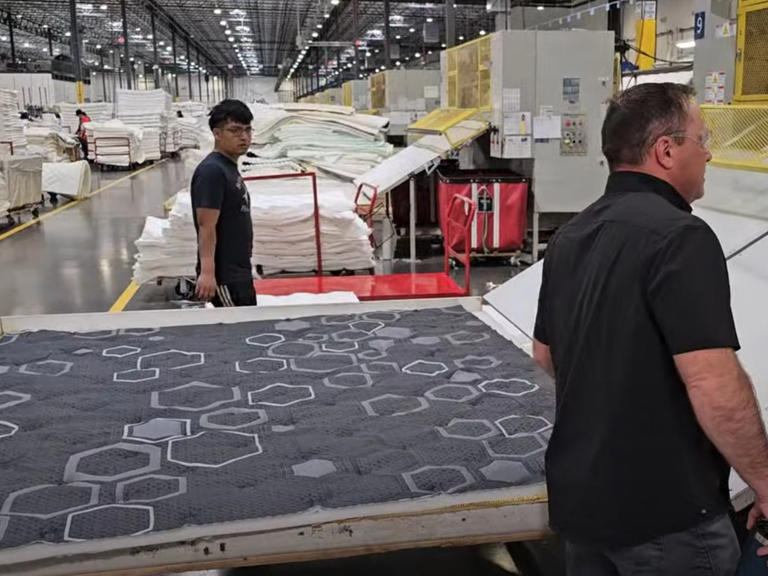
Here, you can see what the finished quilted mattress top looks like. On the right is 3Z Brands CEO John Merwin. I was impressed by his knowledge of every step of the mattress-making process. James Brains/Business Insider
During the tour, my editor tried serging together the mattress’s top layers on an air hockey-like table. She did a good job, but her effort didn’t quite pass quality control. Keep at it, Jaclyn!
Assembling the mattress
Once the foam, pocket springs, and mattress covers are ready, it’s time to assemble all the components together. First, the layers are glued together to keep them in place. Above, workers put together zoned-support mattresses, which must be assembled by hand. You can also see mattresses glued together by a machine on the conveyor belt behind them.
Once the layers are assembled, the cover is stapled in place, and the mattress starts to resemble its final product.
Boxing it up
Ever wonder how they get a mattress into those mini fridge-sized boxes? I always have. You may not be surprised that they rely on a specialized machine. The fully assembled mattress is crushed flat and vacuum-sealed in plastic. Then, it’s folded, rolled, wrapped in more plastic, and stuffed in a box to be delivered to your door. Here’s the whole process at four times the normal speed:
Mattresses can’t stay in the box forever, so most 3Z mattresses are made to order. They should be unboxed within 30 days; any longer than that could compromise their ability to expand. Manufacturers must nail the delicate balance of producing enough beds to meet demand while ensuring they don’t stay on shelves for long.
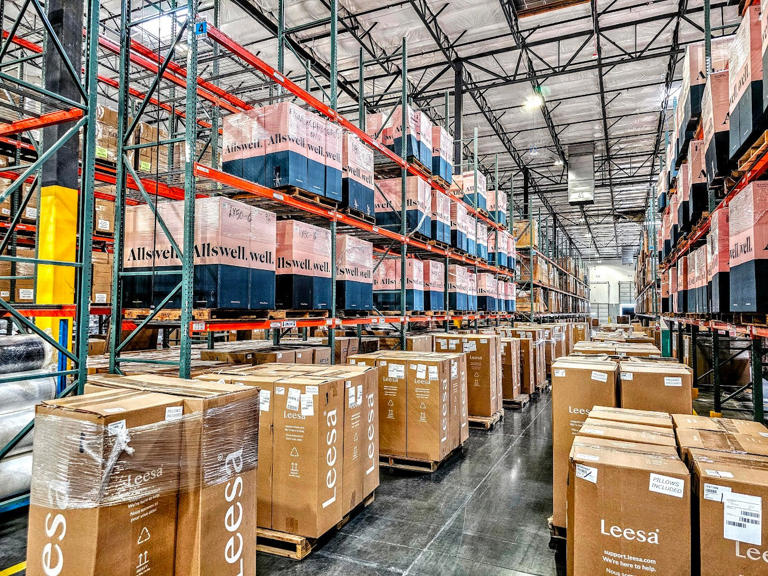
Once boxed up, the clock is ticking to get these mattresses in consumers’ bedrooms. James Brains/Business Insider
Testing and constant modifications
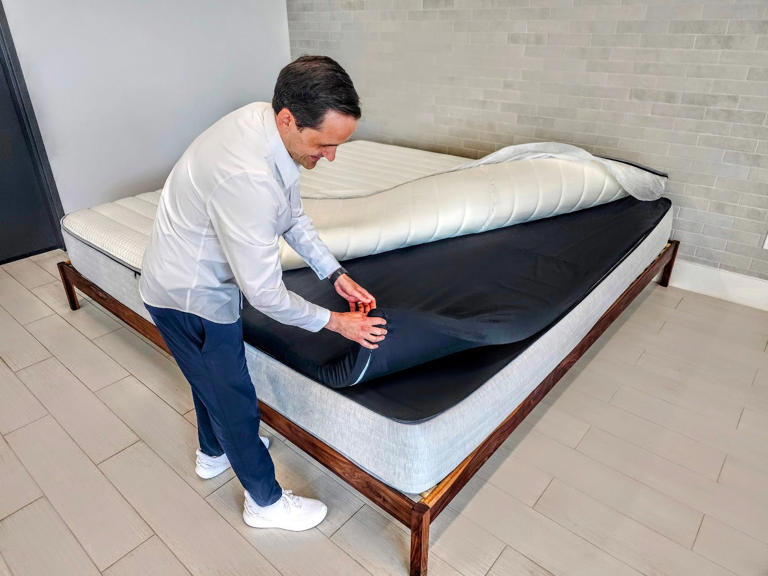
Nolah CEO Stephen Light loves getting geeky with mattress design. Here, he shows off an upcoming release: an Alaskan king bed delivered to you in three boxes. James Brains/Business Insider© James Brains/Business Insider
With hundreds of mattress brands competing for your dollar, manufacturers must stay ahead of the trends and incorporate the latest technology in their mattresses. When we asked 3Z CEO John Merwin and Nolah Mattress CEO Stephen Light about the mattress they’re sleeping on, the answers were related to experimenting with the next product in development, like an expansion into a largely untapped mattress category: the Alaskan King, a 9 foot by 9 foot mattress. 3Z Brands employs a foam engineer with a room full of reference samples for experimenting with new foam variations. The factory also featured an area where you can design your own mattress using the materials made at the facility to help with product development.
What stood out to me were all the companies worldwide that manufacture mattress-making and testing machines. The machine below simulates years of sleeping on the mattress. It’s used to quickly assess durability and determine the warranty length 3Z will offer.
The bottom line
The next time you look at a mattress, think of all the work that went into it. Maybe, take a closer look at the materials and their origin. As you’re drifting off to sleep, think of the hundreds of people who worked together to ensure you get that good night’s sleep. It’s pretty astounding. Sweet dreams!
May 28, 2024
Kronospan Acquires Woodgrain Particleboard Facility
Kronospan makes second particleboard facility acquisition in recent months
By Larry Adams
May 23, 2024 | 9:38 am CDT

Particleboard plant in Island City, Oregon.
Photo By Kronospan
Kronospan, a leading producer of wood panel products, has acquired Woodgrain’s Particleboard facility in Island City, Oregon, which is the second particleboard facility purchase in less than a year.
In December, Kronospan closed the purchase of Roseburg’s Simsboro, Louisiana, particleboard facility.
The company said the addition of the Island City plant will strengthen Kronospan’s position in the North American wood panel market and further demonstrates Kronospan’s commitment to its overall growth strategy. Kronospan has expressed its intent to invest in the modernization of the Island City plant upon completion of the post-acquisition period.
“I’m very excited about today’s announcement. The addition of the Island City plant and its talented team will further enhance our ability to serve our customers and provide long term benefit to our stakeholders” said Hans Obermaier, CEO of Kronospan’s North American operations.
Kelly Dame, president and CEO of Woodgrain stated, “It was important for us to find a buyer that is a good fit for our 124 team members, and one that will continue to invest in the plant and its people”
In addition to the Louisiana, particleboard plant, and now the Oregon facility, Kronospan operates wood products sites in North America, including in Oxford, Alabama, a multi-product site with MDF, Particleboard, Laminate Flooring, TFL and other products, and an MDF/HDF plant in Clarion, Pennsylvania.
May 27, 2024
PCC Urethane Results
Business performance by individual segment
Polyols & Derivatives
The Polyols & Derivatives segment recorded positive
business development in the first quarter of 2024. Overall, sales
volumes and revenues were somewhat weaker than anticipated in
our budget for the current fiscal year. On the earnings side, however,
both the positive prior-year figures and our expectations for the first
quarter of 2024 were exceeded at all levels.
The dominant entity in
this segment is the Polyols business unit of PCC Rokita SA, Brzeg
Dolny (Poland), with its polyether and polyester polyols. Demand for
these polyols remained robust in the first quarter, while a temporary,
force majeure-related plant shutdown at a European competitor led
to a supply shortage with respect to polyether polyols.
As a result, average selling prices showed an upward trend in the first quarter, with
a correspondingly positive impact on the sales and earnings perfor-
mance of this business unit.
At the Polish systems house PCC Prodex
Sp. z o.o., Brzeg Dolny, the production portfolio of which includes
spray foams for the insulation of roofs, the extremely encouraging
business performance of the previous quarter continued through
the first quarter of 2024.
By contrast, the portfolio companies and
business units pooled under the intermediate holding company
PCC Insulations GmbH, which are active in the field of insulation and
other building materials, ended the first quarter of 2024 with a loss,
as had been expected.
The Essen-based manufacturer of specialty
foam blocks and polishing pads, PCC Prodex GmbH (Germany), also
closed the first quarter of 2024 with a slight loss, having seen its
numbers come in slightly worse than expected. However, the out-
look for the following quarter is more optimistic due to the current
order backlog.
The ISO 9001:2015 certification awarded to PCC Pro-
dex GmbH in the first quarter of 2024 should also have a positive
impact.
The start-up PolyU GmbH, Oberhausen (Germany), which
develops specialty chemicals based on polyols, also remained slight-
ly in deficit in the first quarter of 2024. However, the losses were
much lower than expected and the current order situation also in-
dicates a continuation of this encouraging trend at the company.
PCC Synteza S.A., Kędzierzyn-Koźle (Poland), which in addition to
contract manufacturing for PolyU GmbH also continues to operate
its core business, namely the manufacture of alkylphenols, also re-
mained in the red in the first quarter of 2024 due to continuing weak
demand for these products
https://www.pcc.eu/wp-content/uploads/2024/05/PCC-Group-Quarterly-Report-1-2024.pdf
May 27, 2024
PO Licensing Update
KBR Licenses Sumitomo Chemical’s PO Manufacturing Technology
PUdaily | Updated: May 27, 2024
KBR and Sumitomo Chemical announced that they have signed an alliance agreement to make KBR an exclusive licensing partner for Sumitomo Chemical’s state-of-the-art propylene oxide by cumene (POC) technology. Propylene oxide is an intermediate product used primarily in the further manufacture of polyurethanes. Polyurethane is used in many products such as foams, coatings, adhesives and sealants which serve growing industries such as construction, industrials and automotive.
Sumitomo Chemical’s process for propylene oxide production is a unique, environmentally friendly technology that delivers minimal carbon footprint compared to other processes. With lower wastewater generation, and an optimized energy recovery system, this process ensures high propylene oxide yield, and smooth and safe plant operations.
Under the alliance, Sumitomo Chemical’s innovative technology will be delivered to a global customer base, enabled by KBR’s global marketing reach and engineering capabilities. Additionally, this technology is complementary to KBR’s existing, leading phenol technology.
“This alliance combines KBR’s proven experience in licensing sustainable chemical processes on a world scale, complemented by Sumitomo Chemical’s outstanding expertise in propylene oxide production and a track record of several decades of safe, stable and reliable plant operations globally,” said Jay Ibrahim, President, KBR Sustainable Technology Solutions. “Sumitomo Chemical’s POC technology not only delivers the co-product-free pathway to produce propylene oxide but also significantly reduces carbon emission through the recent enhancement of its energy efficiency features. This aligns with KBR’s vision and commitment towards providing sustainable solutions to its customers.”
“Sumitomo Chemical is proud to partner with KBR to provide this exceptional and environmentally friendly technology to clients worldwide, through which they can accelerate their sustainability goals while maximizing the value of their propylene derivatives” said Seiji Takeuchi, Sumitomo Chemical’s Senior Managing Executive Officer for the Essential Chemicals & Plastics Sector. “KBR’s extensive licensing and engineering expertise provides Sumitomo Chemical with a world-class partner to expand its pacesetting technology to a wider market.”
 Everchem Updates Archive
  Sign Up for Email Updates