
Company News
May 1, 2023
Olin Discussion
Olin Corporation (OLN) Q1 2023 Earnings Call Transcript
Apr. 28, 2023 12:42 PM ETOlin Corporation (OLN)2 Comments

136.48K Followers
Q1: 2023-04-27 Earnings Summary
EPS of $1.52 beats by $0.22 | Revenue of $1.84B (-25.07% Y/Y) misses by $204.49M
Olin Corporation (NYSE:OLN) Q1 2023 Results Conference Call April 28, 2023 9:00 AM ET
Company Participants
Steve Keenan – Director, IR
Scott Sutton – CEO
Todd Slater – CFO
Scott Sutton
All right. Thank you, Steve, and good morning, everybody. The Olin team is deeply engaged in doing what we said we would do, which is to establish a new 12-month trough EBITDA level that is significantly higher than previous peaks and additionally supports a higher equity valuation. We are halfway through that demonstration after back-to-back quarters where our EBITDA delivery was $442 million in the fourth quarter and $434 million in the first quarter.
Market conditions are quite poor, and the forward outlook of those conditions is for more of the same. But Olin is busy adjusting our market participation across the ECU to support product values fixing our prior shortfall of not recession-proofing the Epoxy business while simultaneously growing Epoxy systems and correcting commercial ammunition channel loads and landing new military business in Winchester.
Referring to Slide number 5 in our earnings presentation. The initial evolution of Olin to a higher level value state is also about halfway along. Leadership behavior in all three of our businesses through this recessionary environment will lead to more value growth opportunities that, in turn, deliver more firepower for share repurchases. We are currently on a run rate to repurchase 10% of the Company’s outstanding equity this year after repurchasing 16% in 2022.
Kevin McCarthy
Scott, you’ve taken a number of actions toward restructuring your Epoxy business. Can you talk through what you’ve done already and what lies ahead? I think there was a reference in your materials to some additional restructuring actions. It wasn’t clear as to whether that was in addition to what you communicated several weeks ago or just additional implementations against that existing communication?
Scott Sutton
Yes. Sure. Thanks a lot. So we have taken some recent actions to really recession-proof the Epoxy business. And so in March, we announced that the Terneuzen and Cumene plant and our solid epoxy resins facilities in Korea and Brazil are to be closed. And you see that we took a restructuring charge of almost $60 million in the first quarter to do that. We had additionally also closed one BPA facility in our Stade, Germany plant. And there’s more to come. We’re going to have additional asset decisions to make. And then we’re going to also change the way that we go to market in the Epoxy business as well. So, that’s going to happen through the course of this year.
Kevin McCarthy
Okay. And then secondly, perhaps for Todd. Can you speak to the inventory levels on your balance sheet? Optically, it looks like they’re up 20% year-over-year. How much of that is underlying escalation of inventory versus other factors. I’m not sure if your Blue Water joint venture establish an affects any of those numbers?
Todd Slater
Kevin thanks for the question on inventory. We normally build inventory and working capital during the first part of the year and liquidate that late in the third and fourth quarter. The inventory levels are higher than that normal seasonal activity this year because of a major turnaround as planned that we built some inventory in advance of that turnaround. You should expect those levels to decline as the year unfolds with a step down you’ll see in June.
Unidentified Analyst
So, I wanted to follow up on Kevin’s question earlier, Scott. Have you settled on maybe a more permanent vision for what the optimal footprint looks like for the Epoxy business, particularly with regards to an appropriate level of vertical integration?
Scott Sutton
Yes. Yes, I mean, thanks for the question. And look, I mean, as we go through this restructuring, right, we’re going to get to a footprint and a business presence that removes some element of the duplication that we have two of every single kind of assets all across that vertically integrated change. And we may or may not need all of those to have full capability. But what I’ll say, when we get through this Epoxy is still going to be the absolute global leader in that world. And it’s still going to be the absolute most vertically integrated business in that world as well.
Epoxy has certainly been challenge. If you go a little bit backwards in time, whenever Asia volumes became available, customers bought away. And then when those Asian volumes weren’t available because of instability or demand in Asia, they came back to Olin for security of supply. More recently, we probably overpriced a bit for a bit too long. So, now we’re just moving to a point where we’re going to partner with Epoxy customers for a bit longer run, and there’s going to be a lot more cooperation in that forward world with Epoxy customers, especially as our business pivots more to value from systems, so you need to have a longer-term profile mix with customers.
Mike Leithead
First on Epoxy. Scott, can you just maybe talk about where the Chinese export pressure currently stands today versus maybe a quarter ago? And just where you think that trends over, say, the next quarter or so?
Scott Sutton
Yes, sure. I mean, look, that export pressure, I’ll say, in the second quarter is probably even more than in the first quarter. There’s record Epoxy exports coming out of Asia. And those exports out of Asia are being driven by the fact that China has added a lot of capacity. They’ve got their supply apparatus running hard, yet their demand apparatus has not turned back on.
So that sort of reversal in trade flows out of China has caused the rest of the volume in Asia to come towards Europe and North America. So that’s the impact we’re seeing, and we see extreme pressure continuing there.
John Roberts
On Slide 9, the ECU PCI declined sequentially from 287 down to 262. But almost all the chlorine caustic products went up sequentially. So, epoxy was big enough and declined enough that it offset all the gains in the other products sequentially.
Scott Sutton
Yes. I mean, John, Epoxy was a big driver of that because per ECU, there was less delivery of contribution profit. So in epoxy, not only do you have price declines, but you have volume declines as well. So you get the impact of volume and price coming through there.
May 1, 2023
Cornelius Plant to Close
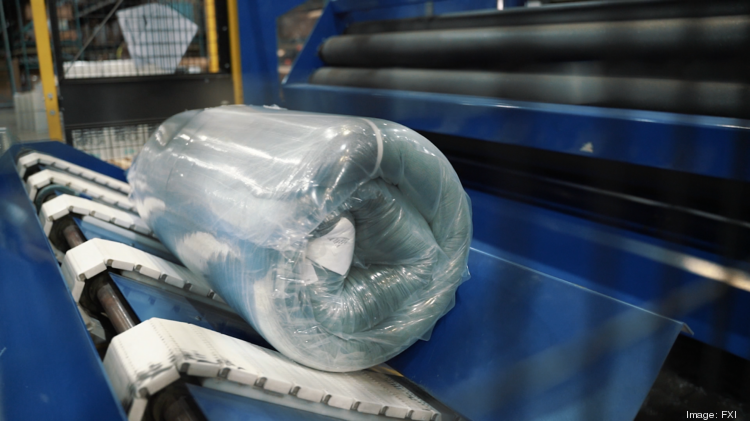
Longtime Charlotte-area manufacturer FXI to close Cornelius facility, laying off nearly 60 workers
By Jenna Martin – Managing Editor, Digital , Charlotte Business Journal
Apr 28, 2023
Listen to this article 3 min
A longtime manufacturer in the Charlotte area is laying off dozens of workers this summer as it plans to close its facility in Cornelius.
Pennsylvania-based FXI says in a Worker Adjustment and Retraining Notification that it will close its plant at 18801 Old Statesville Road by June 20. As a result, about 59 workers will lose their jobs.
The layoffs will begin on a rolling basis on May 22, writes Courtney Damon, chief human resources officer for FXI, in the WARN letter. The closure is expected to be permanent.
The N.C. Department of Commerce received notice on April 24.
FXI manufactures low-density polyurethane foam used in mattresses, furniture and vehicles. It designs, produces and delivers products such as mattresses, toppers and pillows, according to its website.
The company’s 331,400-square-foot building in Cornelius sits on a 48-acre site at Old Statesville and Bailey roads, according to Mecklenburg County real estate records.
A fire broke out at the plant last year, but no injuries were reported, according to Cornelius Today.
A message sent yesterday to Damon seeking more information about the closure was not immediately returned.
FXI has one other North Carolina facility, in High Point, according to its website. The company says it has 34 facilities in the U.S. and Mexico. Twenty-eight locations are listed on its site, excluding the Cornelius plant.
FXI’s history in the Charlotte area
FXI, previously named Foamex International Inc., has operated in Cornelius since at least 2001, according to CBJ archives. Foamex also once had a felt-manufacturing plant in Newton.
The company rebranded to FXI Foamex Innovations in July 2009 after its acquisition by MatlinPatterson Global Opportunities Partners III and Black Diamond Capital Management, CBJ previously reported.
That same month, Foamex LP sold the Cornelius property to Foamex Innovations for about $4 million, according to county real estate records. Foamex originally purchased the site for about $5.76 million in 1990.
In February 2020, FXI merged with New Jersey-based Innocor, which made similar products. As part of that $850 million merger deal, the companies agreed to sell three production facilities in Washington state, Indiana and Mississippi. That left the combined company with 34 manufacturing and distribution facilities across North America and about 4,150 employees.
Both firms were private-equity owned. FXI’s parent company, One Rock Capital Partners, acquired Innocor from Bain Capital. Bain Capital retained a smaller stake in the combined company, CBJ sister publication Philadelphia Business Journal reported at the time.
May 1, 2023
Covestro Earnings Call Urethane Highlights
Covestro AG (CVVTF) Q1 2023 Earnings Call Transcript
Apr. 28, 2023 4:02 PM ETCovestro AG (CVVTF), COVTY

136.48K Followers
Covestro AG (OTCPK:CVVTF) Q1 2023 Earnings Conference Call April 28, 2023 10:00 AM ET
Company Participants
Ronald Koehler – Head, Investor Relations
Markus Steilemann – Chief Executive Officer
Thomas Toepfer – Chief Financial Officer
Carsten Intveen – Investor Relations, Director
Markus Steilemann
Thank you, Ronald, and hello and warm welcome also from my side to the results of our first quarter. Today we published our Q1 details after we had pre-released the headline figures two weeks ago.
Sales were down by 20% compared to last year to EUR3.7 billion, clearly indicating the global demand crisis we are currently facing. Against this trend, we achieved the first quarter EBITDA of EUR286 million, clearly beating the guidance of EUR100 million to EUR150 million given in early March. Free operating cash flow was also better than expected by us, despite the usual seasonal working capital buildup.
After positive trend in EBITDA during the first quarter and improved visibility going forward, we are now returning to a quantitative guidance for full year 2023 with a refined range for our financial KPIs.
Finally, as you recall, in the first quarter 2022, we initiated a EUR500 million share buyback program. The program was paused mid 2022 due to the recessionary environment. With more clarity on the outlook, we are now restarting the program in May.
Markus Steilemann
Thanks a lot, Thomas. And I would now like to come to a specific topic, as we are not only quantifying our full year guidance, but we are also resuming our share buyback program. Let me quickly remind you, we started the EUR500 million share buyback program end of February, 2022, and the reason for the buyback program was that major M&A acquisitions were out of scope. We fed our share to be undervalued, and as such a good investment in two sub tranches of each EUR75 million, we purchased around 3.5 million shares in the first half year of 2022. Yet, due to the recessionary environment with the start of the second half of 2022, we had then temporarily suspended the share buyback to protect our balance sheet and retained cash within the company until an economic rebound becomes foreseeable. However, it was always our strategic intention to execute the share buyback in an anti-cyclical manner.
Now, our raised EBITDA and free operating cash flow guidance and the improved visibility that the second quarter 2023 will sequentially result in higher volumes and a further raised EBITDA. We consider this to be the right point in time to reinitiate the buyback. We are still firm in our opinion that our share is currently undervalued and deemed the investment into our own shares as best investment for our shareholders. Consequently, the third sub charge of up to EUR75 million will be launched in May.
Let’s turn pages now to page number 19. A very busy chart. So let me guide you through it. As you know very well from the past and the current situation, Covestro’s business is a cyclical business. In times of an economic downturn or our core products, MDI, TDI and polycarbonate are usually strongly affected. Our products are an early indicator of a crisis as we are at the very beginning of the value chain and have strong exposure to multiple consumer industries. There are steps in the value chain between us and the consumer market. But in time of crisis, the stop of stock replenishments is regular in immediate action and progressing very fast throughout the different value chains. So our products are an early indicator to an economic downturn.
During a recession, the value chain empties through destocking. Upon the start of an economic recovery, a fast and efficient replenishment of the value chain is also required again. Rebounds often create a strong demand to quickly refill the supply chain. These high growth rates usually lead to supply shortages, allowing Covestro to execute the pricing power to again realize financially attractive margins.
So despite the cyclical behavior, the long-term growth drivers for our products remain intact or even improve. The current energy crisis will have a positive impact on the growth of MDI and polycarbonate. The trend for effective insulation to save energy can add one to two percentage point to the growth rate of MDI in the future as MDI is the best insulating materials for buildings and appliances. And MDI is so versatile, it can also be used in the manufacturing of wind turbine blades giving additional benefits of longer lifetimes and reduced maintenance rates. Our polycarbonates are an essential part of the battery pack in most electric vehicles as well as a contributor to lightweight and technically advanced electrical features. This results in a two to five times higher use of polycarbonates in modern EVs compared to a regular combustion car. With that, we believe that once the crisis is over, we will see again a strong rebound of demand for our products.
Let’s turn pages to page number 20 to another topic of special attention. In the past year, the competitiveness of European TDI production compared to competitor imports from Asia-Pacific was always a point of discussion. And yes, there were times like in the third quarter of 2022 when gas prices peaked so that the import of TDI was cost-wise a better solution than local production in Europe. Consequently, and supported by a temporarily significant gap of toluene prices between Europe and China, the imports were peaking at this point in time, taking into account the shipment delay of about six week. Also, we were importing TDI from our plant in China.
You can clearly see an above chart that the landed cost advantage of imports from China in the third quarter peaked even considering logistics and import duties of EUR350 to EUR600 per ton. But as soon as the gas prices were coming down, this advantage quickly disappeared. And with the continuous gas prices declined since the January, 2023 disadvantage has now reversed. So Europe, as a TDI production location, is definitely competitive and has its place to cover the market demand.
If we take a look at the imports that have been coming in from Asia-Pacific in 2022 around 100 kilotons TDI have been imported, and market prices have nevertheless peaked during the time of high gas prices. This clearly indicates that the market needs the European asset base for reliable supply. And with the announcement of a 300 kiloton of European production disappearing towards third quarter of 2023, Europe will even require more imports to cover again rising demand. Demand as of 2024 will exceed the local European production. And customers are hesitant to rely on import, given the supply chain interruption seen in the past two years. We believe that we have a clear technological and cost advantage with our gas phase TDI technology, and additionally, an advantage of having a production in the heart of Europe being able to supply TDI competitively to our customers.
So now let’s turn to the last page of today’s presentation. Let me quickly summarize on page number 21. Volume decline is resulting in lower sales or has resulted in lower sales of EUR3.7 billion in the first quarter, and that was caused by weak demand and ongoing destocking across many industries. Our EBITDA came in with EUR286 million above guidance range of EUR100 million to EUR150 million, and that was driven by cost efficiency and improved pricing data across both segments. This negative free operating cash flow of minus EUR139 million still came better — came in better than expected, and it was held by ongoing strict working capital measures.
We also now quantified the guidance for full year 2023 with an expected EBITDA between EUR1.1 billion to EUR1.6 billion, and we resumed our — will resume our EUR500 million share buyback program with a third tranche up to EUR75 million starting in May.
Markus Mayer
And then the last question is on TDI, is that last year, roughly 100,000 tons have been imported to Europe, is this is net zero [ph]? Also the maximum of imports which can be imported to Europe given its chemical activity, or what would be theoretical maximum number which could be imported to Europe? That’s all for my side.
Thomas Toepfer
Markus Steilemann
Yeah. Absolutely. So, Markus, if you look at the TDI import capacity, what we are basically talking about is not only shipping capacity, but we — what we need, we need storage capacity and unloading capacity in respective harbors, which is a key challenge as we’re talking here about hazardous and very reactive chemicals. So having said that, it is not easy to build those capacity up. But even if it is built up, let me quickly recap on what I tried to explain a little bit earlier in one of the slides. It is absolutely necessary that we get this additional capacity imported into Europe as one of the largest sites in Europe, which represents roughly 40% of European based capacity is about to be shut down by third quarter of 2023. That means we have name played out 300,000 tons. How much real available capacity is represented by this? The jury is out. Nonetheless, we and our customers strongly believe in the growth opportunities and their demand for TDI, and therefore, we need import capacities. Otherwise we will have at least for some time temporarily maybe a shortage of TDI in Europe.
So we need this capacity, and therefore you can assume that there might be an upscaling within this year of another 50,000 tons of import capacity on top of the 100,000 tons that we have seen being imported last year. So, yeah, once again, it’s difficult to judge talking about, let’s say, the chemistry we are handling here. We need that import capacity and we feel in this overall situation as the — yeah, let’s say, one of the last two standing TDI suppliers with the IP protected leading cost position, let’s say, very well-positioned in that market.
Charlie Webb
Brilliant. It worked. Maybe just two questions from me. So first, just thinking about the spreads, maybe you can just walk us around a little bit obviously you kind of alluded to a slightly better kind of volume indication seasonally and sequentially, looking through the year. So just how do you see spreads shaping up in terms of that balance of supply/demand across some of your key commodities? Just a sense on that regionally, and by you those — kind of key commodities, NDI, TDI, polycarbonate would be really useful.
And then just second question, on TDI itself. Obviously, some talk around some of the limitations MOFCOM has put on TDI prices for one of your competitors to close the deal that they are currently undertaking. How do you think about that in terms of what it — has or what implications it has for the China TDI market? And how would you calibrate that into your kind of mid-cycle thinking in its current form? Does it reduce kind of your mid-cycle as it relates to TDI earnings in in China? Does that have a small impact or not? Just trying to understand that, would be great.
Thomas Toepfer
Yeah. Charlie, let me maybe start with the — with a spread question. So I think from an overall picture, you’ve seen that our mark-to-market stands at 1.4, our midpoint of the EBITDA guidance is at 1.35. So essentially what we’ve done, take the number and maybe reduce it slightly. I’m not going to call it a haircut, but it’s a slight reduction that we’ve made.
If you look into the immediate future, that’s also true for the second quarter. So we’re essentially assuming that the uplift that we’re expecting for Q2 in terms of EBITDA is purely coming from better sales volumes, which are seasonally driven. And as I said, the fact that China has no Chinese New Year, and that the construction season is kicking in, but we’re essentially assuming that the margins stay flat also in the second quarter of the year.
The upper end of the guidance 1.6 would require some meaningful upside of the margin to happen the second half of the year. I think this is in the cards if demand picks up, but of course, we’re not planning with it. As I said, our base assumption is still flat volumes and also, margins essentially flat forward. So — yeah, so I think that would be it from my side on the spread.
Maybe Markus you want to talk about TDI.
Markus Steilemann
Yeah. Thanks Charlie for your question and thanks also for once again hinting on TDI. So what’s the situation? One, the largest, let’s say, local producer of TDI in China has bought a smaller competitor. And one of the first measures is that they will shut down a smaller capacity in the order of magnitude, I think a 30 or 40,000 tons of TDI capacity. So a kind of a small consolidation is going on there. However, given the size of those players, that has called the anti-trust authorities on stage and they have gone through a rather, let’s say, sophisticated paper that kind of limits the opportunity of setting the price for TDI in China. However, that goes back, I think for, looking three to four years backwards on the pricing. And we must not forget that, for example, one of those years was 2021, where we have seen rather high prices.
So long story short, I would not expect that this overall regulation, including, let’s say, this potential price cap, if I may call it that way, will have any significant impact on our ability with regard to earn money with TDI. And secondly, also on our ability with regards to our mid-cycle earnings not only because of that very specifics that I just described, but it is just one country and it’s just one product which is not representing the major share of our entire product portfolio.
Let’s not forget about the wonderful products like MDI, polycarbonate and the Solutions & Specialty segment. I hope that answers your question.
Jaideep Pandya
And then the third question really is on MDI. If I just use furniture as a reference industry, do you expect growth to rebound to the sort of five-year historical average for all this MDI capacity that is coming? Or do you think that even if we under undergo maybe for the next 12 months, because it is coming from essentially one player and that player is expected to be disciplined, we won’t have overcapacity issue in MDI? Thanks a lot.
Thomas Toepfer
Markus Steilemann
Yeah. Maybe then, on — Jaideep, on the last topic with regards to MDI. So we believe that structurally MDI growth is fully intact. We also believe that — and you said, well, just let’s take the furniture example as one example, but to really look into the MDI growth, there’s two things that need to be considered. Number one is, we’re not only talking about newly constructed private and commercial buildings, but also about a significant market for refurbishment of buildings. And not to forget that about 25% to 40% of global energy demand is driven by cooling and heating of buildings. So there’s a huge need for more, let’s say, energy efficient buildings. And that is the key driver for retrofitting of homes and new built homes for insulation materials where MDI plays a major role. And that’s why looking at that demand pattern, first and foremost coming out of a crisis, there is a high chance that the market would show a very strong rebound pattern, which would then very fast lead into balanced markets.
And looking a little bit further out, there is, from today’s perspective, an announcement, limited capacity built up to 2025 and 2026, and following years, in 2026 and following years, there is currently even no announcement about additional capacity being built or edited. So the market might even get short or very short in the midterm, and you cannot just turn on the tap and say, okay, let’s produce some more MDI, no matter how you do it, it takes a couple of years from the first planning/announcement to really get quality MDI out of the pipes. And that’s why from today’s perspective, you might come to a gloomy outlook. I would say with a quick rebound, limited announcements and also the need for structural need for MDI given, let’s say, the sustainable development and energy, let’s say, reduction targets, the MDI market is still intact.
April 27, 2023
Urethane Highlights from Dow’s Investor Call
Dow Inc. (DOW) Q1 2023 Earnings Call Transcript
Apr. 25, 2023 11:15 AM ETDow Inc. (DOW)

136.26K Followers
Q1: 2023-04-25 Earnings Summary
EPS of $0.58 beats by $0.20 | Revenue of $11.85B (-22.36% Y/Y) beats by $516.33M
Dow Inc. (NYSE:DOW) Q1 2023 Earnings Conference Call April 25, 2023 8:00 AM ET
Company Participants
Pankaj Gupta – Investor Relations, Vice President
Jim Fitterling – Chairman and Chief Executive Officer
Howard Ungerleider – President and Chief Financial Officer
Jim Fitterling
Thank you, Pankaj. Beginning on Slide 3. In the first quarter, Team Dow demonstrated its agility, delivering sequential earnings improvement in what continues to be a challenging environment. These results reflect our competitive advantages and operating discipline as we leveraged our structurally advantaged feedstock positions, proactively aligned our operating rates with market demand and focused on higher-value products where pockets of demand remain resilient, such as pharmaceutical applications, energy, commercial building and construction and mobility end markets. Additionally, our actions to deliver $1 billion in cost savings in 2023 are progressing with $100 million achieved in the first quarter. These actions will ensure we continue to focus on cash flow generation through our low-cost to serve operating model.
Turning to the details of the quarter. Net sales were $11.9 billion, down 22% year-over-year. Declines in all operating segments were driven by continued soft global macroeconomic activity. Sales were flat sequentially, as gains in performance materials and coatings and packaging and specialty plastics offset declines in industrial intermediates and infrastructure. Volume decreased 11% year-over-year, led by declines in Europe, the Middle East, Africa and India or EMEA. However, volumes increased 2% sequentially on gains in performance materials and coatings and packaging and specialty plastics.
Local price declined 10% year-over-year and 4% quarter-over-quarter, due to industry supply additions in some businesses amidst soft global economic conditions. Operating EBIT for the quarter was $708 million, down year-over-year due to lower local prices and volumes. Sequentially, operating EBIT improved by $107 million, with gains primarily driven by performance materials and coatings. Cash flow from operations was $531 million in the quarter. On a trailing 12-month basis, cash flow conversion was 85%.
Moving to the Industrial Intermediates & Infrastructure segment. Operating EBIT for the segment was $123 million compared to $661 million in the year ago period. Results were driven by lower pricing and demand, as well as higher energy costs, particularly in EMEA. Sequentially, operating EBIT was down $41 million. Lower energy costs were more than offset by decreased demand and pricing for propylene oxide, its derivatives, and in isocyanates, in polyurethanes and construction chemicals. Industrial Solutions experienced lower volumes due to weather-related impacts and a third-party supply outage combined with lower demand in industrial end markets.
hristopher Parkinson
Okay. Thank you so much. It’s obviously been a few years with China now finally emerging from COVID. But can you just kind of give us your latest and greatest thoughts on your three main segments regarding the potential for new Chinese supply across polyethylene, MDI, and then just the remainder siloxanes, which you’ve already been mentioning. Just given that they’re finally emerging from this, just any update on your thought process there will be incredibly helpful. Thank you so much.
Jim Fitterling
Sure. Let me try to do this MDI and siloxanes. Look, on siloxanes, there were about four additions in China last year on siloxanes capacity. You had each one of them range, they were between 100,000 and 200,000 tons each. And so — there are some more planned additions coming throughout this year. But I think the net total — the biggest year was last year that we saw about 650,000 tons added. So I think we’re through that.
MDI, I think, is a timing game, as we’ve said before, I feel good about where supply/demand is with MDI. In the short term, the operating rates have been between 75% and 80%. And it’s all depending on your view of how fast the Chinese capacity is going to come on. We think it’s going to be spread out a little bit more over time versus all coming on in 2023. And so, our view is that, the industry operating rates should hold up in that high 70s, almost 80% range, which historically is a constructive range for MDI.
April 27, 2023
Stepan Earnings Call Transcript
Stepan Company (SCL) Q1 2023 Earnings Call Transcript
Apr. 25, 2023 2:05 PM ETStepan Company (SCL)

136.26K Followers
Q1: 2023-04-25 Earnings Summary
EPS of $0.71 misses by $0.23 | Revenue of $651.44M (-3.53% Y/Y) beats by $1.70M
Stepan Company (NYSE:SCL) Q1 2023 Results Earnings Conference Call April 25, 2023 8:00 AM ET
Company Participants
Luis Rojo – Vice President and Chief Financial Officer
Scott Behrens – President and Chief Executive Officer
Scott Behrens
Good morning and thank you all for joining us today to discuss our first quarter results. To begin, I will share our first quarter highlights and strategic outlook, while Luis will provide additional details on our financial results.
The company reported first quarter adjusted net income of $16.4 million. Earnings was significantly impacted by a 14% decline in volume, driven by softening market demand, delays in the startup of new low 1,4 dioxane production assets, and continued customer and channel destocking across most of our markets.
Our margins were in line with expectations despite high cost inventory carryover from the fourth quarter and increased competitive activity within certain end use markets. Despite ongoing inflationary pressures and higher cash expenses related to the construction and pre-commissioning activities of our new alkoxylation investment in Pasadena, Texas, and the startup of our new low 1,4 dioxane capacity in the US, we kept cash expenses consistent year-over-year.
For the quarter, adjusted EBITDA was $48.7 million, down $31 million versus Q1 2022, primarily driven by the decline in sales volume.
Polymers operating income was $10 million, a decrease of $4 million versus the prior year or 28%. This decrease was primarily due to an 18% decline in global sales volume, led by a 19% volume decline in rigid polyols. Lower phthalic anhydride volumes were partially offset by slightly higher specialty polyol volumes. The lower demand in rigid polyols reflects customer and channel inventory destocking and lower construction related activities.
Luis Rojo
Now turning to Polymers on slide 7. Net sales were $161 million for the quarter, a 14% decrease versus the prior year. Global volume declined by 18%, primarily due to a 19% volume decline in rigid volumes. This was partially offset by double-digit volume growth in China and mid-single digit growth in North America CASE business. The lower demand reflects customer and channel inventory destocking and lower construction-related activities.
Selling prices increased 8% primarily due to the pass-through of higher raw material and input costs. Foreign currency translation negatively impacted net sales by 4%.
Polymers operating income was $10 million, a decrease of $4 million versus the prior year. The decrease is primarily due to the 18% decline in global volume. North America and Europe results were impacted by lower volumes. Asia results improved on increased demand following the reopening of China.
Scott Behrens
These slides describe our strategic priorities and operating principles for shareholder value creation. We believe our growth strategy is properly aligned to attractive growth vectors within our core markets, and we are committed to delivering greater productivity through efficient allocation of resources to increase value creation for shareholders.
Our customers will always remain at the center of our strategy and innovation. Our longstanding tier 1 customers value our technical capacity and the ability to manufacture and deliver quality products at the scale they need. We continue to diversify our customer base by expanding our global reach to tier 2 and tier 3 customers who highly value the technical support and services that Stepan can provide.
Insulation remains one of the most critical enablers to a more sustainable and energy efficient world. Our Polymers business continues to focus on developing the next generation rigid polyol technologies that can increase the energy efficiency and cost performance of our customers’ insulation products. We are also focused on the spray foam market as it offers attractive diversification and growth for Stepan’s polyol.
Moving to slide 11, construction on our new alkoxylation production facility in Pasadena, Texas, is approximately 25% complete and has surpassed 250,000 hours of construction without an injury. This asset will be a flexible state-of-the-art multi-reactor facility, with approximately 75,000 tons per year of annual alkoxylation capacity and will provide strategically located capacity and capability for long term specialty alkoxylate growth across our strategic growth end markets, including agriculture, oilfield, construction and household and institutional cleaning. We expect the plant to start up in the fall half of 2024.
The underlining alkoxylation business that supports the Pasadena investment continues at strong double-digit volume growth and at attractive margins. As you know, we are increasing North American capability and capacity to produce ether sulfates that meet new regulatory limits on 1,4 dioxane with network completion expected by the end of the second quarter. While we have had some challenges and delays associated with the startup of the initial investments, we believe key learnings will afford efficient commissioning and startup of the remaining new installations. New contracted volume associated with the second quarter asset startup should drive volume growth in the second half of 2023.
Once completed, Stepan will have the largest installed low 1,4 dioxane production capacity serving the North American merchant market, which will enable Stepan to maintain and grow our North American sulfonation business in 2024 and beyond.
Mike Harrison
I was wondering if we could maybe start with some discussion on the raw material and inflationary front. I’m just curious, is the inflationary pressure that you saw in Q1 related to working through some of the high cost inventory that you still have within your system? Or is it related to changes in market prices for your raw materials? I guess I’m curious, are you seeing market pricing today for raws stable, increasing or decreasing?
Luis Rojo
You are 100% correct. What you saw in Q1 was we are still depleting high cost raw materials that we have in the system. Also, because of the fact that volumes have been depressed in Q4 and Q1. So, just to provide more perspective to that point, we saw an impact of around $7 million to $10 million pretax in Q1 due to high raw cost. And we believe we’re going to need at least Q2 to finish the depletion of some of these materials, especially in the polymers business.
So, now to your questions on raw materials, we saw the deflation in Q4 and a little bit more in Q1 and what we see now is more stable prices. And these can continue to be very volatile. We have seen oil going back up. So, we’re going to see more volatility up and down probably in the next few quarters, but right now what we see is very stable raw materials versus Q1. But again, one of the key impacts of our results in Q1 is this high raw material.
Vincent Anderson
What exactly do you need to do to position yourself in spray foam? Is that just about like finetuning a formulation to include blowing agents or a purity component? I’m just wondering what that requires of you and what that might mean for time to market?
Scott Behrens
It’s a slightly different formulation than what we’re historically been supplying into the rigid market. So our formulation chemists are obviously working with customers in that market to meet their specific performance requirements. Some of those customers have very specific and unique formulation. So this is a traditional technical service collaboration with customers in the Springfield market that view Stepan as potentially bringing value, consistency, high quality product to their businesses. So it’s a standard process. And it takes many months and qualification trials before you become approved and start supplying.
Vincent Anderson
But at the end of it, this was a collaboration effort. So the sales will be there.
Scott Behrens
Correct.
ike Harrison
Just a couple more. First on the Polymers business. It seems like you expect destocking to continue at least into the second quarter. Can you talk a little bit more broadly on what you see happening with underlying demand? It seems like from what we’re seeing in the headlines, residential housing is a big concern heading into the rest of this year. But the non-resi side of construction seems like it’s holding up a little bit better. I was curious what you guys are seeing in your business, given that it’s mostly non-residential?
Scott Behrens
You’re correct. The underlying demand in the market seems to be healthy. If you look at Q1, there were a lot of weather events. When you think about the rain on the West Coast, you think about the strong winter up in the upper Midwest and Northeast, that did have an impact on the ability to get jobs done, replacing or building new roofs. But underlining that, as Luis mentioned a little bit earlier, there is a lot of inventory throughout the chain. When you look at those contractors, which is a very fragmented market across the United States, we’re understanding there was a lot of inventory sitting around the country as jobbers would be bidding on work, but needed to guarantee that they had supply of materials. So that is what we believe the industry is working through.
The good news is I think there’s pent up demand. The activity for reroofs and new roofs is out there. We need to continue to work through that destocking of inventory in Q2 and then I think we’ll see recovery in the second half.
Mike Harrison
Also, in Polymers, you noted that the CASE business or that specialty polymers business in North America was showing some volume growth. Is there a chance that we see you guys reemphasize that specialty side of the polymers business, as we kind of navigate this challenging period for the rigid polyols side of the polymers business?
Scott Behrens
No, I wouldn’t expect to see significant movement on the specialty CASE side. We an important player in the market, but our strategy remains focused on the energy efficiency within our polymers business.
https://seekingalpha.com/article/4596423-stepan-company-scl-q1-2023-earnings-call-transcript
 Everchem Updates Archive
  Sign Up for Email Updates