Current Affairs
December 20, 2020
Container Shortage
Shippers Blame Carriers For Entirely Predictable US Container Graveyard
by Tyler DurdenSunday, Dec 20, 2020 – 12:20
By Nick Savvides of ContainerNews
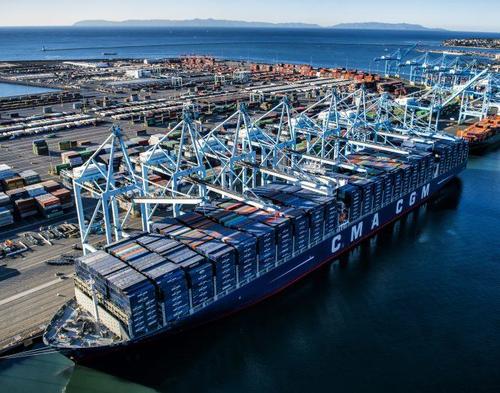
Shippers are not buying into the box shortage paradigm, that the dearth of containers in Asia is caused by the pandemic, presented by shipping lines and others, with one shipper telling Container News, “Containers don’t have a life of their own, the lines manage their box fleets as well as their ships.”
Shippers believe that the cause of the container shortage and the spike in charges is the lines themselves, “Shippers are being charged astronomic rates for the lines’ own incompetence,” said one source, adding, “It’s easy to suggest it’s a problem from the pandemic, but the lines manage their own container fleets as well as the ships.”
Growing anger among global shippers, in both the US and Europe has seen the Federal Maritime Commission (FMC) investigating charges and the box shortages in the US.
However, maritime consultant Mike Garratt, chairman of MDS Transmodal, which this week published a quarterly review of the container industry, argued that just by looking at the port statistics you can see that there is a problem with the view that there is a container shortage and this year there are more ‘missing’ containers than last year.
Los Angeles Port which published its figures for the first 11 months of this year showed that 4.413 million TEU entered the port, with a 3.92 million TEU exported, that means there is 493,000TEU, around 246,000 boxes somewhere in the US.
“Somewhere there is the most enormous hole with containers in it,” Garratt quipped. He adde that most often it is assumed that containers end up in the mid-West for the export of animal feed, but it could also be a secondary impact of the US trade war with China, however, “This could have been anticipated,” said Garratt.
Last year a similar situation was evident, but it was not nearly as acute, with an import deficit of 390,000TEU, around 190,000 boxes in total for the full year. Port of Long Beach figures were unavailable at the time of writing.
Shippers argue that while the lines were shipping containers they must have anticipated that containers would need to come back.
Even if carriers could have anticipated the box shortages the Danish consultancy Sea-Intelligence, with CEO Alan Murphy argue that the “dire shortage” of empty containers will not be resolved until the end of January or early February as with a combination of “aggressive repositioning” and the manufacturing of new boxes this will be the quickest route to alleviate the scarcity.
According to Murphy the acute lack of boxes is the largest problem facing container shipping at this time, with particular reference to Asia, the source of a large proportion of the worlds’ manufactured goods.
“This is what is driving spot rate markets to historical highs, and it is what is causing significant grief to shippers looking to get their product moved in a timely fashion,” said Murphy.
Sea-Intelligence estimated the number of available containers and the volume of cargo moving, which allowed the consultants to predict the time necessary for a loaded container to be shipped from Asia and to make its return journey in readiness for the next cargo.
“We then augmented this with Container Trade Statistics (CTS) demand data, and the potential buffer stock of empty containers in Asia, to model the empty container availability in Asia,” explained Murphy.
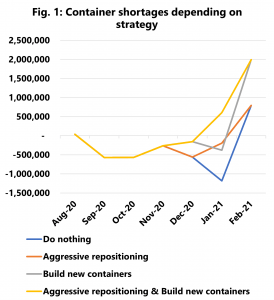
Using these informed predictive estimates Sea-Intelligence was able to model four different scenarios for dealing with the box shortage, do nothing, aggressively reposition containers, an injection of newly manufactured containers and a combination of aggressive repositioning and new boxes, as seen in the graphic, below left.
The combined strategy is the only way to resolve the issue within the end of January timeframe according to Murphy. And that is the method now being used by the carriers to reposition empty boxes. And it could be this strategy that is causing significant box shortages for back-haul cargo.
“The market is thus faced with a stark choice,” explained Murphy, “Either the carriers pursue the current strategy, and there is the possibility of resolving the container shortage during January, or the carriers reduce their aggressive repositioning strategy in order to serve back-haul shippers, but then the consequence is that the empty shortage problem will persist into at least February, and possibly beyond.”
This is not a scenario that James Hookham, the secretary general at the Global Shippers’ Forum (GSF) recognises, “I’m not so sure the shortages are as acute as they say,” he argued.
The GSF and consultants MDS Transmodal released a quarterly review of the container shipping market this week, which included assessing the numbers of containers in and out of ports and the evidence given by shippers, and the swift returns of empty containers are in the interests of the shippers, said Hookham, “No-one is hanging about,” he added.
He went to say, “There is a spike in demand in certain trades, but global trade is not much different to last year and there were no shortages then.”
However, this is not a view shared by the Container xChange and the company’s CAx scale is at 0.05, compared to last year’s 0.25. According to the Container xChange, equipment generally becomes more available at this time of year.
However, the lockdowns in the first and second quarters “disrupted supply-chains, causing significantly longer overall transit times and hence less trips per container per year – effectively reducing container supply,” said the company.
European shippers remain sceptical, with the Policy Manager for Maritime Transport at the European Shippers Council Jordi Espin arguing, “To us, this issue responds to what we call ‘grey containers’ which is repositioning empty containers not to where they are needed but to where there are high freight rates established. This may create an artificial view of relocating containers still far away from where the operational world is demanding them. The supporting policy to this is only more and more profits.”
Espin offers a solution, “There is an easier way of repositioning containers: shipping lines should offer empty containers to shippers under the “shippers’ own” mode. This would relocate containers exactly where the shippers’ demand needs them and would establish an exact pattern of what the operational world flows are demanding. But this latter solution needs a driven customer focus [from the shipping lines], which seems not to be the case now.”
Worldwide Logistics is reporting most of the major container ports in China have a shortage of containers, across all the lines. In addition all the lines have experienced shortages of containers in Thailand, South Korea, Singapore and Malaysia.
Jon Monroe, of Worlwide Logistics and an independent consultant, lists these further problems that must be overcome by the industry in the US.
- Vessel waiting time at anchor: 4 to 6 days
- Terminal congestion due to vessel delays
- Shortage of terminal labour, thereby taking twice as long to offload a vessel
- Appointment times at terminals not honoured.
- Single transactions at terminal rather than dual transactions
- Chassis shortages: companies hoarding chassis
- Importers keeping equipment out for 10 to 14 days
- Shortage of truckers
- Unable to get appointment to return empties
- Carriers returning to Asia empty; or at least with empty containers
These additional challenges to the industry and the criticisms levelled at the carriers by their customers was addressed by the lines through John Butler, President & CEO of World Shipping Council, which represents 20 of the world’s vessel operators.
Butler argues that the assumptions by shippers are false, in the first instance the assumption, “That carriers control demand for transportation services and therefore how many boxes move in each direction, and that carriers have sole control over their equipment. Both assumptions are incorrect. On the first point, import and export numbers, and their effects on intermodal equipment, are driven by cargo demand. Carriers respond to that demand by deploying their vessels and containers to best serve the cargo that is tendered to them. That is what carriers are doing today.
“On the second point, the entire model of containerised transport is that a loaded box can be handed off among multiple actors in the intermodal chain without being unloaded and re-packed at each step. That means that the velocity of the container is affected by marine terminal operations, trucking companies, cargo owners, and others. Carriers do not control the manner in which these third parties work.”
As an example, Butler said if a shipper parks a loaded container and chassis in a depot for 10 days, both the container and the chassis are unavailable to carry other cargo.
“The actions of all participants in the supply chain affect every other participant in the chain. It is this reality that defines the management challenge that we collectively face – not a simplistic approach that incorrectly suggests that one participant controls the entire process,” concluded Butler.
December 20, 2020
Container Shortage
Shippers Blame Carriers For Entirely Predictable US Container Graveyard
by Tyler DurdenSunday, Dec 20, 2020 – 12:20
By Nick Savvides of ContainerNews
Shippers are not buying into the box shortage paradigm, that the dearth of containers in Asia is caused by the pandemic, presented by shipping lines and others, with one shipper telling Container News, “Containers don’t have a life of their own, the lines manage their box fleets as well as their ships.”
Shippers believe that the cause of the container shortage and the spike in charges is the lines themselves, “Shippers are being charged astronomic rates for the lines’ own incompetence,” said one source, adding, “It’s easy to suggest it’s a problem from the pandemic, but the lines manage their own container fleets as well as the ships.”
Growing anger among global shippers, in both the US and Europe has seen the Federal Maritime Commission (FMC) investigating charges and the box shortages in the US.
However, maritime consultant Mike Garratt, chairman of MDS Transmodal, which this week published a quarterly review of the container industry, argued that just by looking at the port statistics you can see that there is a problem with the view that there is a container shortage and this year there are more ‘missing’ containers than last year.
Los Angeles Port which published its figures for the first 11 months of this year showed that 4.413 million TEU entered the port, with a 3.92 million TEU exported, that means there is 493,000TEU, around 246,000 boxes somewhere in the US.
“Somewhere there is the most enormous hole with containers in it,” Garratt quipped. He adde that most often it is assumed that containers end up in the mid-West for the export of animal feed, but it could also be a secondary impact of the US trade war with China, however, “This could have been anticipated,” said Garratt.
Last year a similar situation was evident, but it was not nearly as acute, with an import deficit of 390,000TEU, around 190,000 boxes in total for the full year. Port of Long Beach figures were unavailable at the time of writing.
Shippers argue that while the lines were shipping containers they must have anticipated that containers would need to come back.
Even if carriers could have anticipated the box shortages the Danish consultancy Sea-Intelligence, with CEO Alan Murphy argue that the “dire shortage” of empty containers will not be resolved until the end of January or early February as with a combination of “aggressive repositioning” and the manufacturing of new boxes this will be the quickest route to alleviate the scarcity.
According to Murphy the acute lack of boxes is the largest problem facing container shipping at this time, with particular reference to Asia, the source of a large proportion of the worlds’ manufactured goods.
“This is what is driving spot rate markets to historical highs, and it is what is causing significant grief to shippers looking to get their product moved in a timely fashion,” said Murphy.
Sea-Intelligence estimated the number of available containers and the volume of cargo moving, which allowed the consultants to predict the time necessary for a loaded container to be shipped from Asia and to make its return journey in readiness for the next cargo.
“We then augmented this with Container Trade Statistics (CTS) demand data, and the potential buffer stock of empty containers in Asia, to model the empty container availability in Asia,” explained Murphy.
Using these informed predictive estimates Sea-Intelligence was able to model four different scenarios for dealing with the box shortage, do nothing, aggressively reposition containers, an injection of newly manufactured containers and a combination of aggressive repositioning and new boxes, as seen in the graphic, below left.
The combined strategy is the only way to resolve the issue within the end of January timeframe according to Murphy. And that is the method now being used by the carriers to reposition empty boxes. And it could be this strategy that is causing significant box shortages for back-haul cargo.
“The market is thus faced with a stark choice,” explained Murphy, “Either the carriers pursue the current strategy, and there is the possibility of resolving the container shortage during January, or the carriers reduce their aggressive repositioning strategy in order to serve back-haul shippers, but then the consequence is that the empty shortage problem will persist into at least February, and possibly beyond.”
This is not a scenario that James Hookham, the secretary general at the Global Shippers’ Forum (GSF) recognises, “I’m not so sure the shortages are as acute as they say,” he argued.
The GSF and consultants MDS Transmodal released a quarterly review of the container shipping market this week, which included assessing the numbers of containers in and out of ports and the evidence given by shippers, and the swift returns of empty containers are in the interests of the shippers, said Hookham, “No-one is hanging about,” he added.
He went to say, “There is a spike in demand in certain trades, but global trade is not much different to last year and there were no shortages then.”
However, this is not a view shared by the Container xChange and the company’s CAx scale is at 0.05, compared to last year’s 0.25. According to the Container xChange, equipment generally becomes more available at this time of year.
However, the lockdowns in the first and second quarters “disrupted supply-chains, causing significantly longer overall transit times and hence less trips per container per year – effectively reducing container supply,” said the company.
European shippers remain sceptical, with the Policy Manager for Maritime Transport at the European Shippers Council Jordi Espin arguing, “To us, this issue responds to what we call ‘grey containers’ which is repositioning empty containers not to where they are needed but to where there are high freight rates established. This may create an artificial view of relocating containers still far away from where the operational world is demanding them. The supporting policy to this is only more and more profits.”
Espin offers a solution, “There is an easier way of repositioning containers: shipping lines should offer empty containers to shippers under the “shippers’ own” mode. This would relocate containers exactly where the shippers’ demand needs them and would establish an exact pattern of what the operational world flows are demanding. But this latter solution needs a driven customer focus [from the shipping lines], which seems not to be the case now.”
Worldwide Logistics is reporting most of the major container ports in China have a shortage of containers, across all the lines. In addition all the lines have experienced shortages of containers in Thailand, South Korea, Singapore and Malaysia.
Jon Monroe, of Worlwide Logistics and an independent consultant, lists these further problems that must be overcome by the industry in the US.
- Vessel waiting time at anchor: 4 to 6 days
- Terminal congestion due to vessel delays
- Shortage of terminal labour, thereby taking twice as long to offload a vessel
- Appointment times at terminals not honoured.
- Single transactions at terminal rather than dual transactions
- Chassis shortages: companies hoarding chassis
- Importers keeping equipment out for 10 to 14 days
- Shortage of truckers
- Unable to get appointment to return empties
- Carriers returning to Asia empty; or at least with empty containers
These additional challenges to the industry and the criticisms levelled at the carriers by their customers was addressed by the lines through John Butler, President & CEO of World Shipping Council, which represents 20 of the world’s vessel operators.
Butler argues that the assumptions by shippers are false, in the first instance the assumption, “That carriers control demand for transportation services and therefore how many boxes move in each direction, and that carriers have sole control over their equipment. Both assumptions are incorrect. On the first point, import and export numbers, and their effects on intermodal equipment, are driven by cargo demand. Carriers respond to that demand by deploying their vessels and containers to best serve the cargo that is tendered to them. That is what carriers are doing today.
“On the second point, the entire model of containerised transport is that a loaded box can be handed off among multiple actors in the intermodal chain without being unloaded and re-packed at each step. That means that the velocity of the container is affected by marine terminal operations, trucking companies, cargo owners, and others. Carriers do not control the manner in which these third parties work.”
As an example, Butler said if a shipper parks a loaded container and chassis in a depot for 10 days, both the container and the chassis are unavailable to carry other cargo.
“The actions of all participants in the supply chain affect every other participant in the chain. It is this reality that defines the management challenge that we collectively face – not a simplistic approach that incorrectly suggests that one participant controls the entire process,” concluded Butler.
November 19, 2020
Existing Home Sales Surge
Existing Home Sales Soar To Highest In 15 Years
by Tyler Durden Thu, 11/19/2020 – 10:07
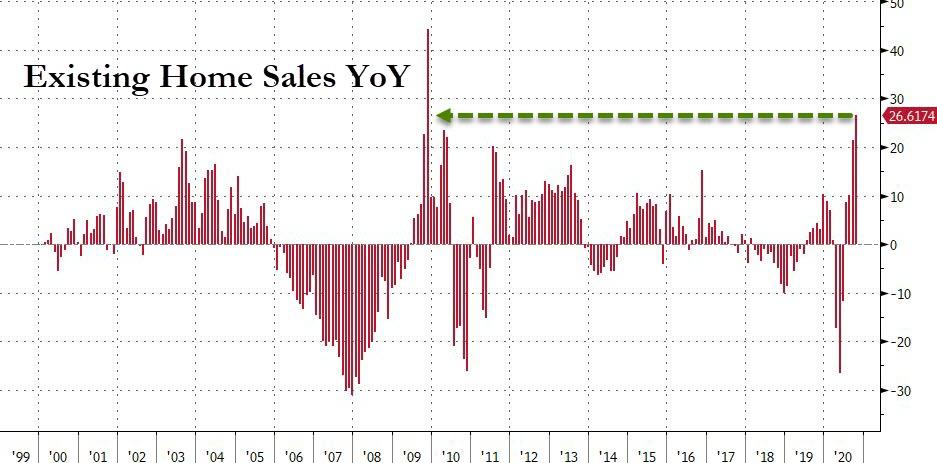
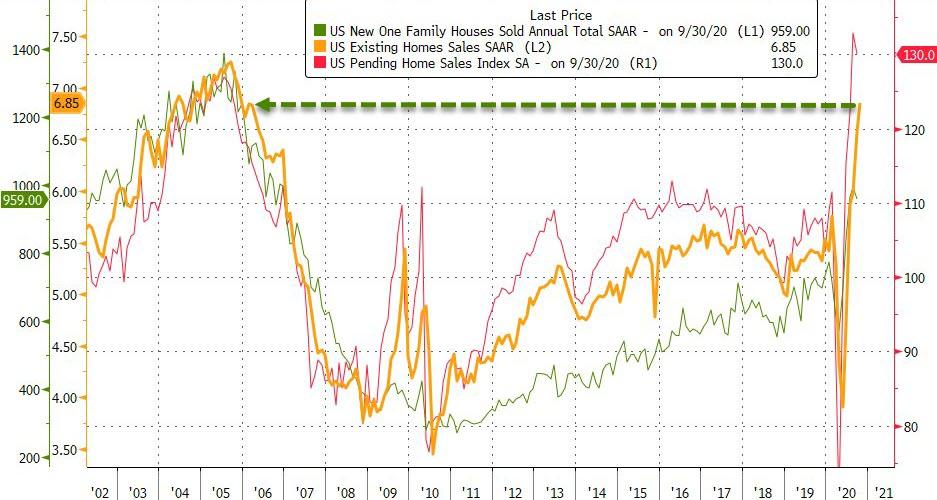
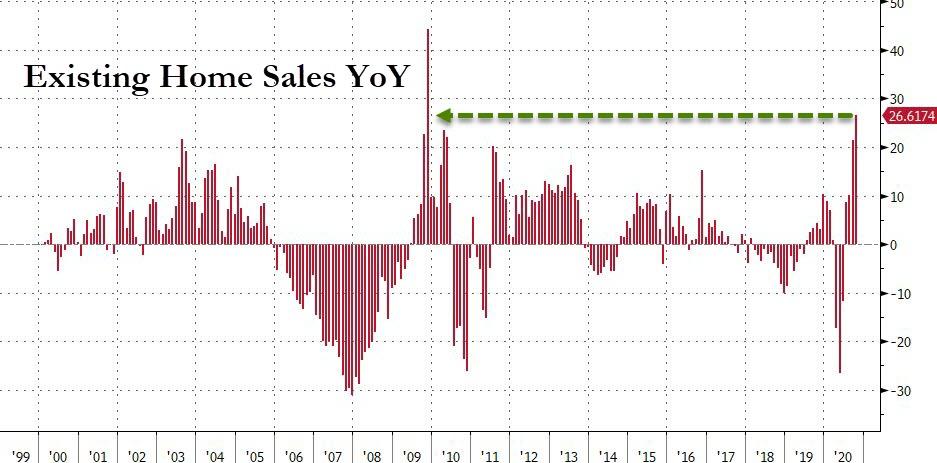
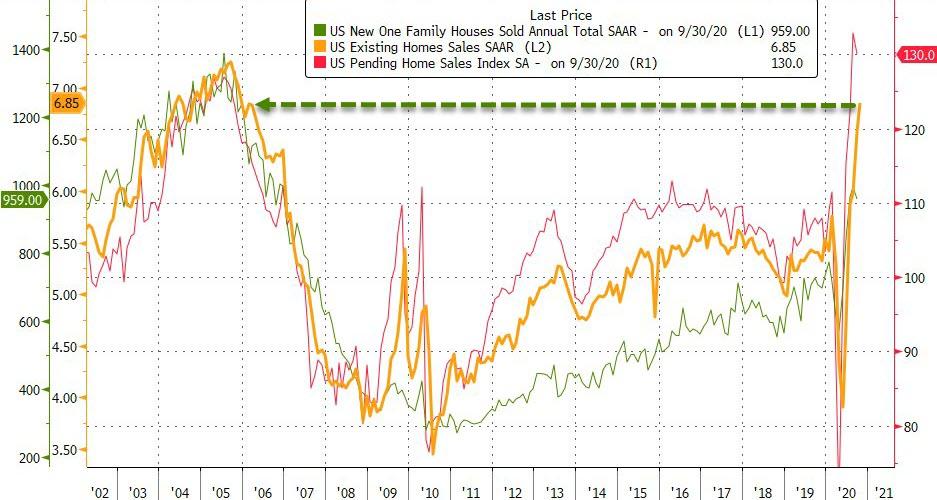
Existing home sales bucked the trend in September (rising to highest since May 2006 as new- and pending-home sales slipped) and analysts expect it too catch down a little in October, but yet again, it surprised to the upside, surging 4.3% MoM (vs a 1.1% MoM expected drop), and September’s jump was revised higher to a 9.9% spike…
This surprise rise has pushed the YoY jump in sales to 26.6% – the biggest spike since Nov 2009
Source: Bloomberg
This is the highest existing home sales print since November 2005…
Source: Bloomberg
Christophe Barraud explains why the number was so ‘surprisingly’ good:
- Buyers continued to benefit from favorable market conditions in October with mortgage rates still close to the lowest level on record
- Local/state reports confirm that sales kept rising by more than 20% YoY (non-seasonally adjusted: NSA) in October, which should translate into a bounce on a MoM basis (seasonally adjusted: SA)
- Recent announcements from corporates suggest that home-improvement activity (correlated to existing home sales) is still booming
Median home price rose 15.5% from last year to $313,000, an all-time high, according to NAR.
“It’s quite amazing, and certainly surprising me,” Lawrence Yun, NAR’s chief economist, said on a call with reporters.
“It’s quite remarkable given that we’re still in the midst of the pandemic and the high unemployment rate.”
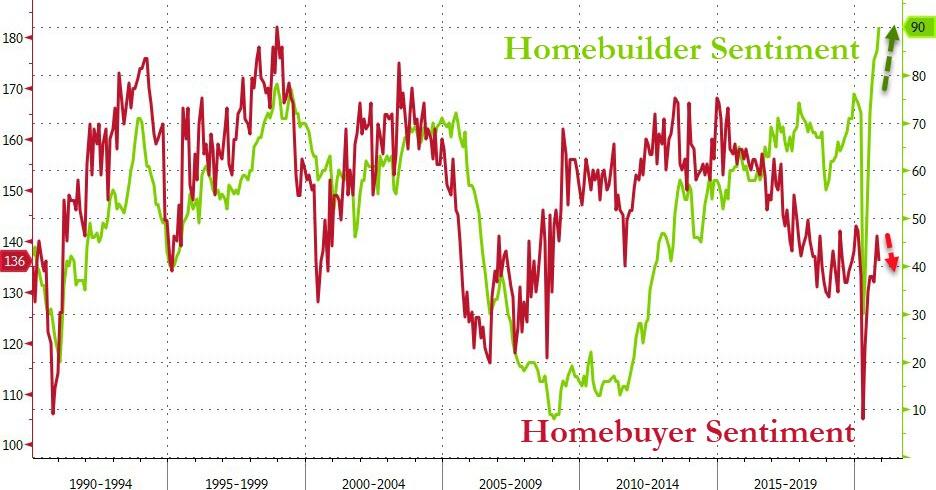
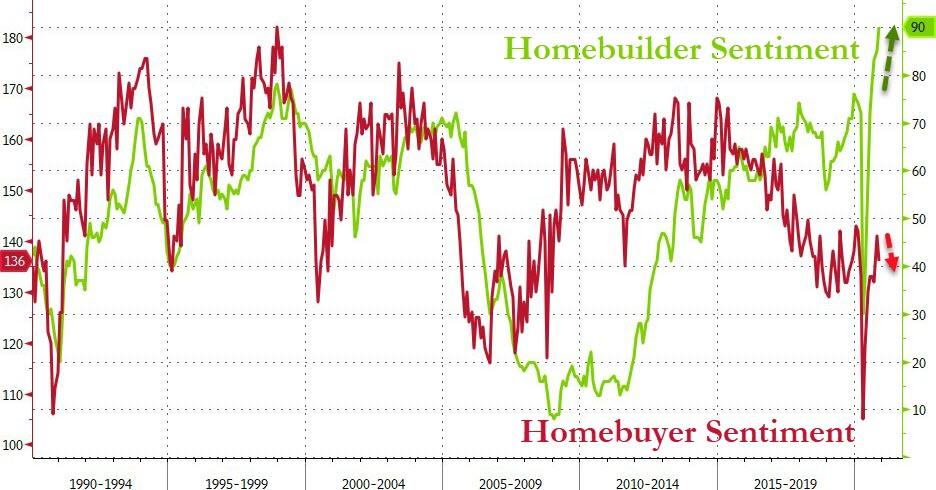
Finally, we note that while homebuilder sentiment is at record highs (but building permits stumbled?), homebuyer sentiment remains low and has rolled over…
Source: Bloomberg
And don’t expect The Fed to come to the rescue with ‘rate-cuts’ anytime soon.
https://www.zerohedge.com/personal-finance/existing-home-sales-soar-highest-15-years
November 19, 2020
Existing Home Sales Surge
Existing Home Sales Soar To Highest In 15 Years
by Tyler Durden Thu, 11/19/2020 – 10:07
Existing home sales bucked the trend in September (rising to highest since May 2006 as new- and pending-home sales slipped) and analysts expect it too catch down a little in October, but yet again, it surprised to the upside, surging 4.3% MoM (vs a 1.1% MoM expected drop), and September’s jump was revised higher to a 9.9% spike…
This surprise rise has pushed the YoY jump in sales to 26.6% – the biggest spike since Nov 2009
Source: Bloomberg
This is the highest existing home sales print since November 2005…
Source: Bloomberg
Christophe Barraud explains why the number was so ‘surprisingly’ good:
- Buyers continued to benefit from favorable market conditions in October with mortgage rates still close to the lowest level on record
- Local/state reports confirm that sales kept rising by more than 20% YoY (non-seasonally adjusted: NSA) in October, which should translate into a bounce on a MoM basis (seasonally adjusted: SA)
- Recent announcements from corporates suggest that home-improvement activity (correlated to existing home sales) is still booming
Median home price rose 15.5% from last year to $313,000, an all-time high, according to NAR.
“It’s quite amazing, and certainly surprising me,” Lawrence Yun, NAR’s chief economist, said on a call with reporters.
“It’s quite remarkable given that we’re still in the midst of the pandemic and the high unemployment rate.”
Finally, we note that while homebuilder sentiment is at record highs (but building permits stumbled?), homebuyer sentiment remains low and has rolled over…
Source: Bloomberg
And don’t expect The Fed to come to the rescue with ‘rate-cuts’ anytime soon.
https://www.zerohedge.com/personal-finance/existing-home-sales-soar-highest-15-years
November 16, 2020
Grenfell Investigations
Grenfell inquiry: Ex-employee describes ‘dishonest’ acts at firm that made flammable insulation used on tower
The ex-Celotex assistant product manager told the inquiry the firm had been dishonest when testing its Rs5000 insulation product.
By Aisha Zahid, news reporter
Monday 16 November 2020 20:05, UK

A former employee of the company that produced flammable insulation used on Grenfell Tower says he complied with “completely unethical” acts, the inquiry into the June 2017 disaster has heard.
Jonathan Roper, the ex-assistant product manager at Celotex, told proceedings the firm had been “dishonest” by “overengineering” a cladding fire safety test to enable its Rs5000 insulation product to pass.
After an initial test failure in January 2014, a second system passed in May 2014 – this was used to incorrectly market the combustible rigid foam boards as safe for use on high-rise buildings, the inquiry heard.
Celotex added a 6mm fire-resisting magnesium oxide board to a cladding test rig consisting of 12mm fibre cement panels for the second test, the hearing was told.
The inquiry heard 8mm fibre cement panels were added to “conceal” the presence of the magnesium oxide, making the whole system almost flush – but for the 2mm difference.
Mr Roper agreed with the inquiry’s chief lawyer Richard Millett QC that using “a thinner layer was to make it less noticeable there was something else behind it”, which would help “see off any prospect of anyone asking questions”, about how it had been made up.
Mr Roper answered “yes it did”, when Mr Millett had asked him the question: “Did that not strike you at the time as dishonest?”
Mr Roper also said: “I went along with a lot of actions at Celotex that, looking back on reflection, were completely unethical and that I probably didn’t potentially consider the impact of at the time.
“I was 22 or 23, first job, I thought this was standard practice albeit it did sit very uncomfortably with me.”

Mr Roper added that his superiors ordered the mention of magnesium oxide to be removed from any marketing, which he agreed was “misleading and intended to mislead”.
Mr Millett also asked: “Did you realise at the time that if this was how the test was to be described to the market it would be a fraud on the market?”
Mr Roper responded by saying: “Yes I did. I felt incredibly uncomfortable with it. I felt incredibly uncomfortable with what I was asked to do.”
He added that he could not voice his concerns to anyone else in the firm at the time.
Mr Roper also told the inquiry that the motivation for getting the Rs5000 product to market was to compete with a rival firm.
Celotex has released a statement, saying: “In the course of investigations carried out by Celotex after the Grenfell Tower fire, certain issues emerged concerning the testing, certification and marketing of Celotex’s products which were previously unknown to Celotex’s current management.”
It added: “Once established, they were promptly and publicly announced by notices on Celotex’s website and reported to the relevant testing and certification bodies, the Ministry of Housing, Communities and Local Government, Trading Standards, the Metropolitan Police and the Inquiry.
“These matters involved unacceptable conduct on the part of a number of employees. They should not have happened and Celotex has taken concerted steps to ensure that no such issues reoccur.
“Celotex is committed to cooperating fully with the Grenfell Tower Inquiry and related investigations, continuing to support the UK Government’s ongoing response to the tragedy.”
The company, part of the French multinational Saint-Gobain group, maintains that it promoted the use of Rs5000 on buildings higher than 18 metres only on a “rainscreen cladding system with the specific components”, used when it passed the fire safety test.
In its opening statement for module two of the inquiry, the firm said: “In the course of investigations carried out by Celotex after the Grenfell Tower fire, certain issues emerged concerning the testing, certification and marketing of Celotex’s products.
“These matters involved unacceptable conduct on the part of a number of employees.”
Module two of the inquiry will scrutinise the production, testing and sale of materials used in the tower’s refurbishment which saw 72 people killed in the 14 June 2017 fire.
 Everchem Updates Archive
  Sign Up for Email Updates