
Current Affairs
January 14, 2021
ASC Board Changes
ASC Announces New Board Officers and Executive Committee for 2021-2022
Published on 2021-01-07. Author : SpecialChem
 Adhesive and Sealant Council (ASC) announces changes in its officers and members of the executive committee for 2021-2022. ASC also announced directors re-elected for another three-year term on the board of directors, beginning January 1, 2021.
ASC’s Newly Elected Officers
- Matt Devine, former president of DHM Adhesives, now at H.B. Fuller. He has been elected to serve as chairman of the board through January 31, 2021. He will also lead the ASC executive committee. Devine previously served as ASC Treasurer for two years.
- Heather Campe, senior vice president, H.B. Fuller. She has been elected to succeed Matt Devine as chairman of the board beginning February 1, 2021 through December 31, 2022.
- Forest Driggs, senior vice president and chief financial officer, Franklin International. He has been elected to serve as treasurer beginning january 1, 2021 through December 31, 2022. he will also lead the audit committee and serve on the ASC executive committee.
Brian McSwigan, vice president, packaging and consumer adhesives at Henkel Corporation, will serve as Past Chair for two years and remain on the ASC executive committee.
The Board elected Tom Stewart, senior director, performance adhesives, at Ashland to a two-year term on the executive committee, beginning January 1, 2021.
Gerhard Haas, vice president, research & development, technical service, purchasing at Jowat Corporation was re-elected to another two-year term on the executive committee, beginning January 1, 2021.
Re-elected Members of ASC Board
- Darius Deak, global R&D director – NonWovens, corporate R&D director-Americas, Bostik;
- Damon Hollis, sales manager-Americas, Eastman;
- Mark Schneider, president, Albion Engineering Company;
- Tom Stewart, senior director, performance adhesives, Ashland;
- Dave White, senior vice president, quality and risk management, Sika; and
- Chuck Williams, senior technical director, global adhesives, polymers, adhesive and coatings center of excellence, Avery Dennison
Re-elected members of the ASC board will serving a three-year term beginning January 1, 2021.
“The newly elected ASC Board officers and directors bring many years of experience as leaders in the adhesive and sealant industry that will strengthen our organization as we transition into a post-COVID world,” said ASC President William Allmond.
“They will lead and oversee new strategic initiatives that emerge from ASC’s three-year long-range plan and reconnect the global value chain as hosts of the 10th World Adhesive and Sealant Conference in April 2022,” added Allmond. “As President, I am excited to work alongside our officers and board to grow the value we deliver to our membership and to the greater adhesive and sealant industry.”
ASC’s board includes 23 directors representing manufacturers, suppliers, distributors, and academia in North America.
January 14, 2021
ASC Board Changes
ASC Announces New Board Officers and Executive Committee for 2021-2022
Published on 2021-01-07. Author : SpecialChem
Adhesive and Sealant Council (ASC) announces changes in its officers and members of the executive committee for 2021-2022. ASC also announced directors re-elected for another three-year term on the board of directors, beginning January 1, 2021.
ASC’s Newly Elected Officers
- Matt Devine, former president of DHM Adhesives, now at H.B. Fuller. He has been elected to serve as chairman of the board through January 31, 2021. He will also lead the ASC executive committee. Devine previously served as ASC Treasurer for two years.
- Heather Campe, senior vice president, H.B. Fuller. She has been elected to succeed Matt Devine as chairman of the board beginning February 1, 2021 through December 31, 2022.
- Forest Driggs, senior vice president and chief financial officer, Franklin International. He has been elected to serve as treasurer beginning january 1, 2021 through December 31, 2022. he will also lead the audit committee and serve on the ASC executive committee.
Brian McSwigan, vice president, packaging and consumer adhesives at Henkel Corporation, will serve as Past Chair for two years and remain on the ASC executive committee.
The Board elected Tom Stewart, senior director, performance adhesives, at Ashland to a two-year term on the executive committee, beginning January 1, 2021.
Gerhard Haas, vice president, research & development, technical service, purchasing at Jowat Corporation was re-elected to another two-year term on the executive committee, beginning January 1, 2021.
Re-elected Members of ASC Board
- Darius Deak, global R&D director – NonWovens, corporate R&D director-Americas, Bostik;
- Damon Hollis, sales manager-Americas, Eastman;
- Mark Schneider, president, Albion Engineering Company;
- Tom Stewart, senior director, performance adhesives, Ashland;
- Dave White, senior vice president, quality and risk management, Sika; and
- Chuck Williams, senior technical director, global adhesives, polymers, adhesive and coatings center of excellence, Avery Dennison
Re-elected members of the ASC board will serving a three-year term beginning January 1, 2021.
“The newly elected ASC Board officers and directors bring many years of experience as leaders in the adhesive and sealant industry that will strengthen our organization as we transition into a post-COVID world,” said ASC President William Allmond.
“They will lead and oversee new strategic initiatives that emerge from ASC’s three-year long-range plan and reconnect the global value chain as hosts of the 10th World Adhesive and Sealant Conference in April 2022,” added Allmond. “As President, I am excited to work alongside our officers and board to grow the value we deliver to our membership and to the greater adhesive and sealant industry.”
ASC’s board includes 23 directors representing manufacturers, suppliers, distributors, and academia in North America.
January 13, 2021
Truck Orders Surge
December Class 8 Truck Orders Are The Fourth Highest In History
by Tyler DurdenWednesday, Jan 13, 2021 – 5:35
Class 8 truck net new orders in December were the fourth highest in history at 50,900 units, down 2% MoM but up 153% YoY. Seasonally adjusted orders in the month came in at 39,500 units (474,000 SAAR), down 18% MoM. Orders were up 139% YoY to 142,000 units in Q4 (the second best quarter on record) and up 54% to 278,400 units in 2020.
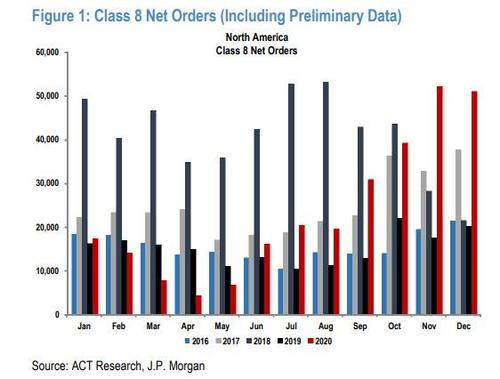
As Alan Adler at Freightwaves writes, the surge in bookings reflects continued demand for consumer goods, an awakening of the manufacturing sector and robust fleet profits from tight freight capacity. A driver shortage is worsened by closed driving schools. Other drivers are sidelined because they failed drug tests. All of these factor into higher per-mile freight rates.
“As we at ACT [Research] can often be heard saying, ‘When carriers make money, they buy trucks,’” ACT President and senior analyst Kenny Vieth told FreightWaves.
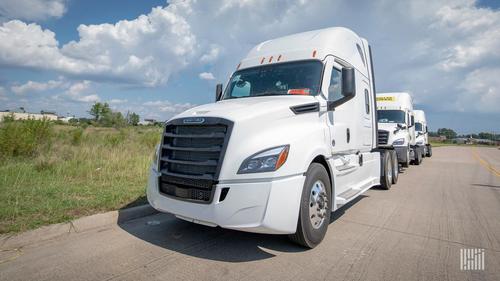
The order strength in the last four months of the year made up for a stagnant order book in April and May, when the first wave of the coronavirus shuttered truck manufacturing plants and disrupted supply chains. But a V-shaped recovery took hold in late summer and plants laid on overtime to make up for delayed orders.
“Looking to 2021, with freight-intensive economic sectors like manufacturing coming on strong, and driver recruitment continuing to lag, carrier profitability should continue to accelerate, which bodes well for new vehicle demand,” Vieth said.
In a Thursday note from JPMorgan, the largest US commercial bank said it expects production of ~250,000 units in 2021 (up 17% YoY) and ~258,000 units in 2022 (up 3% YoY).
Should the economy fall victim to the worsening impact of the pandemic, fleets can cancel or retime orders. Order placements assure carriers of being assigned a build slot for their new trucks. As production backlogs grow, so does the time between order and delivery.
“Although we believe the tailwinds of still-strong consumer buying, likely to be boosted further by new stimulus checks, and inventory restocking will remain powerful in 1H21, a successful vaccine rollout and reopening of economies is likely to drive an aggressive shift in consumer dollars back to services,” Evercore ISI said in an investor note Thursday.
That could occur just as new trucks being ordered now are ready for delivery.
“To get two back-to-back order months over 50,000 is a stellar accomplishment, after previously seeing orders crater to under 5,000 units in April,” said Don Ake, vice president of commercial vehicles at FTR Transportation Intelligence. “Now, 2021 has the potential to be an incredible recovery year.”
Orders for new dry vans and refrigerated trailers mirror the surge in the tractor orders that pull them. Flatbed orders are recovering more slowly. The September-November booking total amounted to the second-best three months in industry history. “The backlog is filled into Q4,” Dave Giesen, vice president of sales at Stoughton Trailers, told FreightWaves in December. “We will wait for the supply chain to catch up before we continue quoting as this is a long way out.”
Meanwhile, December demand for Class 5-7 trucks recorded its second-best ever volume at 35,100 units. Medium-duty orders rose 28% over November and 73% compared to last December.
“There is a symbiotic relationship between heavy-duty freight rates and medium-duty demand,” Vieth said. “Clearly, the shift in consumer spending from experiences to goods has been good for the providers of local trucking services as e-commerce has grown by leaps and bounds during the pandemic.”
https://www.zerohedge.com/markets/december-class-8-truck-orders-are-fourth-highest-history
January 13, 2021
Truck Orders Surge
December Class 8 Truck Orders Are The Fourth Highest In History
by Tyler DurdenWednesday, Jan 13, 2021 – 5:35
Class 8 truck net new orders in December were the fourth highest in history at 50,900 units, down 2% MoM but up 153% YoY. Seasonally adjusted orders in the month came in at 39,500 units (474,000 SAAR), down 18% MoM. Orders were up 139% YoY to 142,000 units in Q4 (the second best quarter on record) and up 54% to 278,400 units in 2020.
As Alan Adler at Freightwaves writes, the surge in bookings reflects continued demand for consumer goods, an awakening of the manufacturing sector and robust fleet profits from tight freight capacity. A driver shortage is worsened by closed driving schools. Other drivers are sidelined because they failed drug tests. All of these factor into higher per-mile freight rates.
“As we at ACT [Research] can often be heard saying, ‘When carriers make money, they buy trucks,’” ACT President and senior analyst Kenny Vieth told FreightWaves.
The order strength in the last four months of the year made up for a stagnant order book in April and May, when the first wave of the coronavirus shuttered truck manufacturing plants and disrupted supply chains. But a V-shaped recovery took hold in late summer and plants laid on overtime to make up for delayed orders.
“Looking to 2021, with freight-intensive economic sectors like manufacturing coming on strong, and driver recruitment continuing to lag, carrier profitability should continue to accelerate, which bodes well for new vehicle demand,” Vieth said.
In a Thursday note from JPMorgan, the largest US commercial bank said it expects production of ~250,000 units in 2021 (up 17% YoY) and ~258,000 units in 2022 (up 3% YoY).
Should the economy fall victim to the worsening impact of the pandemic, fleets can cancel or retime orders. Order placements assure carriers of being assigned a build slot for their new trucks. As production backlogs grow, so does the time between order and delivery.
“Although we believe the tailwinds of still-strong consumer buying, likely to be boosted further by new stimulus checks, and inventory restocking will remain powerful in 1H21, a successful vaccine rollout and reopening of economies is likely to drive an aggressive shift in consumer dollars back to services,” Evercore ISI said in an investor note Thursday.
That could occur just as new trucks being ordered now are ready for delivery.
“To get two back-to-back order months over 50,000 is a stellar accomplishment, after previously seeing orders crater to under 5,000 units in April,” said Don Ake, vice president of commercial vehicles at FTR Transportation Intelligence. “Now, 2021 has the potential to be an incredible recovery year.”
Orders for new dry vans and refrigerated trailers mirror the surge in the tractor orders that pull them. Flatbed orders are recovering more slowly. The September-November booking total amounted to the second-best three months in industry history. “The backlog is filled into Q4,” Dave Giesen, vice president of sales at Stoughton Trailers, told FreightWaves in December. “We will wait for the supply chain to catch up before we continue quoting as this is a long way out.”
Meanwhile, December demand for Class 5-7 trucks recorded its second-best ever volume at 35,100 units. Medium-duty orders rose 28% over November and 73% compared to last December.
“There is a symbiotic relationship between heavy-duty freight rates and medium-duty demand,” Vieth said. “Clearly, the shift in consumer spending from experiences to goods has been good for the providers of local trucking services as e-commerce has grown by leaps and bounds during the pandemic.”
https://www.zerohedge.com/markets/december-class-8-truck-orders-are-fourth-highest-history
January 7, 2021
Back to Normalcy
American Airlines Is Ending Support For Emotional Support Animals
by Tyler DurdenWednesday, Jan 06, 2021 – 23:50
American Airlines is finally ending the literal circus that was becoming “emotional support animals” at airports and in airplanes nationwide. Hopefully, other airlines will follow suit.
Back in the day, there were seeing eye dogs, sheep herding dogs and cadaver dogs that were specially trained and that was it. Every good doggo was an “emotional support animal” for its owner, which is one of the best parts of having a pet: they can calm you down, they can bring joy into your life and they can be your best friend.
But if you don’t know someone that has wrapped their dog up in a military style pet-vest with the words “emotional support animal” written on it lately – as if their “specially trained” dog’s key goal is to somehow psychoanalyze you and offer you written notes on the “anxiety” you feel from capitalism or the patriarchy, versus simply eating, sleeping, farting and crapping – then you haven’t been paying attention.
It has become an epidemic across the U.S. – people using the “emotional support” excuse to gain access for their pets on flights and in airports – where they would usually not be welcome. And once the floodgates for emotional support dogs opened up, Americans starting carting around emotional support squirrels, emotional support clowns, emotional support peacocks and entire emotional support zoos with them as they traveled.
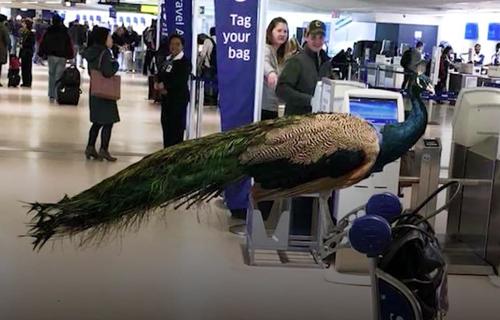
But American Airlines appears to have finally seen enough. The airline has made a policy change that “matches a new Department of Transportation regulation that says airlines aren’t required to treat emotional support animals as service animals,” according to CNN. The rules come into effect on January 11.
At that point, American Airlines says it will “will no longer authorize new travel for animals that do not meet that definition, such as emotional support animals.”
Emotional support animals are supposed to be “prescribed by mental health professionals to provide comfort and support, but unlike service animals, they are not required to have training in specific tasks.”
Jessica Tyler, president of cargo and vice president of airport excellence for American said: “We’re confident this approach will enable us to better serve our customers, particularly those with disabilities who travel with service animals, and better protect our team members at the airport and on the aircraft.”
Among the airline’s concerns was that “passengers were fraudulently passing off their pets as the more loosely defined and fee-free category of emotional support animals”.
What gave it away, guys? Was it the peacock?
https://www.zerohedge.com/markets/american-airlines-ending-support-emotional-support-animals
 Everchem Updates Archive
  Sign Up for Email Updates