
Current Affairs
April 4, 2025
MDI Trade Case Update
USITC Votes to Continue Investigation on Methylene Diphenyl Diisocyanate (MDI) from China

March 28, 2025
News Release 25 -041
Inv. No(s). 731-TA-1733
Contact: Jennifer Andberg, 202-205-1819
USITC Votes to Continue Investigation on Methylene Diphenyl Diisocyanate (MDI) from China
The U.S. International Trade Commission (Commission or USITC) today determined that there is a reasonable indication that a U.S. industry is materially injured by reason of imports of methylene diphenyl diisocyanate (MDI) from China that are allegedly sold in the United States at less than fair value from China.
Chair Amy A. Karpel and Commissioners David S. Johanson and Jason E. Kearns voted in the affirmative.
As a result of the Commission’s affirmative determination, the U.S. Department of Commerce will continue its investigations of MDI from China, with its preliminary antidumping duty determination for China due on or about July 22, 2025.
The Commission’s public report, Methylene Diphenyl Diisocyanate from China (Inv. No 731-TA-1733 (Preliminary), USITC Publication 5606, April 2025), will contain the views of the Commission and information developed during the investigations.
The report will be available by May 5, 2025; when available, it may be accessed on the USITC website.
https://www.usitc.gov/press_room/news_release/2025/er0328_66700.htm
April 2, 2025
Liberation Day – Reciprocal Tariffs
“Well we have some very, very good news today,” Trump began his address exclaiming that “This is Liberation Day.”
“April 2, 2025, will forever be remembered as the day American industry was reborn, the day America’s destiny was reclaimed and the day that we began to make America wealthy again,” Trump says.
Mexico and Canada are not on the list as US will continue to exempt USMCA-compliant goods.
“For decades, our country has been looted, pillaged, raped and plundered by nations near and far, both friend and foe alike. American steel workers, auto workers, farmers and skilled craftsmen — we have a lot of them here with us today. They really suffered gravely.”
“In a few moments, I will sign a historic Executive Order, reciprocal tariffs on countries throughout the world. Reciprocal. That means they do it to us and we do it to them. Very simple. Can’t get any simpler than that.”
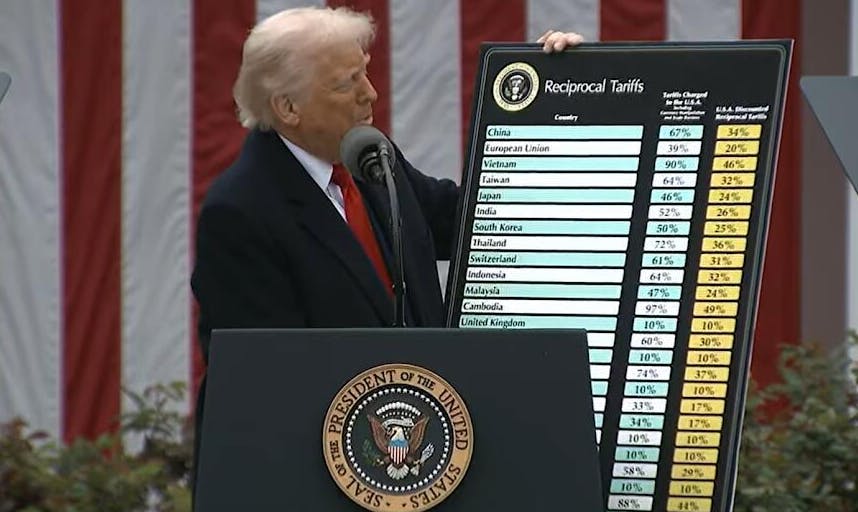
Trump lays out his theory that tariffs will bring back a “golden age” for the US, a phrase he also used in his inaugural address:
“Jobs and factories will come roaring back into our country, and you see it happening already. We will supercharge our domestic industrial base.”
Trump says the reciprocal tariffs will bring “stronger competition and lower prices for consumers” in the US.
Finally, Trump announces his tariff plan details as a “Declaration Of Economic Independence”
The bottom line is that this is targeted reciprocal tariffs, NOT a broad-based 15% or more tariff slap on all products.
Additionally, Trump confirmed that the new reciprocal tariffs will begin at midnight tonight.
However, they did announce a baseline tariff rate of 10% for all countries (below the 15% consensus and 20% worst case) and Trump confirmed the 25% tariff on all auto imports.
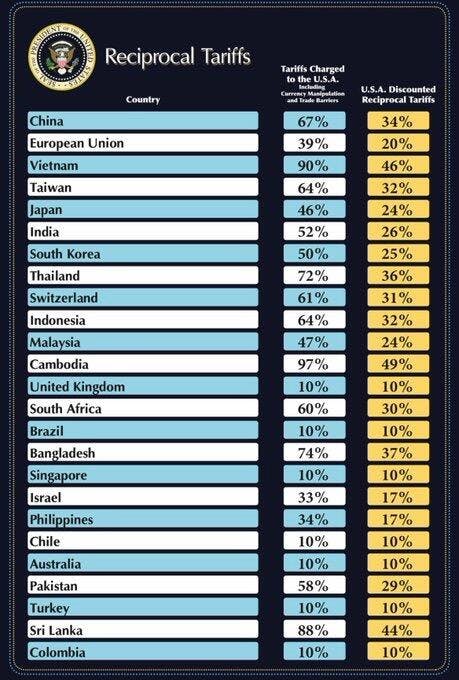
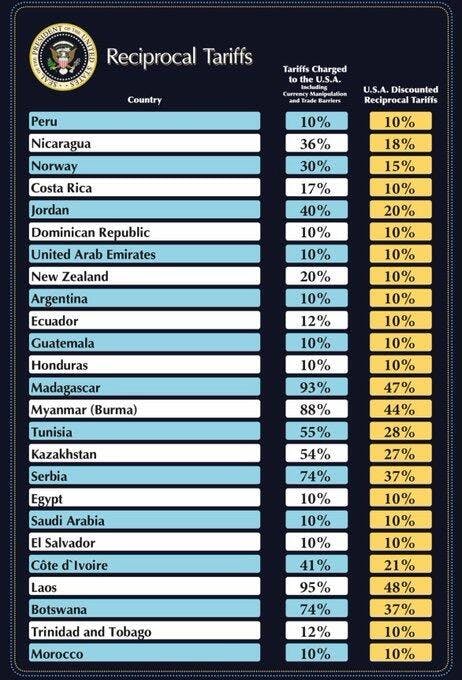
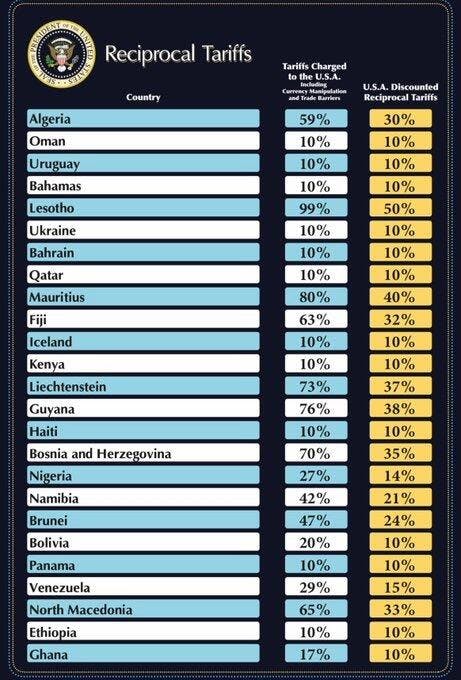
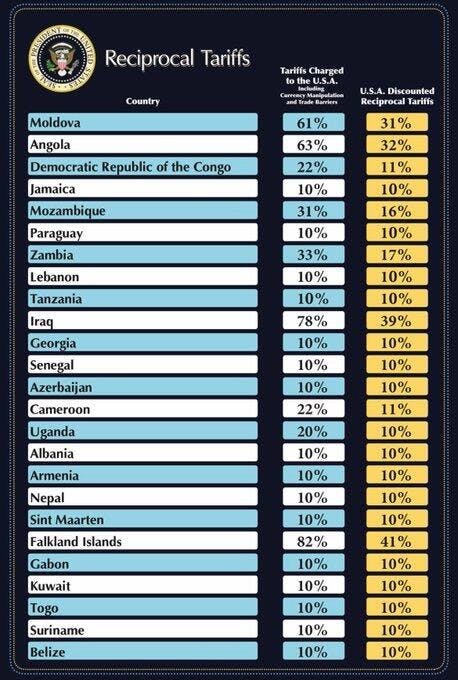
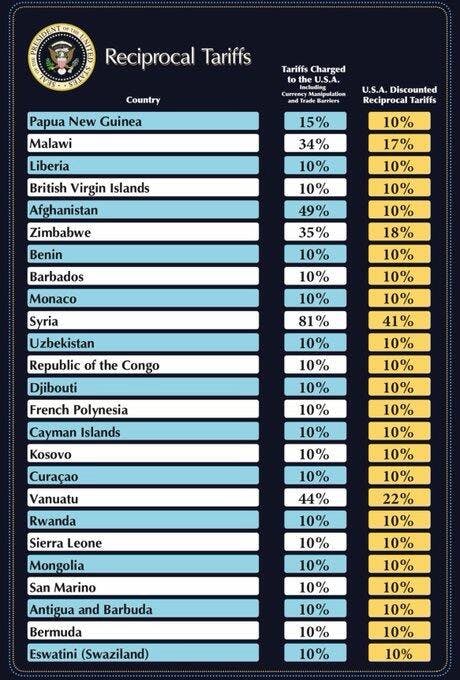
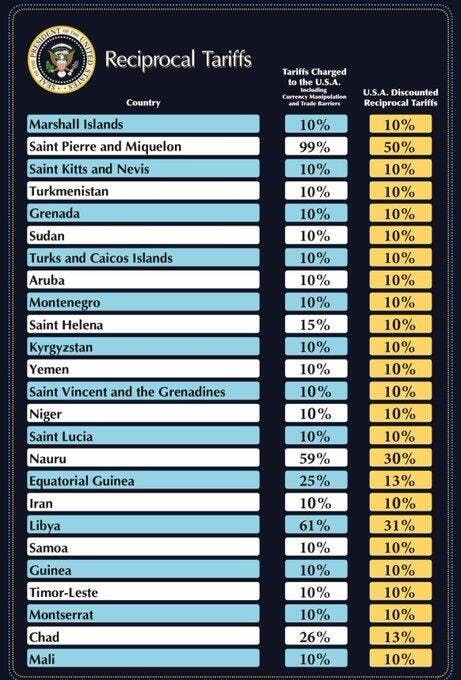
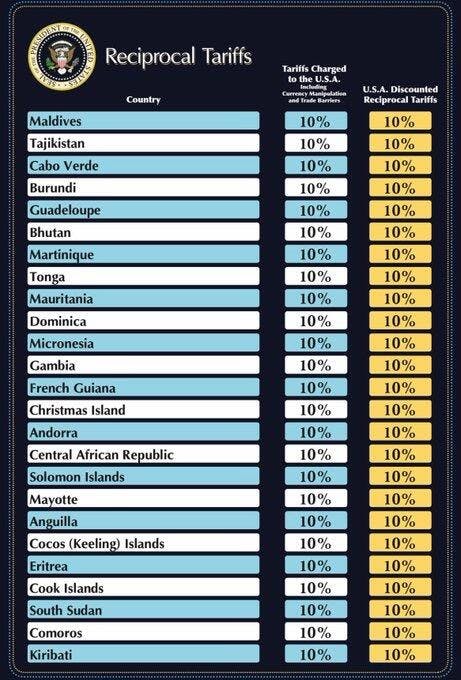
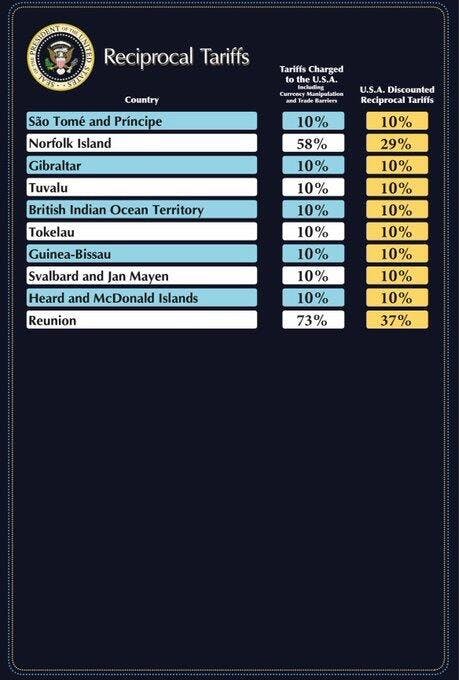
Additionally, Trump said they will not be full reciprocal tariffs, then held a chart up showing the individual nation (trade-weighted average) tariff levels:
Full List of Countries Hit With Reciprocal Tariffs:
For a deeper dive, see: https://www.zerohedge.com/markets/trumps-liberation-day-live-blog-all-you-need-know
April 2, 2025
Factory Orders Surge in February
US Factory Orders Surge Near Record Highs In Feb
by Tyler Durden
Wednesday, Apr 02, 2025 – 10:11 AM
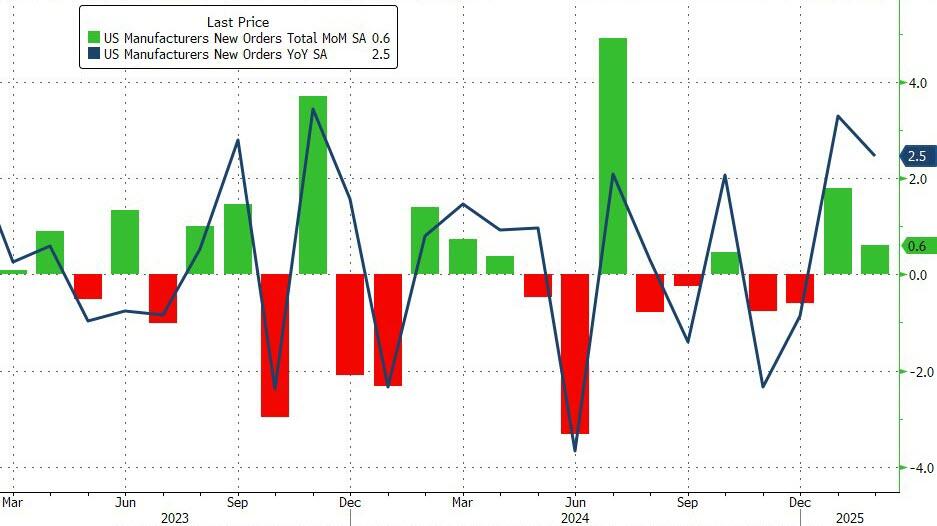
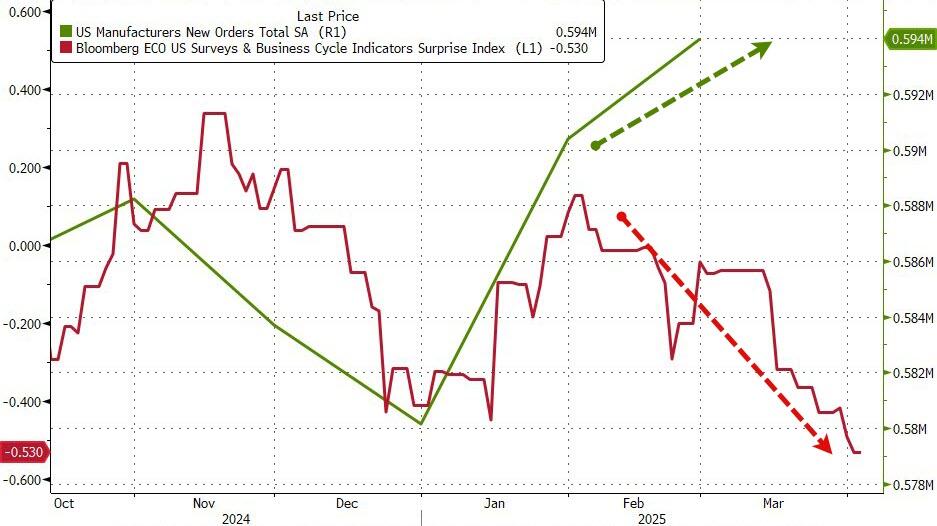
Despite all the ‘soft’ data slumping and legacy media narrative creation that a recession is imminent, US Factory Orders (hard data) surged for the second month in a row (beating expectations). Headline factory orders rose 0.6% MoM (+0.5% MoM exp) in March and February’s 1.7% MoM jump was revised up to +1.8% MoM. This left Factory Orders up 2.5% YoY…
Source: Bloomberg
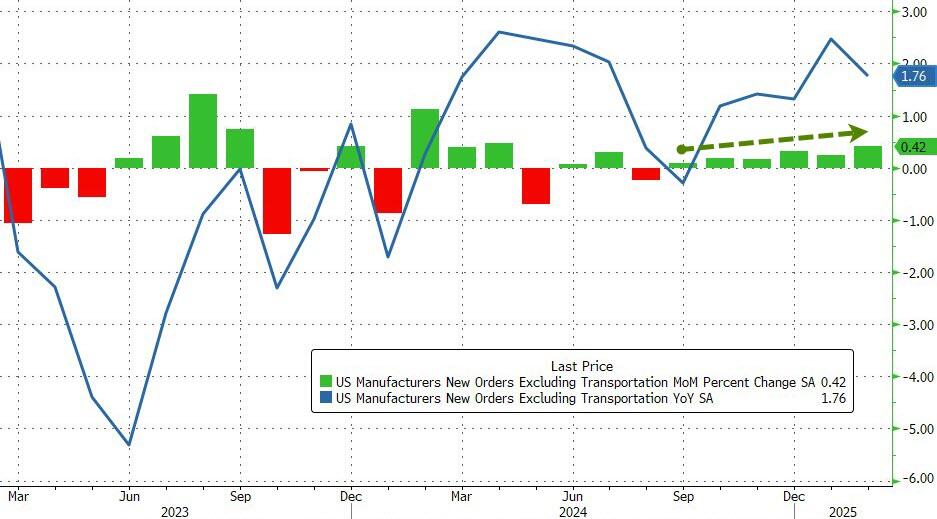
Core Factory Orders (excluding the more volatile Transportation sector) rose 0.4% MoM – accelerating on a MoM basis for the sixth straight month…
Source: Bloomberg
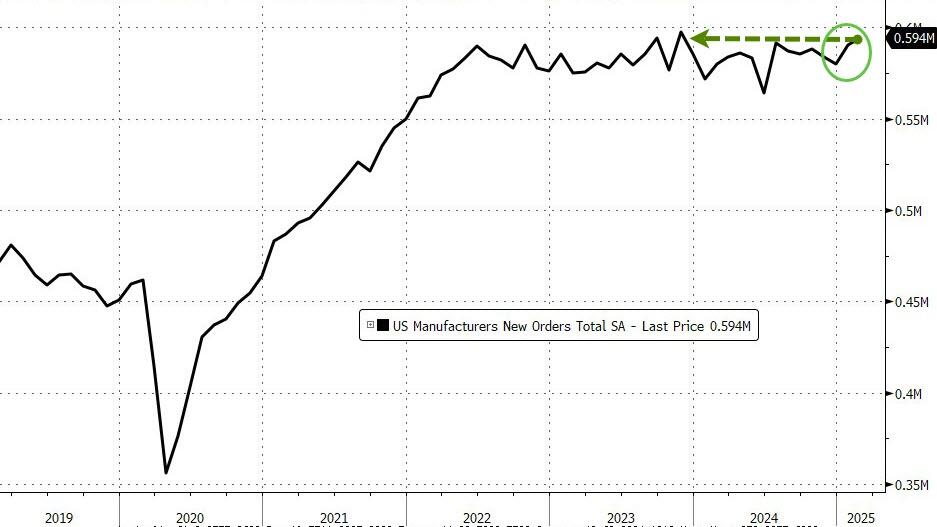
Finally, February’s rise lifted US Factory Orders very close to record highs…
Source: Bloomberg
So much for the ‘soft’ data-driven recession talk?
March 31, 2025
Pending Home Sales Update
NAR: Pending home sales advanced 2.0% in February
By Larry Adams
March 28, 2025 | 1:37 pm CDT

WASHINGTON — Pending home sales improved 2.0% in February, according to the National Association of Realtors. The Northeast and West experienced month-over-month losses in transactions – with a larger decrease in the West – while the Midwest and South saw gains, which were greatest in the South. Year-over-year, contract signings dropped in all four U.S. regions, with the Midwest undergoing the greatest reduction.
The Pending Home Sales Index (PHSI)* – a forward-looking indicator of home sales based on contract signings – grew 2.0% to 72.0 in February. Year-over-year, pending transactions declined 3.6%. An index of 100 is equal to the level of contract activity in 2001.
“Despite the modest monthly increase, contract signings remain well below normal historical levels,” said NAR Chief Economist Lawrence Yun. “A meaningful decline in mortgage rates would help both demand and supply – demand by boosting affordability, and supply by lessening the power of the mortgage rate lock-in effect.”
NAR Quarterly Economic Forecast
“Considering the Federal Reserve’s recent forecast for slower economic growth, we expect mortgage rates to slide moderately lower,” said Yun. “But the current high national debt will prevent mortgage rates from falling drastically – and certainly not to the 4%-to-5% range seen during President Trump’s first term.”
NAR forecasts mortgage rates will average 6.4% in 2025 and 6.1% in 2026. The association expects existing-home sales will rise by 6% in 2025 and accelerate another 11% in 2026. The new-home sales market has plentiful inventory and, therefore, NAR anticipates it will rise by 10% in 2025 and another 5% in 2026. It predicts that the national median home price will increase by 3% in 2025 and 4% in 2026.
“Home price growth will moderate due to more supply coming onto the market,” added Yun. “Having income and wages rise faster than home prices are welcome to improve affordability.”
View NAR’s Nationwide Forecast as of March 2025pdf. (NAR posts the latest quarterly economic forecast online at Research and Statistics under “Latest Housing Indicators.”)
Pending Home Sales Regional Breakdown
The Northeast PHSI fell 0.9% from last month to 62.8, down 2.5% from February 2024. The Midwest index inched up 0.7% to 73.3 in February, down 4.7% from the previous year.
The South PHSI jumped 6.2% to 86.0 in February, down 3.4% from a year ago. The West index contracted by 3.0% from the prior month to 55.9, down 3.5% from February 2024.
March 23, 2025
Home Remodeling Surge
Remodeling market soars, but faces key challenges
By Dakota Smith
March 20, 2025 | 9:42 am CDT

CAMBRIDGE, Mass. — According to Improving America’s Housing 2025, a new report from the Harvard Joint Center for Housing Studies, the US remodeling market soared above $600 billion in the wake of the pandemic and remains 50 percent above pre-pandemic levels despite recent softening.
However, industry fragmentation, inflation, and a shortage of skilled trade labor jeopardize the ability of the industry to fully meet demand. The strength of the remodeling market has been supported by the aging of homes and households, as well as record-high property values, but far more investment is needed to address growing needs for energy efficiency and disaster resilience of the country’s 145 million homes.
Key takeaways from the report:
The pandemic fueled unprecedented spending on remodeling.
Home improvement and repair spending vaulted from $404 billion in 2019 to $611 billion in 2022, and is expected to remain above $600 billion through 2025. Homeowners remain focused on replacement projects such as roofing, windows, and HVAC, accounting for 49 percent of improvement expenditures in 2023. On average, homeowners spent almost $4,700 on improvements in 2023, nearly 9 percent above the previous market boom in 2007.

- The pandemic fueled unprecedented spending on remodeling.Home improvement and repair spending vaulted from $404 billion in 2019 to $611 billion in 2022, and is expected to remain above $600 billion through 2025. Homeowners remain focused on replacement projects such as roofing, windows, and HVAC, accounting for 49 percent of improvement expenditures in 2023. On average, homeowners spent almost $4,700 on improvements in 2023, nearly 9 percent above the previous market boom in 2007.
- The housing stock is older than ever and substandard conditions must be addressed.With a median age of 44 years in 2023, the housing stock is older than ever, and critical improvements are needed to replace aging components. In 2023, average improvement spending for homes built before 1980 was 24 percent higher than spending on homes built since 2010, and maintenance spending was 76 percent higher. Many low-income homeowners live in housing with structural deficiencies or lacking basic features such as running water, electricity, or heat. “There is both a market opportunity and a moral imperative to expand improvement and repair services for these homeowners,” says Sophia Wedeen, a Senior Research Analyst at the Center. “More financing tools and counseling programs can also help preserve the affordable housing stock and ensure that all households live in safe and adequate housing.”
- Changing demographics affect remodeling spending.The shifting characteristics of US households continue to reshape activity and spending patterns in the remodeling market. In 2023, owners age 65 and over contributed 27 percent of total improvement outlays, up from 14 percent two decades earlier. And as the population becomes more racially and ethnically diverse, households headed by a person of color contribute more to the home improvement market; in 2023, homeowners of color accounted for 23 percent of improvement expenditures, up from 14 percent in 2003. Immigrant owners also account for a growing share of the market, up from 8 percent of expenditures in 2003 to 13 percent in 2023.
- Fragmentation, surging costs, and labor shortages hinder remodelers.Despite a flurry of mergers and acquisitions, the remodeling industry remains highly fragmented with large shares of self-employed contractors and small payroll companies. The industry is also hampered by high costs of building materials and labor shortages. Between 2015 and 2023, a majority of remodelers reported a shortage of skilled trade workers including carpenters, electricians, and plumbers. The industry also relies heavily on foreign-born laborers, with immigrants accounting for a record-breaking 34 percent of the construction trades labor force in 2023.
- Material shortages and high costs remain.Even though annual growth in building material prices has largely slowed or even turned negative since 2022 as demand has cooled and bottlenecks have eased, the costs for many key materials are still appreciably above pre-pandemic levels. The price
of lumber and plywood was still 21 percent greater through the third quarter of 2024 than in 2019 despite declining on a year-over-year basis for almost two years. 
In the near term, the remodeling industry faces both challenges and opportunities. On the one hand, elevated interest rates, weak home sales, and a persistent shortage of skilled trade labor are expected to constrain the market. At the same time, massive levels of home equity, a sustained shift toward working from home, and the aging of the housing stock will support significant investment in home improvement, perhaps most notably among owners who prioritize updating their existing homes over moving.
“Given the strong foundation and growing needs, residential remodeling is expected to remain a formidable economic sector in the years ahead,” says Chris Herbert, managing director of the Center. “And despite unparalleled spending in the last few years, far more investment is needed to improve energy efficiency, disaster resilience, and accessibility for the nation’s 145 million homes.”
To read the full report, visit jchs.harvard.edu.
 Everchem Updates Archive
  Sign Up for Email Updates


