Current Affairs
August 12, 2020
Consumer Prices
US Consumer Prices Surge As Food & Medical Costs Jump
by Tyler Durden Wed, 08/12/2020 – 08:36
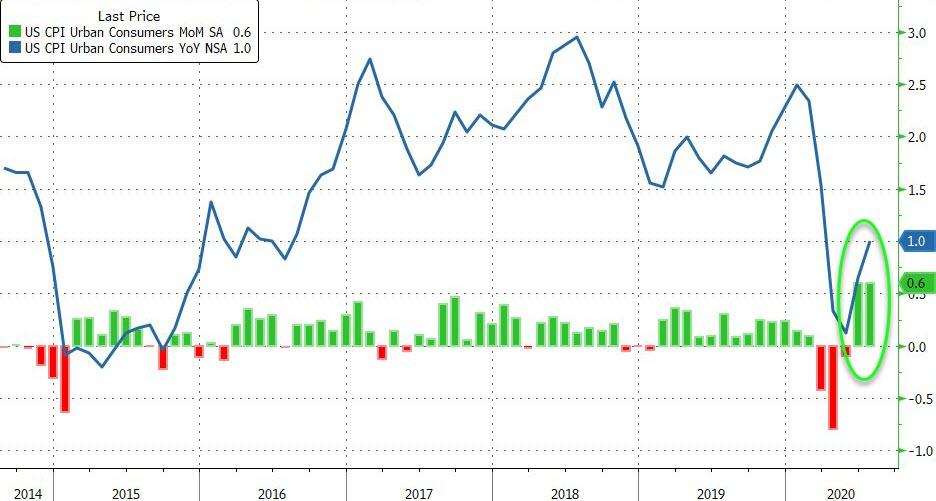
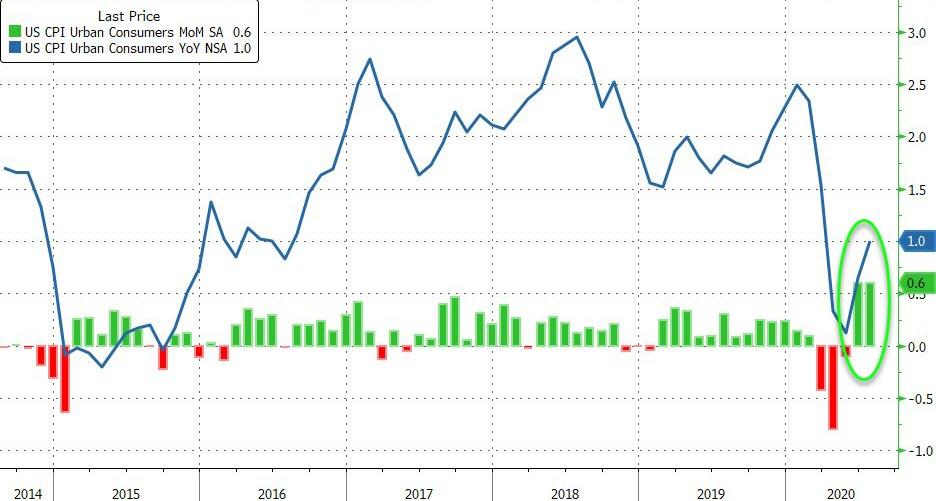
Following yesterday’s hotter-than-expected producer price data (led by a surge in energy costs and day-trading), analysts expected CPI to accelerate modestly YoY in July, but it acelerated significantly (rising 1.6% YoY vs +1.1% expected).
On a month over month basis, the headline CPI rose 0.6% (doubling the expected 0.3% rise)…
Source: Bloomberg
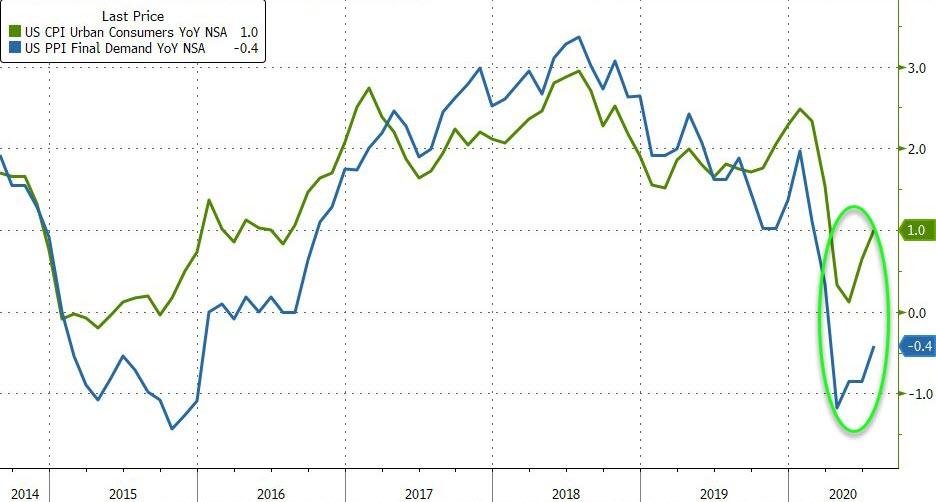
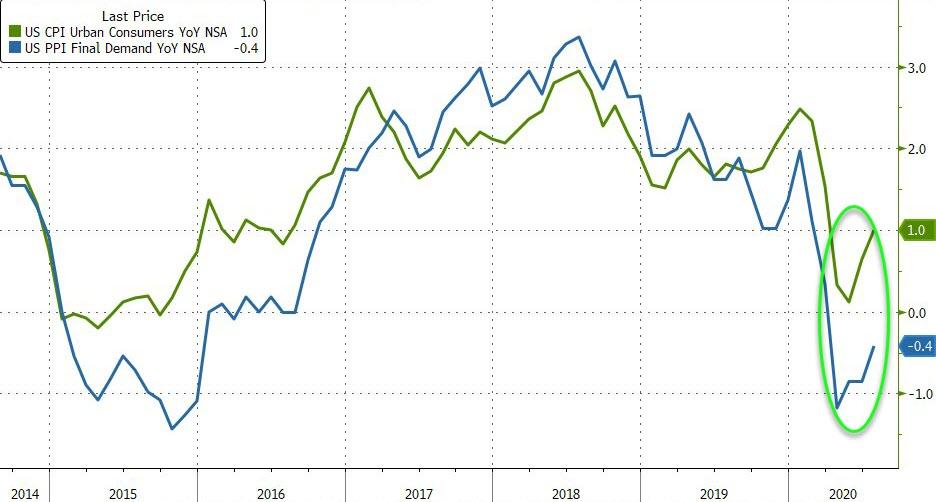
While PPI remains in deflation, Consumer Prices are rising…
Source: Bloomberg
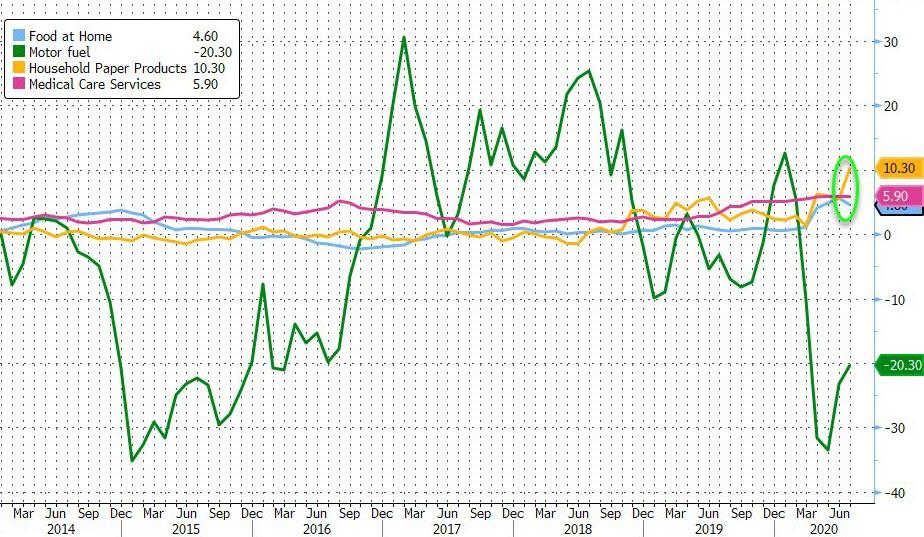
As Food costs continue to surge…
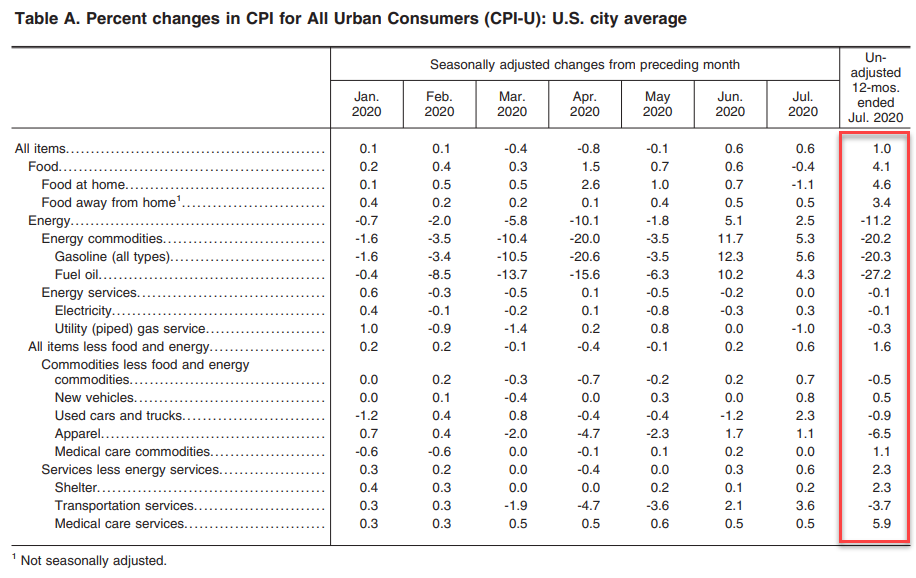
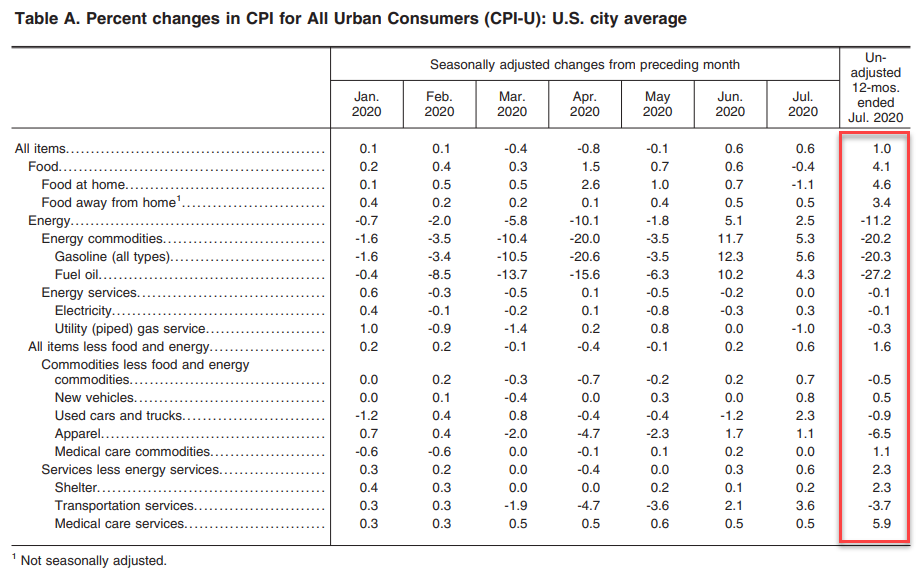
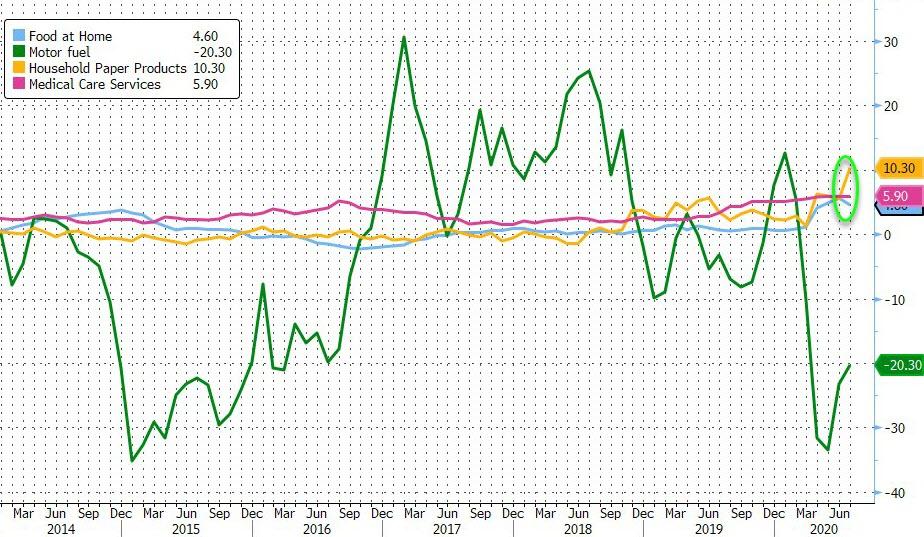
The food at home index increased 4.6 percent over the last 12 months. All six major grocery store food group indexes rose over that span. The index for beef increased 14.2 percent over the last 12 months, contributing to an 8.4-percent increase in the index for meats, poultry, fish, and eggs. The remaining groups rose more modestly, with increases ranging from 2.3 percent (fruits and vegetables) to 5.0 percent (nonalcoholic beverages). The index for food away from home rose 3.4 percent over the last year. The index for limited service meals increased 4.5 percent and the index for full service meals rose 2.9 percent over the last 12 months.
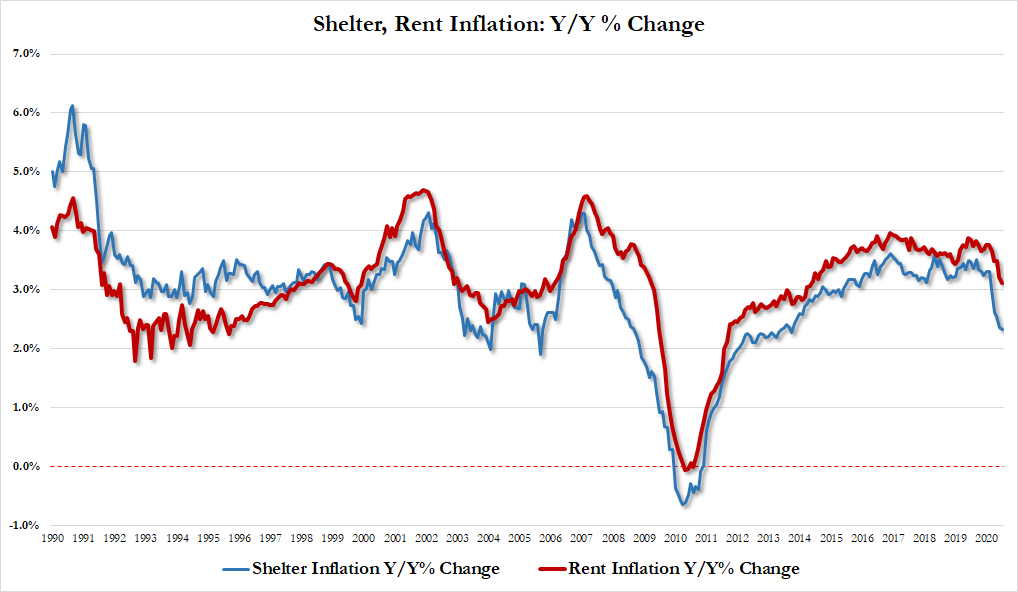
Additionally, medical care services also surged, but on the bright side (for some), rent/shelter inflation is slowing (rent inflation was 3.12% Y/Y, lowest since May 2014 and shelter inflation 2.33% Y/Y, lowest since Oct 2013)…
https://www.zerohedge.com/personal-finance/us-consumer-prices-surge-food-medical-costs-jump
August 12, 2020
Consumer Prices
US Consumer Prices Surge As Food & Medical Costs Jump
by Tyler Durden Wed, 08/12/2020 – 08:36
Following yesterday’s hotter-than-expected producer price data (led by a surge in energy costs and day-trading), analysts expected CPI to accelerate modestly YoY in July, but it acelerated significantly (rising 1.6% YoY vs +1.1% expected).
On a month over month basis, the headline CPI rose 0.6% (doubling the expected 0.3% rise)…
Source: Bloomberg
While PPI remains in deflation, Consumer Prices are rising…
Source: Bloomberg
As Food costs continue to surge…
The food at home index increased 4.6 percent over the last 12 months. All six major grocery store food group indexes rose over that span. The index for beef increased 14.2 percent over the last 12 months, contributing to an 8.4-percent increase in the index for meats, poultry, fish, and eggs. The remaining groups rose more modestly, with increases ranging from 2.3 percent (fruits and vegetables) to 5.0 percent (nonalcoholic beverages). The index for food away from home rose 3.4 percent over the last year. The index for limited service meals increased 4.5 percent and the index for full service meals rose 2.9 percent over the last 12 months.
Additionally, medical care services also surged, but on the bright side (for some), rent/shelter inflation is slowing (rent inflation was 3.12% Y/Y, lowest since May 2014 and shelter inflation 2.33% Y/Y, lowest since Oct 2013)…
https://www.zerohedge.com/personal-finance/us-consumer-prices-surge-food-medical-costs-jump
August 11, 2020
Commercial Truck Sales Rise
“More Robust Than Expected”: Promising Preliminary Class 8 Data For July Has Analysts Cautiously Optimistic
by Tyler Durden Tue, 08/11/2020 – 05:30
Preliminary data for July shows that Class 8 commercial truck sales may have finally started to rebound.
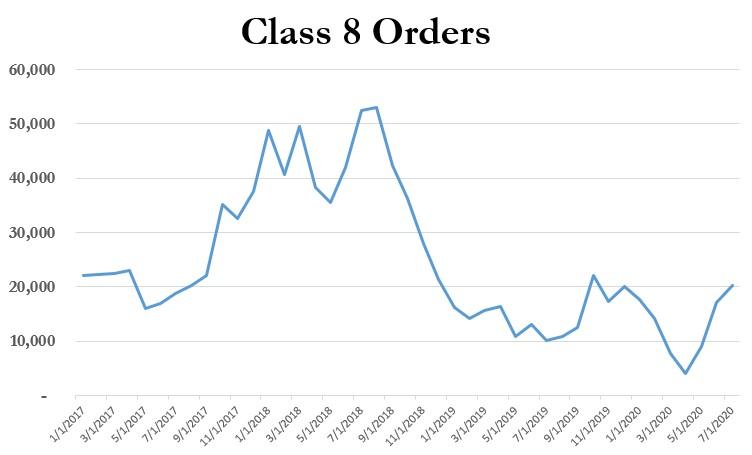
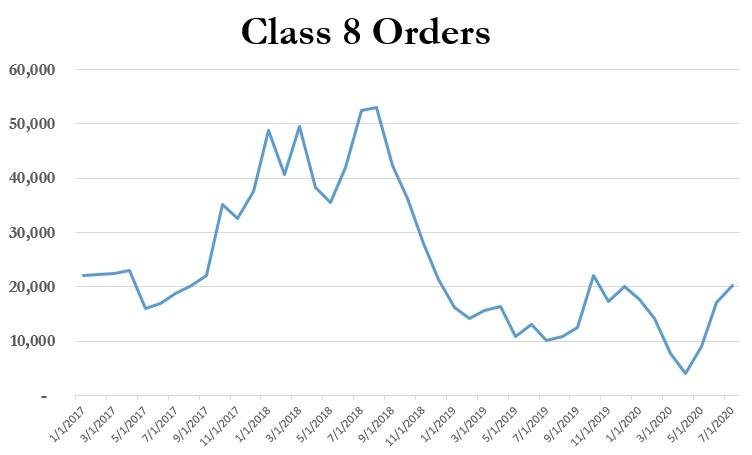
Stung by both the pandemic and a legacy backlog dating back almost two years that has acted as a constant drag on new orders for the last 18 months, preliminary Class 8 orders were 20,300 units for July, up 27% sequentially and up 98% from 2019’s numbers.
Despite the numbers being nowhere near 2017 and 2018 peak levels, July looks to mark the strongest month of the year for Class 8 orders so far, possibly telegraphing an optimistic second half of the year.
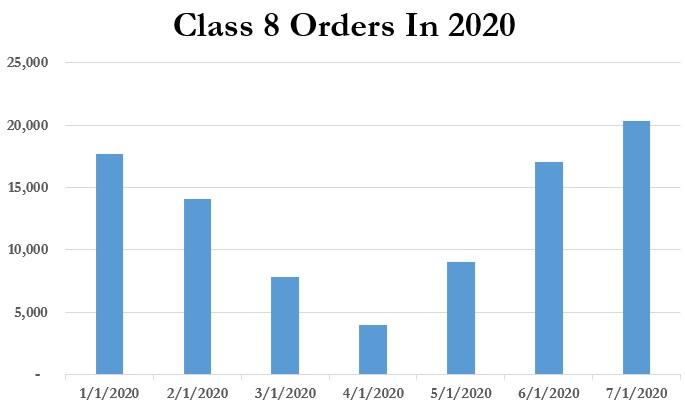
In an August 4 release reported by The Trucker, ACT Research’s Kenny Vieth, president and senior analyst, said: “Preliminary data show that July orders for medium- and heavy-duty vehicles jumped to a six-month high.”
He continued: “The context of rising rates and improving carrier profits adds perspective to what is now occurring in Class 8 orders: Supply matters. With many drivers (and trucks) sidelined, there is now insufficient available capacity for rebounding freight volumes. There is a strong relationship historically between carrier profits and equipment demand.”
He also noted that the positive shift in numbers came despite the additional headwind of a slowing economy during the end of the month:
Vieth noted that during the last week of July, reports showed the U.S. economy for the second quarter of 2020 had dropped 9.5% from the first quarter and was 10.6% below the ending level for 2019.
Jonathan Starks, chief intelligence officer for FTR, says that despite the good month, he is still forecasting a slow recovery: “As we hit the height of summer demand, the freight markets showed strength and resilience and that led to additional orders for trucks. The order activity for both June and July was more robust than expected and is good news for the equipment producers. However, despite the increasing orders, FTR still expects the Class 8 market to maintain a slow, steady recovery.”
He continued: “The freight markets sustained a traumatic decline of volumes at the start of the pandemic and consumer demand, on an absolute basis, will remain weaker as we deal with high levels of unemployment and a Congress that has been unable to foster a bi-partisan solution to stimulate demand. The OEMs received a needed boost from July orders, activity that will help keep the industry moving in an upward direction.”
We will update this article when finalized July data becomes available, which should be in several days.
August 11, 2020
Commercial Truck Sales Rise
“More Robust Than Expected”: Promising Preliminary Class 8 Data For July Has Analysts Cautiously Optimistic
by Tyler Durden Tue, 08/11/2020 – 05:30
Preliminary data for July shows that Class 8 commercial truck sales may have finally started to rebound.
Stung by both the pandemic and a legacy backlog dating back almost two years that has acted as a constant drag on new orders for the last 18 months, preliminary Class 8 orders were 20,300 units for July, up 27% sequentially and up 98% from 2019’s numbers.
Despite the numbers being nowhere near 2017 and 2018 peak levels, July looks to mark the strongest month of the year for Class 8 orders so far, possibly telegraphing an optimistic second half of the year.
In an August 4 release reported by The Trucker, ACT Research’s Kenny Vieth, president and senior analyst, said: “Preliminary data show that July orders for medium- and heavy-duty vehicles jumped to a six-month high.”
He continued: “The context of rising rates and improving carrier profits adds perspective to what is now occurring in Class 8 orders: Supply matters. With many drivers (and trucks) sidelined, there is now insufficient available capacity for rebounding freight volumes. There is a strong relationship historically between carrier profits and equipment demand.”
He also noted that the positive shift in numbers came despite the additional headwind of a slowing economy during the end of the month:
Vieth noted that during the last week of July, reports showed the U.S. economy for the second quarter of 2020 had dropped 9.5% from the first quarter and was 10.6% below the ending level for 2019.
Jonathan Starks, chief intelligence officer for FTR, says that despite the good month, he is still forecasting a slow recovery: “As we hit the height of summer demand, the freight markets showed strength and resilience and that led to additional orders for trucks. The order activity for both June and July was more robust than expected and is good news for the equipment producers. However, despite the increasing orders, FTR still expects the Class 8 market to maintain a slow, steady recovery.”
He continued: “The freight markets sustained a traumatic decline of volumes at the start of the pandemic and consumer demand, on an absolute basis, will remain weaker as we deal with high levels of unemployment and a Congress that has been unable to foster a bi-partisan solution to stimulate demand. The OEMs received a needed boost from July orders, activity that will help keep the industry moving in an upward direction.”
We will update this article when finalized July data becomes available, which should be in several days.
August 10, 2020
Covid Tally
Gross Domestic Product
Q2 GDP Releases:
The size of the Covid-19 Crater
Allianz SE | Munich | Jul 31, 2020
The Covid-19-related trough has been reached. GDP figures for the second quarter confirmed the expected historic slump in economic activity in the Eurozone and the U.S. According to the
Eurostat flash estimate, real GDP declined by -12.1% q/q in Q2 2020.
All major Eurozone economies registered a hitherto unseen quarterly decline in real GDP: Germany -10.1% (after -2.0%), France -13.8% (after -5.9%) and Spain -18.5% (after -5.2%). The U.S. economy shrank at a quarterly rate of -9.5% (after -1.2%.), i.e. an annualized rate of -32.9%. The biggest surprise was Italy, where the GDP contraction was far less than expected at -12.4% (after -5.3%), even outperforming France.
The GDP figures confirm the different recovery speeds across advanced economies: Germany and the U.S. are in the pole position, France and Italy are the chasing group and Spain is the laggard. The main reason for both leaders is a massive fiscal response.
After a historic slump, a historic rebound. For the next quarter, we expect economic activity in the Eurozone to increase by +12.8% q/q.
The most important stage of the recovery is now ahead. The underlying rhythm will be moderate. No sustained impulse is to be expected from foreign trade because of the asynchronous opening of the global economy. Yet, the recovery of domestic demand is not happening at full speed either. Heightened economic uncertainty (insolvency risk) still weighs on investment, while some sectors are still affected by restrictions (major events). Consumers are likely to stay rather cautious, whether out of contagion fears or job insecurity.
GDP figures remain in line with our baseline scenario of a decline in real economic output of -9.0% in the Eurozone and -5.3% in the U.S. in 2020.
 Everchem Updates Archive
  Sign Up for Email Updates