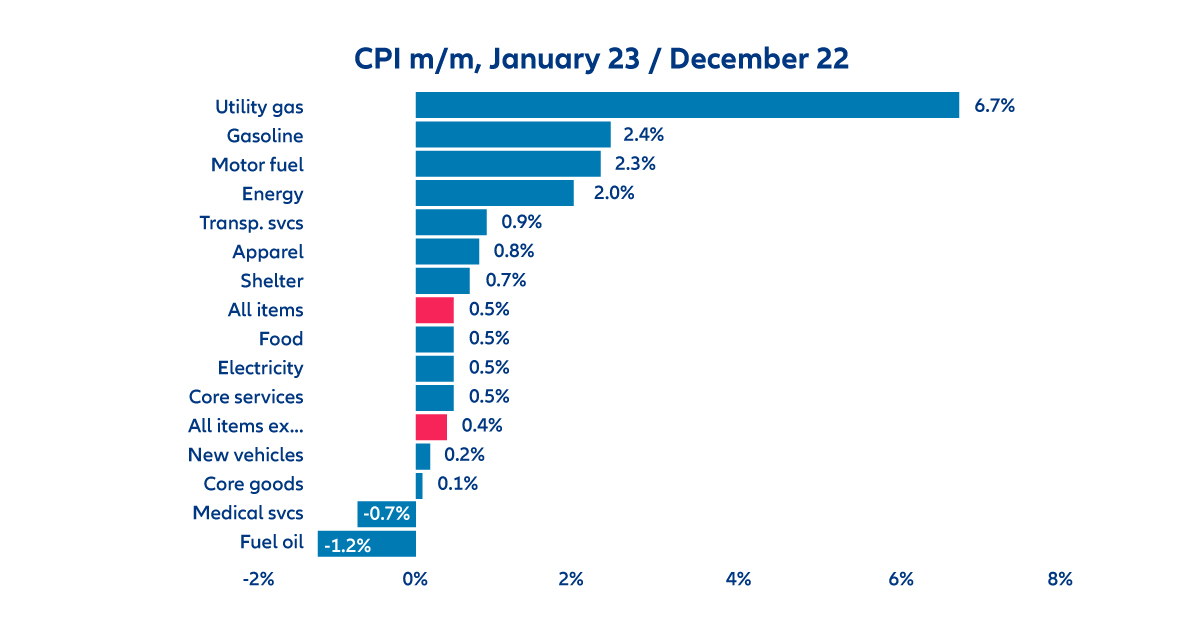
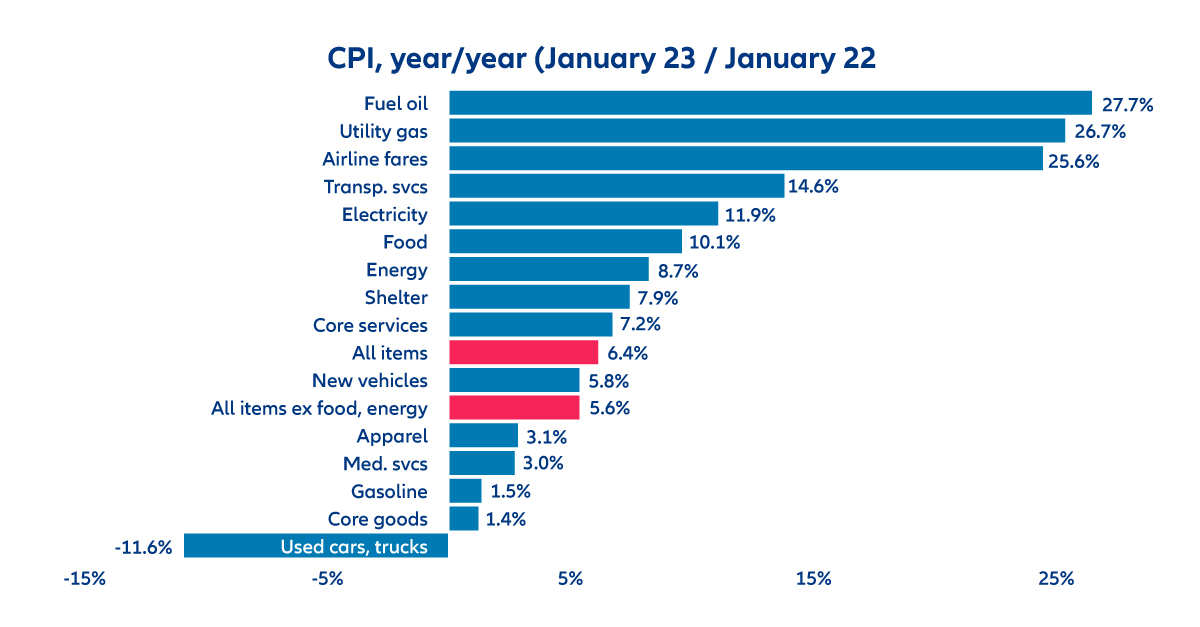
Inflation was a little warmer than expected in January. The headline Consumer Price Index (CPI) rose 0.5% m/m which was a bit higher than expectations of 0.4%. The y/y rate landed at 6.4, which was higher than expectations of 6.2%, and also only a slight improvement from last month’s 6.5%. The core rate, which strips out volatile food and energy prices, rose 0.4% m/m, again exceeding expectations of 0.3%, while the y/y rate came in at 5.6%, just above expectations of 5.5% and again also only a slight improvement from last month’s 5.7%. Energy prices drove the m/m increase with a 6.7% increase in utility gas and a notable 2.4% increase in gasoline prices. On a y/y basis, fuel out and utility gas have been big drivers, while gasoline has only risen 1.5%. Used cars and truck prices which were driven up in the pandemic due to scarcity, have now fallen 11.6% over the past year.
By the way, December’s report, which showed the first m/m decline in the headline CPI in the post Covid-era at -0.1%, was revised back up to +0.1% in this report.
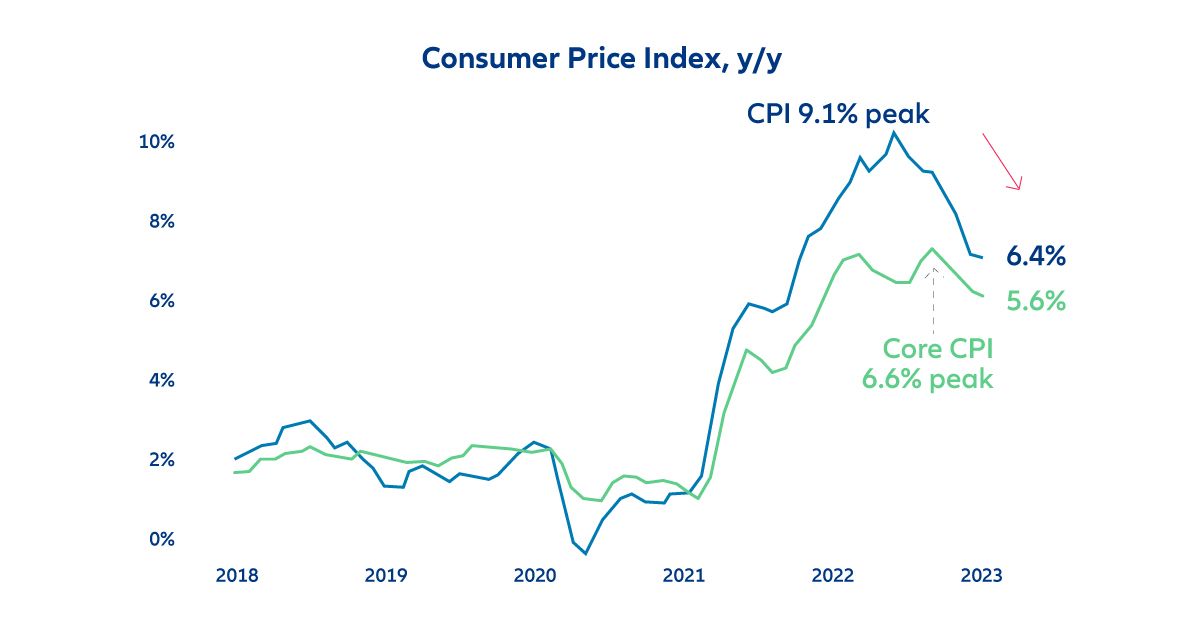
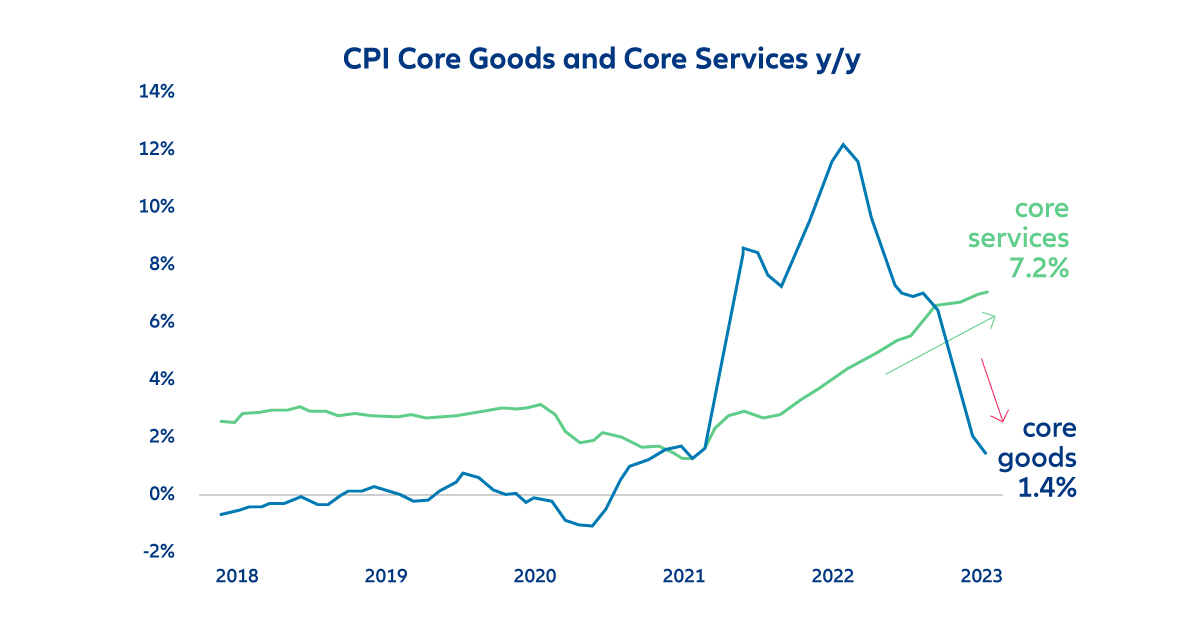
As shown in the first chart below, the headline y/y rate has fallen for seven consecutive months, dropping a total of 2.6% from June’s peak of 9.1%. However, the core rate has been more stubborn and has only fallen for four consecutive months, from the September peak, and has only dropped 1%. That is worrisome for the Fed since it focuses on core inflation. More worrisome still is that while core goods inflation is falling rapidly, core services inflation continues to rise and is now running at a very hot 7.2% y/y rate, the highest in over 40 years. The Fed is now concentrating more on services because 1. it is far outstripping goods inflation, and 2. services are more likely to be driven by labor costs, which in theory the Fed could influence more easily than the cost of goods.
Finally, the Fed has been focusing on “super core” inflation, which is core services excluding housing. Housing accounts for about one-third of the overall index, but it does not include all rental prices, only those that are signed in the month. Since those normally take a year to renew, housing inflation in the CPI lags market prices. And since market prices are falling, so will housing in the CPI going forward. In a sense then, housing inflation is already taken care of, so it makes sense to strip it out to see what’s happening underneath. Super core inflation is now running at 4% y/y, twice the Fed’s 2% target.
So the overall report was a bit warmer than expected, the core is being stubborn, core services are very high and rising, and super core isn’t good either. This report will keep the Fed on track for another 25 bps hike in March.
BASF Senior Vice President Jerry Lebold discusses equipment readings with Utilities Operator David Gass. Photo by Don Kadair
THE CHALLENGE
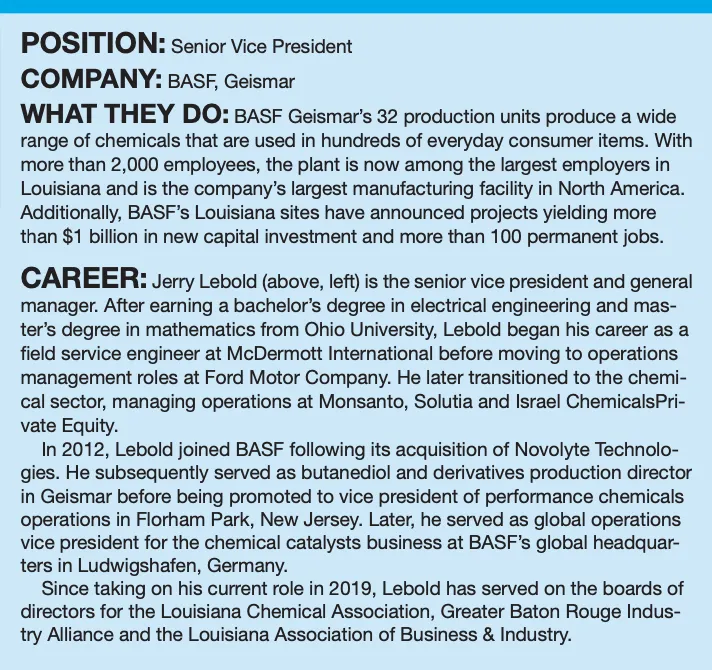
One thing BASF’s Jerry Lebold has learned over the years is the importance of having the right team with the right skills and talents.
That’s particularly important now, given the wave of retirements impacting the industry. “There’s a lot of knowledge that gets lost when someone who has worked for 30 or 40 years retires,” Lebold says. “Our challenge is knowledge retention and getting new team members to learn from that.”
Another hurdle—a cultural preference for four-year college degrees over manufacturing careers. “Students today want to work for Google or Microsoft or Tesla,” Lebold says. “Many of them don’t recognize the opportunities that manufacturing provides in their own backyard. It’s simply a failure to get the word out, and that’s unfortunate given the urgent need for skilled, capable team members and the proliferation of manufacturing jobs.”
THE RESOLUTION
Lebold has learned that the best way to change that perception is through a system of constant engagement. BASF starts early by grooming its future workforce while they’re still in elementary school.
“When I came here three years ago, I began to notice a real value in engaging our local schools,” he adds. “In Ascension Parish, we start very early with kids in the 4th grade. We sponsor the BASF Kids’ Lab at the Louisiana Arts & Science Museum, and we get them excited about the possibilities of a future in STEM.”
It doesn’t stop there. The company targets rising juniors and seniors through its BASF Tech Academy, whereby students visit the Geismar site for a week and are exposed to a variety of jobs in manufacturing, such as process technician, engineering or the skilled trades.
“Later, we offer them mentorships, internships and scholarships, while also guiding the curriculum at local community colleges and universities through advisory panels. That way, we ensure that the programs they’re offering put students in the best position to get hired.”
Lebold’s hope is that BASF will keep students in the local communities “constantly engaged” throughout their education. “In doing so, we’re creating a local pipeline,” he adds. “We hope to see those students who first came to BASF Kids Day in 4th grade also go through the TECH Academy as high schoolers, then eventually land a summer internship and even a full-time job.”
Upon attracting top talent, BASF shifts its focus to retainage through its learning and development program and learning coordinators. In the process, they promote the continuous development of those skillsets.
THE TAKEAWAY
Over the last three years, Lebold has broadened his diversification efforts by focusing more on local minority communities, as well as attracting more women to the manufacturing sector. “I think there’s a great opportunity to work with local underserved communities so that they’re aware of the jobs and opportunities, then put them in a position so that they can successfully be a part of this industry up and down the river,” he adds.
BASF has begun working with advocacy groups in the region such as the Greater Baton Rouge Industry Alliance, Louisiana Chemical Association and Louisiana Association of Business and Industry to make it happen. “We’re in the early stages of trying to figure out what that looks like, but I think it gets solved collaboratively and with the industry as a whole,” he adds.
“We have to look at those hurdles that are preventing these kids from advancing. We’re going to need operators, millwrights and technicians … so we need to work right here in this region to make sure we provide those opportunities.”
More than 40 years after The Buggles released “Video Killed the Radio Star”, radio is still alive and well.
As Statista’s Felix Richter notes, with all the chatter about about streaming and other digital media, it’s easy to forget how powerful traditional media such as radio and television still are. Radio in particular rarely gets credited for what it still is: a true mass medium.
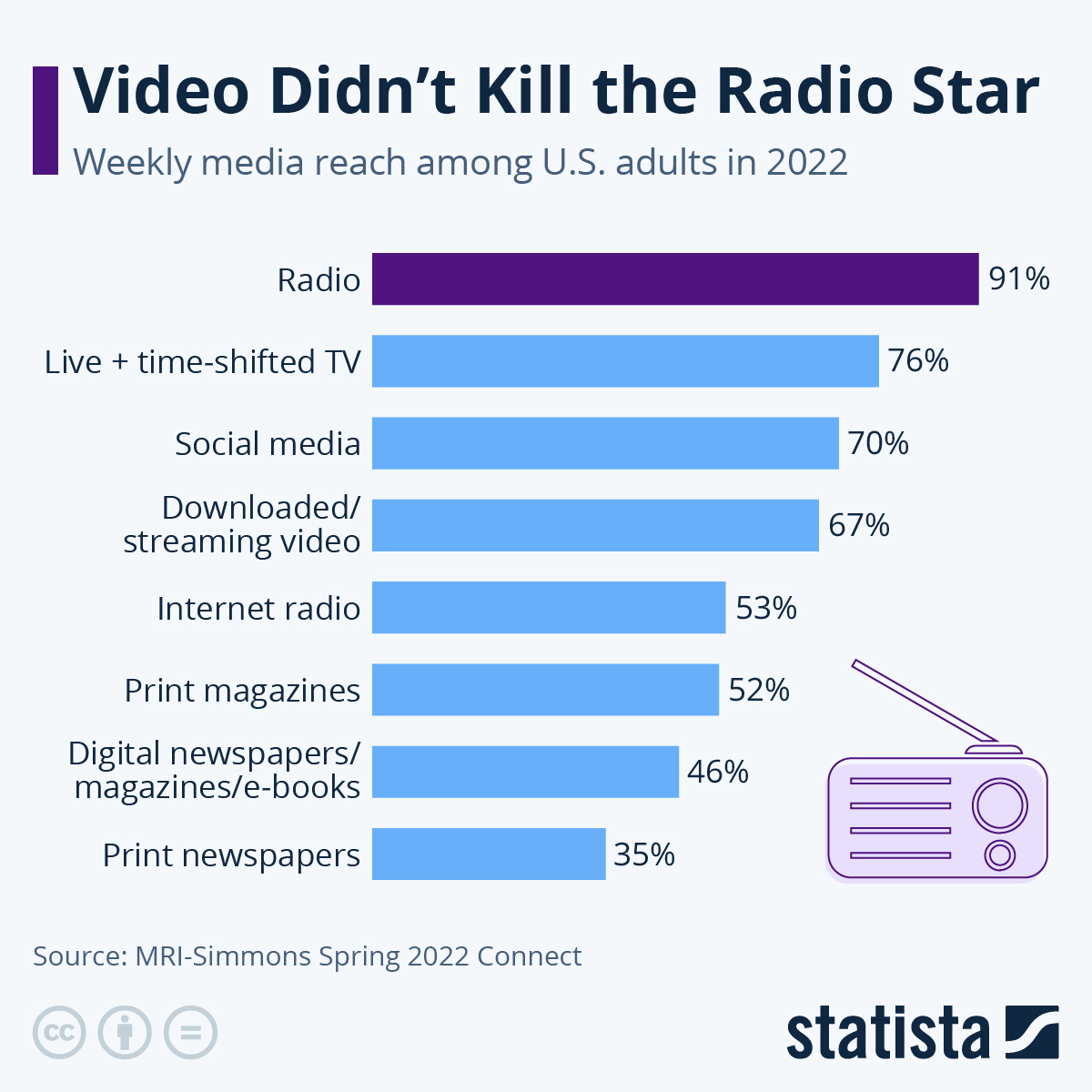
According to MRI-Simmons, radio even trumps TV in terms of its weekly reach among U.S. adults.
According to MRI-Simmons, 91 percent of U.S. adults listen to the radio at least once a week, far exceeding the reach of live and time-shifted TV at 76 percent, social media at 70 percent an online video at 67 percent.
While radio does win in terms of sheer reach, TV remains unparalleled with respect to average daily usage.
According to Nielsen, U.S. adults spent an average of 3 hours and 41 minutes watching live and time-shifted TV in Q3 2020, which is roughly 2.5 times the amount of time they spent listening to the radio (1 hour and 31 minutes).
But if the fear of losing your job hovers over you like a dark cloud, you’re not alone. Nearly 40% of US workers said they “are nervous about being laid off,” a LinkedIn survey of more than 2,000 US employees conducted in December found.
What are the real chances of that happening? To find out, Insider spoke with three experts: Nick Bunker, the head of economic research at Indeed Hiring Lab; Wayne Cascio, an industrial-organizational psychologist at the University of Colorado; and Andrew Flowers, a labor economist at Appcast, the recruitment-advertising technology company. Highlights of what they had to say might help you sleep a little more soundly.
How worried should we be about layoff contagion?
Flowers: Recessions are psychological phenomena. They’re about a loss of confidence in the future.
In the tech sector, there was a collective awareness that companies were operating with a different outlook than they had been previously. Before, growth was the priority and there was lots of optimism — let’s take advantage of low interest rates and hire a bunch of people. That sentiment flipped as the unit economics came under more pressure, along with higher interest rates and more consumer spending on services.
Andrew Flowers is a labor economist at Appcast.Andrew Flowers
As for whether these layoffs spread into other sectors, the risk is not that business leaders will see what’s happening in tech, get spooked, and say, “We need to batten down the hatches and lay off our people, too!” That’s not the channel through which layoff contagion happens.
The risk is if consumers get spooked.
You’re scaring me a little. What happens when consumers get jittery?
Flowers: Over the last year, we’ve seen a disconnect between hard and soft data. The hard data, including GDP, has been relatively strong. But the soft data, including consumer sentiment, which is based on surveys, has been weaker. The fundamentals are good, but the vibes feel off.
Flowers: There’s potential for a recession to become a self-fulfilling prophecy. That could happen if consumers get nervous about the layoffs news. They’ll think, “Maybe I won’t go out to eat. Maybe I won’t buy a new refrigerator.” If their spending falls, the effect on the economy could cause contagion.
Why is there such a disconnect between what the data says about the economy and how we feel about it?
Bunker: I get why people are voicing discontent — inflation is a lot higher than it’s been in the recent past.
But there’s what people say and what they do. They say it’s not great and they complain about it. But they’re still quitting their jobs and going out to dinner. What people are doing is indicative of a strong economy.
And by “people,” do you mean CEOs, too? Are they operating in a way that’s indicative of a strong economy?
Bunker: Unfortunately, I can’t read the mind of the CEOs. Economic growth is slowing down, but there’s still growth.
We could see a rise in layoffs if that takes a hit moving forward. But that would be based on economic growth, not based on what other CEOs are doing.
That’s encouraging. As long as fundamentals stay solid, we’re not all in danger of getting pink slips, right?
Cascio: You don’t need to hit the panic button. In this tight labor market, the demand for talent is high and supply is limited. The last thing enlightened CEOs want to do is cut people when things look like they’re turning south.
So I guess we all should hope we work for an enlightened CEO then?
Cascio: One of the things you want to look at is what your employer did in past downturns. Did they turn to layoffs during the financial crisis? What about in the tech wreck of 2001? Research shows that’s the best predictor of future behavior. If they’ve done it once, they’re going to do it again.
I’ve been doing research on downsizing since the ’90s and one thing is clear: Companies that move quickly to lay off their workers never outperform their competitors in the same field. If companies are doing layoffs to cut costs, there are better ways than cutting people.
Has The Housing Market Bottomed? The Surprising Result From A Little-Known Market Indicator
by Tyler Durden
Monday, Jan 30, 2023 – 03:20 PM
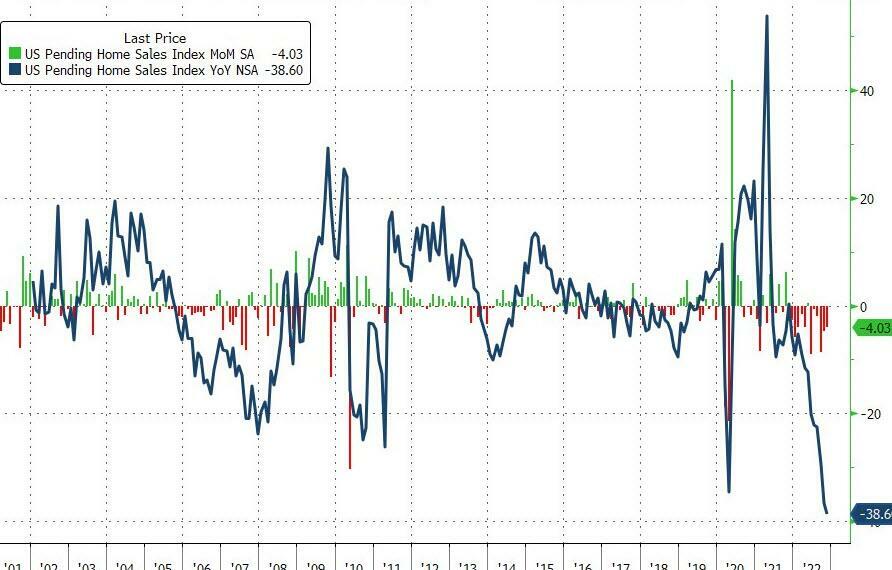
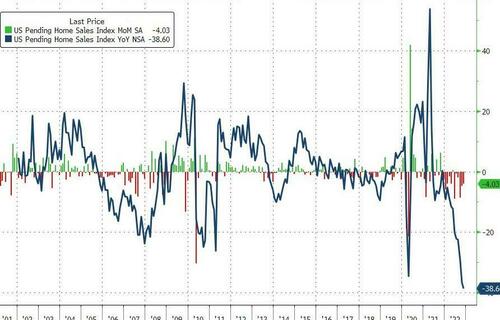
It may come as a bit of a shock to those who have been following the creeping freeze in housing transactions as the bid-ask spread grows to monstrous proportions, leading to a record crash in pending home sales…
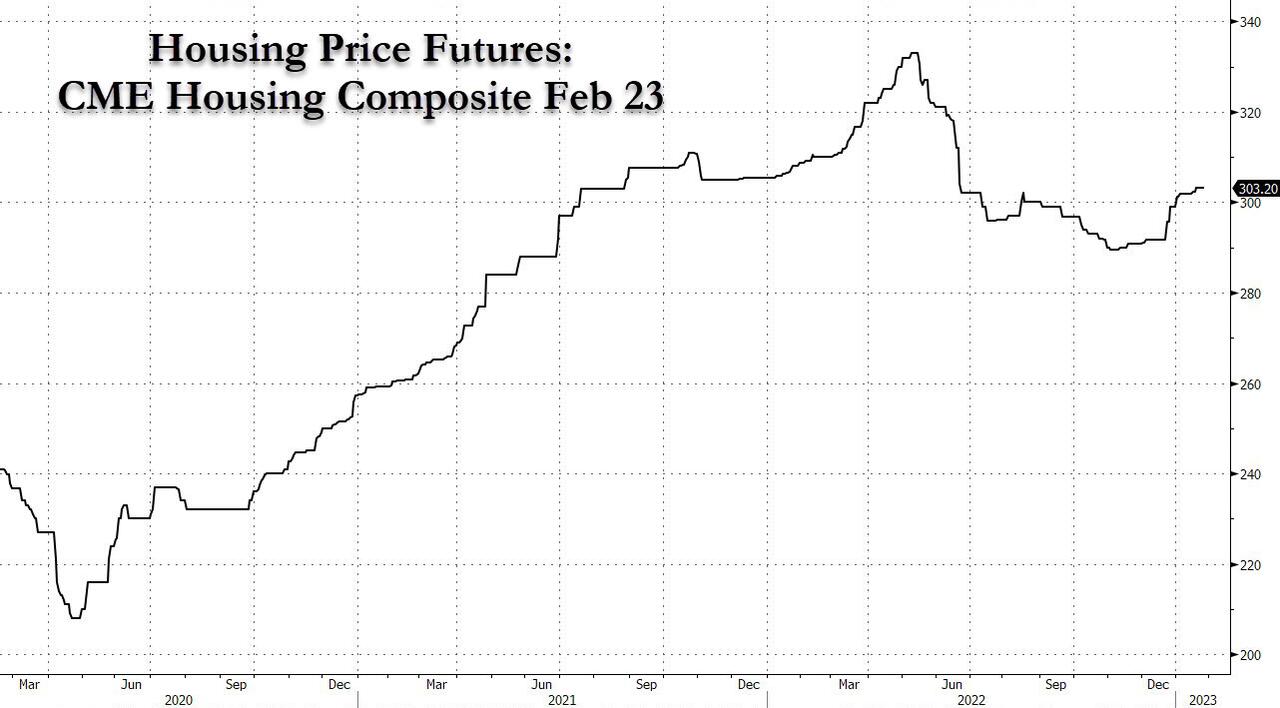
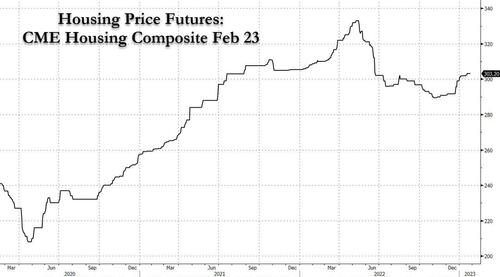
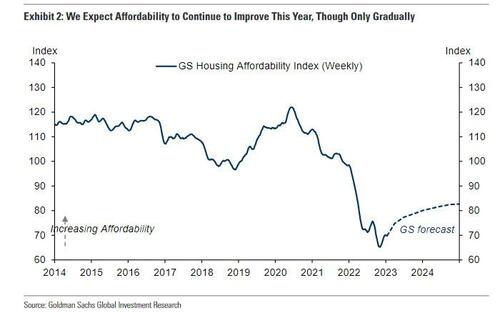
… but even though mortgage rates ticked higher back to 6% in January, there is growing speculation that the housing market has bottomed. Why? Because as Goldman’s Rich Provorotsky notes, “bet you didn’t know there were housing price futures…they bottomed in Q4 and have been rallying.” Indeed, the Housing Composite Index traded on the CME is up decidedly in the past month after hitting a 16 month low in November.
Why this surprising bounce? A big reason for the unexpected rebound may be a recent report from real estate company Redfin which last Wednesday reported that “the housing market has begun to recover from a trough in the second week of November with buyers returning at a faster pace than sellers. The number of Redfin customers asking for first tours has improved by 17 percentage points from the November low, and the number of clients contacting.”
Furthermore, according to the report, Redfin agents to begin the home-buying process has improved by 13 points: “I’ve seen more homes go under contract this month than in the entire fourth quarter,” Angela Langone, a San Jose, California, agent, said in the report.
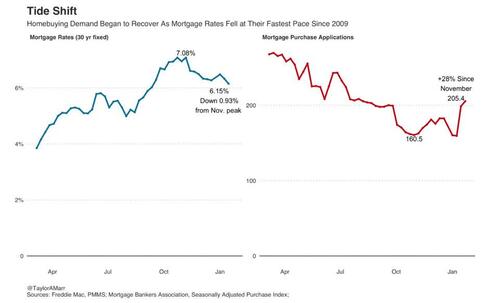
Among notable market moves, Redfin points to mortgage applications which are up 28% from early November as the average 30-year-fixed mortgage rate has dropped to 6.15% from its peak of 7.08% in November, the biggest decline since 2009. Pending home sales rose 3% in December from November.
Preliminary data on the share of Redfin agents’ offers facing bidding wars points to small upticks in the Seattle and Tampa markets this month (however, since this is an uneven trend, expect it to take some time before bidding wars nationally show an upward trend).
“Bidding wars are back in Seattle,” said local Redfin real estate agent Shoshana Godwin. “One of our Issaquah listings got 12 offers and is under contract for $155,000 over the $1.4 million list price. The buyer waived every contingency, handed over $300,000 of earnest money and is letting the seller stay for free for two months after closing. Another home in Seattle’s popular Ballard neighborhood was recently delisted after sitting on the market for over three months. The seller relisted it last week and it went pending in under a day.”
Eric Auciello, Redfin’s team manager in Tampa, has seen three modest single-family homes priced around $300,000 wind up in bidding wars in central Florida this month, with 16, 17 and 23 competing offers, respectively.
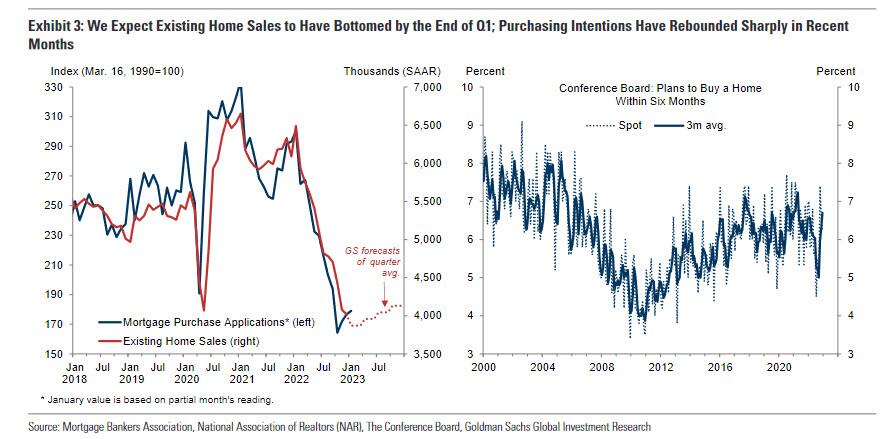
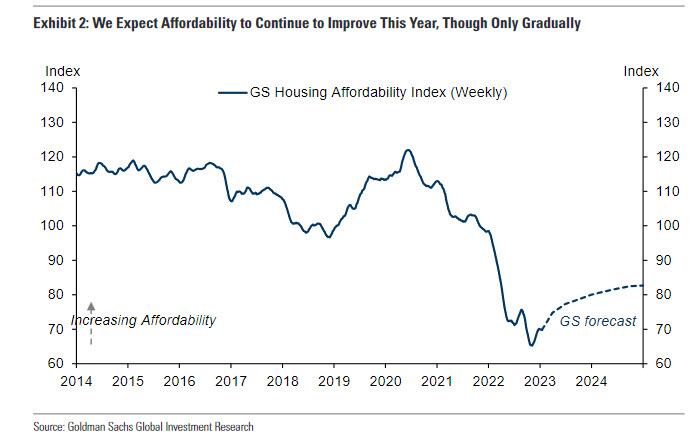
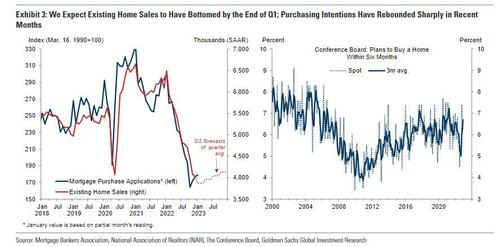
But while one can accuse Redfin of bias – after all the company recently laid off some 13% of its employees due to the housing market collapse so it is certainly interested in sparking some animal spirits in the sector – it is not alone in predicting a housing recovery. One week ago, Goldman’s Jan Hatzius published the bank’s Housing Outlook for 2023 in which he predicted that “home sales appear set to turn higher.” That’s because “mortgage purchase applications have averaged 9% above their October trough so far in January and survey-based measures of purchasing intentions have rebounded sharply” and while Goldman expects that existing home sales could decline slightly further “but will likely bottom in Q1 (GS forecast: Q1 average of 3.85mn saar vs. 4.02mn in December) before rebounding modestly by year-end (GS forecast: Q4 average of 4.1mn).”
Here are some more observations from the Goldman note (full report available to pro subs):
We forecast that housing starts will take longer to stabilize, declining to a trough pace of 1¼mn in 2023Q4 (vs. 1.4mn in 2022Q4) before recovering next year. We expect completions to total 1½mn this year, the most since 2007, which will help to clear the backlog of homes under construction and contribute to a modest increase in the homeowner vacancy rate (GS forecast of 1.2% in 2023Q4 vs. 0.9% now and 1.4% in 2019Q4).
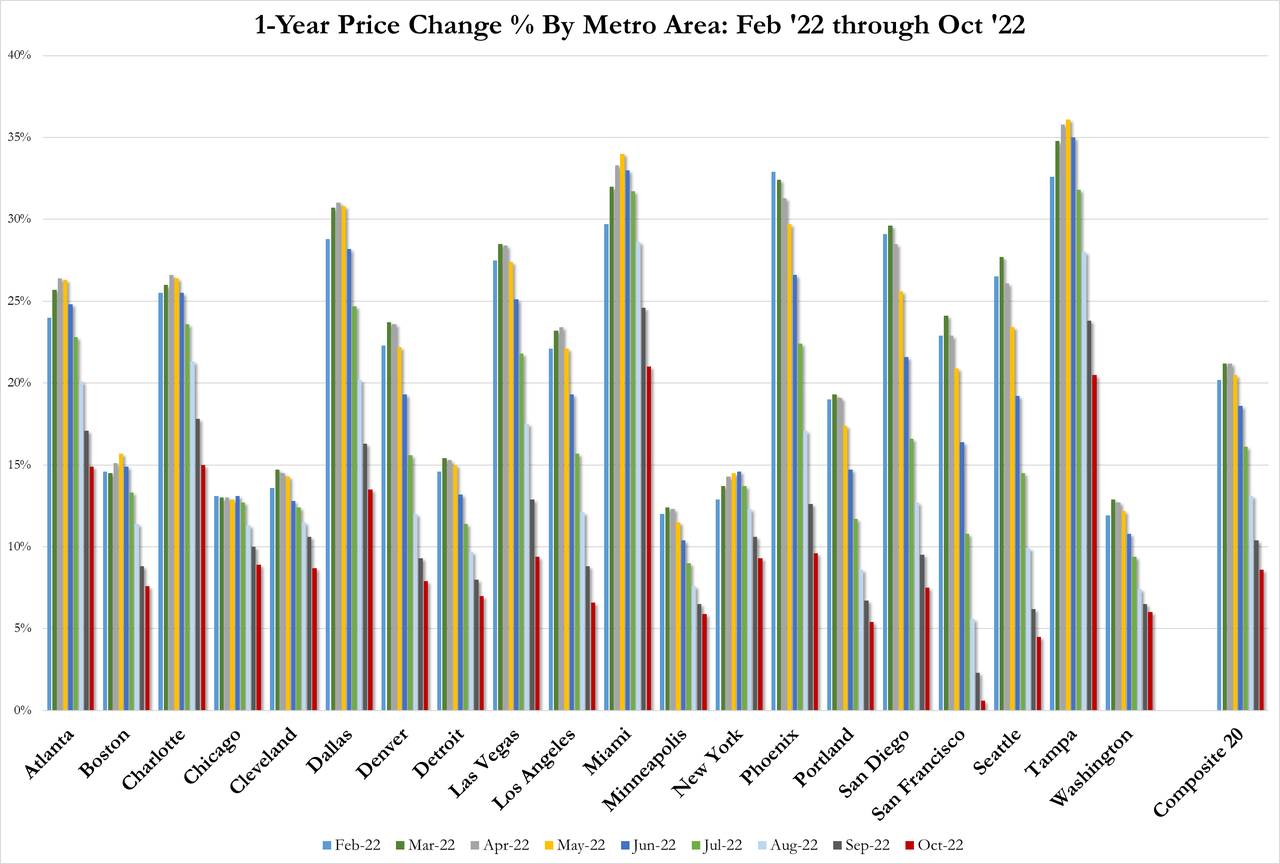
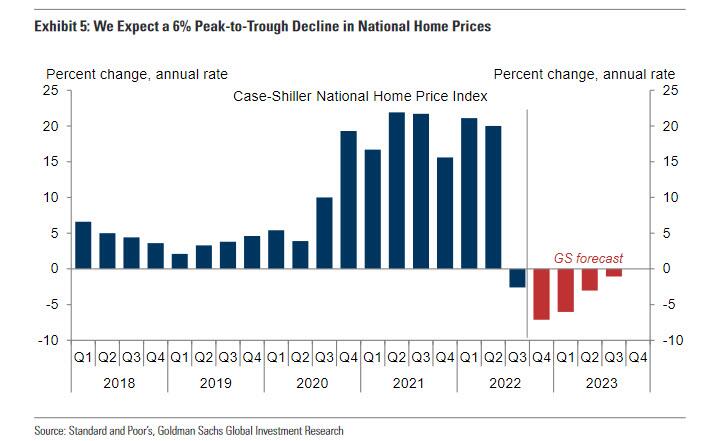
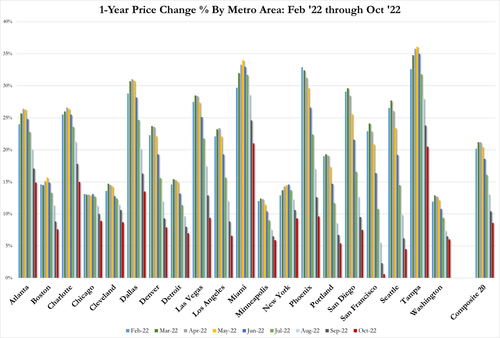
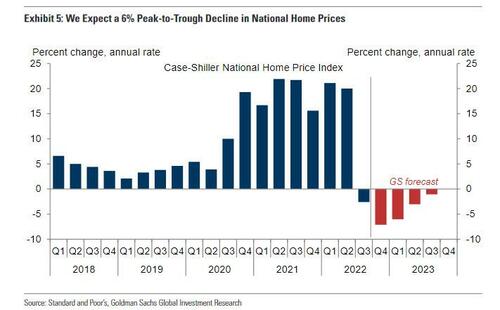
We expect a peak-to-trough decline in national home prices of roughly 6% and for prices to stop declining around mid-year.
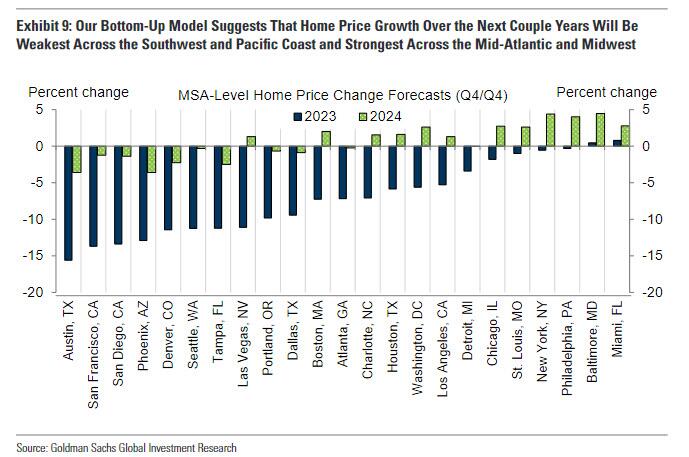
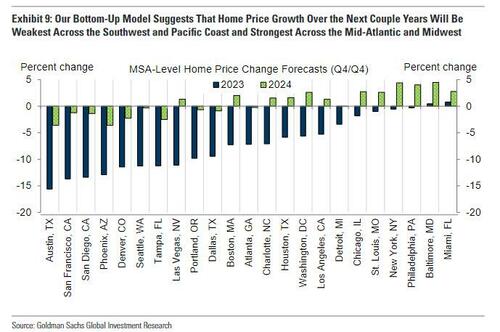
On a regional basis, we project larger declines across the Pacific Coast and Southwest regions—which have seen the largest increases in inventory on average—and more modest declines across the Mid-Atlantic and Midwest—which have maintained greater affordability over the past couple years.
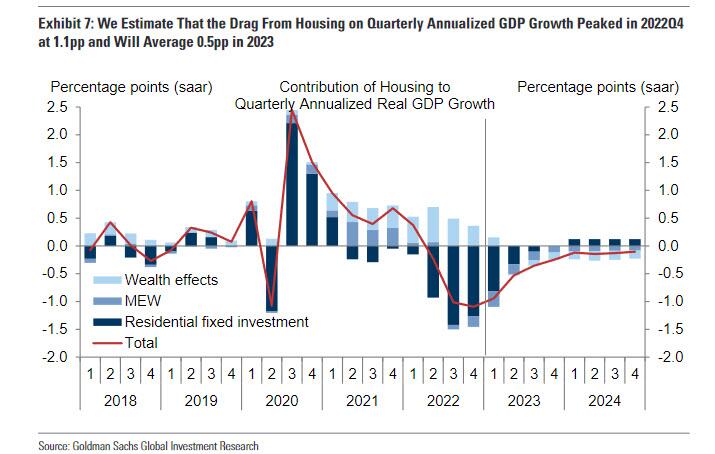
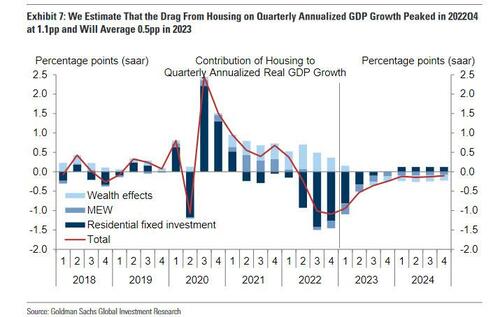
Higher rates and lower home prices will increase the drag on GDP growth from negative wealth effects and declining mortgage equity withdrawal, but we believe that the aggregate drag on GDP growth from the housing sector peaked in 2022Q4 at 1.1pp and will moderate to just 0.25pp by 2023Q4.
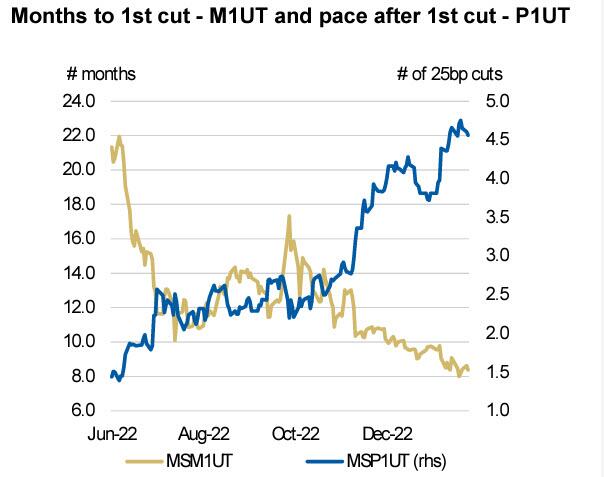
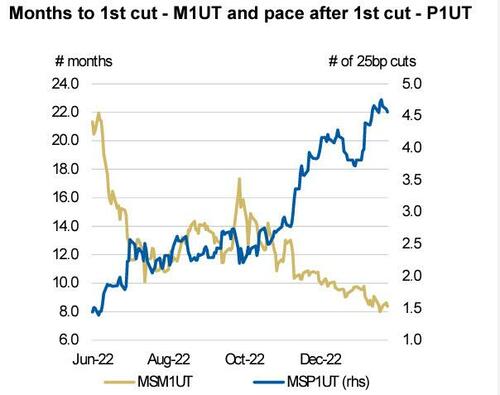
If the housing price futures market – and Goldman – is right in pricing in a housing trough than the consequences could confound markets: on one hand, a stabilization in housing will likely make any coming recession less severe; on the other, since housing is the primary channel by which the Fed can slowdown the economy, any failure to cripple this key US asset, could mean that Powell will be stuck in a “higher for longer” mode for, well, longer than the market expects. As a reminder, as the following Morgan Stanley chart shows, consensus is that the Fed is about 8 months away from its first rate cut, which will be promptly followed by ~4.5 25bps rate cuts.




 Everchem Updates Archive
  Sign Up for Email Updates