Current Affairs
October 25, 2022
Home Prices Tumble
Home Prices Plunge Most Since 2009, Pulte CEO Fears “Financial & Psychological Hurdles” Ahead For Homebuyers
by Tyler Durden
Tuesday, Oct 25, 2022 – 09:06 AM
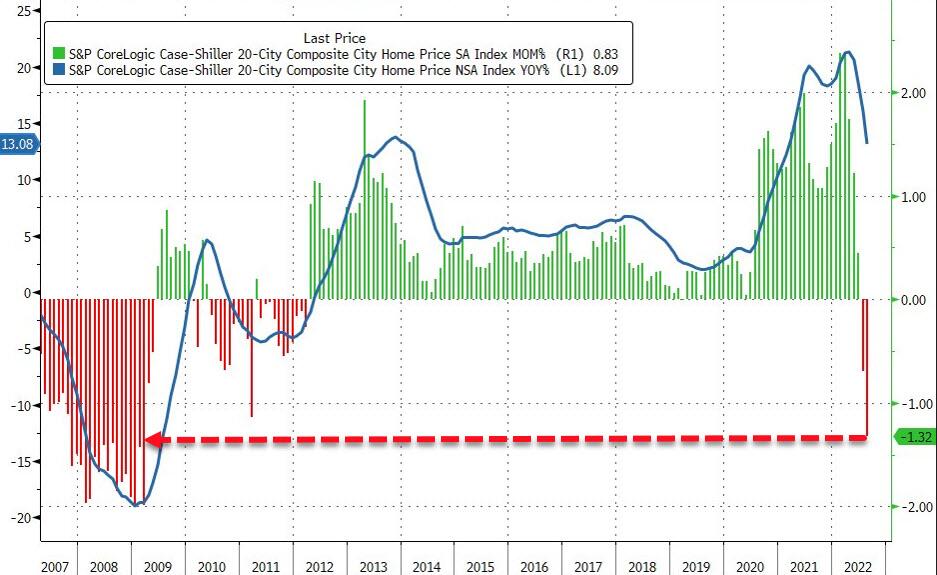
After tumbling for the first time since 2012 in July, Case-Shiller’s 20-City Composite Home Price index was expected to drop even faster in August (the latest data available) as mortgage rates soared, crushing affordability. Analysts were right as the 20-City Composite index plunged 1.32% MoM (far larger than the 0.8% drop expected), diving the YoY growth in the 20-City Composite to 13.08% (well down from the 14.0% exp)
Source: Bloomberg
That is the biggest MoM drop since March 2009 and the slowest YoY growth since Feb 2021.
“The forceful deceleration in U.S. housing prices that we noted a month ago continued,” Craig J. Lazzara, managing director at S&P Dow Jones Indices, said in statement.
“Price gains decelerated in every one of our 20 cities. These data show clearly that the growth rate of housing prices peaked in the spring of 2022 and has been declining ever since.”
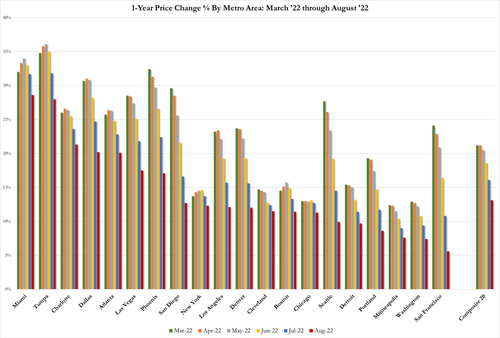
Miami, Tampa, Charlotte reported highest year-over-year gains among 20 cities surveyed, while on a seasonally-adjusted basis, prices fell the most in August (MoM) in San Francisco (-4.3%), Seattle (-3.9%), San Diego (-2.8%), and Los Angeles (-2.3%).
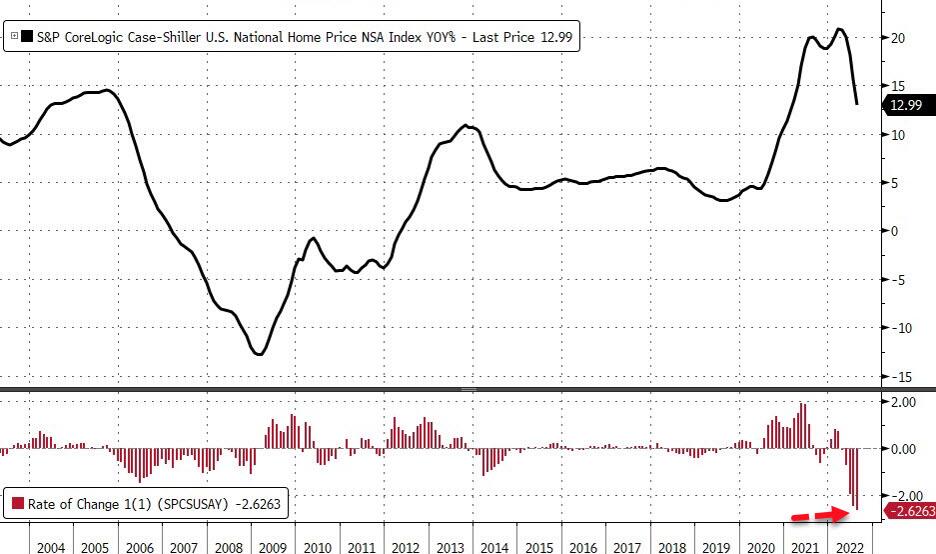
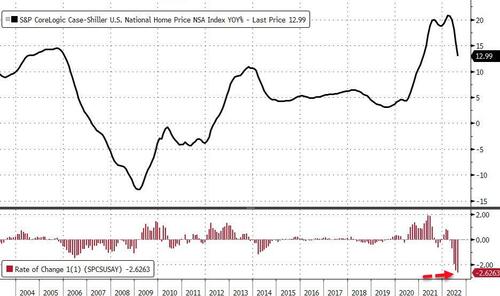
The growth in the national home price index has now slowed for 5 straight months (now below 13% YoY for the first time since Feb 2021). The absolute drop in the growth rate of 2.62 percentage points is the largest ever…
Source: Bloomberg
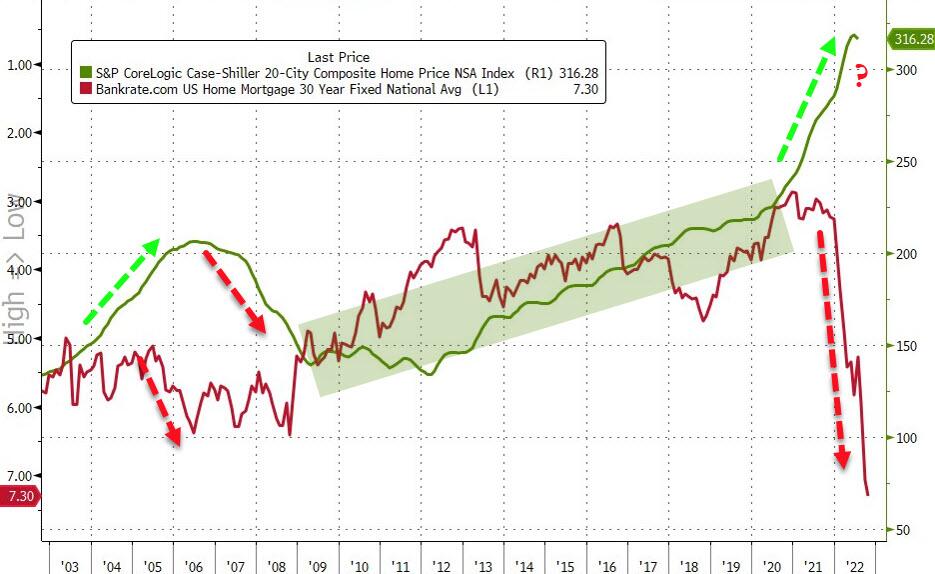
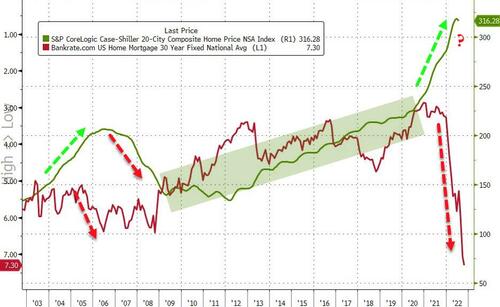
Finally, given the unprecedented explosion in mortgage rates, just where will home prices end?
Source: Bloomberg
We would like to think Powell’s plan does not involve that kind of collapse… or maybe it is – since prices will have to fall considerably more to become affordable for the average American to follow his ‘dream’.
As Lazzara previously concluded, “as the Federal Reserve continues to move interest rates upward, mortgage financing has become more expensive, a process that continues to this day. Given the prospects for a more challenging macroeconomic environment, home prices may well continue to decelerate.”
And by way of example, Pulte Homes today, during their earnings conference call, said that it was expanding incentives, including price-cuts, as sales slump.
“Demand clearly slowed in the period as dramatically higher interest rates created financial and psychological hurdles for potential homebuyers,” Ryan Marshall, PulteGroup’s president and chief executive officer, said in the statement.
Additionally, contracts were canceled in 24% of deals in the period, up from 15% in the second quarter, the Atlanta-based builder said in a statement Tuesday. Purchase contracts fell 28% from a year earlier to 4,924, missing the average estimate of 5,715 from analysts surveyed by Bloomberg. And bear in mind that this is for Q3 (after the heavily lagged Case-Shiller Index) with Pulte warning in today’s call that “demand got even more challenging in October”.
October 24, 2022
Diesel Prices an Issue
Runaway diesel prices top trucking industry’s critical issues list
Driver shortage slips to second-most critical issue after 5 years in top spot
Alan AdlerSaturday, October 22, 2022
3 minutes read

Listen to this article
0:00 / 4:24BeyondWords
SAN DIEGO — Soaring diesel prices displaced the driver shortage after five years in the top spot in the American Transportation Research Institute’s 18th annual Critical Issues in the Trucking Industry.
“It certainly brings attention to it when it overtakes something [like driver shortage],” Rebecca Brewster, ATRI president and COO, told FreightWaves.
The independent research group that works closely with the American Trucking Associations released its 18th annual survey Saturday during the ATA’s Management Conference and Exhibition.
Truck parking showed up No. 10 on the motor carrier’s side and No. 1 on the driver’s list. It finished third overall, up from fifth in 2021. The issue of where drivers stop to rest has finished no lower than sixth since 2013.
‘Tremendous issue for their driver workforce’
“I think this is an acknowledgement this year that the motor carriers see what a tremendous issue this is for their driver workforce because it has so many tentacles,” Brewster said. “You see it show up in our ability to recruit drivers, to retain drivers, to bring more women into the profession.
“When you think about all the attention on the truck parking issue from the U.S. DOT [Department of Transportation], from the Biden administration, and every time you see it written about, it references that drivers have identified this as their top concern,” she said.
Florida and Tennessee recently won $37.6 million in competitive grants from the DOT for trucking parking projects in their states. The Federal Motor Carrier Safety Administration is keenly aware of the issue as well, Robyn Hutcheson, FMCSA administrator, told a gathering of ATA conference attendees Saturday.

“We’re working very closely with the Federal Highway Administration,” which recently published an 80-page Truck Parking Development Handbook.
“We have a very clear direction to prioritize this,” Hutcheson said. “For our part, Jack VanSteenburg, our executive director, has communicated with every division administrator to use this guide.”
In addition to diesel prices and truck parking, carriers and drivers both listed driver detention while waiting to pick up or drop off a load, and the economy, as issues on which they agreed.
Driver shortage is still top motor carrier concern
Carriers continued to rank the driver shortage, estimated by the American Trucking Associations at 80,000, as the top issue. Drivers ranked the lack of parking as their top issue.
The rest of the ATRI Top 10 were:
4. Driver compensation
5. Economy
6. Driver detention/delay
7. Driver retention
8. CSA [Compliance, Safety, Accountability]
9. Speed limiters
10. Lawsuit abuse reform
October 24, 2022
Diesel Prices an Issue
Runaway diesel prices top trucking industry’s critical issues list
Driver shortage slips to second-most critical issue after 5 years in top spot
Alan AdlerSaturday, October 22, 2022
3 minutes read
Listen to this article
0:00 / 4:24BeyondWords
SAN DIEGO — Soaring diesel prices displaced the driver shortage after five years in the top spot in the American Transportation Research Institute’s 18th annual Critical Issues in the Trucking Industry.
“It certainly brings attention to it when it overtakes something [like driver shortage],” Rebecca Brewster, ATRI president and COO, told FreightWaves.
The independent research group that works closely with the American Trucking Associations released its 18th annual survey Saturday during the ATA’s Management Conference and Exhibition.
Truck parking showed up No. 10 on the motor carrier’s side and No. 1 on the driver’s list. It finished third overall, up from fifth in 2021. The issue of where drivers stop to rest has finished no lower than sixth since 2013.
‘Tremendous issue for their driver workforce’
“I think this is an acknowledgement this year that the motor carriers see what a tremendous issue this is for their driver workforce because it has so many tentacles,” Brewster said. “You see it show up in our ability to recruit drivers, to retain drivers, to bring more women into the profession.
“When you think about all the attention on the truck parking issue from the U.S. DOT [Department of Transportation], from the Biden administration, and every time you see it written about, it references that drivers have identified this as their top concern,” she said.
Florida and Tennessee recently won $37.6 million in competitive grants from the DOT for trucking parking projects in their states. The Federal Motor Carrier Safety Administration is keenly aware of the issue as well, Robyn Hutcheson, FMCSA administrator, told a gathering of ATA conference attendees Saturday.
“We’re working very closely with the Federal Highway Administration,” which recently published an 80-page Truck Parking Development Handbook.
“We have a very clear direction to prioritize this,” Hutcheson said. “For our part, Jack VanSteenburg, our executive director, has communicated with every division administrator to use this guide.”
In addition to diesel prices and truck parking, carriers and drivers both listed driver detention while waiting to pick up or drop off a load, and the economy, as issues on which they agreed.
Driver shortage is still top motor carrier concern
Carriers continued to rank the driver shortage, estimated by the American Trucking Associations at 80,000, as the top issue. Drivers ranked the lack of parking as their top issue.
The rest of the ATRI Top 10 were:
4. Driver compensation
5. Economy
6. Driver detention/delay
7. Driver retention
8. CSA [Compliance, Safety, Accountability]
9. Speed limiters
10. Lawsuit abuse reform
October 20, 2022
Imports to West Coast Continue to Fall
Container imports to Los Angeles and Long Beach are plummeting
Port of LA imports haven’t been this low in September since 2009
Greg Miller Follow on Twitter Wednesday, October 19, 2022
4 minutes read

Listen to this article
0:00 / 6:08BeyondWords
September is usually a strong month for West Coast imports as U.S. companies bring in their year-end holiday goods. Not so in 2022.
On Wednesday, the Port of Los Angeles reported its lowest import total for September since 2009, amid the Great Recession. The day before, the neighboring Port of Long Beach posted its weakest import total for September since 2016.
Imports to Southern California ports are falling fast because shippers have shifted volumes to East and Gulf coast ports, fearing disruptions from West Coast port labor negotiations. Simultaneously, volumes are now pulling back nationwide due to falling demand.
Holiday imports ‘dropped precipitously’
“In the month of September is where the real story lies,” explained Gene Seroka, executive director of the Port of Los Angeles, during a news conference on Wednesday.
Earlier this year, imports of durable goods bought heavily during the pandemic — furniture, appliances, etc. — began pulling back. In September, declines were heavily driven by reductions in holiday goods, as well.
“September is traditionally a high-volume month for end-of-year products,” said Seroka. “Think toys and games, clothing, footwear and other products. Those holiday gift items dropped precipitously compared to last September, mainly because they came in earlier. This year our peak season was in June and July, as savvy importers moved up the arrival of these goods to bring some certainty back to when they could get to market.”
Commenting on the shift to East and Gulf coast ports, Seroka said “concern over the dockworkers labor contract negotiations [was] a major factor contributing to volume declines.” He believes the shift “is likely to continue until a West Coast labor contract is in place — and that can’t happen soon enough.” The previous contract expired July 1.
Asked by American Shipper how October’s volumes are shaping up versus September’s, he said they will be “probably about the same or a little bit lighter. It’s going to be a soft October.”
LA September imports down 15% vs. August
The Port of Los Angeles reported total throughput of 709,873 twenty-foot equivalent units in September, down 21.5% year on year (y/y). Exports came in at 77,680 TEUS, up 2.6% y/y, while empties totaled 288,731 TEUs, down 19.8% y/y.
Loaded imports to Los Angeles totaled just 343,462 TEUs, down 26.6% y/y. Imports fell 15.1% sequentially versus August, following a 16.7% drop in August versus July.
Los Angeles’ imports reached their highest level this year in May. September imports were down 31.3% compared to that month. Imports in September were the lowest for any month since May 2020, when the U.S. was in the midst of COVID-19 lockdowns.

Long Beach September imports down 11% vs. August
The Port of Long Beach reported total throughput of 741,823 TEUs for September, down 0.9% y/y. Exports came in at 112,940 TEUs, up 1.9% y/y, and empties totaled 286,212 TEUs, up 7% y/y.
Long Beach handled 342,671 TEUs of imports in September, down 7.4% y/y and down 10.9% sequentially versus August. As in Los Angeles, Long Beach’s imports peaked this year in May. September was down 27.5% from that high. Monthly imports have not been this low since June 2020.

Port of Long Beach Executive Director Mario Cordero blamed the import decline on consumer and retail concerns about inflation, “leading to warehouses filled with inventory and fewer product orders from Asia.”
Fewer ships being worked at berths
The focus during the supply chain crisis was on the massive number of container ships at anchorages or loitering offshore as they waited for berths in Los Angeles or Long Beach. Statistics from the Marine Exchange of Southern California show a steep drop throughout this year, from a high of 109 waiting container ships Jan. 9 to just four on Wednesday, the lowest number since October 2020.
The Marine Exchange also collects data on the number of container ships at the berths in the two ports. This data also shows a major — and more recent — change.
As the supply crisis intensified, there were often over 30 ships at the two ports’ berths each day. Between August 2021 and February 2022, there were an average of 28.8 container vessels alongside in Los Angeles and Long Beach daily.
In recent weeks, however, the numbers have sunk to much lower levels. The average from Sept. 1 through Tuesday was 19 ships alongside, down over 30% from peak levels. There were 18 ships at the ports’ berths Tuesday. There were only 10 ships alongside on Sept. 12.
This is getting closer to pre-COVID levels. The average number of ships at the ports’ berths daily in full-year 2019 was 14.8.

Click for more articles by Greg Miller
October 20, 2022
Imports to West Coast Continue to Fall
Container imports to Los Angeles and Long Beach are plummeting
Port of LA imports haven’t been this low in September since 2009
Greg Miller Follow on Twitter Wednesday, October 19, 2022
4 minutes read
Listen to this article
0:00 / 6:08BeyondWords
September is usually a strong month for West Coast imports as U.S. companies bring in their year-end holiday goods. Not so in 2022.
On Wednesday, the Port of Los Angeles reported its lowest import total for September since 2009, amid the Great Recession. The day before, the neighboring Port of Long Beach posted its weakest import total for September since 2016.
Imports to Southern California ports are falling fast because shippers have shifted volumes to East and Gulf coast ports, fearing disruptions from West Coast port labor negotiations. Simultaneously, volumes are now pulling back nationwide due to falling demand.
Holiday imports ‘dropped precipitously’
“In the month of September is where the real story lies,” explained Gene Seroka, executive director of the Port of Los Angeles, during a news conference on Wednesday.
Earlier this year, imports of durable goods bought heavily during the pandemic — furniture, appliances, etc. — began pulling back. In September, declines were heavily driven by reductions in holiday goods, as well.
“September is traditionally a high-volume month for end-of-year products,” said Seroka. “Think toys and games, clothing, footwear and other products. Those holiday gift items dropped precipitously compared to last September, mainly because they came in earlier. This year our peak season was in June and July, as savvy importers moved up the arrival of these goods to bring some certainty back to when they could get to market.”
Commenting on the shift to East and Gulf coast ports, Seroka said “concern over the dockworkers labor contract negotiations [was] a major factor contributing to volume declines.” He believes the shift “is likely to continue until a West Coast labor contract is in place — and that can’t happen soon enough.” The previous contract expired July 1.
Asked by American Shipper how October’s volumes are shaping up versus September’s, he said they will be “probably about the same or a little bit lighter. It’s going to be a soft October.”
LA September imports down 15% vs. August
The Port of Los Angeles reported total throughput of 709,873 twenty-foot equivalent units in September, down 21.5% year on year (y/y). Exports came in at 77,680 TEUS, up 2.6% y/y, while empties totaled 288,731 TEUs, down 19.8% y/y.
Loaded imports to Los Angeles totaled just 343,462 TEUs, down 26.6% y/y. Imports fell 15.1% sequentially versus August, following a 16.7% drop in August versus July.
Los Angeles’ imports reached their highest level this year in May. September imports were down 31.3% compared to that month. Imports in September were the lowest for any month since May 2020, when the U.S. was in the midst of COVID-19 lockdowns.
Long Beach September imports down 11% vs. August
The Port of Long Beach reported total throughput of 741,823 TEUs for September, down 0.9% y/y. Exports came in at 112,940 TEUs, up 1.9% y/y, and empties totaled 286,212 TEUs, up 7% y/y.
Long Beach handled 342,671 TEUs of imports in September, down 7.4% y/y and down 10.9% sequentially versus August. As in Los Angeles, Long Beach’s imports peaked this year in May. September was down 27.5% from that high. Monthly imports have not been this low since June 2020.
Port of Long Beach Executive Director Mario Cordero blamed the import decline on consumer and retail concerns about inflation, “leading to warehouses filled with inventory and fewer product orders from Asia.”
Fewer ships being worked at berths
The focus during the supply chain crisis was on the massive number of container ships at anchorages or loitering offshore as they waited for berths in Los Angeles or Long Beach. Statistics from the Marine Exchange of Southern California show a steep drop throughout this year, from a high of 109 waiting container ships Jan. 9 to just four on Wednesday, the lowest number since October 2020.
The Marine Exchange also collects data on the number of container ships at the berths in the two ports. This data also shows a major — and more recent — change.
As the supply crisis intensified, there were often over 30 ships at the two ports’ berths each day. Between August 2021 and February 2022, there were an average of 28.8 container vessels alongside in Los Angeles and Long Beach daily.
In recent weeks, however, the numbers have sunk to much lower levels. The average from Sept. 1 through Tuesday was 19 ships alongside, down over 30% from peak levels. There were 18 ships at the ports’ berths Tuesday. There were only 10 ships alongside on Sept. 12.
This is getting closer to pre-COVID levels. The average number of ships at the ports’ berths daily in full-year 2019 was 14.8.
Click for more articles by Greg Miller
 Everchem Updates Archive
 Sign Up for Email Updates