Epoxy
June 14, 2021
Container Ship Consolidation
Top 10 Liners Control 85% Of The Container-Ship Market… And They’re Not Done Yet
by Tyler DurdenMonday, Jun 14, 2021 – 02:06 PM
By Greg Miller of FreightWaves,
The extreme consolidation within the container liner sector is the kind of thing owners of tankers and bulk carriers can only dream of. The latest data from Alphaliner highlights the extent of liner consolidation, how soon the rankings will change, and how newbuilding orders will render the carrier arena even more concentrated than it already is.
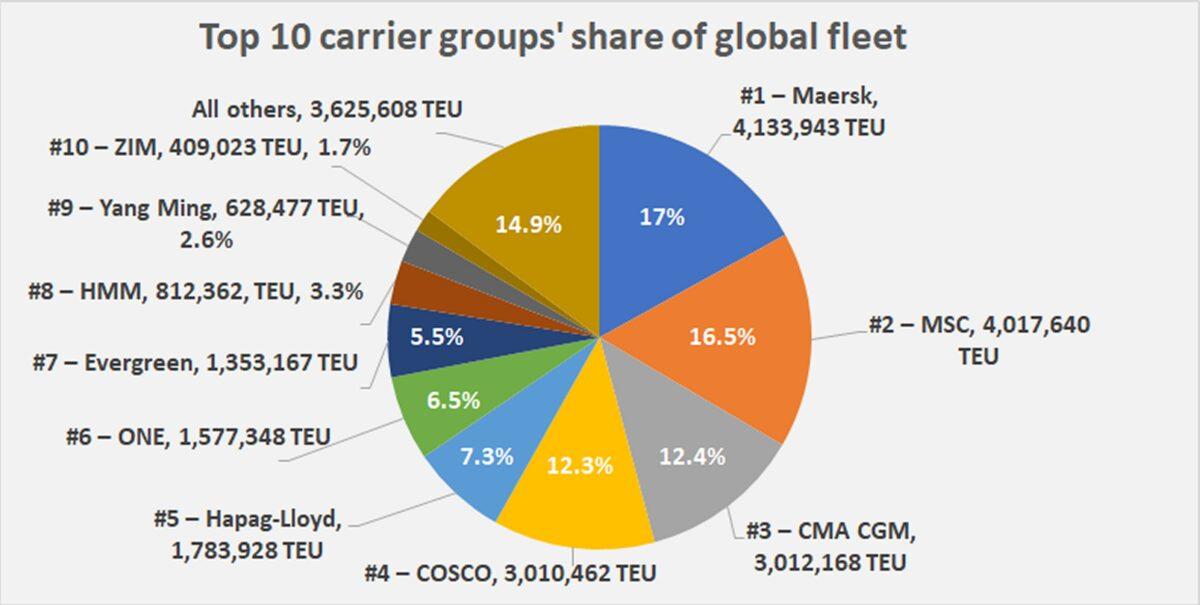
The top 10 carriers now operate 85% of global shipping capacity. Four groups — Maersk, MSC, CMA CGM and COSCO — control more than half of capacity (58%). The top seven, including Hapag-Lloyd, ONE and Evergreen, control 78%.TEU = twenty-foot equivalent unit (Chart: American Shipper based on data from Alphaliner)
This base level of fleet concentration is then greatly enhanced by the existence of three vessel-sharing alliances on the mainline East-West trades — 2M, the Ocean Alliance and THE Alliance — which count nine of the top 10 liner groups as members.
Big moves by MSC
The big mover at the top end of the liner rankings is MSC. The Switzerland-based carrier has been extremely active in the secondhand market, purchasing 49 vessels since August. It has also been busy in the charter market and very active in the newbuild market.
Including three secondhand ships it recently acquired, MSC just passed the 4 million-TEU (twenty-foot-equivalent unit) fleet milestone. Alphaliner noted that MSC’s fleet has increased 4% from the beginning of this year alone.
Including newbuilds on order, MSC effectively surpassed Maersk months ago to become the world’s largest carrier. Even in terms of ships on the water, it will take the crown soon. “The takeover could even happen before the end of the year, as MSC is to take delivery of four more 23,656-TEU ‘megamax’ newbuildings in the coming months,” said Alphaliner.
Newbuildings to hike carriers’ shares
When all newbuildings on order are delivered, MSC will pull far ahead of the pack. Although the sum of on-the-water tonnage and newbuild tonnage is not equivalent to future capacity (because there can be more orders in the interim, and ships can go on and off charter, be bought, sold, or scrapped), it does provide an indicator of future rankings.
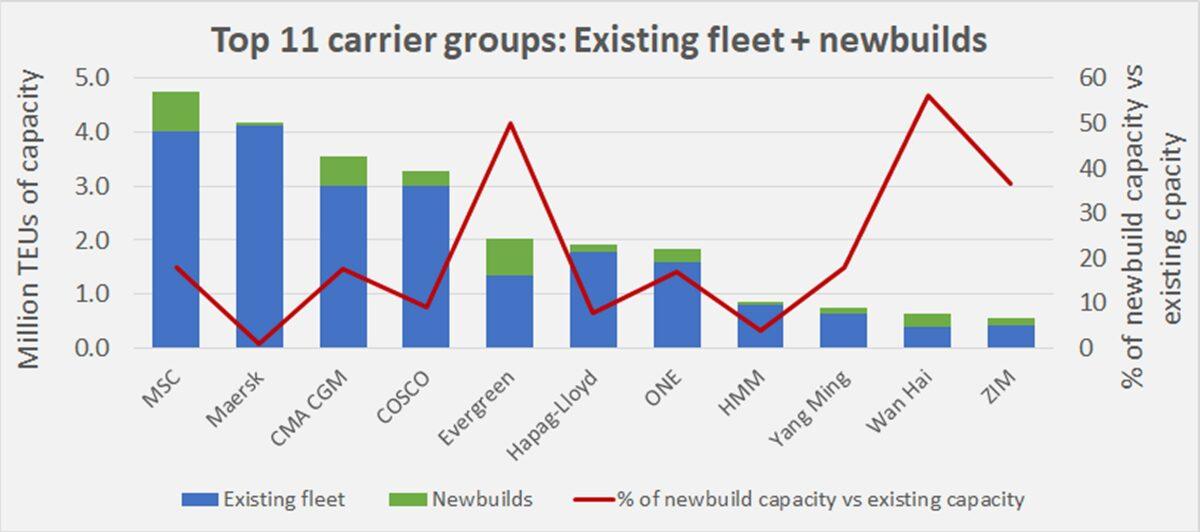
Maersk has the least on order of all the larger liner companies, with newbuild capacity of just 0.9% of on-the-water capacity. In sharp contrast, MSC’s orderbook is 18% of its operating fleet, according to Alphaliner data. The combined tonnage of existing ships and newbuilds for MSC is 4,742,400 TEUs, 14% and 34% above the same calculation for Maersk and CMA CGM, respectively.(Chart: American Shipper based on data from Alphaliner)
Beyond the “who has the biggest fleet” contest between Maersk and MSC, the broader and more important story is that the world’s top few carriers will be the overwhelming recipients of the new tonnage arriving in 2023-24 that was ordered starting in Q4 2020.
Among the other top players, the orderbook-to-fleet ratio of Wan Hai is 56%, Evergreen 50%, ZIM 37%, CMA CGM and Yang Ming 18%, ONE 17%, and COSCO 9%. These percentages will increase further as newbuilds ordered by non-operating owners are identified with their charterers over time.
A portion of this new capacity is replacement tonnage for older vessels, yet the newbuilding data implies that the top 10 liners’ capacity control will climb from its current 85% level in the direction of the 90s.
June 14, 2021
Container Ship Consolidation
Top 10 Liners Control 85% Of The Container-Ship Market… And They’re Not Done Yet
by Tyler DurdenMonday, Jun 14, 2021 – 02:06 PM
By Greg Miller of FreightWaves,
The extreme consolidation within the container liner sector is the kind of thing owners of tankers and bulk carriers can only dream of. The latest data from Alphaliner highlights the extent of liner consolidation, how soon the rankings will change, and how newbuilding orders will render the carrier arena even more concentrated than it already is.
The top 10 carriers now operate 85% of global shipping capacity. Four groups — Maersk, MSC, CMA CGM and COSCO — control more than half of capacity (58%). The top seven, including Hapag-Lloyd, ONE and Evergreen, control 78%.TEU = twenty-foot equivalent unit (Chart: American Shipper based on data from Alphaliner)
This base level of fleet concentration is then greatly enhanced by the existence of three vessel-sharing alliances on the mainline East-West trades — 2M, the Ocean Alliance and THE Alliance — which count nine of the top 10 liner groups as members.
Big moves by MSC
The big mover at the top end of the liner rankings is MSC. The Switzerland-based carrier has been extremely active in the secondhand market, purchasing 49 vessels since August. It has also been busy in the charter market and very active in the newbuild market.
Including three secondhand ships it recently acquired, MSC just passed the 4 million-TEU (twenty-foot-equivalent unit) fleet milestone. Alphaliner noted that MSC’s fleet has increased 4% from the beginning of this year alone.
Including newbuilds on order, MSC effectively surpassed Maersk months ago to become the world’s largest carrier. Even in terms of ships on the water, it will take the crown soon. “The takeover could even happen before the end of the year, as MSC is to take delivery of four more 23,656-TEU ‘megamax’ newbuildings in the coming months,” said Alphaliner.
Newbuildings to hike carriers’ shares
When all newbuildings on order are delivered, MSC will pull far ahead of the pack. Although the sum of on-the-water tonnage and newbuild tonnage is not equivalent to future capacity (because there can be more orders in the interim, and ships can go on and off charter, be bought, sold, or scrapped), it does provide an indicator of future rankings.
Maersk has the least on order of all the larger liner companies, with newbuild capacity of just 0.9% of on-the-water capacity. In sharp contrast, MSC’s orderbook is 18% of its operating fleet, according to Alphaliner data. The combined tonnage of existing ships and newbuilds for MSC is 4,742,400 TEUs, 14% and 34% above the same calculation for Maersk and CMA CGM, respectively.(Chart: American Shipper based on data from Alphaliner)
Beyond the “who has the biggest fleet” contest between Maersk and MSC, the broader and more important story is that the world’s top few carriers will be the overwhelming recipients of the new tonnage arriving in 2023-24 that was ordered starting in Q4 2020.
Among the other top players, the orderbook-to-fleet ratio of Wan Hai is 56%, Evergreen 50%, ZIM 37%, CMA CGM and Yang Ming 18%, ONE 17%, and COSCO 9%. These percentages will increase further as newbuilds ordered by non-operating owners are identified with their charterers over time.
A portion of this new capacity is replacement tonnage for older vessels, yet the newbuilding data implies that the top 10 liners’ capacity control will climb from its current 85% level in the direction of the 90s.
June 14, 2021
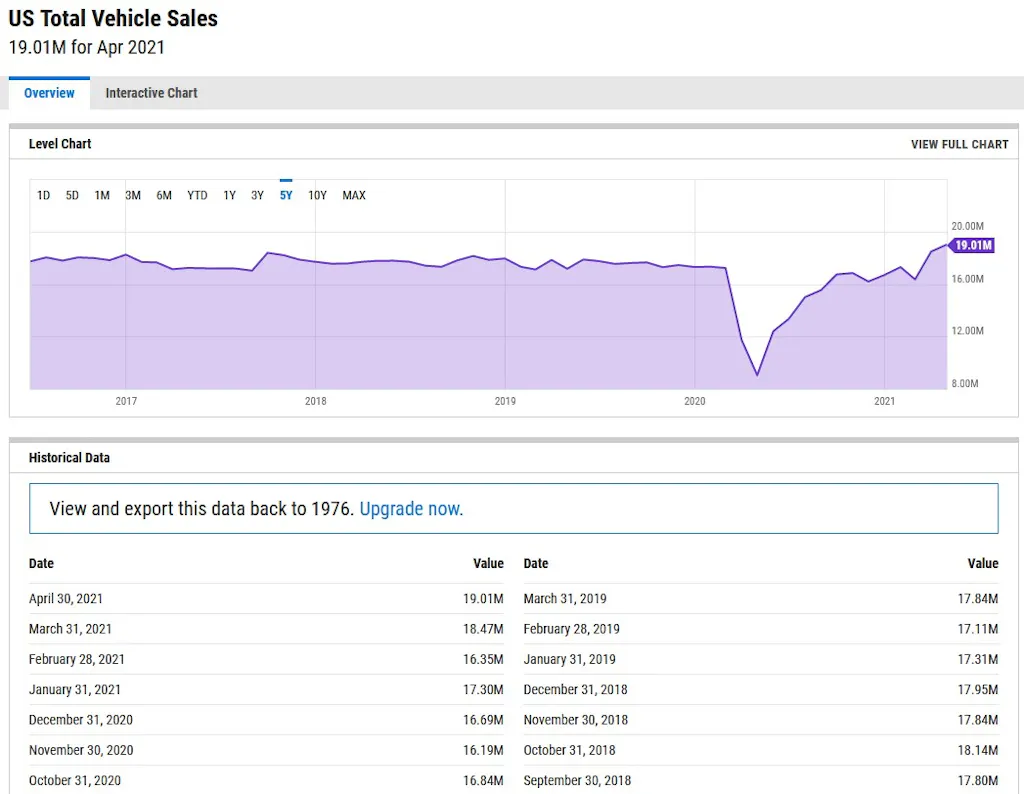
U.S. Vehicle Sales Top 19MM in April
June 14, 2021
U.S. Vehicle Sales Top 19MM in April
June 10, 2021
Chinese Epoxy Update
Epoxy resin is rising by RMB 6,700/ton! The domestic and international market may fall into the “two heavens of ice and fire”?
Echemi 2021-06-08
Judging from the list of commodity price rises and falls last week, there were only 4 products in the plasticization sector that rose month-on-month. The top 3 products were nitrile rubber (1.28%), PP fiber (0.77%), and PA6 (0.68%). .
The month-on-month decline in products reached 12, and the top 3 products were EVA (-3.91%), HIPS (-3.71%), and styrene-butadiene rubber (-3.34%).
It can be seen that the country’s regulation has been quite effective, and the domestic chemical raw materials are still mainly falling, but in contrast, overseas, the voices of price increases are still one after another! Sending out four or five price increase letters at a time is commonplace! The domestic and international market may fall into the “two heavens of ice and fire”?
Centralized suspension of production for 15 days,
Epoxy resin is rising by RMB 6,700/ton!
Recently, news came from the Huangshan area of Anhui that the Shexian Circular Economy Park will stop steam supply for annual maintenance at 10 am on June 7, 2021, and the furnace is expected to be shut down for about 15 days. Local epoxy resin companies remind customers that if they need to stock up, they can stock up in time.
The epoxy resin industry has been ups and downs since the beginning of this year. The supply of epoxy resins has been very unstable due to multiple factors such as environmental protection suspension and production restrictions, steam suspension, and annual maintenance. For 10 days, the furnace has been shut down for nearly half a month, which is expected to have an impact on the supply of products, or a reversal signal of the market since the epoxy resin peaked and plummeted in late April.
In foreign countries, epoxy resin has been the first to increase. Mitsubishi Chemical announced that it will increase the prices of epoxy resins and epoxy curing agents from June 1, including:
The increase of bisphenol A type/F type epoxy resin is 100 yen/kg (about 5822 yuan/ton),
The epoxy resin thinner series is 47~93 yen/kg (about 2736-5414 yuan/ton),
Special epoxy resin is 18-19 yen/kg (about 1048-1106 yuan/ton),
The epoxy resin hardener is 73-115 yen/kg (approximately 4249-6695 yuan/ton).
 Everchem Updates Archive
  Sign Up for Email Updates