Epoxy
April 24, 2021
A Sign of the Times
“That’s How Crazy The Market Is” – A “Virtually Unheard Of Trade” Spotted In Lumber
by Tyler DurdenFriday, Apr 23, 2021 – 08:40 PM
On Monday we highlighted a remarkable fact about the buying frenzy in the US lumber market: lumber futures were up for 16 consecutive days, a stretch without a down day since March 26, and while they did dip on Tuesday, the have more than recovered this latest decline, and are now up 19 of the past 20 days.
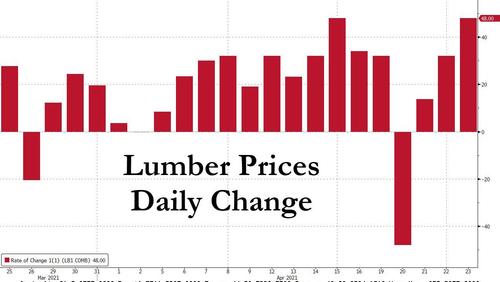
This surge in lumber prices to record highs, which was driven by an unprecedented shortages coupled with soaring demand by homebuilders…Lumber prices compared to last year and long term averages; source: @forexlive
… has also translated to unprecedented events in the supply chain, with Bloomberg today reporting a remarkable episode showing how extreme America’s shortage of lumber has become: For the first time in recent memory, a lumberyard was the one selling wood to a supplier.
Needless to say, this kind of trade – where a customer sells goods to its traditional supplier – is virtually unheard of.
MaterialsXchange, a Chicago-based digital trading platform for physical wood products, reports that the trade involved a lumberyard selling about 30,000 square feet of oriented strand board, or OSB ( a cheaper stand-in for plywood that is widely used to make house floors and walls).
“Building materials are moving from company to company in nontraditional flows,” said MaterialsXchange co-founder and CEO Mike Wisnefski. He added that prices have gotten so high that some homebuilders are being forced to cancel projects, leaving certain lumberyards with a little “excess inventory.”
On Wednesday, his company brokered another OSB sale involving a US East Coast lumberyard selling to another one in Arkansas at $1,500 per 1,000 square feet, surpassing a record $999 that was reached at the end of March, based on Random Lengths pricing.
For those confused, Bloomberg explains: in a normal world, wholesale distributors buy lumber from sawmills and sell that to the yards that homebuilders frequent. But lumber markets today are anything but normal with futures surging by more than 60% to record levels this year as the entire timber supply chain collapses under the weight of soaring demand from people renovating their homes and buying bigger ones. As a result, sawmills can’t keep up with orders. Truck shipments have been delayed. And distributors are running short on product.
“That’s how crazy the marketplace is,” said RCM Alternatives lumber analyst Brian Leonard, who has covered the industry for 35 years and had previously never heard of lumberyards selling to distributors. “Obviously it shouldn’t happen. You never push product back up the chain but you can today because of the volatility of the market.”
Furthermore, “reverse” trades like the one that occurred earlier this month will push wood prices even higher. Distributors buying back supply from yards will inevitably mark up prices to the customers they resell to, “potentially creating a vicious cycle that continues to stoke what has already proven to be an unrelenting lumber rally”, according to Bloomberg.
And, as we discussed earlier this week, soaring lumber prices are directly translating into much higher prices for new homes, making housing – where prices have already exploded thanks to the Biden stimulus and the Fed’s ZIRP – even more unaffordable.
https://www.zerohedge.com/markets/thats-how-crazy-market-virtually-uneard-trade-spotted-lumber
When you can make more money selling your inventory than other alternatives . . . buy back later when prices fall.
April 24, 2021
A Sign of the Times
“That’s How Crazy The Market Is” – A “Virtually Unheard Of Trade” Spotted In Lumber
by Tyler DurdenFriday, Apr 23, 2021 – 08:40 PM
On Monday we highlighted a remarkable fact about the buying frenzy in the US lumber market: lumber futures were up for 16 consecutive days, a stretch without a down day since March 26, and while they did dip on Tuesday, the have more than recovered this latest decline, and are now up 19 of the past 20 days.
This surge in lumber prices to record highs, which was driven by an unprecedented shortages coupled with soaring demand by homebuilders…Lumber prices compared to last year and long term averages; source: @forexlive
… has also translated to unprecedented events in the supply chain, with Bloomberg today reporting a remarkable episode showing how extreme America’s shortage of lumber has become: For the first time in recent memory, a lumberyard was the one selling wood to a supplier.
Needless to say, this kind of trade – where a customer sells goods to its traditional supplier – is virtually unheard of.
MaterialsXchange, a Chicago-based digital trading platform for physical wood products, reports that the trade involved a lumberyard selling about 30,000 square feet of oriented strand board, or OSB ( a cheaper stand-in for plywood that is widely used to make house floors and walls).
“Building materials are moving from company to company in nontraditional flows,” said MaterialsXchange co-founder and CEO Mike Wisnefski. He added that prices have gotten so high that some homebuilders are being forced to cancel projects, leaving certain lumberyards with a little “excess inventory.”
On Wednesday, his company brokered another OSB sale involving a US East Coast lumberyard selling to another one in Arkansas at $1,500 per 1,000 square feet, surpassing a record $999 that was reached at the end of March, based on Random Lengths pricing.
For those confused, Bloomberg explains: in a normal world, wholesale distributors buy lumber from sawmills and sell that to the yards that homebuilders frequent. But lumber markets today are anything but normal with futures surging by more than 60% to record levels this year as the entire timber supply chain collapses under the weight of soaring demand from people renovating their homes and buying bigger ones. As a result, sawmills can’t keep up with orders. Truck shipments have been delayed. And distributors are running short on product.
“That’s how crazy the marketplace is,” said RCM Alternatives lumber analyst Brian Leonard, who has covered the industry for 35 years and had previously never heard of lumberyards selling to distributors. “Obviously it shouldn’t happen. You never push product back up the chain but you can today because of the volatility of the market.”
Furthermore, “reverse” trades like the one that occurred earlier this month will push wood prices even higher. Distributors buying back supply from yards will inevitably mark up prices to the customers they resell to, “potentially creating a vicious cycle that continues to stoke what has already proven to be an unrelenting lumber rally”, according to Bloomberg.
And, as we discussed earlier this week, soaring lumber prices are directly translating into much higher prices for new homes, making housing – where prices have already exploded thanks to the Biden stimulus and the Fed’s ZIRP – even more unaffordable.
https://www.zerohedge.com/markets/thats-how-crazy-market-virtually-uneard-trade-spotted-lumber
When you can make more money selling your inventory than other alternatives . . . buy back later when prices fall.
April 16, 2021
Overview of Chinese Prices
Oil prices have soared by 5%! Resin breaks through 40,000 yuan/ton! Chemical price increases continue!
Echemi 2021-04-16
Recently, international crude oil futures ushered in a surge. As of the close of April 14, the price of light crude oil futures for delivery in May on the New York Mercantile Exchange rose 2.97 US dollars to close at US$63.15 per barrel, an increase of 4.94%; the price of London Brent crude oil futures for June delivery rose 2.91 US dollars, closed at 66.58 US dollars per barrel, an increase of 4.57%. Calculated on a spot-month contract, WTI futures and Brent crude oil futures prices both hit their highest closing prices since March 17.
According to industry insiders, following OPEC, the International Energy Agency has also raised its oil demand forecast for this year. Last week, US crude oil inventories fell by 6 million barrels more than expected. Crude oil inventories fell for the third consecutive week, and the decline exceeded expectations. , Boosted people’s optimistic expectations for a recovery in energy demand. The Yemeni Houthi rebels backed by Iran attacked an oil facility in Saudi Arabia, leading to escalation of tensions in the oil-rich Middle East. Geopolitical changes have also helped support crude oil prices.
The futures market is booming in large areas, and the price of chemical products is strongly driven
Affected by the increase in crude oil, the commodity futures market opened on the 15th with a large area of red, among which crude oil futures rose the most. As of 11:20, the main crude oil rose more than 4%, thermal coal, and the main styrene-ethyl PTA futures contract rose nearly 3%. Chemical raw materials are also showing a trend of rapid rise. In recent days, dozens of chemical raw materials have risen wildly. Liquid epoxy resin has been raised by RMB 6,600/ton during the month, and some chemicals have increased by RMB 500/ton daily.
The East China liquid resin market has broken through the 40,000 yuan/ton (barreled) mark, and the offer is 40,000-41,000 yuan/ton, an increase of 6,600 yuan/ton from the beginning of the month. Since 2021, the East China liquid resin has increased by 86%. The Huangshan solid resin market also rose to 33,000-34,000 yuan/ton, and the two-step method hit 38,000 yuan/ton, a record high.
The comprehensive PC market price is 28,900 yuan/ton, an increase of 2,800 yuan/ton compared to the same period last month, an increase of 10.45%; compared with the same period last week, the price has risen 1,700 yuan/ton, an increase of 3.96%, reaching a new historical height.
Bisphenol A is quoted at RMB 30,000/ton, which is an increase of RMB 1066.67/ton from last week.
The average ex-factory price of methyl ethyl ketone in the domestic market is 8666 yuan/ton. Compared with the previous working day, the average price is raised by 500 yuan/ton, a single-day increase of 6.12%, and an increase of 7.88% compared to April 1.
Isobutyraldehyde was quoted at RMB 13,400/ton, an increase of RMB 1,150/ton or 9.39% from the beginning of the month.
Wanhua Chemical’s MTBE price in Shandong area is 6,450 yuan/ton, up by 600 yuan/ton from last week, and the North China area’s price is 6,350 yuan/ton, up by 400 yuan/ton from last week.
The average ex-factory price of methyl ethyl ketone in the domestic market is 8666 yuan/ton. Compared with the previous working day, the average price is increased by 500 yuan/ton, a daily increase of 6.12%; compared with the daily price, the average price is increased by 633 yuan/ton, an increase 7.88%.
The price of n-butanol was 11,333.33 yuan/ton, an increase of 400 yuan/ton from last week.
Epichlorohydrin is quoted at 16067 yuan/ton, an increase of 400 yuan/ton per day. Jinan Aochen Chemical Co., Ltd. quoted RMB 16,500 per ton of epichlorohydrin, and merchants’ spot prices follow the market.
Wanhua Chemical’s propylene oxide quoted price was 18,700 yuan/ton, an increase of 400 yuan/ton from last week.
The domestic acetic acid price was 7116.67 yuan/ton, an increase of 303.34 yuan/ton or 4.45% from last week. In East China and North China, some acetic acid manufacturers have failed to store and shut down equipment, and it is difficult to reverse the tight supply of market resources in the short term.
Wanhua Chemical’s diisobutylene price was 11,800 yuan/ton, up by 300 yuan/ton from last week.
Diethylene glycol was quoted at 7663 yuan/ton, a daily increase of 280 yuan/ton.
Styrene was quoted at RMB 9,250/ton, a daily increase of RMB 262/ton.
The price of hydrogenated benzene in East China is 6,725 yuan/ton, up 200 yuan/ton per day.
…
At present, the production and consumption growth of petrochemical products have not encountered bottlenecks. Under the influence of the epidemic last year, there was a shortage of orders in the first half of the year, chemical product inventories were high, and prices continued to fall. In the second half of the year, downstream industries continued to recover, and demand growth also drove the price of chemical products, but more often they were “rising to falling”, and the landing price was still based on actual negotiations. This year, the chemical industry has seen a subversive market situation, and the tensions of geopolitical remediation have escalated. International crude oil hit a new high in 13 months, and then continued to fluctuate at a high level. The supply of the overseas chemical industry has decreased and the demand for domestic chemicals has soared. Under the supply reduction, the price speculation brought about by the global economic recovery is superimposed. It is expected that the chemical industry will continue to rise in the future, and the supply and demand imbalance in the first half of the year will not be quickly alleviated.
April 15, 2021
Middle East Update
Mideast petrochemical supply mixed; demand slows amid Ramadan
Author: Felicia Loo
2021/04/15
SINGAPORE (ICIS)–Petrochemical supply conditions are mixed in the Middle East, with trade limited for some products while cargo availability is tight when it comes to base oils, polyols and polystyrene in the first week of Ramadan.
The bulk of the region’s polyethylene (PE) and polypropylene (PP) business for April in the Middle East has been completed before the Muslim fasting month started on 12 April.
Demand is set to taper off due to shorter working hours in place in most Middle Eastern countries during Ramadan, which will end with the Eid ul-Fitr holiday.
Markets across the region are generally expected to pick up pace around mid-May.
In the East Mediterranean market, demand remains restricted with purchases being done on a need-to basis amid a sharp resurgence in coronavirus cases in Jordan and Lebanon.
With regards to polyethylene terephthalate (PET), imports Asian cargoes into the Middle East have slowed down.
Sellers were mostly looking to sell June or later deliveries, but buyers hesitate to commit on purchases amid recent price softening.
Downstream consumption in the Gulf Cooperation Council (GCC) may not experience the usual boost during the Eid holidays after Ramadan this year since big gatherings are restricted amid the pandemic.
PET bottle grade resins are typically used in bottle and sheet packaging applications
For isocyanates, trade is limited for polymeric methylene diphenyl diisocyanate (PMDI) and toluene diisocyanate (TDI) in the region.
Demand is slow and there have been few enquiries, also due to soft macroeconomic conditions.
Buyers are cautious, adopting a wait-and-see stance on the market, with a pick-up in consumption expected in mid-May while supply remains modest amid an outage at a regional facility.
For PMDI, supply from European suppliers is tight which coincides with slow demand in the GCC.
In the base oils market, supply is tight in the Middle East, with Group I supply not expected to improve soon.
Iranian producers may continue to float small-volume export tenders for the grade.
Over the last two weeks, Iranian producers have issued export sales tenders totalling just under 10,000 tonnes of Group I SN500 product, less than half the estimated monthly requirement of the UAE market.
In addition, Group II and III spot supply is expected to remain short.
There are minimal known turnarounds among base oils producers in the Middle East through the second quarter, but spot supply is likely to remain challenged as many producers have had to reduce output in part due to lower feedstock availability.
For 10-13.5% polyether polyols (POP), most customers in the Middle East have assumed a wait-and-see stance on the market this week amid tight supply in northeast Asia.
Less supply is available to the Middle East as most cargoes from northeast Asia had previously been sold to the US and Europe.
GCC polyols supply is seen to be limited due to unexpected upstream issues at a regional facility.
Meanwhile, polystyrene (PS) buyers in the Middle East reported a shortage of supply from a major regional producer, preventing it from making offers to some customers.
Spot availability was also hard to come by from other suppliers in Asia and Europe.
Focus article by Felicia Loo and Veena Pathare
 Everchem Updates Archive
 Sign Up for Email Updates