Epoxy
June 8, 2022
The New Reality
US Import Demand Is Dropping Off A Cliff
by Tyler DurdenTuesday, Jun 07, 2022 – 07:25 PM
By Henry Byers of FreightWaves
The latest ocean container bookings data reveals that despite the strong levels of inbound cargo during the first five months of 2022, import demand is not just softening — it’s dropping off a cliff. Because capacity on the trans-Pacific has remained relatively stable, Drewry’s container spot rates from China to the West Coast have plunged 41% month-over-month to $9,630.
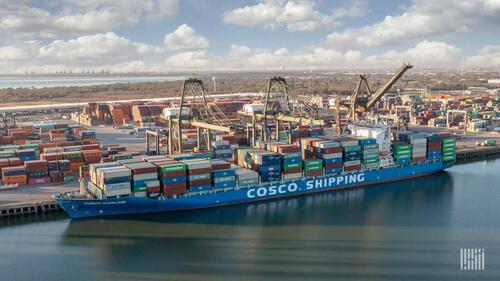
Freight forwarders will enjoy expanding margins on ocean freight, while U.S. trucking carriers and intermodal volume providers may start to see volume risks.
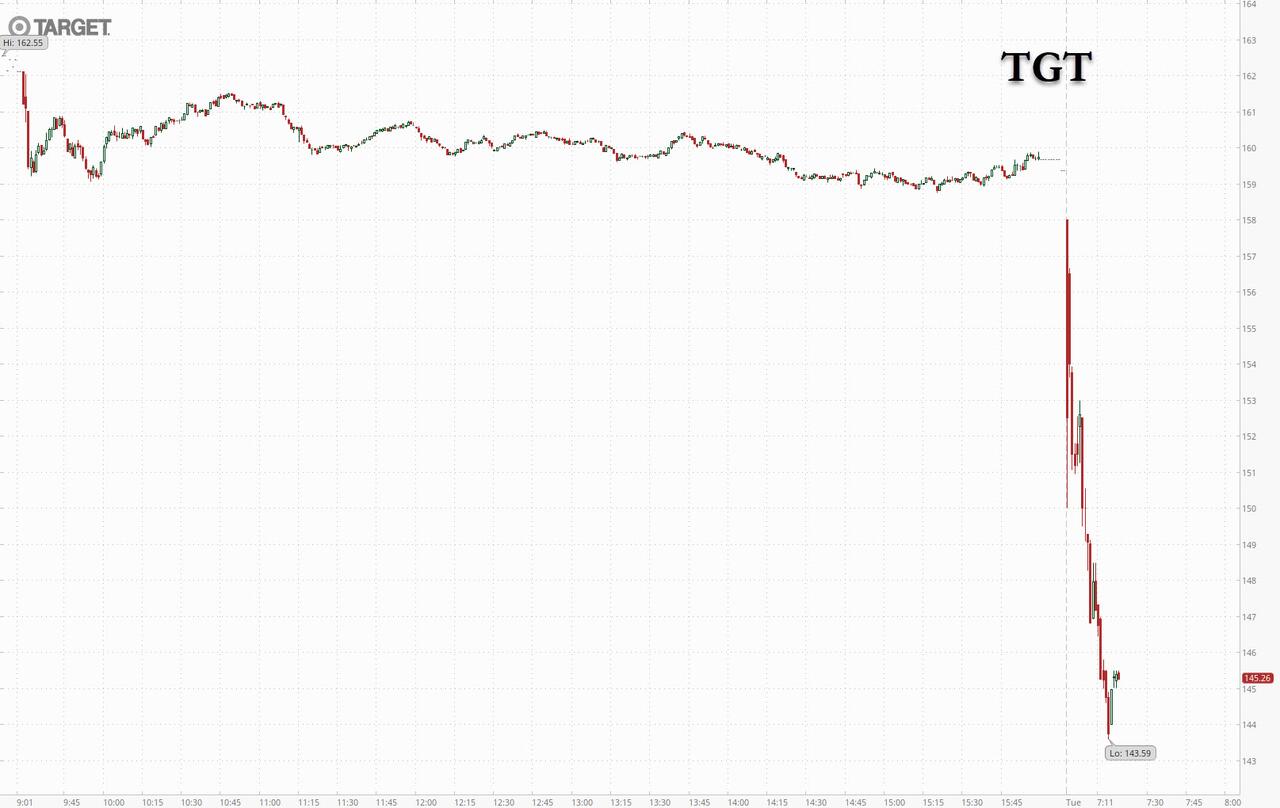
Consumer buying patterns are rapidly normalizing to pre-COVID levels, and U.S. retailers are stuck with too much inventory. Target shares dropped Tuesday morning after executives said the company would mark down unwanted items, cancel purchase orders and move quickly to get rid of excess inventory.
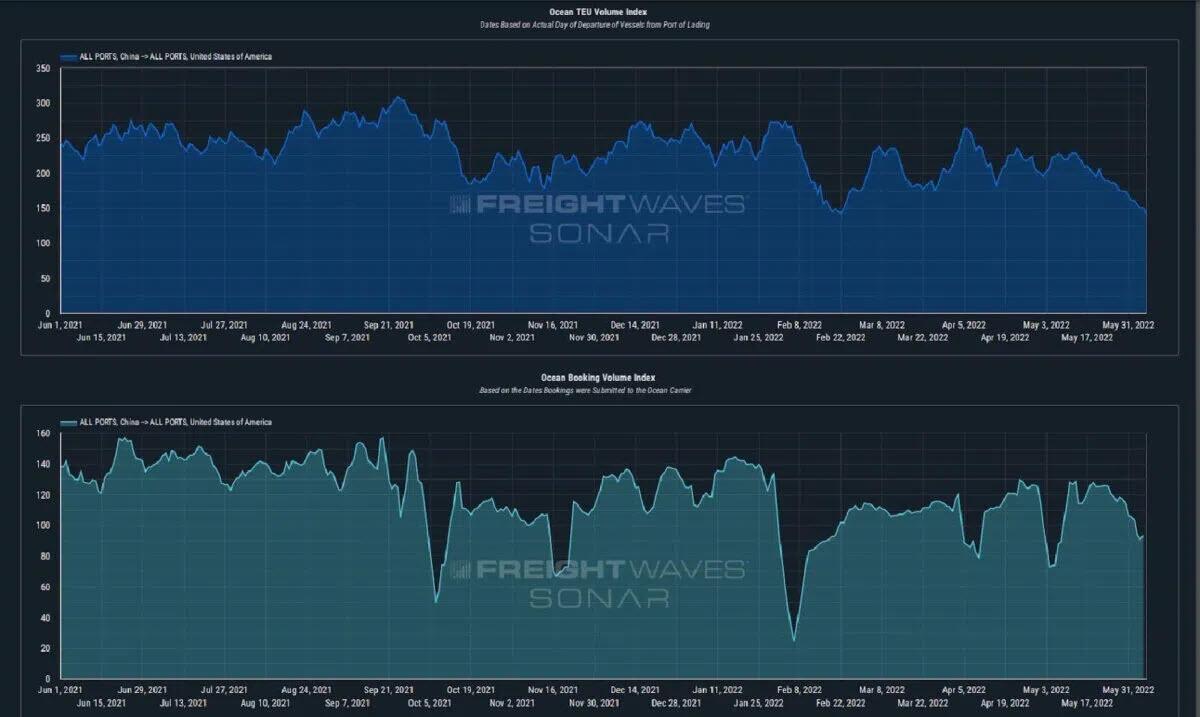
Container imports bound for the U.S. have dropped over 36% since May 24. (This index measures departing container volumes at the port of origin). This is a troubling sign for domestic U.S. freight markets that have been benefiting from an unprecedented surge of containerized import volumes over the last 18 months. Since ocean transit times for these inbound container volumes have recently been averaging between 30 and 35 days, we will begin seeing the softer volumes show up at U.S. ports in the first couple of weeks of July.
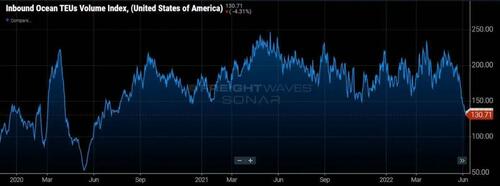
This also puts U.S. containerized imports from all countries of origin down 36% year-over-year, which is a reversion back to the volume levels of the summer of 2020. But what is the cause of the sudden drop in containerized import volumes? Well, there are a few simultaneous factors converging that serve as likely explanations for why volumes are suddenly dropping.
The inventory glut
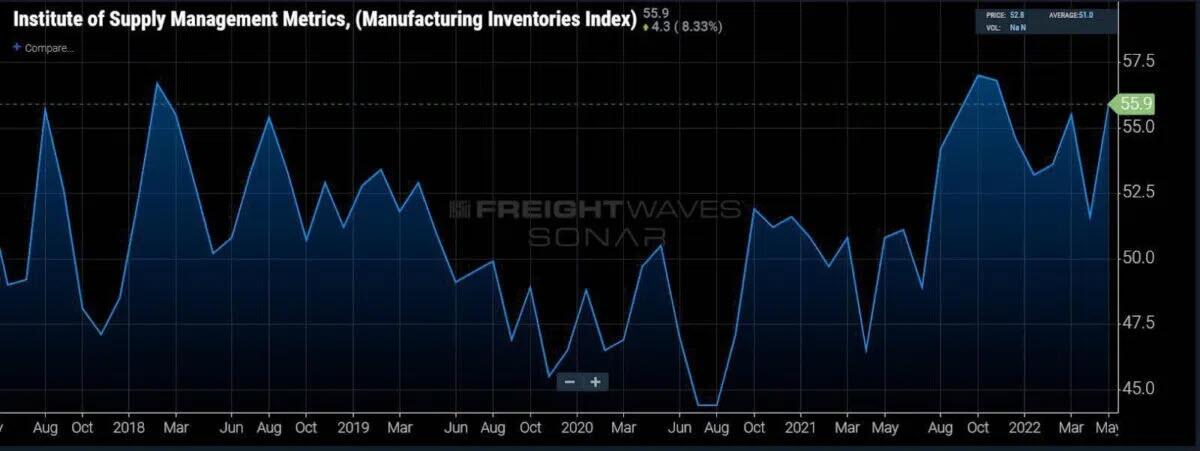
At the forefront of these reasons is the buildup of inventory here in the U.S. resulting from companies attempting to both replenish inventories that were largely depleted in 2021, but also from these companies wanting to keep enough inventory on hand in case of any further disruptions that may occur. Consecutive rounds of COVID lockdowns in China only exacerbated those fears, but after the war between Russia and Ukraine broke out more than 100 days ago, the geopolitical risks seem to only be escalating, and for better or for worse, companies decided that they would rather have the inventory safely here in the U.S. than risk having it abroad should there be a sudden surge in consumer demand.
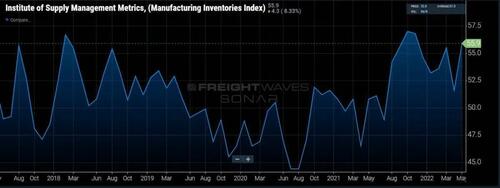
So, if consumers are now shifting buying trends from goods to services, those goods-producing companies may get stuck with too much inventory or the wrong inventory in order to try to capture sales. This buildup of inventory will inevitably lead to a slowdown in new import orders abroad and thus will only add to the demand destruction we are seeing for containerized imports into the U.S. Just Tuesday Target announced an “aggressive” inventory reduction plan led by canceling orders and marking down even more inventory.
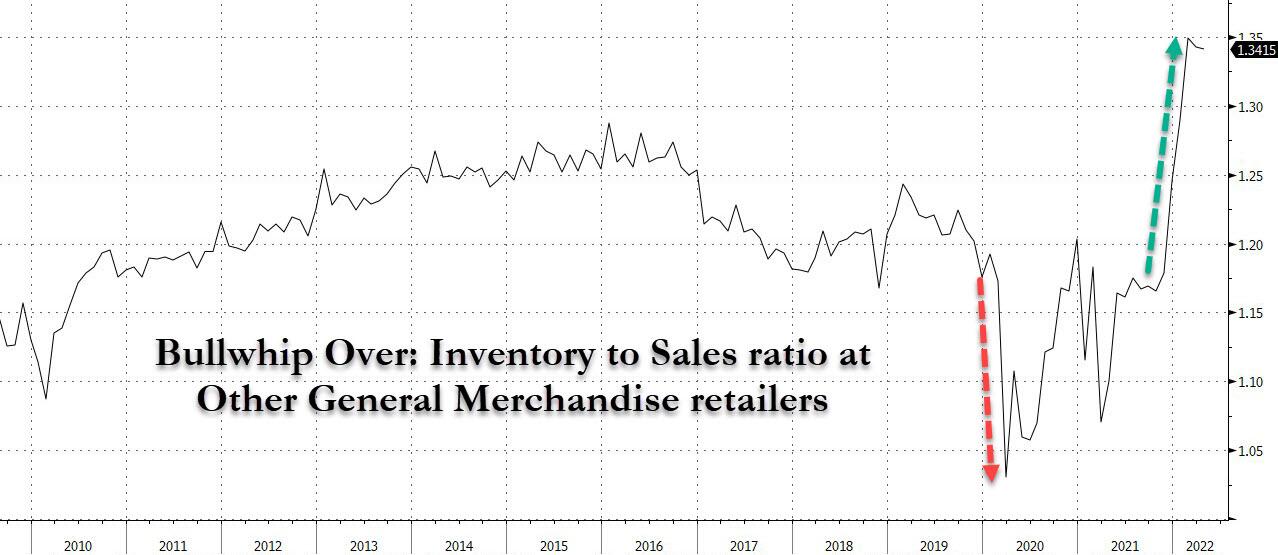
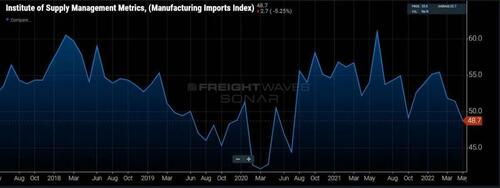
The chart above, displaying rising inventories, and the chart below, displaying falling imports, reveal that retailers are upside down after the last surge of freight to hit the United States’ shores and are throttling down freight velocity in their networks.
The consumer is getting crushed
Conditions for the consumer seem to be getting worse and worse as inflation takes hold and prices get more and more expensive. Just this week, AAA reported a new record high for gasoline prices at $4.51 per gallon on its national index.
Some economists speculate that with the Fed beginning to raise rates and draw down its balance sheet, we may be experiencing “peak inflation.” However, even if inflationary pressures begin to ease, consumers may still be overexposed to rising interest rates through the use of credit in a way that could further deteriorate demand and discretionary spending.
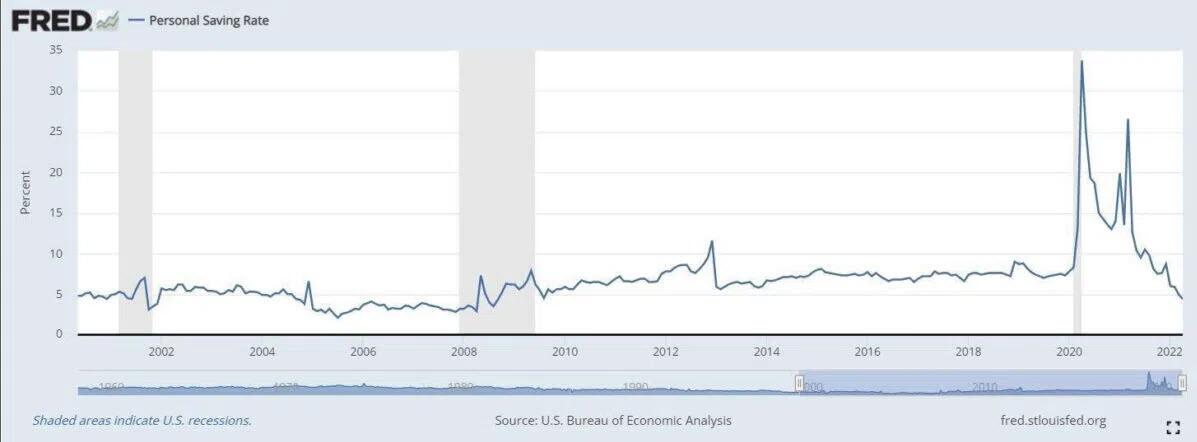
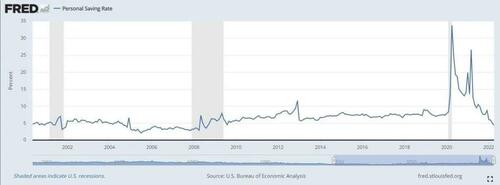
Credit card spending has been accelerating at a time when personal savings rates have continued to decrease and move toward some of their lowest rates (last reading 4.4) since the Great Financial Crisis (4.5 in August 2009). There are two ways to read very low savings rates: either consumers are exceptionally confident and exuberantly spending their money or consumers are spending every last dollar they have in an attempt to keep their heads above water in a high-inflation environment. Either way, there isn’t any slack left in consumer wallets — it’s hard to imagine consumer spending growing from here.
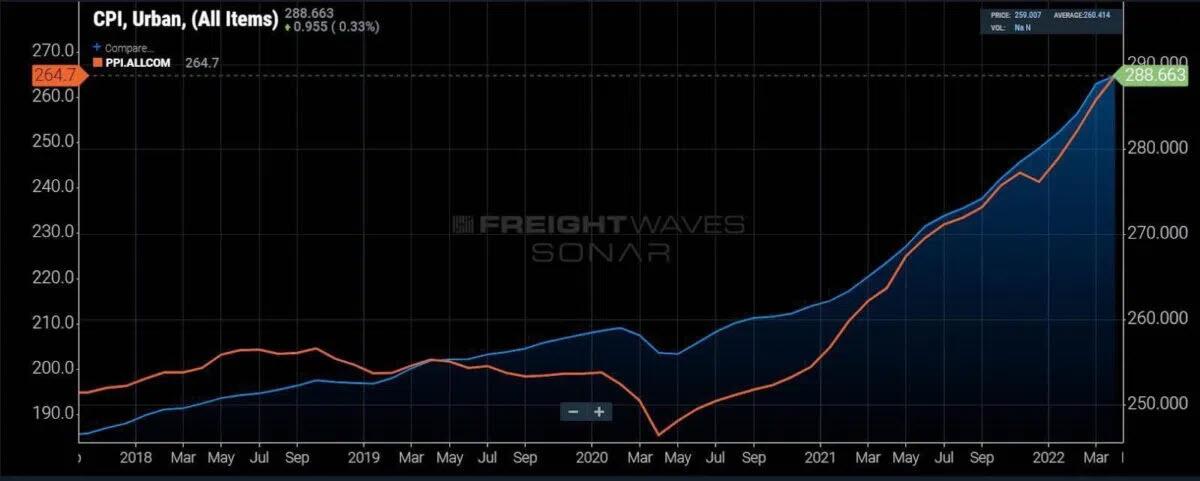
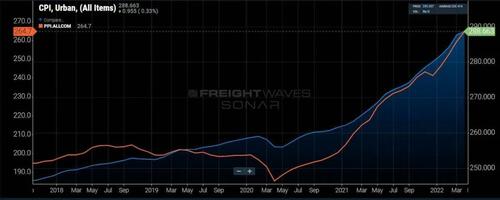
Unfortunately, inflationary pressures in energy and food don’t know or care that American consumers are out of money — inflation in those sectors was caused by supply shocks, not artificially stimulated demand. It is also important to keep in mind that the rate of growth for the Producer Price Index has been outpacing the Consumer Price Index, so some producers may still be taking some hits from rising costs that have not yet been passed on to the consumer.
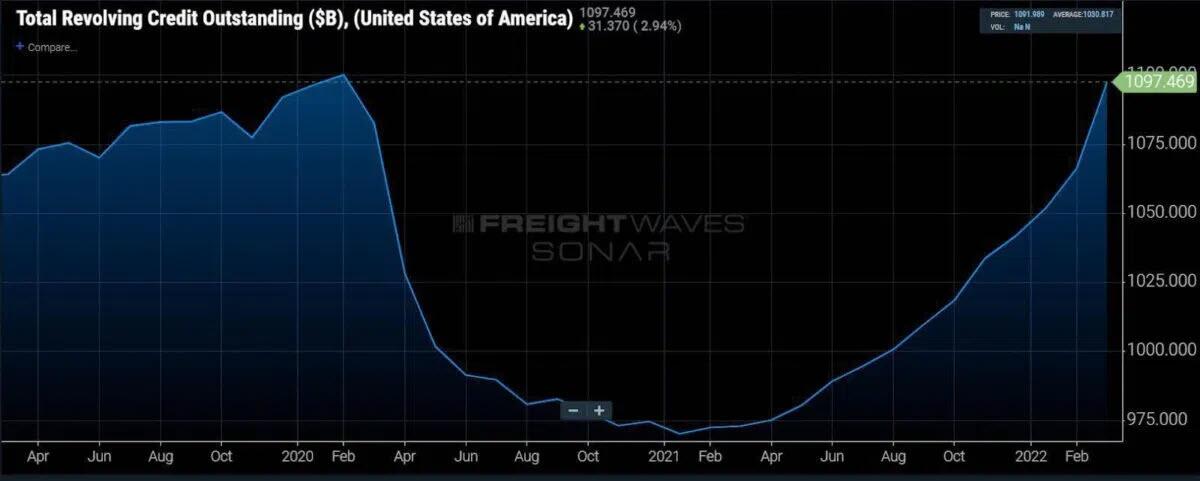
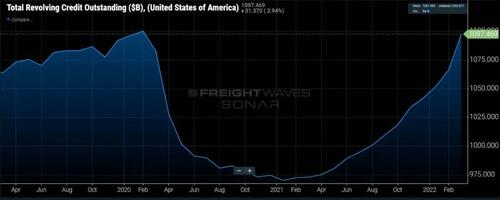
So even though total revolving credit outstanding is just at pre-pandemic levels, it is nonetheless accelerating, and if prices continue to rise, it is reasonable to expect that revolving credit outstanding will rise as well.
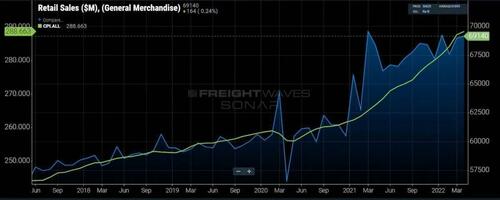
At first glance, one may look at retail sales (charted below) and conclude that they are growing, but keep in mind that the report is measured in nominal dollars unadjusted for inflation and represents increases in the prices of goods being sold — not so much the strength or resilience of consumers. Goods-producing companies will not be alone. Services and tech companies will also be under pressure in the coming months, and sell-offs could lead to layoffs.
As we see a growing number of signs pointing toward further demand destruction from U.S. consumers, and thus a further reversion of import container volumes back to levels closer to 2019, it is worth examining the trade lane that handles a majority of that volume: China to the U.S.
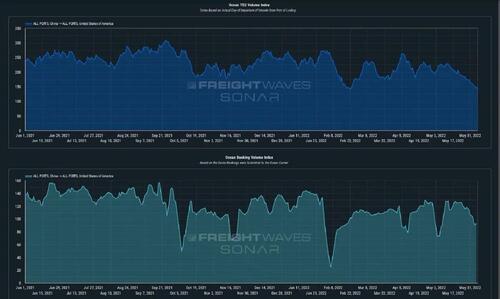
When looking at aggregated volumes from China to all U.S. ports, we are able to see that volumes have been declining from the “peak of peak season” in September 2021 through Tuesday (currently down 51% from that peak). While late March through the beginning of May is historically (pre-trade war/pre-pandemic) a softer period for volumes on this trade lane, it is important to realize that this decline in volumes has also been amplified by the COVID restrictions and lockdowns implemented by the Chinese government in Shanghai as well as other important manufacturing regions in China (most notably around Beijing and its major nearby port of Tianjin).
Despite the lockdowns, a decline in volumes on this major trade lane was seemingly inevitable in 2022 as the massive volumes moved between these two countries in 2021 were at unprecedented and unsustainable levels. Now some industry observers are calling for a “container surge” as China reopens, but it seems that the demand destruction has already spilled over into this trade lane in a big way.
The ‘container surge’ that never was
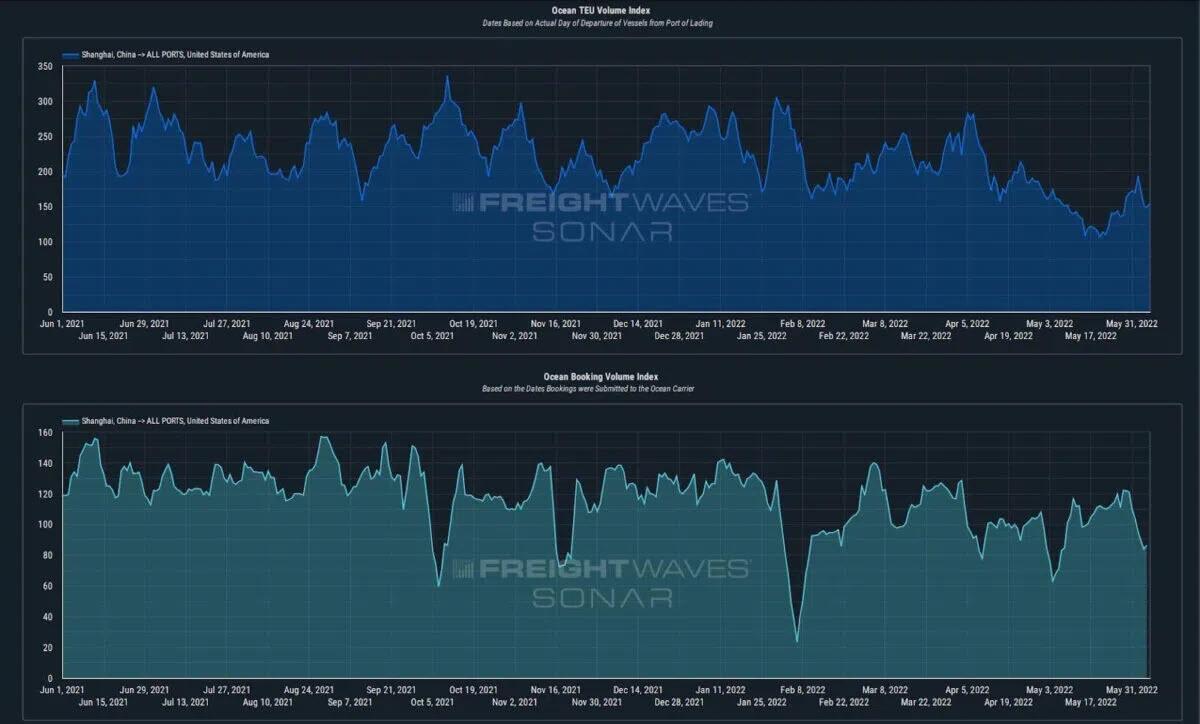
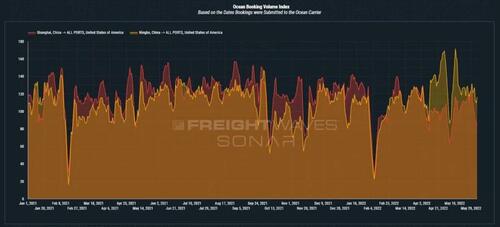
The “container surge” that many have been expecting from Shanghai (thought to be building during the lockdowns) appears to have mostly already been rerouted through the Port of Ningbo (yellow). With access to the Port of Shanghai being largely blocked due to landside restrictions (i.e., road closures), shippers were quick to reroute volumes through the closest alternate major port to the Port of Shanghai (red). Since the lockdowns began in Shanghai in late March, the decline in Shanghai new bookings (and thus load volumes) has been more than offset by a surge of volumes through Ningbo from rerouted containers. This led to booking lead times hitting their lowest levels on record as shippers scrambled to get their volumes moving.
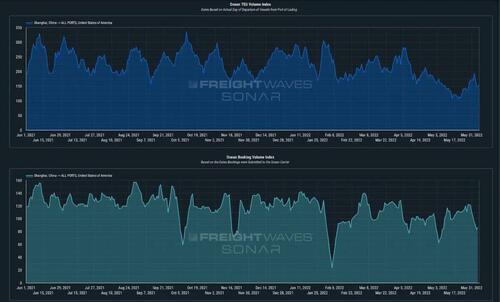
Despite the reopening of Shanghai, total container volumes from China to the U.S. have continued their downward trajectory, and that trend is not likely to be reversed by an easing of COVID restrictions alone. As of the latest data points, if this is the “container surge” from Shanghai to U.S. ports upon its reopening last Wednesday, then right now, it is barely a “blip on the radar” compared to the volumes from Shanghai to the U.S. that what we have seen over the last 18 to 22 months. This could easily change within our bookings data for the weeks ahead, and if there is pent-up demand, it will undoubtedly show up in the bookings data, but as of Tuesday, it has not yet materialized in any significant way.
This steady decline in volumes from China to the U.S. has also put significant downward pressure on spot rates from the demand side. As capacity remained relatively consistent in the first few weeks post-lockdown (March 28 onward), the drop in volumes caused a decline in both the Freightos Baltic Daily Index and the Drewry World Container Index spot rates from China/East Asia to the U.S. West Coast (down 41% per FEU month-over-month [m/m] – $9,630), as well as from China/East Asia to the U.S. East Coast (down 36% per FEU m/m – $11,907). While this has been a welcome downturn in spot rates for shippers that battled the record-setting spot rates of 2021, we should also keep in mind that these spot rates remain elevated on a y/y basis (73% to the West Coast and 59% to the East Coast).
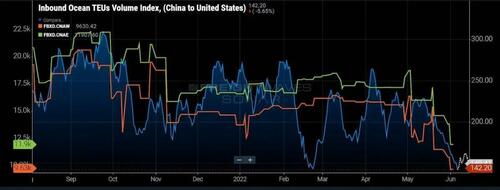
If bookings continue to soften through June, we expect to see spot rates on this trade lane decline further, but ocean carriers may go to greater lengths than ever before to try and protect their record-setting earnings. They have already been cutting capacity on major trade routes through measures such as blank sailings and reassigning vessels to other services, but if the decline in volumes accelerates in the weeks ahead, we may see the alliances test their strength and discipline like never before.
If rates start dropping quickly, it is reasonable to suspect that the ocean carriers that have not locked in a majority of their allocations in longer-term contracts may begin aggressively undercutting one another as they compete in the spot market.
Interestingly enough, the last port labor negotiations at LAX/LGB that caused disruptions to supply chains (and thus led to a buildup of inventory in the U.S.) in 2014-15 created a similar situation. Coming off of a record year, that may sound like an unlikely scenario, but there is a distinct possibility that sharply softening spot rates could cause a shakeup and/or reorganization of the current alliances.
https://www.zerohedge.com/markets/us-import-demand-dropping-cliff
June 8, 2022
The New Reality
US Import Demand Is Dropping Off A Cliff
by Tyler DurdenTuesday, Jun 07, 2022 – 07:25 PM
By Henry Byers of FreightWaves
The latest ocean container bookings data reveals that despite the strong levels of inbound cargo during the first five months of 2022, import demand is not just softening — it’s dropping off a cliff. Because capacity on the trans-Pacific has remained relatively stable, Drewry’s container spot rates from China to the West Coast have plunged 41% month-over-month to $9,630.
Freight forwarders will enjoy expanding margins on ocean freight, while U.S. trucking carriers and intermodal volume providers may start to see volume risks.
Consumer buying patterns are rapidly normalizing to pre-COVID levels, and U.S. retailers are stuck with too much inventory. Target shares dropped Tuesday morning after executives said the company would mark down unwanted items, cancel purchase orders and move quickly to get rid of excess inventory.
Container imports bound for the U.S. have dropped over 36% since May 24. (This index measures departing container volumes at the port of origin). This is a troubling sign for domestic U.S. freight markets that have been benefiting from an unprecedented surge of containerized import volumes over the last 18 months. Since ocean transit times for these inbound container volumes have recently been averaging between 30 and 35 days, we will begin seeing the softer volumes show up at U.S. ports in the first couple of weeks of July.
This also puts U.S. containerized imports from all countries of origin down 36% year-over-year, which is a reversion back to the volume levels of the summer of 2020. But what is the cause of the sudden drop in containerized import volumes? Well, there are a few simultaneous factors converging that serve as likely explanations for why volumes are suddenly dropping.
The inventory glut
At the forefront of these reasons is the buildup of inventory here in the U.S. resulting from companies attempting to both replenish inventories that were largely depleted in 2021, but also from these companies wanting to keep enough inventory on hand in case of any further disruptions that may occur. Consecutive rounds of COVID lockdowns in China only exacerbated those fears, but after the war between Russia and Ukraine broke out more than 100 days ago, the geopolitical risks seem to only be escalating, and for better or for worse, companies decided that they would rather have the inventory safely here in the U.S. than risk having it abroad should there be a sudden surge in consumer demand.
So, if consumers are now shifting buying trends from goods to services, those goods-producing companies may get stuck with too much inventory or the wrong inventory in order to try to capture sales. This buildup of inventory will inevitably lead to a slowdown in new import orders abroad and thus will only add to the demand destruction we are seeing for containerized imports into the U.S. Just Tuesday Target announced an “aggressive” inventory reduction plan led by canceling orders and marking down even more inventory.
The chart above, displaying rising inventories, and the chart below, displaying falling imports, reveal that retailers are upside down after the last surge of freight to hit the United States’ shores and are throttling down freight velocity in their networks.
The consumer is getting crushed
Conditions for the consumer seem to be getting worse and worse as inflation takes hold and prices get more and more expensive. Just this week, AAA reported a new record high for gasoline prices at $4.51 per gallon on its national index.
Some economists speculate that with the Fed beginning to raise rates and draw down its balance sheet, we may be experiencing “peak inflation.” However, even if inflationary pressures begin to ease, consumers may still be overexposed to rising interest rates through the use of credit in a way that could further deteriorate demand and discretionary spending.
Credit card spending has been accelerating at a time when personal savings rates have continued to decrease and move toward some of their lowest rates (last reading 4.4) since the Great Financial Crisis (4.5 in August 2009). There are two ways to read very low savings rates: either consumers are exceptionally confident and exuberantly spending their money or consumers are spending every last dollar they have in an attempt to keep their heads above water in a high-inflation environment. Either way, there isn’t any slack left in consumer wallets — it’s hard to imagine consumer spending growing from here.
Unfortunately, inflationary pressures in energy and food don’t know or care that American consumers are out of money — inflation in those sectors was caused by supply shocks, not artificially stimulated demand. It is also important to keep in mind that the rate of growth for the Producer Price Index has been outpacing the Consumer Price Index, so some producers may still be taking some hits from rising costs that have not yet been passed on to the consumer.
So even though total revolving credit outstanding is just at pre-pandemic levels, it is nonetheless accelerating, and if prices continue to rise, it is reasonable to expect that revolving credit outstanding will rise as well.
At first glance, one may look at retail sales (charted below) and conclude that they are growing, but keep in mind that the report is measured in nominal dollars unadjusted for inflation and represents increases in the prices of goods being sold — not so much the strength or resilience of consumers. Goods-producing companies will not be alone. Services and tech companies will also be under pressure in the coming months, and sell-offs could lead to layoffs.
As we see a growing number of signs pointing toward further demand destruction from U.S. consumers, and thus a further reversion of import container volumes back to levels closer to 2019, it is worth examining the trade lane that handles a majority of that volume: China to the U.S.
When looking at aggregated volumes from China to all U.S. ports, we are able to see that volumes have been declining from the “peak of peak season” in September 2021 through Tuesday (currently down 51% from that peak). While late March through the beginning of May is historically (pre-trade war/pre-pandemic) a softer period for volumes on this trade lane, it is important to realize that this decline in volumes has also been amplified by the COVID restrictions and lockdowns implemented by the Chinese government in Shanghai as well as other important manufacturing regions in China (most notably around Beijing and its major nearby port of Tianjin).
Despite the lockdowns, a decline in volumes on this major trade lane was seemingly inevitable in 2022 as the massive volumes moved between these two countries in 2021 were at unprecedented and unsustainable levels. Now some industry observers are calling for a “container surge” as China reopens, but it seems that the demand destruction has already spilled over into this trade lane in a big way.
The ‘container surge’ that never was
The “container surge” that many have been expecting from Shanghai (thought to be building during the lockdowns) appears to have mostly already been rerouted through the Port of Ningbo (yellow). With access to the Port of Shanghai being largely blocked due to landside restrictions (i.e., road closures), shippers were quick to reroute volumes through the closest alternate major port to the Port of Shanghai (red). Since the lockdowns began in Shanghai in late March, the decline in Shanghai new bookings (and thus load volumes) has been more than offset by a surge of volumes through Ningbo from rerouted containers. This led to booking lead times hitting their lowest levels on record as shippers scrambled to get their volumes moving.
Despite the reopening of Shanghai, total container volumes from China to the U.S. have continued their downward trajectory, and that trend is not likely to be reversed by an easing of COVID restrictions alone. As of the latest data points, if this is the “container surge” from Shanghai to U.S. ports upon its reopening last Wednesday, then right now, it is barely a “blip on the radar” compared to the volumes from Shanghai to the U.S. that what we have seen over the last 18 to 22 months. This could easily change within our bookings data for the weeks ahead, and if there is pent-up demand, it will undoubtedly show up in the bookings data, but as of Tuesday, it has not yet materialized in any significant way.
This steady decline in volumes from China to the U.S. has also put significant downward pressure on spot rates from the demand side. As capacity remained relatively consistent in the first few weeks post-lockdown (March 28 onward), the drop in volumes caused a decline in both the Freightos Baltic Daily Index and the Drewry World Container Index spot rates from China/East Asia to the U.S. West Coast (down 41% per FEU month-over-month [m/m] – $9,630), as well as from China/East Asia to the U.S. East Coast (down 36% per FEU m/m – $11,907). While this has been a welcome downturn in spot rates for shippers that battled the record-setting spot rates of 2021, we should also keep in mind that these spot rates remain elevated on a y/y basis (73% to the West Coast and 59% to the East Coast).
If bookings continue to soften through June, we expect to see spot rates on this trade lane decline further, but ocean carriers may go to greater lengths than ever before to try and protect their record-setting earnings. They have already been cutting capacity on major trade routes through measures such as blank sailings and reassigning vessels to other services, but if the decline in volumes accelerates in the weeks ahead, we may see the alliances test their strength and discipline like never before.
If rates start dropping quickly, it is reasonable to suspect that the ocean carriers that have not locked in a majority of their allocations in longer-term contracts may begin aggressively undercutting one another as they compete in the spot market.
Interestingly enough, the last port labor negotiations at LAX/LGB that caused disruptions to supply chains (and thus led to a buildup of inventory in the U.S.) in 2014-15 created a similar situation. Coming off of a record year, that may sound like an unlikely scenario, but there is a distinct possibility that sharply softening spot rates could cause a shakeup and/or reorganization of the current alliances.
https://www.zerohedge.com/markets/us-import-demand-dropping-cliff
June 7, 2022
More on Inventories
Target Crashes After Cutting Profit Outlook For 2nd Time In Three Weeks Due To Excess Inventory
by Tyler DurdenTuesday, Jun 07, 2022 – 07:23 AM
Just two weeks ago, Target dropped the most since 1987’s Black Monday after the retailer warned profits would come in well below expectation due to soaring inflation eating into profit margins and would also impact revenue growth. Fast forward to today when Target issued another profit warning, just as we expected now that we have entered the prime of guidance cut season
… because the retailer will need to cancel orders or offer discounts to clear out unwanted goods, the latest sign of the sudden mismatch between supply and demand inside America’s stores.
In this morning’s profit warning, Target warned that operating profit will amount to just 2% of sales in the current quarter, well below its May 18 prediction that the gauge would be in a wide range around 5.3%. Target still sees operating margin rising to about 6% in the second half of the year, but that number will be cut too in time.
In addition, the company will offload excess inventory and adjust some prices “to address the impact of unusually high transportation and fuel costs.” Target is also seeking to get a handle on supply-chain disruptions by adding “incremental holding capacity near U.S. ports,” which will give it greater flexibility.
“We’ve had some additional time after earnings to really evaluate the overall operating environment,” said Target Chief Executive Brian Cornell in an interview with the WSJ. That includes watching consumer behavior as they face high rates of inflation, he said, and seeing many other retailers talk about high inventory levels during their earnings presentations. “We have to be decisive and get out in front of this to make sure this doesn’t linger through the back half of the year.”
“Excess inventory doesn’t usually age well,” Chief Financial Officer Michael Fiddelke told Bloomberg. “We want to make sure that we’re being aggressive to right-size our inventory now.” He said this would help improve shoppers’ experience while boosting value for shareholders.
Of course, none of this should be news to regular Zero Hedge readers because just three weeks ago we wrote “Bullwhip Effect Ends With A Bang: Why Prices Are About To Fall Off A Cliff” in which we showed the dramatic surge in the inventory-to-sales ratio at General Merchandise retailers, and predicted that as they have no choice but to liquidate excess inventory, prices – and profit margins – are set to crater.
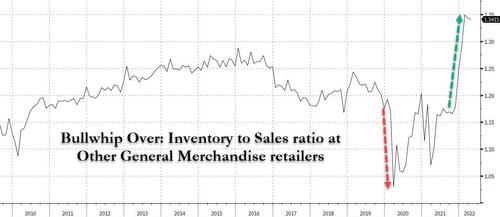
Big retailers benefited over the past two years from the pandemic rush to buy patio furniture, laptops and home décor, as shoppers were buoyed by savings and government stimulus checks. Now many of those same stores are grappling with a swift reversal of buying behavior with consumers spending less on goods in favor of services and necessities such as food and fuel.
The measures show Target’s struggle to adjust to rapid shifts in demand amid stubborn inflation that’s forced consumer spending into less-profitable staple goods and away from discretionary categories such as electronics and home products. That’s left Target and its big-box rivals with more merchandise that consumers don’t want, complicating their effort to maintain their market-share gains of the pandemic while keeping investors happy.
As Bloomberg adds, retailers have to account for many consumers’ sudden price sensitivity, while balancing their own surging operating costs from fuel, labor and other expenses. Meanwhile, the lessons of the pandemic, when shoppers hoarded goods, are still fresh, and companies are wary of being caught without enough merchandise to sell.
But holding on to larger quantities of products is expensive, and if they fail to move, markdowns further hurt profitability while benefiting bargain-hunting shoppers. Inventories have soared at retailers from Gap Inc. to Costco Wholesale Corp. Last week, Walmart Inc. said it would need “another couple quarters” to work through its bloated inventory. Given the industry overhang, Target decided since its earnings report to take “a decisive set of actions,” Fiddelke said.
Needless to say, the market was not happy, although it certainly was surprised despite our explicit warning that this was coming. On May 13, Target shares plunged the most since 1987 after the release of its first-quarter results, which included the more pessimistic profit outlook and an increase in product inventories. The following week, the stock sank to the lowest since September 2020 before recording meager gains since then. In all, Target has fallen 31% so far this year. And this morning, the stock is plunging another 10%,
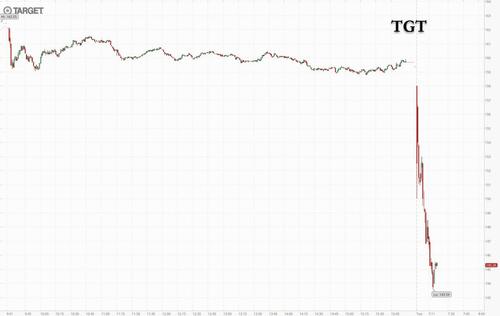
Target was not alone as the market realize that we were right all along, and peer retailers such as Walmart and Costco all fell premarket after Target’ margin guidance cut. WMT was down as much as 4.3% ahead of the bell, COST -2.9%, while TGT shares sank as much as 10%, Kroger -1.3%, Macy’s -3%, and so on as traders realize that the US is about to be hit with a historic liquidation wave as retailers rush to dump tens of billions in excess inventory.
June 7, 2022
More on Inventories
Target Crashes After Cutting Profit Outlook For 2nd Time In Three Weeks Due To Excess Inventory
by Tyler DurdenTuesday, Jun 07, 2022 – 07:23 AM
Just two weeks ago, Target dropped the most since 1987’s Black Monday after the retailer warned profits would come in well below expectation due to soaring inflation eating into profit margins and would also impact revenue growth. Fast forward to today when Target issued another profit warning, just as we expected now that we have entered the prime of guidance cut season
… because the retailer will need to cancel orders or offer discounts to clear out unwanted goods, the latest sign of the sudden mismatch between supply and demand inside America’s stores.
In this morning’s profit warning, Target warned that operating profit will amount to just 2% of sales in the current quarter, well below its May 18 prediction that the gauge would be in a wide range around 5.3%. Target still sees operating margin rising to about 6% in the second half of the year, but that number will be cut too in time.
In addition, the company will offload excess inventory and adjust some prices “to address the impact of unusually high transportation and fuel costs.” Target is also seeking to get a handle on supply-chain disruptions by adding “incremental holding capacity near U.S. ports,” which will give it greater flexibility.
“We’ve had some additional time after earnings to really evaluate the overall operating environment,” said Target Chief Executive Brian Cornell in an interview with the WSJ. That includes watching consumer behavior as they face high rates of inflation, he said, and seeing many other retailers talk about high inventory levels during their earnings presentations. “We have to be decisive and get out in front of this to make sure this doesn’t linger through the back half of the year.”
“Excess inventory doesn’t usually age well,” Chief Financial Officer Michael Fiddelke told Bloomberg. “We want to make sure that we’re being aggressive to right-size our inventory now.” He said this would help improve shoppers’ experience while boosting value for shareholders.
Of course, none of this should be news to regular Zero Hedge readers because just three weeks ago we wrote “Bullwhip Effect Ends With A Bang: Why Prices Are About To Fall Off A Cliff” in which we showed the dramatic surge in the inventory-to-sales ratio at General Merchandise retailers, and predicted that as they have no choice but to liquidate excess inventory, prices – and profit margins – are set to crater.
Big retailers benefited over the past two years from the pandemic rush to buy patio furniture, laptops and home décor, as shoppers were buoyed by savings and government stimulus checks. Now many of those same stores are grappling with a swift reversal of buying behavior with consumers spending less on goods in favor of services and necessities such as food and fuel.
The measures show Target’s struggle to adjust to rapid shifts in demand amid stubborn inflation that’s forced consumer spending into less-profitable staple goods and away from discretionary categories such as electronics and home products. That’s left Target and its big-box rivals with more merchandise that consumers don’t want, complicating their effort to maintain their market-share gains of the pandemic while keeping investors happy.
As Bloomberg adds, retailers have to account for many consumers’ sudden price sensitivity, while balancing their own surging operating costs from fuel, labor and other expenses. Meanwhile, the lessons of the pandemic, when shoppers hoarded goods, are still fresh, and companies are wary of being caught without enough merchandise to sell.
But holding on to larger quantities of products is expensive, and if they fail to move, markdowns further hurt profitability while benefiting bargain-hunting shoppers. Inventories have soared at retailers from Gap Inc. to Costco Wholesale Corp. Last week, Walmart Inc. said it would need “another couple quarters” to work through its bloated inventory. Given the industry overhang, Target decided since its earnings report to take “a decisive set of actions,” Fiddelke said.
Needless to say, the market was not happy, although it certainly was surprised despite our explicit warning that this was coming. On May 13, Target shares plunged the most since 1987 after the release of its first-quarter results, which included the more pessimistic profit outlook and an increase in product inventories. The following week, the stock sank to the lowest since September 2020 before recording meager gains since then. In all, Target has fallen 31% so far this year. And this morning, the stock is plunging another 10%,
Target was not alone as the market realize that we were right all along, and peer retailers such as Walmart and Costco all fell premarket after Target’ margin guidance cut. WMT was down as much as 4.3% ahead of the bell, COST -2.9%, while TGT shares sank as much as 10%, Kroger -1.3%, Macy’s -3%, and so on as traders realize that the US is about to be hit with a historic liquidation wave as retailers rush to dump tens of billions in excess inventory.
June 7, 2022
Azelis M&A Focus
Azelis Strengthens Executive Leadership to Support Group’s Growth Strategy
June 7, 2022 by admin
ANTWERP, Belgium–(WORK TEL)–Regulatory Information:
Azelis (Brussels:AZE), a number one world innovation providers supplier within the specialty chemical substances and meals elements business, introduced the appointment of Laurent Nataf as Head of Mergers and Acquisitions (M&A), a brand new strategic perform on the group’s Government Committee. Sertaç Sürür, who was appointed as the brand new CEO and President of Azelis Asia Pacific, joined the Government Committee in his new place, growing the manager management of Azelis to 6 members.
As a part of Azelis’ technique to speed up development, Laurent Nataf, at the moment the CEO and President of Azelis Asia Pacific, will assume the function of Chief M&A Officer efficient September 1, 2022. The creation of this new function on the Government Committee displays the continued significance of the Group’s M&A program to enhance its natural development growth in strengthening its footprint and market management. Laurent will additional develop and drive Azelis’ world M&A method consistent with the group’s bold development plans and also will oversee post-acquisition integration applications. Laurent will leverage his management abilities and enterprise growth expertise by main the acquisition of 17 firms for Azelis in Asia Pacific. Below Laurent’s management, the group’s Asia Pacific enterprise grew from 8% to over 15% of group income, increasing Azelis’ footprint to incorporate 12 nations within the area.
Sertaç Sürür, who’s at the moment the Common Supervisor of Azelis Turkey, will take over the management of the Asia Pacific area from Laurent Nataf. Since becoming a member of in 2015, Sertaç has taken on numerous native and regional management roles, driving the group’s Turkey enterprise to develop into a number one specialty chemical substances distributor within the home market, rising from 2% to roughly 6% of Azelis’ EMEA income. Previous to becoming a member of Azelis, Sertaç held numerous business and administration management positions at world industrial and chemical distribution and manufacturing firms, together with DSM and Ravago.
Laurent and Sertaç, as members of the Government Board, will report back to the Group CEO,Dr. Hans Joachim Muller. They may quickly start to transition into their new roles to make sure a easy and seamless handover.
Dennis Verhaert, present Group M&A Director, will tackle a brand new function at Azelis, particulars of which shall be introduced quickly.
Azelis CEO Dr. Remark by Hans Joachim Müller:
“I’m happy to announce to the management of the group these strategic appointments that mark the following stage in our evolution to develop into the reference innovation service supplier within the specialty chemical substances and meals elements distribution market. Including M&A performance to the Government Committee is a logical step given our technique to enhance natural development with acquisitions to strengthen our facet worth chain and world footprint.
I wish to thank Dennis for his contribution to the event of a powerful M&A group that has supported the group’s speedy development over the previous 4 years. Laurent and Sertaç have a formidable monitor document of growing enterprise for the group and I’ve full confidence that they are going to proceed to efficiently fulfill their new roles.”
About Azelles
Azelis is a number one world innovation service supplier within the specialty chemical substances and meals elements business, with greater than 3,000 staff positioned in additional than 50 nations worldwide. Every of our educated groups of business, market and technical specialists is devoted to a selected market inside Life Sciences and Industrial Chemical compounds. We provide greater than 51,000 prospects a lateral complementary product worth chain, backed by roughly 2,300 key relationships, producing turnover of €2.8 billion (2021). Azelis Group NV is listed on Euronext Brussels with the code AZE.
Throughout our intensive community of greater than 60 software labs, our award-winning workers help within the growth of formulations and supply technical steerage for purchasers all through the product growth course of. We mix a world market attain with an area footprint to offer a dependable, built-in and distinctive digital service to native prospects and enticing job alternatives for principals. With an EcoVadis Platinum ranking, Azelis is a frontrunner in sustainability. We imagine in establishing and nurturing stable, sincere and clear relationships with our staff and companions.
Affect via concepts. Innovation via formulation.
www.azelis.com
https://webringnet.com/azelis-strengthens-executive-leadership-to-support-groups-growth-strategy/
 Everchem Updates Archive
 Sign Up for Email Updates