
Epoxy
June 16, 2022
More Chlor-alkali Woes
Westlake declares force majeure on chlor-alkali throughout U.S. system
Jun. 15, 2022 8:06 PM ETWestlake Corporation (WLK)OLNBy: Carl Surran, SA News Editor1 Comment
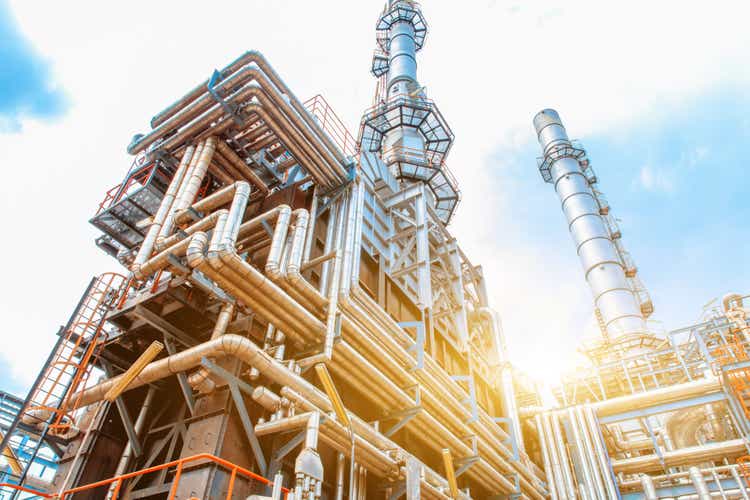
Westlake (NYSE:WLK) -6.2% in Wednesday’s trading, tumbling to its lowest in more than three months, after it declared force majeure on chlorine and all grades of caustic soda throughout its U.S. system, S&P Global Platts reported.
Westlake (WLK) said its chlor-alkali production “has been directly and adversely impacted due to the sudden and unanticipated failures of critical processing equipment,” according to a letter seen by S&P Global.
Westlake (WLK) did not specify the sites affected by equipment failures, but S&P Global said the chlor-alkali unit in Natrium, West Virginia, has experienced equipment issues since concluding a recent turnaround and was operating at reduced rates.
S&P Global also reported the company has faced brine quality problems from a third-party provider at its Geismar, Louisiana, chlor-alkali unit, and has launched a complex-wide turnaround at its Plaquemine, Louisiana, site, including the chlor-alkali facility.
Westlake’s (WLK) force majeure came a day after top chlor-alkali producer Olin (OLN) said its Freeport, Texas, plant would temporarily idle a “significant portion” of its ethylene dichloride and related chlor-alkali production.
June 16, 2022
More Chlor-alkali Woes
Westlake declares force majeure on chlor-alkali throughout U.S. system
Jun. 15, 2022 8:06 PM ETWestlake Corporation (WLK)OLNBy: Carl Surran, SA News Editor1 Comment
Westlake (NYSE:WLK) -6.2% in Wednesday’s trading, tumbling to its lowest in more than three months, after it declared force majeure on chlorine and all grades of caustic soda throughout its U.S. system, S&P Global Platts reported.
Westlake (WLK) said its chlor-alkali production “has been directly and adversely impacted due to the sudden and unanticipated failures of critical processing equipment,” according to a letter seen by S&P Global.
Westlake (WLK) did not specify the sites affected by equipment failures, but S&P Global said the chlor-alkali unit in Natrium, West Virginia, has experienced equipment issues since concluding a recent turnaround and was operating at reduced rates.
S&P Global also reported the company has faced brine quality problems from a third-party provider at its Geismar, Louisiana, chlor-alkali unit, and has launched a complex-wide turnaround at its Plaquemine, Louisiana, site, including the chlor-alkali facility.
Westlake’s (WLK) force majeure came a day after top chlor-alkali producer Olin (OLN) said its Freeport, Texas, plant would temporarily idle a “significant portion” of its ethylene dichloride and related chlor-alkali production.
June 15, 2022
Olin Idling Freeport Production
Olin to idle part of chlor-alkali, EDC capacity at Texas plant on weak demand
Jun. 15, 2022 10:43 AM ETOlin Corporation (OLN)By: Carl Surran, SA News Editor
Olin (NYSE:OLN) -7.1% in Wednesday’s trading after saying it is temporarily curtailing a significant part of ethylene dichloride and related chlor-alkali production at its Freeport, Texas, plant, and epoxy and related upstream inputs production at its Freeport and Guaruja, Brazil, facilities, citing weaker than expected epoxy resin demand in North America and South America.
Olin (OLN) also said it has restarted half of its chlor-alkali unit at its Plaquemine, Louisiana, complex, with the rest of the plant expected to return to operations in early August.
The Freeport facility continues to operate at a reduced level of power generation, and the company expects part of the power generation will be restored in Q4.
June 15, 2022
Olin Idling Freeport Production
Olin to idle part of chlor-alkali, EDC capacity at Texas plant on weak demand
Jun. 15, 2022 10:43 AM ETOlin Corporation (OLN)By: Carl Surran, SA News Editor
Olin (NYSE:OLN) -7.1% in Wednesday’s trading after saying it is temporarily curtailing a significant part of ethylene dichloride and related chlor-alkali production at its Freeport, Texas, plant, and epoxy and related upstream inputs production at its Freeport and Guaruja, Brazil, facilities, citing weaker than expected epoxy resin demand in North America and South America.
Olin (OLN) also said it has restarted half of its chlor-alkali unit at its Plaquemine, Louisiana, complex, with the rest of the plant expected to return to operations in early August.
The Freeport facility continues to operate at a reduced level of power generation, and the company expects part of the power generation will be restored in Q4.
June 10, 2022
Trucking Strike in South Korea
S Korea truckers’ strike to hit Ulsan petrochemical output; halts port ops
Nurluqman Suratman
10-Jun-2022Full storyRelated newsRelated contentContact us SHARE THIS
SINGAPORE (ICIS)–The ongoing nationwide strike by unionised truckers in South Korea are forcing several producers in the petrochemical hub of Ulsan to consider production cuts amid logistics disruption.
Synthetic rubber giant Kumho Petrochemical is expected to slash production rates at its acrylonitrile butadiene styrene (ABS) and polystyrene (PS) units from the second half of June due to the strike, according to market sources.
HDC Hyundai Engineering Plastics Co is also expected to slash production at its 160,000 tonne/year PS plant in the complex.
While there have been no immediate reports of polyethylene (PE) production losses due to the strike, facilities in Ulsan and elsewhere in the country could be affected if the strike drags on.
The strike by the Cargo Truckers Solidarity (CTS) union entered its fourth day on Friday.
Some PE producers may face pressure to sell prompt cargoes or further reduce their cracker run rates owing to the ongoing strike by truckers.
If the transportation problem persists, “I expect more PE plants in South Korea will cutback or shut down in the short term,” ICIS senior analyst Amy Yu said.
The strike has slowed down the delivery of PE cargoes, raising concerns that some producers might have to lower their downstream operation, to manage their already high inventory if the logistic issues continue next week.
“South Korea is a major exporter in Asia PE market, which may lead to a decrease in the supply of short-term exports,” Yu said.
“In addition, due to the high naphtha cost, the average operating rate of steam crackers and PE plants in Korea has shown a relatively low level. The strikes may exacerbate this situation,” she added.
For polyethylene terepthalate (PET), export deliveries were able to continue this week as some cargoes had been prepared before the strike started, however domestic deliveries faced challenges with the reduced trucking capabilities.
For propylene, the country’s exports may increase should the strike be prolonged as domestic distribution of derivative products becomes disrupted, market sources said.
A senior truckers union official quoted by newswire agency Reuters on Friday said that the number of vehicles entering the complex in the country’s east has been cut to one-tenth of normal levels.
The union also plans more stringent strike action at other petrochemical complexes across the country, the unnamed official told Reuters.
The general strike by CTS under the wing of the Korean Confederation of Trade Unions, was launched on 7 June.
The truckers were demanding the government to extend a freight rate system, which guarantees basic wages to cope with surging fuel costs. The system was due to expire in December.
South Korea’s Ministry of Land, Infrastructure and Transport had expected some 7,500 members, representing about 35% of the CTS union, to go on strike on Friday,
There have been “local transport obstructions in some ports such as Busan Port and Ulsan Port. Carry-out volume is reduced compared to normal”, the ministry said.
Traffic at the Busan port, which accounts for 80% of container activity in the country, was down to a third of normal levels on Friday, Reuters reported, quoting a government official.
At the port of Ulsan – the industrial hub where much of the strike action has occurred – movement of containers has totally been suspended as of Friday morning due to the strike, according to Reuters.
Around 1,000 truckers were protesting at the main complex of Korea’s biggest automotive manufacturer Hyundai Motor in Ulsan on Friday, Reuters reported.
Hyundai operates the world’s largest integrated automobile manufacturing facility in Ulsan which has an annual production capacity of 1.6m units. The strike has halved Hyundai’s production in Ulsan.
The automotive sector is a major downstream industry for petrochemicals.
Focus article by Nurluqman Suratman
Additional reporting by Trixie Yap, Yeow Pei Lin, Hazel Goh and Julia Tan
 Everchem Updates Archive
 Sign Up for Email Updates