
Government Regulation
September 29, 2025
India Polymer Polyol ADD
India Imposes ADD on Chinese Copolymer Polyol Following DGTR Investigation
PUdaily | Updated: September 29, 2025
On September 26, 2025, the Indian government took steps to protect its domestic chemical industry from unfairly traded imports, announcing definitive anti-dumping duties on a key polymer imported from China. The decision follows an extensive investigation by the Directorate General of Trade Remedies (DGTR), which found evidence of significant dumping causing material injury to a local producer.
The duties apply to imports of “Copolymer Polyol of hydroxyl value >= 23.5” (HS Codes 3907 2910 and 3907 2990), a chemical primarily used in the production of flexible foam for mattresses and other applications. The DGTR clarified that Polyester Polyol of the same grade is excluded from this measure.
The investigation, initiated in September 2024, concluded that imports from China were entering the Indian market at dumped prices, with margins ranging from 20% to over 50%. This unfair pricing undercut domestic sales and severely harmed the financial health of the sole Indian manufacturer, M/s Expanded Polymer Systems Pvt. Ltd.
The following key findings from the investigation formed the basis for the final determination:
- Massive Import Surge & Market Displacement: Import volumes from China surged by 287% (from 4,988 to 19,338 MT), seizing over 90% of the total import market. This massive influx displaced traditional suppliers from Europe and the USA and severely eroded the domestic industry’s market share.
- Significant Price Undercutting & Suppression: The landed value of Chinese imports was consistently 10-20% below the domestic industry’s price. This forced the domestic producer to suppress its prices below its own cost of sales for the entire period, directly preventing profitability.
- Severe Financial Injury: Despite a 96% growth in domestic demand, the domestic company operated at a loss with negative returns. Its capacity utilisation was critically low at around 32%, while inventories swelled by 137%, confirming financial distress due to unfair competition.
- Causal Link Established: The Authority definitively ruled out other factors like demand contraction or technological changes, concluding that the surge of low-priced, dumped imports was the primary cause of the material injury.
In its final findings, the DGTR affirmed that Expanded Polymer Systems Pvt. Ltd. constitutes a valid ‘domestic industry’ and that a direct causal link exists between the dumped imports and the injury suffered.
Recommended Anti-Dumping Duties
The DGTR has recommended the following duties (CIF value in USD per Metric Tonne) for a period of five years:
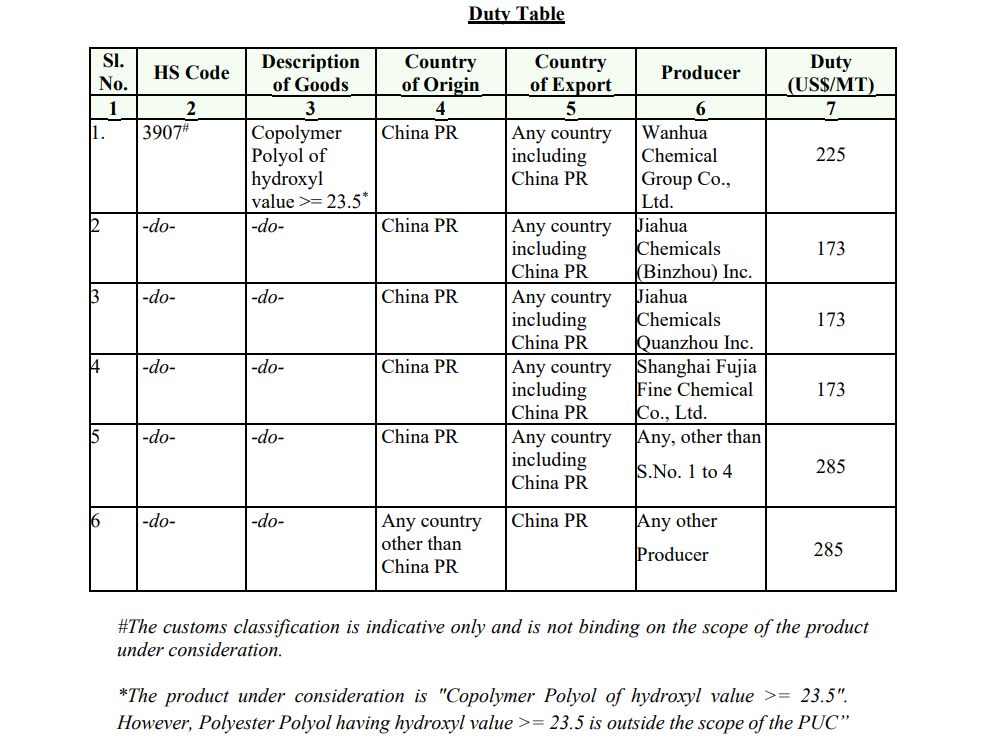
The authority stated that the imposition of these duties aligns with the World Trade Organisation’s (WTO) framework and aims to restore fair competition in the Indian market. It emphasised that the measures are not intended to restrict imports but to ensure they enter India at non-injurious prices, thereby safeguarding the interests of the domestic industry.
India’s Ministry of Finance will issue the final notification for the imposition of these duties.
September 18, 2025
Preliminary MDI ADD Ruling
Preliminary ruling made in US MDI antidumping investigation

Washington DC, US – The US Department of Commerce has announced its preliminary determination in the antidumping duty investigation of MDI imports from China. The investigation was in response to a petition made by the Ad Hoc MDI Fair Trade Coalition, which comprises BASF and Dow. Both companies manufacture MDI on the US Gulf coast, BASF in Geismar, Louisiana and Dow in Freeport, Texas.
Preliminary dumping rates of 376.12% were announced for Covestro Polymers (China), and Wanhua Chemical plus its exporter Shandong Mingko. For other companies in China, the rate is 511.75%, which the department said was “based on facts available with adverse inferences”.
The announcement was accompanied by MDI import statistics, although the department stated that the way the data are accumulated “may not accurately reflect actual imports of MDI covered by the scope of the investigation”. This is because the imports enter the country under tariff schedule subheadings that may cover both subject and non-subject merchandise.
Unless it is postponed, the final determination of the antidumping investigation is set to be announced on 25 November. The US International Trade Commission is also running an injury determination investigation.
https://www.utech-polyurethane.com/news/preliminary-ruling-made-us-mdi-antidumping-investigation
September 10, 2025
Annex II Updated
MODIFYING THE SCOPE OF RECIPROCAL TARIFFS AND ESTABLISHING PROCEDURES FOR IMPLEMENTING TRADE AND SECURITY AGREEMENTS
September 5, 2025
By the authority vested in me as President by the Constitution and the laws of the United States of America, including the International Emergency Economic Powers Act (50 U.S.C. 1701 et seq.) (IEEPA), the National Emergencies Act (50 U.S.C. 1601 et seq.), section 232 of the Trade Expansion Act of 1962, as amended (19 U.S.C. 1862) (section 232), section 604 of the Trade Act of 1974, as amended (19 U.S.C. 2483), and section 301 of title 3, United States Code, it is hereby ordered:
Section 1. Background. In Executive Order 14257 of April 2, 2025 (Regulating Imports With a Reciprocal Tariff To Rectify Trade Practices That Contribute to Large and Persistent Annual United States Goods Trade Deficits), I found that conditions reflected in large and persistent annual U.S. goods trade deficits, including the consequences of those deficits, constitute an unusual and extraordinary threat to the national security and economy of the United States that has its source in whole or substantial part outside the United States. I declared a national emergency with respect to that threat, and to deal with that threat, I imposed certain ad valorem duties that I deemed necessary and appropriate. In Annex II to Executive Order 14257, I set forth a list of certain goods that, in my judgment, should not be subject to the ad valorem rates of duty imposed pursuant to that order.
In section 4 of Executive Order 14257, section 5 of Executive Order 14326 of July 31, 2025 (Further Modifying the Reciprocal Tariff Rates), and other Executive Orders issued to address the national emergency declared in Executive Order 14257, I directed various officials to monitor the circumstances involving the emergency declared in Executive Order 14257 and to recommend to me additional action that would more effectively deal with the emergency conditions described in Executive Order 14257. Based on this monitoring, among other things, I have received additional information and recommendations from these officials. After considering the information and recommendations these officials have provided to me, among other things, I have determined that it is necessary and appropriate to modify Annex II to Executive Order 14257 as shown in the updated version of Annex II that is attached to this order. In my judgment, these modifications are necessary and appropriate to deal with the national emergency declared in Executive Order 14257.
Further, in section 4(c) of Executive Order 14257, I noted that I might further decrease or limit in scope the duties imposed under Executive Order 14257, as amended, if any trading partner takes significant steps to remedy non-reciprocal trade arrangements and align sufficiently with the United States on economic and national security matters. Accordingly, I later temporarily suspended the individual ad valorem rate of duty for certain trading partners to reflect the fact that some trading partners had signaled a willingness to undertake meaningful economic and national security commitments with the United States designed to combat the emergency declared in Executive Order 14257. In Executive Order 14326, I noted that certain foreign trading partners had agreed, or were on the verge of agreeing, to meaningful trade and security agreements with the United States, with the conclusion of the agreements to be completed in the future.
In my judgment, it is necessary and appropriate to take steps contemplated in certain current and forthcoming trade and security framework agreements (framework agreements) between a foreign trading partner and the United States. I determine that any modification of tariffs required to implement current and forthcoming framework agreements is necessary and appropriate to deal with the national emergency declared in Executive Order 14257 and to reduce or eliminate the threats to national security found in Proclamation 9704 of March 8, 2018 (Adjusting Imports of Aluminum Into the United States), as amended; Proclamation 9705 of March 8, 2018 (Adjusting Imports of Steel Into the United States), as amended; Proclamation 9888 of May 17, 2019 (Adjusting Imports of Automobiles and Automobile Parts Into the United States), as amended; and Proclamation 10962 of July 30, 2025 (Adjusting Imports of Copper Into the United States). Except in rare circumstances, I will refrain from narrowing the scope of the reciprocal tariff or any relevant section 232 tariff before the conclusion of a final trade and security agreement (final agreement) between the foreign trading partner and the United States.
For example, the United States and the European Union recently announced a landmark “Framework on an Agreement on Reciprocal, Fair, and Balanced Trade” (Framework Agreement). In the joint statement announcing the Framework Agreement, the United States committed to reduce the reciprocal tariff imposed under Executive Order 14257, as amended, on certain products of the European Union to zero percent and to reduce tariffs imposed under section 232 for automobiles and automobile parts originating from the European Union if the European Union takes certain steps. In my judgment, it is necessary and appropriate to implement the tariff modifications described in the Framework Agreement. These modifications are necessary and appropriate to deal with the national emergency declared in Executive Order 14257 and to reduce or eliminate the threat to national security found in Proclamation 9888, as amended.
Similarly, I determine that it is necessary and appropriate to implement the terms of any final agreement between a foreign trading partner and the United States related to the national emergency declared in Executive Order 14257. In my judgment, the modifications required to implement the terms of such a final agreement are necessary and appropriate to deal with the national emergency declared in Executive Order 14257 and to reduce or eliminate the threats to national security I have found pursuant to section 232.
Though I am generally unwilling for framework agreements to narrow the scope of the reciprocal tariffs or modify any relevant section 232 tariff before the conclusion of a final agreement, final agreements with the United States may include such modifications. My willingness to reduce the reciprocal tariff to zero percent for a given import or to modify tariffs imposed under section 232 will depend on numerous factors, including the scope and economic value of a trading partner’s commitments to the United States in its agreement on reciprocal trade, the national interests of the United States, the need to deal with the national emergency declared in Executive Order 14257, and the need to reduce or eliminate the threats to national security I have found pursuant to section 232. The list of imports for which I may be willing to provide a zero percent reciprocal tariff rate is set forth in the Annex to this order entitled “Potential Tariff Adjustments for Aligned Partners,” which contains products that cannot be grown, mined, or naturally produced in the United States or grown, mined, or naturally produced in sufficient quantities in the United States to satisfy domestic demand; certain agricultural products; aircraft and aircraft parts; and non-patented articles for use in pharmaceutical applications. Given the complex, fact-specific, and sensitive nature of negotiations and the national emergency declared in Executive Order 14257, among other relevant considerations, the imports that might receive a reciprocal tariff rate of zero percent may be different for each final agreement between a foreign trading partner and the United States.
Sec. 2. Updating Scope of Duties Globally. (a) The updated version of Annex II to Executive Order 14257 is attached to this order and shall be effective with respect to goods entered for consumption, or withdrawn from warehouse for consumption, on or after 12:01 a.m. eastern daylight time 3 days after the date of this order.
(b) The Harmonized Tariff Schedule of the United States (HTSUS) shall be modified as provided in Annex I to this order. These modifications shall enter into effect on the date set forth in Annex I to this order.
Sec. 3. Framework Agreements. (a) Upon the conclusion of any framework agreement of a kind described in section 1 of this order, the Secretary of Commerce and the United States Trade Representative shall determine whether the United States must take any action to implement such framework agreement. Doing so shall include determining whether any condition or conditions to an action by the United States has occurred or will occur before the relevant action by the United States.
(b) If the Secretary of Commerce and the United States Trade Representative determine that an action must be taken to implement a framework agreement pursuant to subsection (a) of this section and that any condition or conditions to such action have occurred or will occur before the relevant action by the United States, the Secretary of Commerce and the United States Trade Representative shall take the necessary and appropriate actions to implement such framework agreement in accordance with this order.
(c) The Secretary of Commerce and the United States Trade Representative shall act in a manner consistent with the national interests of the United States, the purpose of this order, the need to deal with the national emergency declared in Executive Order 14257, and the need to reduce or eliminate the threats to national security I have found pursuant to section 232.
Sec. 4. Final Agreements. (a) Upon the conclusion of any final agreement of a kind described in section 1 of this order, the Secretary of Commerce and the United States Trade Representative shall take the necessary and appropriate actions to implement the final agreement in accordance with this order.
(b) In implementing any final agreement, the Secretary of Commerce and the United States Trade Representative shall act in a manner consistent with the national interests of the United States, the purpose of this order, the need to deal with the national emergency declared in Executive Order 14257, and the need to reduce or eliminate the threats to national security I have found pursuant to section 232.
Sec. 5. Monitoring and Recommendations. (a) The Secretary of Commerce and the United States Trade Representative, in consultation with any officials they deem appropriate, shall continue to monitor the conditions underlying the national emergency declared in Executive Order 14257, including the U.S. trade deficit, the lack of reciprocity in our bilateral trade relationships, disparate tariff rates and non-tariff barriers, U.S. trading partners’ economic policies that suppress domestic wages and consumption imports, the strength of our domestic manufacturing base, the strength of our defense industrial base, and any other relevant factors. The Secretary of Commerce and the United States Trade Representative shall, from time to time, update me on the status of these conditions.
(b) The Secretary of Commerce and the United States Trade Representative, in consultation with the Secretary of State, the Secretary of the Treasury, the Secretary of Homeland Security, the Assistant to the President for Economic Policy, the Senior Counselor for Trade and Manufacturing, and the Assistant to the President for National Security Affairs, shall continue to inform me of any circumstance that, in their opinion, might indicate the need for further action and shall continue to recommend to me additional action that, in their opinion, will more effectively deal with the emergency declared in Executive Order 14257.
(c) The Secretary of Commerce and the United States Trade Representative, in consultation with the Secretary of State, the Secretary of the Treasury, the Secretary of Homeland Security, the Assistant to the President for Economic Policy, the Senior Counselor for Trade and Manufacturing, and the Assistant to the President for National Security Affairs, shall advise me of the conclusion of any agreement on reciprocal trade with a particular trading partner.
Sec. 6. Delegation. (a) Consistent with applicable law, the Secretary of Commerce, the Secretary of Homeland Security, and the United States Trade Representative are directed and authorized to take all necessary actions to implement and effectuate this order and any actions taken under section 3 or section 4 of this order — including through temporary suspension or amendment of regulations or through notices in the Federal Register and by adopting rules, regulations, or guidance — and to employ all powers granted to the President, including those granted by IEEPA and section 232, as may be necessary to implement and effectuate this order.
(b) The Secretary of Commerce and the United States Trade Representative, in consultation with the Commissioner of U.S. Customs and Border Protection (CBP), the Chair of the United States International Trade Commission, and any other senior official they deem appropriate, shall determine whether modifications to the HTSUS are necessary to effectuate this order and any actions taken under section 3 or section 4 of this order and may direct such modifications through notice in the Federal Register.
(c) If implementation of a framework agreement or final agreement of a kind described in section 1 of this order requires a refund of duties collected, CBP shall provide the refund to the extent consistent with law. Any refunds shall be processed pursuant to applicable law and CBP’s standard procedures for such refunds.
(d) Consistent with applicable law, the Secretary of Commerce, the Secretary of Homeland Security, and the United States Trade Representative may redelegate any of these functions within their respective department or agency.
(e) All executive departments and agencies shall take all appropriate measures within their authority to implement this order.
Sec. 7. General Provisions. (a) Nothing in this order shall be construed to impair or otherwise affect:
(i) the authority granted by law to an executive department or agency, or the head thereof; or
(ii) the functions of the Director of the Office of Management and Budget relating to budgetary, administrative, or legislative proposals.
(b) This order shall be implemented consistent with applicable law and subject to the availability of appropriations.
(c) This order is not intended to, and does not, create any right or benefit, substantive or procedural, enforceable at law or in equity by any party against the United States, its departments, agencies, or entities, its officers, employees, or agents, or any other person.
(d) The costs for publication of this order shall be borne by the Department of Commerce.
DONALD J. TRUMP
THE WHITE HOUSE,
September 5, 2025.
ANNEX I
Effective with respect to goods entered for consumption, or withdrawn from warehouse for consumption, on or after 12:01 a.m. eastern daylight time 3 days after the date of this order, subdivision (v)(iii) of U.S. note 2 to subchapter III of chapter 99 of the HTSUS shall be amended by inserting in numerical order the following provisions of the HTSUS:
| 2504.10.10 |
| 2604.00.00 |
| 2609.00.00 |
| 2612.20.00 |
| 2613.90.00 |
| 2825.40.00 |
| 2833.24.00 |
| 2903.51.10 |
| 2924.29.01 |
| 2924.29.03 |
| 2924.29.23 |
| 2924.29.26 |
| 2924.29.28 |
| 2924.29.33 |
| 2924.29.57 |
| 2924.29.80 |
| 2926.90.50 |
| 2933.29.05 |
| 2933.29.60 |
| 4703.11.00 |
| 4703.21.00 |
| 4703.29.00 |
| 7108.11.00 |
| 7108.12.50 |
| 7108.13.10 |
| 7108.13.55 |
| 7108.13.70 |
| 7108.20.00 |
| 7115.90.05 |
| 7115.90.30 |
| 7202.60.00 |
| 7501.10.00 |
| 7502.10.00 |
| 7502.20.00 |
| 7503.00.00 |
| 7504.00.00 |
| 7903.90.30 |
| 8505.11.0070 |
| 8541.41.00 |
Effective with respect to goods entered for consumption, or withdrawn from warehouse for consumption, on or after 12:01 a.m. eastern daylight time 3 days after the date of this order, subdivision (v)(iii) of U.S. note 2 to subchapter III of chapter 99 of the HTSUS shall be amended by removing the following provisions of the HTSUS:
| 2818.30.00 |
| 3824.99.93 3907.29.00 3907.30.00 |
| 3907.61.00 |
| 3907.69.00 |
| 3907.99.50 |
| 3910.00.00 |
September 4, 2025
Adnoc Covestro EU Probe Delayed
Adnoc says EU probe delays could jeopardize Covestro deal – reports
Sep. 04, 2025 10:00 AM ETCovestro AG (CVVTF) Stock, COVTY StockBy: Joshua Fineman, SA News Editor

Abu Dhabi’s Adnoc said the European Union competition regulator’s decision to temporarily halt its probe into the Covestro (OTCPK:CVVTF) deal could jeopardize the transaction.
“While we remain committed to pursuing a constructive path forward, the continuation of such an approach raises serious questions about the viability of this investment,” a spokesperson for XRG, the international investment arm of Adnoc, told Reuters and MLex in an email.
The European Commission was set to decide on the probe by Dec. 2, though it will now set a new deadline.
“We are deeply disappointed by today’s decision,” the spokesperson for XRG told the news outlets. “The Commission’s demands have strayed far beyond what is reasonable or relevant to this transaction, crossing into areas that are both disproportionate and invasive.”
Covestro shares fell as much as 11% on Thursday in Frankfurt.
The European Commission in late July announced it was starting an in-depth probe into Abu Dhabi National Oil Co.’s €11.7B (~$13.75B) acquisition of Covestro (OTCPK:CVVTF) (OTCPK:COVTY) under the European Union’s tough new foreign subsidy rules. The EC said it will investigate concerns that Adnoc’s state funding by the United Arab Emirates could allow it to behave in a way that interferes with fair competition across the bloc.
August 29, 2025
Customs Investigation
U.S. Customs accuses 23 importers in shipping scheme to evade duties
Sheila Long O’Mara //Executive Editor, Furniture Today//August 29, 2025

WASHINGTON – More than 20 mattress importers were part of a U.S. Customs and Border Protection investigation into illegal transshipment of goods to evade trade duties.
In an investigation that spans back to the spring of 2024, companies brought products into the U.S. through “evasion” and a “network of Chinese shell companies” funneling products manufactured in China through South Korea, Indonesia, Taiwan and Vietnam. CBP estimated that the scheme resulted in more than $250 million in revenue owed.
“Never before has CBP identified this many importers evading AD/CVD in a single consolidated EAPA investigation,” said Susan S. Thomas, acting executive assistant commissioner for CBP’s office of trade. “The revenue identified for collection exceeds $250 million, but this figure may increase as we uncover additional importers in the scheme.”
The evasion scheme, the government said, hinges on the lower duty rate in countries other than China. As an example, CBP pointed out that under the China antidumping order, duty rates were up to 1,731.75%, while the Indonesia Order carried a duty rate of 2.2%.
The CBP carried out port inspections, analyzed trade data and conducted “on-the-ground” verifications in Indonesia and Taiwan. As part of its investigation, CBP said it visited a number of the companies’ listed factories only to learn that the locations were not operational. In one instance, a factory was said to have been destroyed in a fire in 2023 and never rebuilt.
In its determination, CBP paints a picture of companies that have U.S. addresses that are in strip centers and other suspect locations. A quick Google search indicates one company’s address as the location of a restaurant, Bean Bandit, in Colorado Springs, Colo. Another has the address of a PostNet location in Denver. Some companies in the filing share an address, and a number of the companies’ U.S. addresses are in residential areas with two as neighbors.
Ten companies are listed with U.S. locations in Colorado, six in New Jersey, two in New York with a shared address, four in California and one in Houston.
Companies listed as part of the investigation include the following companies, some of which, the government says, are tied to a larger entity, Foshan Aiyi, previously investigated for transshipping. The companies cited are:
Alexand Inc., Alloech Inc., Anlowo Inc., Bentensh Inc., Calimoon Inc., Day Day Up Inc., Deluxe Home of USA Inc., Gemmeo Inc., Haiide Inc., Hondex Inc., Incoroy Inc., Inland Empire Decor Home Furnishing Inc., Lincody Inc., Lirachy Inc., Newland Technology Inc., Outlier Inc., Splendid Life Distribute Inc., Startown Inc., Sunshine International Inc., Vovyace Inc., Weekaly Inc., Wuleitex Inc. and Zozonid Inc.
Products from some of the companies are sold via Amazon, Wayfair, Walmart and other furniture retailers, according to an online search.
Earlier this year, the Department of Commerce and the U.S. International Trade Commission also published its continuation of the order from the 2018 antidumping case that resulted in duties on mattresses imported into the U.S. from China. The ITC said revoking the order would likely lead to continued or recurrent dumping and injury to the U.S. mattress market.
 Everchem Updates Archive
  Sign Up for Email Updates