
Government Regulation
February 1, 2026
Class Action Update
2 Foreign Cos. Escape Pa. Polyurethane Price-Fixing MDL
By Lauren Berg · Listen to article
Law360(January 29, 2026, 8:23 PM EST)– A Pennsylvania federal judge on Thursday unsealed his opinion from earlier this month dismissing two parent companies in Germany and China from multidistrict antitrust litigation that accuses several companies of conspiring to manipulate the prices of two chemicals used to make polyurethane, saying the court doesn’t have jurisdiction.
After the parties agreed it could be unsealed, U.S. District Judge W. Scott Hardy made public his Jan. 8 opinion granting renewed motions to dismiss by Covestro AG, headquartered in Leverkusen, Germany, and Wanhua Chemical Group Co. Ltd., headquartered in Yantai, China, agreeing that his court “is unable to exercise general or specific personal jurisdiction over” the foreign parent companies.
“In the court’s estimation, plaintiffs fail to establish that Covestro AG and Wanhua China had sufficient minimum contacts evidencing they do business in the United States to be ‘found’ here, nor do they establish that these defendants availed themselves of the privileges of American law or otherwise reasonably could anticipate being involved in litigation in the United States,” the judge said.
Judge Hardy dismissed the claims against Covestro AG and Wanhua China with prejudice, but the companies’ domestic subsidiaries, Covestro LLC and Wanhua Chemical America Co. Ltd., remain in the case.
The Pittsburgh-based multidistrict litigation accuses several companies — including BASF Corp., The Dow Chemical Co. and Huntsman Corp. — of using plant closures and limited supplies to drive up the prices of methylene diphenyl diisocyanate and toluene diisocyanate.
The class action generally alleges that the chemical companies reacted to a period of low MDI and TDI prices in 2014 and 2015 by limiting production and artificially inflating the prices for manufacturers of polyurethane plastic products, including plaintiffs such as Rhino Linings Corp. and Elliott Co. of Indianapolis.
According to the complaints, the defendant companies conspired through trade groups and took advantage of the difficulty that competitors would face when entering the market for the chemicals, known as diisocyanates and isocyanates, along with their control over most of the supply and the fact that the chemicals can’t be replaced with substitutes.
In March 2020, U.S. District Judge Donetta Ambrose denied the defendants’ joint motion to dismiss the case, finding the allegations in the complaint were sufficiently supported to move the case ahead. She also denied a motion to dismiss for lack of jurisdiction brought by foreign-based corporations BASF SE, Covestro AG, Mitsui Chemicals, MCNS and Wanhua China.
But following jurisdictional discovery, Covestro AG in July 2022 and Wanhua China in February 2023 renewed their motions to dismiss for lack of jurisdiction, and Judge Hardy granted both on Jan. 8, according to the docket.
In his opinion, unsealed Thursday, Judge Hardy first determined that the “foreign corporations with a headquarters and a principal place of business in other countries are not ‘at home’ in the United States,” meaning his court cannot exercise general personal jurisdiction over the companies.
The court also doesn’t have specific personal jurisdiction over Covestro AG and Wanhua China under both the traditional three-step analysis known as the “minimum contacts” test or under the “Calder effects test” laid out in the 1984 U.S. Supreme Court case Calder v. Jones , which can be used when an intentional tort is alleged, the order said.
“As to both Covestro AG and Wanhua China, the record makes clear that personal jurisdiction does not lie under the traditional test because neither foreign defendant ‘purposefully availed itself of the privilege of conducting activities’ in the United States,” Judge Hardy said, noting that neither company has manufactured or sold MDI or TDI in the U.S.
Turning to the Calder test, Judge Hardy determined that the plaintiffs have not alleged the crucial third factor — that Covestro AG and Wanhua China “expressly aimed tortious conduct at the United States such that it can be said to be the focal point of the tortious activity,” according to the order.
“Given that Covestro AG is a German holding company which does not manufacture or sell MDI or TDI, or otherwise perform any operational functions … it strains credulity that it expressly aimed the tortious conduct at issue here at the United States,” Judge Hardy said.
As for Wanhua China, the plaintiffs “inaccurately contend” that the company is involved in setting a floor price for sales of MDI through its American subsidiary and that it controlled the subsidiary by having Wanhua China members on the subsidiary’s board of directors, the order states.
The judge also rejected the plaintiffs’ argument that Wanhua China’s announcement and subsequent cancellation of an MDI plant in the U.S. “would have constrained the market by boosting supply expectations and then not delivering,” according to the order.
“Plaintiffs’ purely speculative argument on this point is wholly insufficient to establish Calder’s express aiming prong,” Judge Hardy said, likewise rejecting the plaintiffs’ “contention that Wanhua China engaged directly with United States customers by attending meetings, hosting visits at its plant in China, or engaging with them on technical issues and providing updates on research and development” would establish that it expressly aimed tortious conduct at the U.S.
The judge also rejected the plaintiffs’ argument for express aiming based on their claim that Wanhua China shipped diisocyanates into the U.S., saying in the opinion that this argument “obscures the fact that although the vast majority of the MDI that [Wanhua Chemical America Co.] sells in the United States comes from Wanhua China, WCA, not Wanhua China, sells MDI and TDI” to U.S. customers.
“Even in instances where WCA offered ‘China Direct’ shipping for customers to save on overall supply chain logistics and costs, customers contracted and interacted with WCA, not Wanhua China,” the judge said.
Craig Seebald of Vinson & Elkins LLP, an attorney for Wanhua, told Law360 Thursday, “We are pleased with the court’s decision and its thorough consideration of the jurisdictional record. With the jurisdictional motion decided, we can move forward with the litigation and look forward to filing our summary judgment motion.”
Counsel for the plaintiffs and Covestro did not immediately respond to requests for comment.
The plaintiffs’ interim co-lead counsel are Megan E. Jones of Hausfeld LLP and Jason S. Hartley of Hartley LLP, and their interim liaison counsel is William Pietragallo II of Pietragallo Gordon Alfano Bosick & Raspanti LLP.
Wanhua is represented by Craig P. Seebald, Adam Hudes, Brian Schnapp, Charles L. Wesley and Nicole Castle of Vinson & Elkins LLP.
Covestro is represented by John F. Terzaken, Abram J. Ellis and Avia Gridi of Simpson Thacher & Bartlett LLP.
The case is In re: Diisocyanates Antitrust Litigation, case number 2:18-mc-01001, in the U.S. District Court for the Western District of Pennsylvania.
January 25, 2026
Plywood Anti-Dumping Update
Commerce Department rules in favor of preliminary countervailing duties in hardwood plywood cases
By Larry Adams
January 22, 2026 | 8:49 am CST

Prevailing countervailing duties on hardwood plywood imports from China, Indonesia and Vietnam have been calculated.
On January 16, the U.S. Department of Commerce released its preliminary affirmative countervailing duty findings on hardwood and decorative plywood after identifying significant subsidies provided by the governments of China, Indonesia, and Vietnam, reports the Decorative Hardwoods Association.
Commerce calculated preliminary countervailing duties of 81.34% on imports from China, 2.40% to 128.66% on imports from Indonesia, and 4.37% to 26.75% on imports from Vietnam. These rates will be added to existing tariffs on products from these countries and will be charged as soon as the decision is published in the Federal Register.
In addition, preliminary antidumping rates are scheduled to be announced in late February 2026. Final rulings are expected in early May.
The Coalition for Fair Trade in Hardwood Plywood (Coalition), representing a substantial majority of the American hardwood and decorative plywood industry, commends Commerce for its decision to impose these preliminary duties to remedy the unfair trade practices of China, Indonesia, and Vietnam.
“The domestic hardwood and decorative plywood industry has been harmed for decades by unfairly traded imports from China, Indonesia, and Vietnam. Friday’s decision by the Department of Commerce is another critical step in leveling the playing field for American hardwood and decorative plywood manufacturers,” said Timothy C. Brightbill, lead counsel to the Coalition and co-chair of Wiley’s International Trade Practice.
As soon as Commerce’s preliminary determination is published in the Federal Register, U.S. Customs and Border Protection (CBP) will begin collecting preliminary duties on entries of hardwood and decorative plywood from China, Indonesia, and Vietnam. Commerce also found that critical circumstances exist with respect to imports of hardwood and decorative plywood from China. As a result, duties will be collected on entries of hardwood and decorative plywood from China that were entered on or after 90 days before publication of the preliminary determination.
Commerce’s countervailing duty investigations will continue over the coming months, with the agency further investigating subsidies—including newly alleged subsidy programs—received by the Chinese, Indonesian, and Vietnamese industries. Commerce’s final determination is currently scheduled for early May 2026. Commerce is also simultaneously investigating antidumping duty allegations on hardwood and decorative plywood from China, Indonesia, and Vietnam. The preliminary antidumping rates are scheduled to be announced in late February 2026.
The duties that will now be imposed are assessed on the importer of record of the covered merchandise. Duty evasion, absorption, and circumvention are illegal and closely monitored by CBP, in conjunction with the Commerce Department. Counsel for the Coalition is working closely with U.S. Customs and Border Protection to share evidence of duty evasion, which is leading to heightened scrutiny of imports.
January 13, 2026
China Reducing VAT Rebate for Exports of Polyol
Export Tax Rebate Adjustment on Photovoltaic Products & Polyether Polyols
PUdaily | Updated: January 12, 2026
For the polyurethane industry, the update is particularly relevant because it captures product classifications that may apply to polyether materials commonly traded as polyether polyols (depending on the exporter’s declared HS code and customs classification). As a result, affected exporters may face higher effective export costs after April 1, 2026, which could translate into adjustments in export offers and contract pricing discussions.
Market participants should monitor potential impacts on export netbacks and shipment planning. As rebate removal typically increases the effective export cost for in-scope products, exporters and buyers may also reassess shipment schedules and commercial terms ahead of the implementation date where feasible.
https://www.pudaily.com/Home/NewsDetails/61866
Key Policy Shift: China’s Polyether Polyols VAT Export Rebates Cancelled from April 2026
January 13, 2026
China’s Ministry of Finance and State Taxation Administration have announced the removal of VAT export rebates for polyether polyols (HS 39072990), effective April 1, 2026. This marks a pivotal moment for an industry where export dependency has reached ~33%, with 2026 exports projected at 2M tons.
The change will reshape competitiveness in global markets and accelerate strategic reviews across the polyether-PO value chain.

Propylene Oxide (PO): A Short-Term Demand Pulse
A short-term demand surge is expected as exporters accelerate orders pre-deadline. While current PO operating rates are high, the demand pulse may tighten availability. PO prices have already begun rising (up ~RMB 200/ton in Jiangsu), with further increases anticipated.

Downstream Ripple Effect: Cost pressure will extend to key PO derivatives.
- Propylene Glycol (PG)
- Propylene Carbonate (PC)
- Dimethyl Carbonate (DMC)
Looking Ahead: With over 2.5M tons of new polyether and PO capacity scheduled through 2028—including multiple 2026 startups—the industry faces both policy-driven restructuring and expanding supply.
#PolyetherPolyols #PropyleneOxide #ChemicalIndustry #ExportPolicy #ChinaMarket #PG #PC #DMC #SupplyChain
Views are personal and not those of the company.
Linkedin.com
January 9, 2026
India ADD on Flexible Polyol
India Extends Anti-Dumping Duty on Saudi, UAE Flexible Polyol
PUdaily | Updated: January 8, 2026

The Government of India has extended the existing anti-dumping duty on imports of Flexible Slabstock Polyol of molecular weight 3000–4000 originating in or exported from Saudi Arabia and the United Arab Emirates until 17 June 2026, the Ministry of Finance said in a notification issued on Friday.
The extension has been notified through Notification No. 01/2026-Customs (ADD), published in the Gazette of India, Extraordinary. The duty was originally imposed in April 2021 to address injury to the domestic industry caused by dumped imports.
The decision follows a sunset review initiated by the Directorate General of Trade Remedies (DGTR) on 18 March 2025 under Section 9A (5) of the Customs Tariff Act, 1975, read with Rule 23 of the Anti-Dumping Rules, 1995. The designated authority had recommended continuation of the duty pending completion of the review.
Accordingly, the Central Government has amended Notification No. 20/2021-Customs (ADD) to provide that, notwithstanding the original expiry date, the anti-dumping duty shall remain in force up to and inclusive of 17 June 2026, unless revoked, superseded, or amended earlier.
Flexible Slabstock Polyol, classified under Customs Tariff Heading 3907 29, is a key raw material used in the manufacture of polyurethane foams, with applications across furniture, bedding, and automotive sectors.
The extension is intended to ensure continued protection to the domestic industry against unfair pricing practices while the sunset review process is underway.
October 19, 2025
India Tariff Update
India’s exports to US plunge as Trump’s 50% tariffs bite
2 days ago
Abhishek DeyBBC News, Guwahati
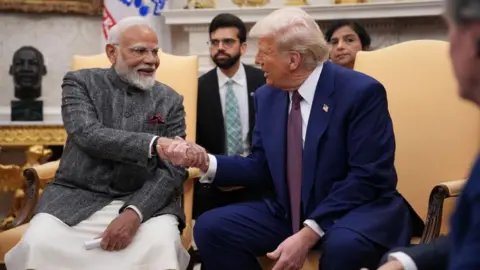
India’s goods exports to the US, its largest foreign market, dropped sharply by 20% in September and nearly 40% in the last four months, as Trump’s steep tariffs took effect, data shows.
September was the first full month of Washington’s 50% tariffs on Indian goods, which kicked in on 27 August. This includes a 25% penalty for Delhi’s refusal to stop buying oil from Russia.
“US has become India’s most severely affected market since the tariff escalation began,” said Ajay Srivastava of Global Trade Research Initiative (GTRI), a Delhi-based think tank.
Negotiations for a trade deal between the two countries are under way, with the goal of concluding an agreement by next month.
According to GTRI, the most significant impact of the tariffs has been felt by labour-heavy sectors such as textiles, gems and jewellery, engineering goods, and chemicals, which have suffered the heaviest losses.
Shipments to the US have seen four consecutive months of decline, and are down 37.5% – from $8.8bn (£6.5bn) in May to $5.5bn in September.
The drop in exports have also contributed to India’s trade deficit (the gap between what a country imports and exports), which widened to a 13-month high of $32.15 billion in September.
Some of the reduction in exports to the US was cushioned by improved trade with countries like the UAE and China.
Trade negotiations between India and the US resumed last month after months of stalling over a number of differences. An Indian delegation is currently in the US for talks.
On Wednesday, Trump said that Indian Prime Minister Narendra Modi has agreed to stop buying Russian oil, as the US seeks to put economic pressure on the Kremlin as part of efforts to end the war in Ukraine.
A spokesperson of the Indian foreign ministry said discussions were “ongoing” with the US administration which had “shown interest in deepening energy co-operation with India”.
But major sticking points over trade still remain, including access to agriculture and dairy.
For years, Washington has pushed for greater access to India’s farm sector, seeing it as a major untapped market. But India has fiercely protected it, citing food security, livelihoods and the interests of millions of small farmers.
Until recently, the US was India’s largest trading partner, with bilateral trade reaching $190bn in 2024. Trump and Modi have set a target to more than double this figure to $500bn.
 Everchem Updates Archive
  Sign Up for Email Updates