
Government Regulation
May 22, 2019
Roadcheck
The CVSA International Roadcheck will take place from June 4-6 this year, with an emphasis on an important topic: steering and suspension.
During this time, the CVSA will be inspecting commercial motor vehicles and drivers across North America for both driver operating requirements and vehicle mechanical fitness. Below you will see that during last year’s Roadcheck more than 21% of the 67,603 vehicles inspected were placed out of service. View the full infographic.
I want to remind you how important it is to plan your freight ahead for Roadcheck week. Due to increased scrutiny, a number of carriers and drivers choose not to operate the week of the event and our data shows that each year there is a significant drop in overall available capacity in the marketplace. Reduced capacity or delays caused by non-compliant drivers or faulty equipment will add days to your supply chain.
http://s1392407584.t.en25.com/e/es?s=1392407584&e=27103&elqTrackId=0835ad748d6a4b29b602eaa6ee5bf011&elq=7262554ac4ad4dd49cada8de32a94b80&elqaid=1361&elqat=1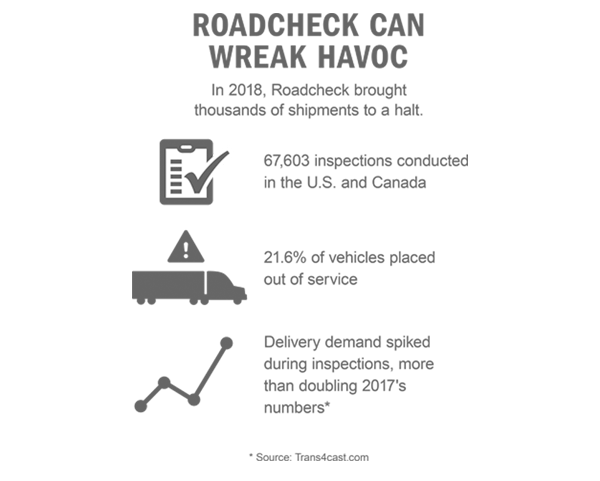
May 22, 2019
Roadcheck
The CVSA International Roadcheck will take place from June 4-6 this year, with an emphasis on an important topic: steering and suspension.
During this time, the CVSA will be inspecting commercial motor vehicles and drivers across North America for both driver operating requirements and vehicle mechanical fitness. Below you will see that during last year’s Roadcheck more than 21% of the 67,603 vehicles inspected were placed out of service. View the full infographic.
I want to remind you how important it is to plan your freight ahead for Roadcheck week. Due to increased scrutiny, a number of carriers and drivers choose not to operate the week of the event and our data shows that each year there is a significant drop in overall available capacity in the marketplace. Reduced capacity or delays caused by non-compliant drivers or faulty equipment will add days to your supply chain.
http://s1392407584.t.en25.com/e/es?s=1392407584&e=27103&elqTrackId=0835ad748d6a4b29b602eaa6ee5bf011&elq=7262554ac4ad4dd49cada8de32a94b80&elqaid=1361&elqat=1
May 10, 2019
FR Debate in MA
Lawmakers restart flame retardant bill debate
BOSTON — Four months after a bill restricting chemical flame retardants died on Gov. Charlie Baker’s desk, its proponents are again making their health-related case to lawmakers as industry representatives continue to voice concerns.
“We hope this bill comes out early, really early, so we all have an opportunity to stand tall, and if we need to, override any vetoes,” Sen. Cynthia Creem told the Public Health Committee on Tuesday.
At the very end of the last two-year legislative session, on New Year’s Eve and New Year’s Day, lawmakers worked to send Baker a bill that would prohibit the manufacture or sale of children’s products, household furniture and bedding that contain 11 chemical flame retardants. Despite a push by the 12,000-member Professional Fire Fighters of Massachusetts, Baker pocket vetoed the bill and said he would have returned it with an amendment had time not run out.
“Now we have another chance,” said Creem, who along with Rep. Marjorie Decker refiled a version of the bill (H 3500, S 1230) this year.
Supporters have said the flame retardants targeted by the bill are unnecessary and can pose health risks to firefighters and children.
Creem, a Newton Democrat, and Decker, a Cambridge Democrat, testified alongside Professional Fire Fighters of Massachusetts President Richard MacKinnon, who said firefighters now deal with “a far more toxic soot” than in years past and face higher risks of cancer diagnosis and cancer death than the general public. Cancer is the leading cause of death for firefighters, MacKinnon said.
“The hazards of these flame retardants presented are not new,” MacKinnon said. “However, we are learning more and more each day that these chemicals pose a greater risk than we ever thought we ever could have imagined. Exposure to these chemicals in performance of our duties and the resulting cancers associated with the exposure is the greatest threat to firefighters in Massachusetts and across the country.”
Baker wrote in a message to lawmakers in January that he looked forward to working with sponsors and stakeholders on a revised version. He said last session’s bill would have made Massachusetts the only state “to ban certain flame retardants in car seats and the non-foam parts of adult mattresses, products already subject to federal flammability requirements” and took issue with the June 1 implementation date.
Trade groups representing chemical companies, the electronics and technology industry, makers of children’s products, and mattress manufacturers testified against the bill.
Ryan Trainer, president of the International Sleep Products Association, said the bill, if passed, could force the redesign and remerchandising of many mattress styles, which would “cause commercial confusion,” raise prices for consumers and hurt manufacturing and retail businesses.
Joseph Colella of the Juvenile Product Manufacturers Association said the 13 other states that have moved forward on flame retardant bans have exempted child car seats, which are regulated separately and could become more expensive if other flame retardants had to be used.
Representing the Consumer Technology Association, Dan Moyer said some chemicals listed in the bill are needed for circuit boards and electronic parts that carry currents or are near parts that carry currents. He said other states exempt consumer electronics and that while such an exemption was in last session’s bill, it is not this year.
Decker asked the committee to advance the bill in its current form and not carve out any particular products.
“The carve-outs are a game that we play when we’re at the 11th hour and we’re hoping to get something done,” Decker said. “A favorable recommendation is believing the science, a favorable recommendation is standing with pediatricians and children, and a favorable recommendation is standing with firefighters who every day risk their lives without ever complaining. They’re the only people in the world who run into a fire, and they’re asking us to take the science seriously and help protect their lives.”
https://www.gloucestertimes.com/news/local_news/lawmakers-restart-flame-retardant-bill-debate/article_6610b8f4-d345-5c52-9458-2f3fd528d491.html
May 10, 2019
FR Debate in MA
Lawmakers restart flame retardant bill debate
BOSTON — Four months after a bill restricting chemical flame retardants died on Gov. Charlie Baker’s desk, its proponents are again making their health-related case to lawmakers as industry representatives continue to voice concerns.
“We hope this bill comes out early, really early, so we all have an opportunity to stand tall, and if we need to, override any vetoes,” Sen. Cynthia Creem told the Public Health Committee on Tuesday.
At the very end of the last two-year legislative session, on New Year’s Eve and New Year’s Day, lawmakers worked to send Baker a bill that would prohibit the manufacture or sale of children’s products, household furniture and bedding that contain 11 chemical flame retardants. Despite a push by the 12,000-member Professional Fire Fighters of Massachusetts, Baker pocket vetoed the bill and said he would have returned it with an amendment had time not run out.
“Now we have another chance,” said Creem, who along with Rep. Marjorie Decker refiled a version of the bill (H 3500, S 1230) this year.
Supporters have said the flame retardants targeted by the bill are unnecessary and can pose health risks to firefighters and children.
Creem, a Newton Democrat, and Decker, a Cambridge Democrat, testified alongside Professional Fire Fighters of Massachusetts President Richard MacKinnon, who said firefighters now deal with “a far more toxic soot” than in years past and face higher risks of cancer diagnosis and cancer death than the general public. Cancer is the leading cause of death for firefighters, MacKinnon said.
“The hazards of these flame retardants presented are not new,” MacKinnon said. “However, we are learning more and more each day that these chemicals pose a greater risk than we ever thought we ever could have imagined. Exposure to these chemicals in performance of our duties and the resulting cancers associated with the exposure is the greatest threat to firefighters in Massachusetts and across the country.”
Baker wrote in a message to lawmakers in January that he looked forward to working with sponsors and stakeholders on a revised version. He said last session’s bill would have made Massachusetts the only state “to ban certain flame retardants in car seats and the non-foam parts of adult mattresses, products already subject to federal flammability requirements” and took issue with the June 1 implementation date.
Trade groups representing chemical companies, the electronics and technology industry, makers of children’s products, and mattress manufacturers testified against the bill.
Ryan Trainer, president of the International Sleep Products Association, said the bill, if passed, could force the redesign and remerchandising of many mattress styles, which would “cause commercial confusion,” raise prices for consumers and hurt manufacturing and retail businesses.
Joseph Colella of the Juvenile Product Manufacturers Association said the 13 other states that have moved forward on flame retardant bans have exempted child car seats, which are regulated separately and could become more expensive if other flame retardants had to be used.
Representing the Consumer Technology Association, Dan Moyer said some chemicals listed in the bill are needed for circuit boards and electronic parts that carry currents or are near parts that carry currents. He said other states exempt consumer electronics and that while such an exemption was in last session’s bill, it is not this year.
Decker asked the committee to advance the bill in its current form and not carve out any particular products.
“The carve-outs are a game that we play when we’re at the 11th hour and we’re hoping to get something done,” Decker said. “A favorable recommendation is believing the science, a favorable recommendation is standing with pediatricians and children, and a favorable recommendation is standing with firefighters who every day risk their lives without ever complaining. They’re the only people in the world who run into a fire, and they’re asking us to take the science seriously and help protect their lives.”
https://www.gloucestertimes.com/news/local_news/lawmakers-restart-flame-retardant-bill-debate/article_6610b8f4-d345-5c52-9458-2f3fd528d491.html
April 23, 2019
Proposed Spray Foam Practices in Canada
DEPARTMENT OF HEALTH
CANADIAN ENVIRONMENTAL PROTECTION ACT, 1999
Notice with respect to the Proposed Code of Practice for Certain Methylenediphenyl Diisocyanates in Low-Pressure Two-Component Spray Polyurethane Foam Products
Whereas a screening assessment of benzene, 1,1′-methylenebis[4-isocyanato-; benzene, 1,1′-methylenebis[2-isocyanato-; benzene, 1-isocyanato-2-[(4-isocyanatophenyl)methyl]-; benzene, 1,1′-methylenebis[isocyanato-; and isocyanic acid, polymethylenepolyphenylene ester conducted under section 74 of the Canadian Environmental Protection Act, 1999 has concluded that the substances meet one or more of the criteria set out in section 64 of the Canadian Environmental Protection Act, 1999;
Whereas on April 6, 2019, the Minister of the Environment and the Minister of Health (the ministers) published in the Canada Gazette, Part I, a statement under subsection 77(6) of the Act indicating their intention to recommend that benzene, 1,1′-methylenebis[4-isocyanato-; benzene, 1,1′-methylenebis[2-isocyanato-; benzene, 1-isocyanato-2-[(4-isocyanatophenyl)methyl]-; benzene, 1,1′-methylenebis[isocyanato-; and isocyanic acid, polymethylenepolyphenylene ester be added to the List of Toxic Substances in Schedule 1 of the Canadian Environmental Protection Act, 1999;
And whereas subsection 91(1) of the Canadian Environmental Protection Act, 1999 requires a regulation or instrument respecting preventive or control action for this substance be proposed and published;
Pursuant to subsection 55(3) of the Canadian Environmental Protection Act, 1999, notice is hereby given that the Minister of Health is issuing the following proposed Code of Practice under subsection 55(1) of that Act:
Proposed Code of Practice for Certain Methylenediphenyl Diisocyanates in Low-Pressure Two-Component Spray Polyurethane Foam Products
Electronic copies of this proposed Code of Practice may be downloaded from the Consulting Canadians (Canada.ca) web page.
Any person may, within 60 days after publication of this notice, file with the Minister of the Environment written comments on the measure the ministers propose to take and on the scientific considerations on the basis of which the measure is proposed. More information regarding the scientific considerations may be obtained from the Canada.ca (Chemical Substances) website. All comments must cite the Canada Gazette, Part I, and the date of publication of this notice and be sent to the Executive Director, Program Development and Engagement Division, Department of the Environment, Gatineau, Quebec K1A 0H3, by fax to 819‑938‑5212, or by email to ec.substances.ec@canada.ca. Comments can also be submitted to the Minister of the Environment using the online reporting system available through Environment and Climate Change Canada’s Single Window.
In accordance with section 313 of the Canadian Environmental Protection Act, 1999, any person who provides information in response to this notice may submit with the information a request that it be treated as confidential.
Gwen Goodier
Acting Director General
Science and Risk Assessment Directorate
On behalf of the Minister of the Environment
David Morin
Director General
Safe Environments Directorate
On behalf of the Minister of Health
Read more here: http://gazette.gc.ca/rp-pr/p1/2019/2019-04-06/html/notice-avis-eng.html#na3
 Everchem Updates Archive
  Sign Up for Email Updates