
Government Regulation
February 2, 2025
Tariff Thoughts
All About The New Trump Tariffs, And Why The Hysteria Is Overblown
by Tyler Durden
Sunday, Feb 02, 2025 – 02:35 PM
By Peter Tchir of Academy Securities
Some Tariff Basics
Report after report I read seems to jump straight to either the good from tariffs (getting others to pay our taxes, advantage to American manufacturing, etc.) or to the doom and gloom of tariffs (inflation, trade wars, etc.). While we all understand the basics of tariffs, or at least I think I do, it seems worth spending a minute or two making sure that we are all on the same page.
My understanding is that the importer of a good pays the tariff to the government at the port or place of entry of the good into the country.
So, if you pay $100 for something from Canada or Mexico, you pay a $25 tariff, and your cost has increased to $125.
Which begs the question – who pays the $25 tariff?
One of the first things most importers will do is ask for a reduction in price from the exporter. If I was doing business thinking that something was only going to cost $100 and it now costs $125, I’d try to negotiate my purchase price down.
What I find “interesting” is if the exporter takes a 20% haircut, the price stays at $100. 20%off of $100 is $80. Then a 25% tariff on something for $80 is $20, getting us back to $100.
Step 1 is getting a discount, where even a 10% discount means the tariff only increases costs by 12.5%.
Now let’s look at the FX market (which maybe we should have done before step 1, but it would be a pain to rewrite stuff, and it isn’t really a step, as it is outside the control of the importer and the exporter, though no less important).
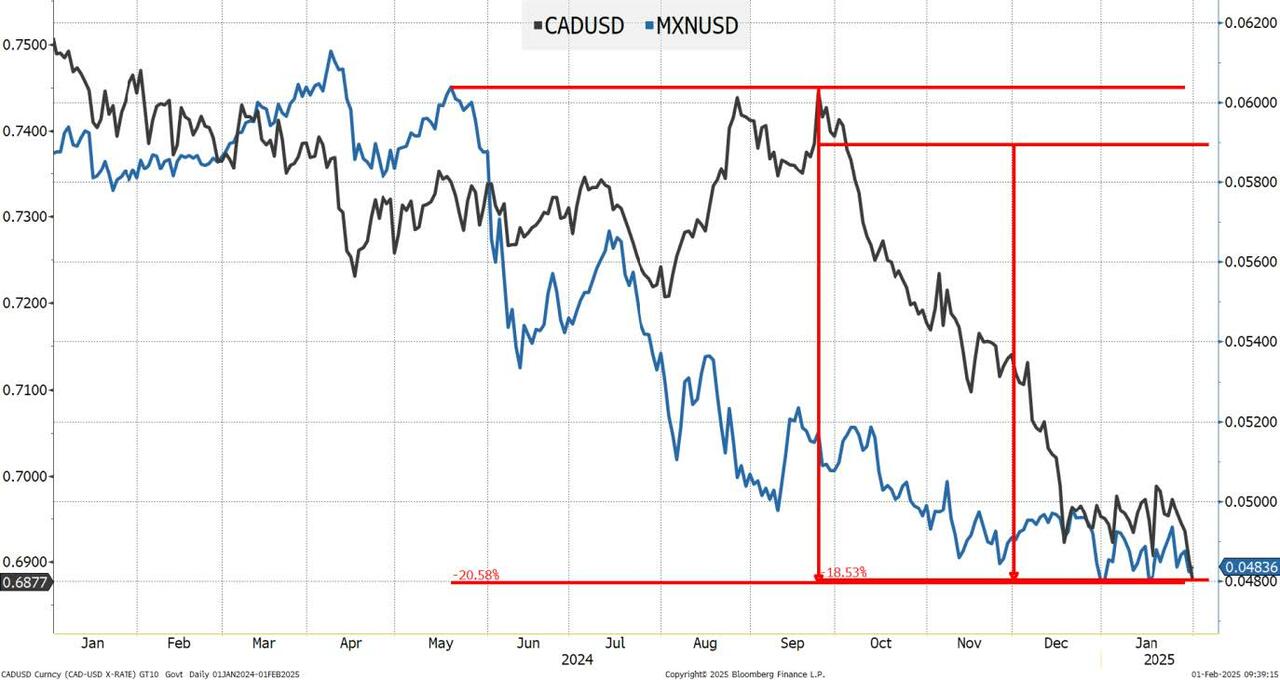
Since the summer, the Peso has declined by 20% versus the dollar and since late September, the Canadian Dollar has dropped by around 18%.
Let’s say that back in September, a Canadian exporter was happy to get paid 135 CAD. That translates into 100 USD for the importer. Let’s say that the Canadian exporter is still happy to accept the equivalent of 135 CAD. That drops the USD price to 93 for the importer. Making the “new” cost to the importer, including the tariff, “only” $116.25. This is all moving around in real time and has been a cumulative move, so this is a massive oversimplification, but still relevant.
The currency market is already helping the importer.
Step 2 is for the importer to figure out what amount of profit he is willing to forgo, if any. Assuming the importer was paying $100 it seems reasonable to assume that the price for the consumer is significantly more. For argument’s sake, let’s say the final price was $200. There is distribution and selling costs, etc. that the importer pays to sell the product on to the next leg. Maybe $200 is too high? Possibly, but I’m not sure it is that unreasonable for many finished goods. Now $25 out of $200 is “only” 12.5%. Giving up 12.5% is probably too much, but is 5% reasonable?
So, let’s look at this possibility (which as a whole, doesn’t seem too far-fetched to me).
Negotiate a 10% discount from the Canadian or Mexican exporter. Argue that it is “temporary” but crucial if you don’t want me (the importer) looking for alternative suppliers. Add in that you (the exporter) will also take a hit.
So, the Canadian exporter reduces the cost from 135 CAD to 121.5 CAD (in hopes it is temporary, and they don’t want to risk losing this customer to another provider of such goods).
Due to the big increase in the USD, the cost is only $83.40 (the importer has been making a lot of extra money in the past few months, but that is always a risk and may well have been hedged).
The 25% tariff is $20.85, bringing the total cost to $104.25.
In your planning, as of a month or two ago, you were anticipating a cost of $100. It is now just under $105. Do you raise your final prices, or leave them, at least for a little while, anticipating Canada (or Mexico) will make progress on fentanyl and the tariff will go away? That seems at least plausible, and it might depend on how easy it is for you to raise and lower prices. Is the hit to profit margin, hopefully a temporary one, worth not having to deal with a new supplier?
If the alternative supplier is Canadian or Mexican, they have the same problem.
If the supplier is from elsewhere, presumably there will be some logistics in getting their goods over in time.
The alternative, an American supplier, does look better as they were just given an effective cost benefit, but not really a 25% cost benefit. The dollar strength takes away some of the desire to shift to a domestic supplier. Presumably, the domestic supplier was already more expensive (or not as good, or there is some other reason why they weren’t being used). So, even with the indirect competitive boost, is it worth it?
Read more here: https://www.zerohedge.com/markets/all-about-new-trump-tariffs-and-why-hysteria-overblown
January 7, 2025
Formaldehyde
EPA finds formaldehyde an ‘unreasonable risk,’ industry says evaluation flawed
By Larry Adams
January 6, 2025 | 7:16 am CST

WASHINGTON, D.C. — The U.S. Environmental Protection Agency (EPA) released Jan. 2 the final risk evaluation for formaldehyde conducted under the Toxic Substances Control Act (TSCA). EPA has determined that formaldehyde presents an unreasonable risk of injury to human health, specifically to workers and consumers, under its conditions of use (COUs).
The American Chemical Council, on the other hand, said the EPA’s evaluation process was flawed and was not based on the best available science. The ACC warned that the EPA’s Final TSCA Risk Evaluation for Formaldehyde potentially jeopardizes domestic production and critical American industries.
According to the EPA, studies in people demonstrate that exposure to formaldehyde for a short periods, such as for 15 minutes (called an acute exposure) cause sensory irritation such as eye and respiratory inflammation. Sensory irritation effects go away when exposure stops. Inhaling formaldehyde for longer ‘chronic’ periods can reduce lung function and increase asthma and allergy-related conditions, and cancer. Skin contact with products containing formaldehyde can also cause allergic reactions. Formaldehyde is not expected to persist in water or soils based on its physical and chemical properties; therefore, it is not expected in groundwater or surface water used for drinking water.
EPA’s risk evaluation focused on formaldehyde sources involved in the manufacturing, processing, distribution in commerce, use, and disposal of formaldehyde and formaldehyde-containing products and articles that are subject to TSCA. These may include composite wood furniture or other articles, plastics, paints, adhesives, and sealants. The highest releases of formaldehyde from articles occur when new.
EPA assessed human exposure for 63 TSCA conditions of use of formaldehyde. Of these, 58 conditions of use (50 occupational and 8 consumer) significantly contribute to the unreasonable risk determination. Workers who are in workplaces where formaldehyde is used are at the most risk from formaldehyde exposure, particularly if workers are not wearing personal protective equipment. Workers may be exposed to formaldehyde in air during manufacturing, processing, or use of formaldehyde and products and articles containing formaldehyde. Workers can also be exposed to formaldehyde by making skin contact with formaldehyde-containing materials. Most of the risk to workers is because of acute inhalation and dermal exposures. Cancer risk to workers under many conditions of use also supports the risk determination.
EPA also found some risk from chronic exposure to ambient air for people living near facilities that release formaldehyde. EPA did not determine that ambient air contributes significantly to the unreasonable risk determination.
Industry objects
The American Chemistry Council’s Formaldehyde Panel issued the following statement on the U.S. Environmental Protection Agency’s (EPA) completion of the final risk evaluation for formaldehyde under the Toxic Substances Control Act (TSCA):
“While ACC acknowledges EPA made several important adjustments in the final risk evaluation, concerns remain about the agency’s continued disregard for statutory requirements on scientific quality, peer reviews, and engagement with public and interagency comments. TSCA requires that EPA reviews and regulates a chemical based on the best available science. This risk evaluation relies on a flawed assessment by EPA’s Integrated Risk Information System (IRIS) program – a program that has never been authorized by Congress, lacks transparency, and is out of step with the best available science and methods. EPA should go back to the scientific drawing board on formaldehyde instead of pursuing unaccountable lame duck actions that threaten the U.S. economy and key sectors that support health, safety and national security.
“Government agencies like Department of Defense, Department of Agriculture, the Centers for Disease Control and Prevention, and the Small Business Administration and EPA-selected expert peer reviewers have raised concerns about the shortened timeline, scientific shortcomings, and potential devastating effects of a flawed TSCA risk evaluation. Ignoring these concerns could result in overly restrictive regulation of this building block chemistry, handicapping America’s economy and creating reliance on overseas production.
“Despite minor improvements, EPA’s final evaluation concludes that virtually all conditions of use contribute to ‘unreasonable risk’ under TSCA. This includes 58 of 63 subcategories of formaldehyde uses, including subjecting all manufacturing, import, processing, distribution in commerce, recycling, disposal, and industrial use of formaldehyde and formaldehyde-derived products to potential bans or difficult-to-meet standards for some uses.
“EPA’s suggested starting place for workplace limits continue to be inconsistent with the best available science and ignore practices that are already in place to protect workers, including the use of personal protective equipment. These workplace limits are significantly lower than the recently updated European Union occupational limits.
“Any assessment of formaldehyde must begin with the best available science. Formaldehyde is a natural part of our world and, through decades of responsible innovation and regulation, is essential to critical applications for housing, agriculture, transportation, healthcare, and national security. Formaldehyde technologies have broad roles in the economy, supporting over 1.5 million jobs and $1.6 trillion in manufacturing shipments and other economic output in 2023 in the United States.
“Effective implementation of the TSCA program has been plagued with challenges, and the final risk evaluation does not meet EPA’s requirement to use the best available science. If EPA continues on its current path during the two-year risk management phase, formaldehyde manufacturing and many of its downstream uses could be severely restricted or potentially banned in the United States.
“Formaldehyde is integral to modern life, and businesses and families rely on the important products it enables. Without robust formaldehyde manufacturing in the United States, we could face increased product prices, reduced economic output, and a loss of the U.S.’s competitive edge. In the coming months, we will collaborate with formaldehyde users to engage the next Administration and safeguard access to this essential chemical building block.”
It’s interesting how the ACC defends formaldehyde and yet promotes MDI for certain end-uses.
December 11, 2024
Epoxy Resin Antidumping Update
Preliminary Affirmative Determinations in the Antidumping Duty Investigations of Epoxy Resins from the People’s Republic of China, India, the Republic of Korea, Taiwan and Thailand.
On November 7, 2024, the U.S. Department of Commerce (Commerce) announced its preliminary affirmative determinations in the antidumping duty (AD) investigations of epoxy resins from People’s Republic of China (China), India, the Republic of Korea (Korea), Taiwan, and Thailand. Commerce is conducting concurrent countervailing duty (CVD) investigations of epoxy resins from China, India, Korea, and Taiwan.
Preliminary Dumping Rates
China
| Exporter/Producer | Dumping Margin (Percent) | Cash Deposit Rate (Adjusted for Subsidy Offset) (percent) |
|---|---|---|
| China-Wide Entity* | 354.99 | 344.45 |
*Rate based on facts available with adverse inferences.
India
| Exporter/Producer | Dumping Margin (Percent) | Cash Deposit Rate (Adjusted for Subsidy Offset) (percent) |
|---|---|---|
| Atul Limited | 12.01 | 10.52 |
| Champion Advanced Materials | 15.68* | 0.00* |
| All Others | 12.01 | 10.52 |
*Rate is based on Adverse Facts Available (AFA).
Korea
| Exporter/Producer | Dumping Margin (Percent) |
|---|---|
| Kukdo Chemical Co. Ltd/Kukdo Finechem | 24.65 |
| Kumho P&B Chemicals Inc. | 16.02 |
| All Others | 21.56 |
Taiwan
| Exporter/Producer | Dumping Margin (Percent) |
|---|---|
| Nan Ya Plastics Corporation | 20.61 |
| Chang Chun Plastics Co., Ltd. | 9.43 |
| All Others | 14.81 |
Thailand
| Exporter/Producer | Dumping Margin (Percent) |
|---|---|
| Aditya Birla Chemicals (Thailand) Limited | 5.59 |
| All Others | 5.59 |
Case Calendar
| Event | AD INVESTIGATION |
|---|---|
| Petition Filed | April 3, 2024 |
| Commerce Initiation Date | April 23, 2024 |
| ITC Preliminary Determinations | May 20, 2024 |
| Commerce Preliminary Determinations | November 7, 2024 |
| Commerce China Final Determination | January 21, 2025 |
| ITC Final China Determination* | March 7, 2025 |
| Issuance of China Order** | March 14, 2025 |
| Commerce Final Determinations | March 27, 2025 |
| ITC Final Determinations* | May 12, 2025 |
| Issuance of Orders** | May 19, 2025 |
NOTE: Commerce’s preliminary and final determination deadlines are governed by statute. For AD investigations, the deadlines are set forth in sections 733(b) and 735(a) of the Tariff Act of 1930, as amended (the Act). For CVD investigations, the deadlines are set forth in sections 703(b) and 705(a)(1) of the Act.
* This will take place only in the event of a final affirmative determination from Commerce.
** This will take place only in the event of final affirmative determinations from Commerce and the U.S. International Trade Commission (ITC).
IMPORT STATISTICS:
| CHina | 2021 | 2022 | 2023 |
|---|---|---|---|
| Volume (lbs) | 8,422,944 | 6,325,121 | 4,084,046 |
| Value (USD) | $ 16,010,873 | $ 9,828,551 | $ 5,713,015 |
| India | 2021 | 2022 | 2023 |
|---|---|---|---|
| Volume (lbs) | 1,989,235 | 4,481,097 | 4,720,313 |
| Value (USD) | $ 4,746,992 | $ 11,544,062 | $ 7,638,308 |
| Korea | 2021 | 2022 | 2023 |
|---|---|---|---|
| Volume (lbs) | 149,812,310 | 183,972,055 | 124,718,712 |
| Value (USD) | $ 337,791,283 | $ 488,536,144 | $ 204,619,008 |
| Taiwan | 2021 | 2022 | 2023 |
|---|---|---|---|
| Volume (lbs) | 16,525,475 | 32,454,690 | 40,026,647 |
| Value (USD) | $ 33,749,942 | $ 63,666,493 | $ 51,496,148 |
| Thailand | 2021 | 2022 | 2023 |
|---|---|---|---|
| Volume (lbs) | 12,354,755 | 10,480,614 | 12,718,384 |
| Value (USD) | $ 22,336,233 | $ 23,051,817 | $ 19,769,126 |
Source: U.S. Census Bureau, accessed through S&P Global Trade Atlas (Harmonized Tariff Schedule of the United States (HTSUS) subheading 3907.30.0000.
Other Case Information
- The petitioner is the U.S. Epoxy Resin Producers Ad Hoc Coalition, which consists of Olin Corporation (Clayton, MO) and Westlake Corporation (Houston, TX).
- For general information and next steps, please refer to a list of preliminary FAQs.
- To date, Commerce maintains 714 AD and CVD orders that provide relief to American companies and industries impacted by unfair trade.
- Additional case information, including the scope of the investigations, are on file electronically via Enforcement and Compliance’s Antidumping and Countervailing Duty Centralized Electronic Service System (ACCESS). Once you log in, please refer to case numbers:
- China A-570-166, C-570-167
- India A-533-926, C-533-927
- Korea A-580-919, C-580-920
- Taiwan A-583-876, C-583-877
- Thailand A-549-850
December 10, 2024
Alkyl Phosphate Esters Antidumping Update
Preliminary Affirmative Determination in the Antidumping Duty Investigation of Certain Alkyl Phosphate Esters from the People’s Republic of China
On November 27, 2024, the U.S. Department of Commerce (Commerce) announced its preliminary affirmative determination in the antidumping duty (AD) investigation of certain alkyl phosphate esters from the People’s Republic of China (China). Commerce is also conducting a concurrent countervailing duty (CVD) investigation of certain alkyl phosphate esters from China.
Preliminary Dumping Rates
China
| Exporter | Producer | Estimated Weighted-Average Dumping Margin (percent) | Cash Deposit Rate (Adjusted for Subsidy Offset(s)) (percent) |
|---|---|---|---|
| Anhui RunYue Technology Co., Ltd. | Anhui RunYue Technology Co., Ltd. | 247.52 | 175.82 |
| Zhejiang Wansheng Co., Ltd. | Zhejiang Wansheng Co., Ltd. | 164.29 | 141.98 |
| ACETO (SHANGHAI) LTD. | Xinji Hongzheng Chemical Co., Ltd. | 182.22 | 135.22 |
| Anhui Shengli Import and Export Co., Ltd. | Anhui Shengli Pesticide & Chemistry Co., Ltd. | 182.22 | 135.22 |
| Anhui Shengli Import and Export Co., Ltd. | Ningguo Long Day Chemical Co., Ltd. | 182.22 | 135.22 |
| Fujian Wynca Technology Co., Ltd. | Fujian Wynca Technology Co., Ltd. | 182.22 | 135.22 |
| Fujian Wynca Technology Co., Ltd. | Anhui RunYue Technology Co., Ltd. | 182.22 | 135.22 |
| Fujian Wynca Technology Co., Ltd. | Shandong Yarong Chemical Co., Ltd. | 182.22 | 135.22 |
| Shandong Yarong Chemical Co., Ltd. | Shandong Yarong Chemical Co., Ltd. | 182.22 | 135.22 |
| Shanghai Iroyal Chemical Co., Ltd. | Futong Chemical Co., Ltd. | 182.22 | 135.22 |
| Shanghai Iroyal Chemical Co., Ltd. | Fujian Wynca Technology Co., Ltd. | 182.22 | 135.22 |
| Shanghai Iroyal Chemical Co., Ltd. | Zhejiang Hong Hao Technology Co., Ltd. | 182.22 | 135.22 |
| Shanghai Iroyal Chemical Co., Ltd. | Shandong Yarong Chemical Co., Ltd. | 182.22 | 135.22 |
| Shanghai Iroyal Chemical Co., Ltd. | Xuancheng City Trooyawn Refined Chemical Industry Co., Ltd. | 182.22 | 135.22 |
| Shanghai Yongxiangshun International Trade Co., Ltd. | Hebei Zhenxing Chemical and Rubber Co., Ltd. | 182.22 | 135.22 |
| Xuancheng City Trooyawn Refined Chemical Industry Co., Ltd. | Xuancheng City Trooyawn Refined Chemical Industry Co., Ltd. | 182.22 | 135.22 |
| Yoke Chemicals and New Materials (Shanghai) Co. Ltd. | Jiangsu Yoke Technology Co., Ltd. | 182.22 | 135.22 |
| Zhangjiagang Fortune Chemical Co., Ltd. | Nantong Jiangshan Agrochemical & Chemicals Limited Liability Co., Ltd. | 182.22 | 135.22 |
| Zhangjiagnag Fortune Chemical Co., Ltd . | Shandong Yarong Chemical Co., Ltd. | 182.22 | 135.22 |
| China-Wide Entity | 269.60* | 247.29 | |
* This rate is based on facts available with adverse inferences.
Case Calendar
| Event | AD INVESTIGATION |
|---|---|
| Petition Filed | April 23, 2024 |
| Commerce Initiation Date | May 13, 2024 |
| ITC Preliminary Determination* | June 7, 2024 |
| Commerce Preliminary Determination | November 26, 2024 |
| Commerce Final Determination | April 17, 2025* |
| ITC Final Determination** | June 2, 2025 |
| Issuance of Order*** | June 9, 2025 |
NOTE: Commerce’s preliminary and final determination deadlines are governed by statute. For AD investigations, the deadlines are set forth in sections 733(b) and 735(a) of the Tariff Act of 1930, as amended.
* If a deadline falls on a weekend of Federal Holiday, the deadline falls to the next business day.
** This will take place only in the event of a final affirmative determination from Commerce.
*** This will take place only in the event of final affirmative determinations from Commerce and the U.S. International Trade Commission (ITC).
Import Statistics
| China | 2021 | 2022 | 2023 |
|---|---|---|---|
| Volume (KG) | 51,713,548 | 47,871,892 | 53,501,318 |
| Value (USD) | 118,783,614 | 104,873,453 | 73,791,562 |
Source: U.S. Census Bureau, accessed through S&P Global Trade Atlas (Harmonized Tariff Schedule of the United States subheading 2919.90.5050).
Other Case Information
- The petitioner is ICL-IP America, Inc. (Saint Louis, MO)
- For general information and next steps, please refer to a list of preliminary FAQs.
- Additional case information, including the scope of the investigations, are on file electronically via Enforcement and Compliance’s Antidumping and Countervailing Duty Centralized Electronic Service System (ACCESS). Once you log in, please refer to case numbers: Trading PartnerAntidumping Duty Investigation Case NumberChinaA-570-160
- To date, Commerce maintains 716 AD and CVD orders that provide relief to American companies and industries impacted by unfair trade.
November 25, 2024
Government Regulation Impacting the RV Industry
RV industry continues fight against multi-state motorhome ‘ban’
By Larry Adams
November 22, 2024 | 12:51 pm CST

Six states are on a collision course to limit the sale of new gas- and diesel-powered RVs.
The states — California, Washington, New York, Oregon, Massachusetts, and New Jersey — are poised to effectively eliminate the sale of new gas- and diesel-powered RVs starting January 1, 2025.
RV Industry Association Government Affairs staff, along with several of our motorhome manufacturer members, met on Tuesday. Nov. 19, with the California Air Resources Board (CARB) staff overseeing the Advanced Clean Trucks (ACT) regulation.
According to the RVIA’s most recent newsletter, the meeting was requested by CARB to discuss in more detail the RV industry comments submitted as part of the ACT amendments proceeding in October.
“They also wanted to hear more directly from our members about what they are being told by the chassis manufacturers about why they are unable to deliver products,” according to the newsletter.
RVIA representatives repeated its belief that an “exemption or a delay in implementation from the ACT would be of greatest benefit to allow the industry to continue to provide motorhomes to dealers and customers in the state.”
CARB said it does have the authority to create exemptions to the regulation. This is different than what CARB has said on other regulations when they stated that allowable exemption are set by the law which created the rule, not by CARB.
“While no final resolution was attained, all sides agreed to continue talking and another meeting is being arranged in early December. The RV Industry Association will continue to explore all its options to find an equitable solution.”
In 2025, California’s Advanced Clean Trucks (ACT) regulation, aimed at promoting zero-emission vehicles (ZEVs), will create a near-total “ban” on motorhome sales in the state, as well as in additional states that follow the California Air Resource Board (CARB) regulations. While the regulation does not specifically ban motorhome sales, the ACT regulation mandates manufacturers of medium and heavy-duty vehicles to sell an increasing percentage of ZEVs each year. This has led chassis manufacturers to halt sales of traditional internal combustion engine chassis for motorhomes in California, stemming from the lack of ZEV chassis suitable for motorhomes.
Since 2020, the RV Industry Association has been working with CARB on the ACT regulations through conversations directly with CARB staff as well as written and oral testimony at multiple public hearings. When CARB filed its proposed amendments earlier this year, the RV industry met with CARB staff to discuss the impact on the industry. The Association also submitted comments laying out the negative impact of the regulation on the motorhome industry.
Unfortunately, CARB did not make any further amendment that would alleviate the problem of motorhome manufacturers being told by chassis manufacturers that they would not be able to supply ICE (internal combustion engine) chassis for sale into California since they could not offset their ZEV deficits by sales of a ZEV motorhome chassis.
Making the matter more complicated, it is not just the ACT that is causing the issue right now; it is the trio of regulations passed in the last 2-3 years: the ACT, along with the Omnibus Low NOx rule and the Advanced Clean Fleets rule. These three rules work together to gradually transition medium- and heavy-duty vehicles to zero-emission vehicles (ZEVs) by 2036. We have commented to CARB on each of them, and also on the Small Off-Road Engine regulation which threatens spark-ignition engines on generators.
 Everchem Updates Archive
  Sign Up for Email Updates