
The Urethane Blog
June 3, 2024
Pending home sales slumped 7.7% in April
By Larry Adams
May 31, 2024 | 12:59 pm CDT

Contract signings retreated in all regions compared to the previous month and one year ago. The Midwest and West experienced the largest monthly declines.
WASHINGTON — The Pending Home Sales Index (PHSI) – a forward-looking indicator of home sales based on contract signings – decreased to 72.3 in April. Year over year, pending transactions were down 7.4%. An index of 100 is equal to the level of contract activity in 2001.
“The impact of escalating interest rates throughout April dampened home buying, even with more inventory in the market,” said NAR Chief Economist Lawrence Yun. “But the Federal Reserve’s anticipated rate cut later this year should lead to better conditions, with improved affordability and more supply.”
Regional breakdown
The Northeast PHSI fell 3.5% from last month to 62.9, a decline of 3.1% from April 2023. The Midwest index dropped 9.5% to 70.7 in April, down 8.7% from one year ago.
The South PHSI lowered 7.6% to 88.6 in April, dropping 8.2% from the prior year. The West index decreased 8.5% in April to 55.9, down 7.3% from April 2023.
“Home prices are hitting record highs, but the pace of gains should decelerate with more supply,” said Yun. “However, the prospect of measurable home price declines appears minimal. The few markets experiencing price declines will be viewed as second-chance opportunities for buyers to enter the market if those regions continue to add jobs.”
May 30, 2024
Supply Shock: Shipping Container Costs Top $10,000 Amid Red Sea Turmoil Thinning Global Capacity
by Tyler Durden
Thursday, May 30, 2024 – 02:45 AM
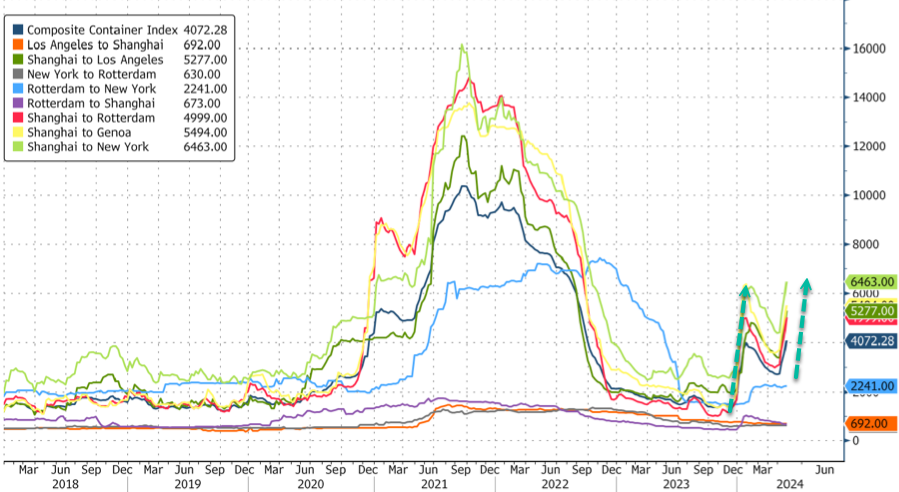
A more conventional supply shock is underway – nowhere near the nuclear-level hit by government-enforced lockdowns several years ago. The Israel-Hamas war has led to Iran-backed Houthis freezing the critical maritime chokepoint of the Bab al-Mandab Strait, attacking Western commercial vessels with missiles and drones (the latest incident on Tuesday), and forcing major shipping operators to reroute containerized freight around the Cape of Good Hope, which strains the world’s containerized capacity and has just sent shipping costs surging once again.
Bloomberg reports new data from France-based CMA CGM SA, the world’s third-largest carrier, indicating that the cost of shipping a 40-foot container from Asia to northern Europe jumped to $7k in the second half of June, up from $5k in the first half of the month. Rates ranged from $6k to $6.5k, with premium services approaching $1k.
“With capacity stretched by more than five months of attacks on vessels in the Red Sea, the container shipping industry is scrambling to meet demand that’s picking up in the US and Europe,” Bloomberg said.
Data from Bloomberg shows that Shanghai to Los Angeles, Shanghai to Rotterdam, Shanghai to Genoa, and Shanghai to New York are some of the most critical shipping lanes experiencing a price jump.
Trine Nielsen, senior director and head of ocean EMEA at Flexport, said companies are “double-booking or increasing booking numbers to secure space” amid thinning capacity.
The chief executive of Germany-based Hapag-Lloyd AG, the world’s number five container carrier, blamed the surge in shipping rates on the continued Red Sea chaos and shrinking capacity, plus “really strong demand.”
There are no forecasts on how long the price surge will last. However, Hapag-Lloyd CEO Rolf Habben Jansen said, “It could still last for another couple of months if the Red Sea situation doesn’t improve.”
News today from Bloomberg says Israel will need at least seven more months to defeat Hamas. This suggests the fight could expand outside of Gaza to either Lebanon or Iran. If that’s the case, expect continued bombardment of ships in critical maritime chokepoints by Houthi rebels – with increasing risks of an oil supply shock that could send Brent crude over $100/bbl.
May 28, 2024
Kronospan makes second particleboard facility acquisition in recent months
By Larry Adams
May 23, 2024 | 9:38 am CDT

Particleboard plant in Island City, Oregon.
Photo By Kronospan
Kronospan, a leading producer of wood panel products, has acquired Woodgrain’s Particleboard facility in Island City, Oregon, which is the second particleboard facility purchase in less than a year.
In December, Kronospan closed the purchase of Roseburg’s Simsboro, Louisiana, particleboard facility.
The company said the addition of the Island City plant will strengthen Kronospan’s position in the North American wood panel market and further demonstrates Kronospan’s commitment to its overall growth strategy. Kronospan has expressed its intent to invest in the modernization of the Island City plant upon completion of the post-acquisition period.
“I’m very excited about today’s announcement. The addition of the Island City plant and its talented team will further enhance our ability to serve our customers and provide long term benefit to our stakeholders” said Hans Obermaier, CEO of Kronospan’s North American operations.
Kelly Dame, president and CEO of Woodgrain stated, “It was important for us to find a buyer that is a good fit for our 124 team members, and one that will continue to invest in the plant and its people”
In addition to the Louisiana, particleboard plant, and now the Oregon facility, Kronospan operates wood products sites in North America, including in Oxford, Alabama, a multi-product site with MDF, Particleboard, Laminate Flooring, TFL and other products, and an MDF/HDF plant in Clarion, Pennsylvania.
May 27, 2024
Business performance by individual segment
Polyols & Derivatives
The Polyols & Derivatives segment recorded positive
business development in the first quarter of 2024. Overall, sales
volumes and revenues were somewhat weaker than anticipated in
our budget for the current fiscal year. On the earnings side, however,
both the positive prior-year figures and our expectations for the first
quarter of 2024 were exceeded at all levels.
The dominant entity in
this segment is the Polyols business unit of PCC Rokita SA, Brzeg
Dolny (Poland), with its polyether and polyester polyols. Demand for
these polyols remained robust in the first quarter, while a temporary,
force majeure-related plant shutdown at a European competitor led
to a supply shortage with respect to polyether polyols.
As a result, average selling prices showed an upward trend in the first quarter, with
a correspondingly positive impact on the sales and earnings perfor-
mance of this business unit.
At the Polish systems house PCC Prodex
Sp. z o.o., Brzeg Dolny, the production portfolio of which includes
spray foams for the insulation of roofs, the extremely encouraging
business performance of the previous quarter continued through
the first quarter of 2024.
By contrast, the portfolio companies and
business units pooled under the intermediate holding company
PCC Insulations GmbH, which are active in the field of insulation and
other building materials, ended the first quarter of 2024 with a loss,
as had been expected.
The Essen-based manufacturer of specialty
foam blocks and polishing pads, PCC Prodex GmbH (Germany), also
closed the first quarter of 2024 with a slight loss, having seen its
numbers come in slightly worse than expected. However, the out-
look for the following quarter is more optimistic due to the current
order backlog.
The ISO 9001:2015 certification awarded to PCC Pro-
dex GmbH in the first quarter of 2024 should also have a positive
impact.
The start-up PolyU GmbH, Oberhausen (Germany), which
develops specialty chemicals based on polyols, also remained slight-
ly in deficit in the first quarter of 2024. However, the losses were
much lower than expected and the current order situation also in-
dicates a continuation of this encouraging trend at the company.
PCC Synteza S.A., Kędzierzyn-Koźle (Poland), which in addition to
contract manufacturing for PolyU GmbH also continues to operate
its core business, namely the manufacture of alkylphenols, also re-
mained in the red in the first quarter of 2024 due to continuing weak
demand for these products
https://www.pcc.eu/wp-content/uploads/2024/05/PCC-Group-Quarterly-Report-1-2024.pdf
 Everchem Updates Archive
 Sign Up for Email Updates
