The Urethane Blog
October 29, 2023
Recticel Trading update third quarter 2023

Regulated information, Brussels, 27/10/2023 — 06:55 CET, 27.10.2023
- Third quarter net sales decrease from € 160.2 million in 2022 to € 132.3 million (-17.5%) in 2023
- Year-to-date September net sales decrease from € 447.5 million in 2022 to € 398.4 million (-11.0%) in 2023
- Net cash position: € 155.6 million (30 June 2023: net cash position € 142.3 million ; 31 December 2022: net financial debt of € 250.0 million)
- Divestment of the 33% share in Orsa Foam completed on 11 October 2023 and first instalment received
Jan Vergote (CEO Recticel): “European construction markets have further contracted throughout the third quarter of 2023.
Compared to the first half of 2023, our Insulated Panels activity has increased volumes and profitability generally in line with our previous outlook and will also enter 2024 with a stronger order book then at the start of 2023.
On the contrary, our Insulation Boards activity has been confronted with additional margin pressure, severely impacting profitability.
These market trends have been observed now in all European countries and our teams are working on several projects to compensate for these shortfalls going into 2024, as no material improvement in market conditions is expected.
Our net cash position has further improved to € 155.6 million since June 2023, linked to disciplined working capital management, some M&A related incoming payments and positive interest income. We continue to further explore several acquisition opportunities to enhance our market and segment positions in Europe.”
OUTLOOK
While Insulated Panels has improved its performance compared to the first half of 2023, Insulation Boards’ profitability has further deteriorated due to increased competition in depressed markets.
In this context, we have to adjust our guidance downwards and expect our full year 2023 Adjusted EBITDA to come out between € 35-40 million.
https://www.recticel.com/recticel-trading-update-third-quarter-2023.html
October 26, 2023
US Durable Goods Orders Soared In September By Most In Over 3 Years
by Tyler Durden
Thursday, Oct 26, 2023 – 08:50 AM
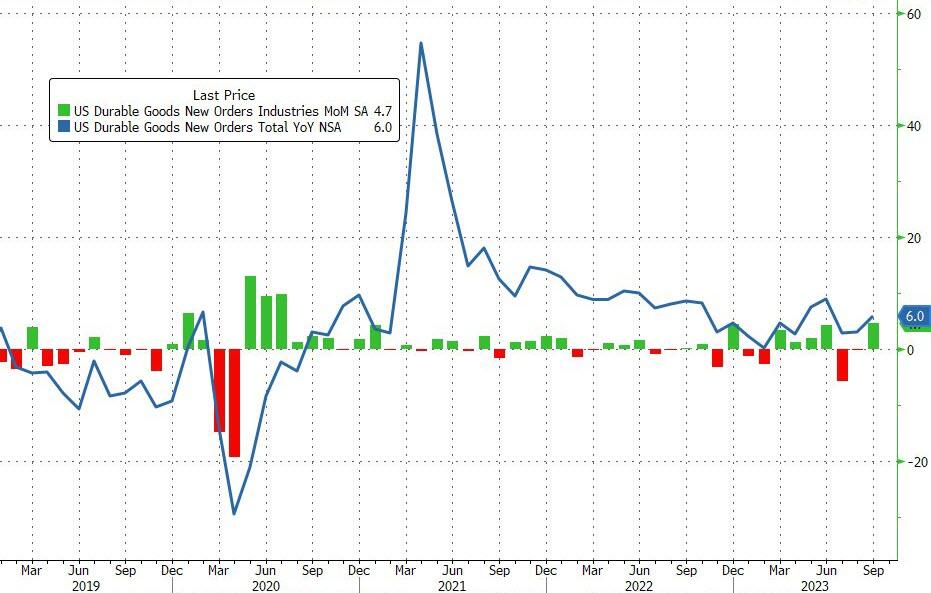
After two straight months of declines, preliminary durables goods orders for September soared 4.7% MoM (far higher than the 1.8% expected), lifting orders by 6.0% YoY…
Source: Bloomberg
That is the biggest MoM jump since July 2020.
Orders ex-transports rose just 0.5% MoM and ex-defense soared 5.8% MoM.
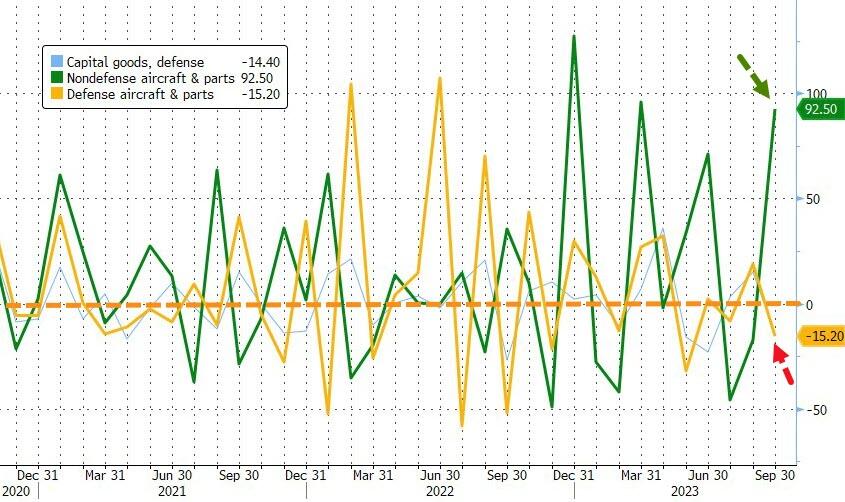
Defense spending tumbled 14.4% MoM but non-defense aircraft spending soared 92.5% MoM…
Source: Bloomberg
Finally, as a reminder, this data is all nominal – i.e not adjusted for inflation.
https://www.zerohedge.com/economics/us-durable-goods-orders-soared-september-most-over-3-years
October 25, 2023

INVISTA decision to close Orange facility catches many by surprise Published 3:09 pm Thursday, October 5, 2023 By Staff Reports (invista.com) INVISTA’s announcement that it is shutting down production at its Orange facility was unexpected news to many.
Orange County Judge John Gothia said he was informed of the news Thursday. “Anytime we have a shut down or loss of jobs in the community, it’s never a good day,” Gothia said.
Gothia said the county has a number of programs to entice businesses to the area and stay competitive, but there’s not a lot to offer to keep an existing business. Looking toward the positive, Gothia noted there are a lot of growth and job opportunities on the horizon in Orange County coming in the next year, in addition to Lamar State College Orange offering a number of training programs to aid job seekers.
INVISTA operates its facility at 3055 FM 1006 in Orange. Francis Murphy, INVISTA president and CEO, said they appreciate the diligent and innovative work of employees at the Orange site over the years. “Unfortunately, lower than anticipated growth and an increase in global supply led to this difficult decision,” a company statement read. The site will begin the safe shutdown of the adiponitrile production unit right away and expects to cease production of hexamethylene diamine in mid-2024, according to information from INVISTA.
HMDA is the precursor for HDI.
Approximately 240 of the site’s 300 roles will be eliminated by the end of 2024. All impacted employees will be eligible for severance benefits. Throughout this transition, the company is committed to treating every employee with dignity and respect, leaders said. INVISTA’s top priority now and always is the safety of employees, contractors and the surrounding community.
“Ultimately, this decision was made to position our business to more competitively serve the long-term needs of our customers,” Murphy said.
Read more at: https://www.orangeleader.com/2023/10/05/invista-decision-to-close-orange-facility-catches-many-by-surprise/
October 24, 2023
Dow Inc. (DOW) Q3 2023 Earnings Call Transcript
Oct. 24, 2023 11:37 AM ETDow Inc. (DOW)

Dow Inc. (NYSE:DOW) Q3 2023 Earnings Conference Call October 24, 2023 8:00 AM ET
Company Participants
Pankaj Gupta – IR, VP
Jim Fitterling – Chairman and CEO
Howard Ungerleider – President and CFO
Jim Fitterling
Thank you, Pankaj.
Beginning on Slide 3. For the third quarter, we continued to advance our long-term strategy while also taking action to reduce costs and maximize cash generation in the face of slow global macroeconomic activity and higher sequential feedstock costs. In particular, we continue to implement targeted actions to deliver $1 billion in cost savings in 2023 and delivered a sequential improvement to operating cash flow of more than $300 million.
Net sales were $10.7 billion, down 24% versus the year ago period reflecting declines in all operating segments due to slower global macroeconomic activity. Sales were down 6% sequentially as volume gains were more than offset by lower local prices. Volume decreased 6% year-over-year, mainly due to lower merchant Hydrocarbons and Energy sales. Volume was up 1% sequentially, led by gains in Industrial Intermediates & Infrastructure and Performance Materials & Coatings. Volume was up 3% sequentially, excluding merchant sales and Hydrocarbons & Energy with gains across all operating segments.
Local price decreased 18% year-over-year with declines in all operating segments and regions, primarily due to lower feedstock and energy costs. Sequentially, price was down 7%, primarily in Europe, the Middle East, Africa and India or EMEAI.
Operating EBIT for the quarter was $626 million, down from $1.2 billion in the year ago period and $885 million in the prior quarter. Our consistent focus on cash flow generation and working capital management enabled team Dow to generate cash flow from operations of $1.7 billion, resulting in a cash flow conversion of 129% for the quarter and 103% on a trailing 12-month basis.
We continue to invest in our long-term strategic priority while also returning $617 million to shareholders in the quarter through dividends and share repurchases. Year-to-date, we’ve returned nearly $2 billion to shareholders. Our cash flow generation continues to enable Dow to fully cover its capital allocation priorities. And our balance sheet remains the best it has been in four decades, supported by strong investment-grade credit ratings with no substantive long-term debt maturities due until 2027.
And in the Performance Materials & Coatings segment, operating EBIT was $179 million compared to $302 million in the year ago period, driven by local price declines in both businesses. Volume was down as gains in commercial building and construction end markets were more than offset by lower demand for personal care and coatings applications and residential construction. Sequentially, operating EBIT increased $113 million, driven by higher operating rates and cost savings.
Starting with decarbonize and grow. In September, we achieved startup of a new MDI distillation and pre-polymer facility at our manufacturing site in Freeport, Texas. This new facility replaces Dow’s existing capacity in La Porte, Texas, and expand supply by an additional 30% at the site to support high-value demand growth in polyurethane systems while also reducing our greenhouse gas emissions by more than 45% compared to the La Porte asset.
Finally, before we move to Q&A, I would like to speak to the announcement this morning that Howard is elected to retire from the company following 33 years of dedicated service. I want to personally thank Howard for his significant contributions to Dow over the last three decades. He’s been an incredible business and strategic partner, created a financial and leadership team that guided our company through numerous challenges and accomplishments and most importantly, he’s been a tremendous colleague and friend.
In addition to recognizing and thanking Howard, we are pleased to share that the Board has elected Jeff Tate to the role of CFO effective November 1, 2023. As we thank Howard for his years of service and there will be time to honor and recognize him for that. We’re excited to welcome Jeff back to Dow. Many of you will remember, Jeff, who also previously led Dow’s Investor Relations team. He returns to us following a 4-year stint as the CFO of Leggett & Platt.
Prior to that, Jeff had 27 years with Dow in various finance roles, including VP of Finance for Packaging and Specialty Plastics and was our lead auditor. Jeff is joining us here today, and we’ll look forward to him joining our next earnings call in his formal role.
Jeff Zekauskas
Thanks very much. In your $1 billion cost-cutting program, how much of that comes out of SG&A and R&D? And in your slides, you say that your share count in the fourth quarter is 7.10 and in the third quarter, it was7 or 7.5. Are you rounding or is the share count going up?
Jim Fitterling
Yes, Jeff, good morning. On the cost, about half of the costs come out of our structural operating cost model, which would include obviously, making sure that we’re controlling SG&A, during this time period. It also includes things like contract labor and what we’ve been doing, there to reduced headcount.
On our operating cost side, it’s things like purchase raw material and logistics costs, utilities costs being down, our turnaround spend, which is down about $300 million. And while SG&A is down both in cost and as a percent of sales, we’re obviously still continuing to invest in research as we go forward. Howard, do you want to touch on the share count?
Kevin McCarthy
Yes, good morning. Jim, I’d appreciate your outlook for Dow’s construction-facing businesses heading into 2024. Some of the companies that we cover are pointing to meaningful benefits from infrastructure and reshoring-related investments, basically fiscal stimulus. On the other hand, we’ve got rising rates, and that typically has a chilling effect. So, how do you see those countervailing trends netting out for Dow and affecting the way you’re planning for the future?
Jim Fitterling
Yes. Good morning, Kevin. The things we watch on construction, obviously, on commercial construction just the completion rates on existing builds and the permit work that’s going on new builds. I would say this has been a relatively strong year on commercial because there have been a lot of projects that were in flight. We’re starting to see, obviously, some tick up in applications for pyramids on residential for the noncommercial side of things, which is good.
But I think as long as there’s a question out there on rates and will rates continue to rise, that’s going to put a lid on what we’ll see on residential construction. In terms of infrastructure, we are seeing some movement in that space. I would say the biggest rate-limiting step on infrastructure is permitting. So, the speed at which people can get permits, whether that’s for – it could be for pipelines.
It could be for transmission cabling, you name it, but there could be some limitations there, and we keep an eye on that. Overall, I feel good about the fact that we’re moving through the toughest phase of it right now. And if we could see some positive growth come back in the construction markets in China and the U.S., that will be a nice upside for us in ’24.
Steve Byrne
Yes. Thank you. The inventory chart you have on Slide 6 is intriguing. What I’m curious about is, for each of your businesses, do you have a view as to how much your customers have destocked your products relative to their end market demand. And thus, how much of this sequential decline that you’ve seen 12, 15 months is destocking versus just end market underlying demand weakness. You showed some sequential improvement, in each of your businesses in the third quarter. Is that just destocking coming to an end? Or do you think that this is really some firming demand by your customers?
Jim Fitterling
Good morning, Steve, it’s a good question. Obviously, we get industry data that we published on the chart that you see there. When it comes to downstream when we get into the consumer brands and the retailer space, we have to go on reported data that we clean out of their public reports. But just a few things to keep in mind. We know in the auto sector, for example, that with the OEMs.
It’s been pretty much hand to mouth, because there have been other rate-limiting steps like the ability, to get computer chips. We haven’t seen a big restocking with the OEMs. We’ve seen the OEMs continuing to run, because they want to be in a position to ramp up when the strikes get settled. So, I would say, I don’t feel like there’s a lot of restocking going on there.
I would say on the consumer brands and the pharma companies lately seen them, obviously, watching inventory levels. I don’t get any sense of any stocking or big destocking going on there. I think it’s running more to meet demand. And then, the other thing we take a look at is obviously what’s going on with the construction segments, as I just mentioned.
But it’s a little bit harder. It’s a little bit fuzzier when we get into the downstream. We don’t have as much published data to rely on. So, we look more at PMI. We look more at retail sales. We look more at, what they comment on in their public filings.
October 23, 2023
North American chem rail traffic rises

MRC — North American chemical rail traffic rose for a ninth consecutive week, with railcar loadings for the week ended 14 October up 0.3% year on year to 44,668, according Association of American Railroads.
For the first 41 weeks of 2023 ended 14 October, North American chemical rail traffic was down 1.1% year on year to 1,857,880 – with the US down 2.3% to 1,275,816.
In the US, chemical railcar loadings represent about 20% of chemical transportation by tonnage, with trucks, barges and pipelines carrying the rest. In Canada, chemical producers rely on rail to ship more than 70% of their products, with some exclusively using rail.
We remind, for last week, total U.S. weekly rail traffic was 499,217 carloads and intermodal units, up 3.0 percent compared with the same week last year. Total carloads for the week ending October 7 were 233,768 carloads, up 3.6 percent compared with the same week in 2022, while U.S. weekly intermodal volume was 265,449 containers and trailers, up 2.5 percent compared to 2022.
https://www.mrchub.com/news/409834-north-american-chem-rail-traffic-rises
 Everchem Updates Archive
 Sign Up for Email Updates