
Chetan UdeshiAnd can I follow up quickly on chlorine. What is exactly the problem with chlorine production? Is it — I think you produce your own chlorine. So is it something got to do with the Covestro production system having some issues?Markus SteilemannYes, this — okay, let me call it that way. There is an issue with the piping in the chloride plant and that was due to some repair works that has been conducted. And that repair works that have been conducted led then later on to, let’s say, a mechanical disruption of the system, and that then has caused us to figure out that while the pipes were replaced, there was obviously a material issue with the pipes. And to replace that and to make absolutely sure that this never happens again, we are currently with the entire value chain that delivers those pipes that is actually also using those pipes and repairing those pipes does not make any mistake anymore. And that’s why we are currently in that situation.
The Urethane Blog
March 3, 2023
Covestro AG (CVVTF) Q4 2022 Earnings Call Transcript
Mar. 02, 2023 3:47 PM ETCovestro AG (CVVTF), COVTY

Covestro AG (OTCPK:CVVTF) Q4 2022 Results Conference Call March 2, 2023 10:30 AM ET
Company Participants
Ronald Koehler – Head, IR
Markus Steilemann – CEO
Thomas Toepfer – CFO
Markus Steilemann
Thank you, Ronald, and good afternoon, a warm welcome also from my side. Looking back to the year 2022, we must clearly admit that the last year was challenging. The effects of the coronavirus lockdown in China during the second quarter caused severe disruptions of logistic chains within China and the rest of the world. Then the war in Ukraine also with a tremendous humanitarian impact. We have and continue to support the Ukrainian people with our donations through the United Nations Refugee Agency and our local country organizations in Poland and Slovakia.
Let me give you an overview of the key financials. Covestro achieved a record sales of €18 billion, driven by significant price increases in order to cope with the tremendous energy and raw material cost inflation. The EBITDA decreased to €1.6 billion, unfortunately, with strong downward traction in the second half of 2022. Nevertheless, — we were able to secure a positive free operating cash flow supported by significant working capital savings in the fourth quarter. Despite all these challenges, we returned more than €800 million to our shareholders in form of dividends and share buybacks. The nonfinancials are getting more and more important for Covestro and also for our shareholders.
Let’s turn to Page #4. Another highlight of the quarter was the successful start-up of our new world scale facility to produce chlorine in Tarragona, Spain. The new plant is based on one of the highly innovative and energy-efficient oxygen depolarized cathode technology invented by Covestro and its partners. This new plant ensures an efficient and independent supplier of chlorine and caustic soda to our MDI production in Tarragona. The €200 million investment will strengthen the European production network for MDI and has created 50 new jobs on site. In 2022, our MDI plant in Spain was already the low-cost plant in Covestro’s European network. Please note that Spain has its gas supply coming from North Africa. The expected EBITDA contribution of the reduced cost of chlorine purchases and additional sales of caustic soda and hydrochloric acid is estimated to be a mid-double-digit million euro amount compared to the predominantly used conventional [chloralkali] electrolysis.
Now turning to Page #5. Let us now have a closer look at the past year, starting with the volume development. Year-on-year, the global sales volume decreased by 5%, mainly driven by weaker demand in the region EMLA and destocking mainly in Europe and to a smaller extent in North America. The region EMLA has seen significant decreases in all industries important to Covestro and was clearly the weakest region. Despite the lockdown situation in the first half 2022, Asia Pacific is showing just a slightly negative volume development. Electro declined significantly and furniture, slightly. However, the stimulus program for auto and transport as well as construction reduced the overall loss with both industries showing growth. Sales volumes in North America were flat with slight decline in furniture wood being offset by construction and auto and transport.
Looking closer into the different industries, the clear and lasting negative trend in furniture wood is continuing in all regions. Electrode shows especially in the 2 regions, Asia Pacific and EMLA, a continued negative trend. Both industries are affected by a post-COVID decline and a reluctance in private spending due to rising inflation. The picture is, however, mixed for the construction industry. Whilst volumes in Asia Pacific and North America are increasing, the situation in EMEA was negatively affected by the raw material energy price situation. The globally positive trend is the volume increase in the automotive industry, at least in 2 regions, Asia Pacific and North America namely. Also in Europe, the trend was positive in the fourth quarter, quarter-over-quarter, but not strong enough to compensate for the losses quarter 1 to quarter 3.
Thomas Toepfer
So with that, let us go into the 2 segments, and let’s start with Performance Materials. Clearly, the segment suffered from the significant negative pricing delta. And while in the first half of the year 2022, we were still able to pass through the majority of higher feedstock and energy prices on solid demand. In the second half, this pricing delta turned largely negative because the demand significantly weakened first in Europe, but then also globally across all the industries, as Markus has outlined earlier. And because of the stronger commodity character of the PM products, and the result is that we’re much more exposed to variations in the supply and demand structure. So overall, the PM segment EBITDA declined year-over-year by 63% to €951 million because the supply was outperforming demand, and we had low pricing power and consequently, also the EBITDA margin declined significantly to 10.5%.
Now if we look forward into the year 2023, we are expecting that our sales volumes should stay flat versus 2022 with Q1 and Q2 being still weak, and we’re expecting the second half to show a recovery. And I would also say that the first half of this year will still be burdened by idle costs, especially in Europe, for almost all core products, but we’re expecting that this situation should then ease in the second half of the year.
Markus Steilemann
Thank you, Thomas. Let’s turn to Page #14 and take a look at the growth demand outlook for our key customer industries. Our outlook into 2023 expects a further contraction of the global GDP to only 1.5% underlying in the weakness in demand we are currently observing in many industries. Despite exhibiting the most optimistic growth number with 4.6%, automotive is expected to remain below 2019 levels. However, the electric vehicle outlook remains strong with almost 43% growth. The outlook on construction for 2023 is with 0.8%, again, less optimistic and is strongly influenced by the European raw material and energy price situation. The resulting high inflation and increased interest rates are especially hitting the residential sector where the outlook is even negative. After a year of contraction, we foresee a stable trend in the furniture industry. Electro is also expected to further slowdown and demand is only expected to grow at a rate of 2.0%.
However, for the appliance industry, after the negative demand development in 2022, a recovery with a slight growth of 3.7% is expected. This industry is an important consumer of MDI for the insulation part of the appliances.
Christian Faitz
You incurred some [indiscernible] impairment losses in Q4 in Solutions and Specialties. I know that, Thomas, you just elucidated those a bit just now. Are there also impairments from the DSM Resins acquisition? And the second question I have is, how is demand out of China at present? Is the post-COVID recovery as strong as hoped for a few weeks ago?
Thomas Toepfer
Yes, Christian, let me start with the impairment. So again, the vast majority of the impairments, as I said, comes from the polyols and from TDI, and a very, very limited amount refers to, as you said, to a specific business segment in the RFM business that we acquired. Remember, the business that we acquired had various segments, and there’s one smaller one, which was also hit by an impairment, but the vast majority of RFM was absolutely unaffected.
Charlie Webb
Maybe just following up on the demand picture. Could you help us understand a little bit if you didn’t have the force majeures in the fourth quarter, where volumes would have been across PM would be helpful. And how do you see volumes in Q1 — within that Q1 guidance given the force majeures are still in place?
And then just second question just around, I guess, the health of the supply and demand for your key commodities. Obviously, the question around demand and I understand that’s very difficult to answer. But when you look at the supply, I mean, we’re expecting additional supply additions in TDI and MDI in China this year. I suspect polycarbonate is largely done, but certainly, the utilization rate is not quite low. So just trying to understand how do you see the current balance across those commodities looking through this year? Because it does still seem like we’re still in a wave of supply additions regardless of where the demand comes spectrum or not. That might dampen any sort of recovery for ’23. Just on to gauge your view on that.
Markus Steilemann
Charlie, this is Markus speaking. So first and foremost, thanks for the question, and it is one of the questions that is really on top of our heads. Also, when we try to look into this year and also when we looked into the guidance for this year. So you’re absolutely right. We were dealing in the fourth quarter of last year with quite a number of force majeure, and those are continuing into the first quarter. And that is, for example, our TDI unit in [Dormagen], which is only running maximum at half capacity, our [Uerdingen] polycarbonate as well as MDI facility in Uerdingen impacted basically by the chlorine supply chain that supplies all of the 3 mentioned assets. So it is not only but strongly, let’s say, focusing on Europe when we talk about respective supply topics with regard to force majeure that we have. They’re definitely has led also to the inability to supply more, and that also has partially contributed to the volume development.
But let me also be clear, the volume development on the one hand is limited by our supply situation, but it is also limited and that also continues into the first quarter by still a challenging demand environment. And here, and I alluded, based on Christian’s question a little bit to that, the demand situation is particularly, let’s say, challenged in Europe and challenging — and continues to be challenging in Europe. And we still have not yet seen major positive signs from an improvement in demand in China. Whereas the U.S., that was, I would say, slightly — flat to slightly negative. So that is how we have started. So baseline after a little bit more detailed explanation. The majority of decline in demand is really coming from weaker demand or sales from our side is coming from weaker demand and not, let’s say, from our force majeure situation.
So for Q1, therefore, we expect, in total, a mid-teens volume decline, and yes, that’s what we currently expect. If we talk about the balance or let’s say, supply-demand balance, TDI was very strongly down in a year talking market. Market for TDI in 2022 by minus 7%. But let’s not forget, in which position Covestro is in those markets. We are normally first ones to be in when a crisis comes, but we’re also the first ones to be out. That means a very fast rebound and very quick recovery is possible. So that is how I see it. If you want to have, let’s say, a guess on MDI, construction is still, let’s say, as we said, expect it to be slightly positive for the full year. However, we have not yet seen that there’s a pickup, as I said, with regard to China. We expect the pickup to happen now in March because that’s normally when construction season starts. And yes, that’s the current situation.
I hope it’s helpful. It’s a very mixed bag, honestly speaking, and we try to provide you with as much insight as we have, but we’re also trying to figure out what is currently going on.
Charlie Webb
Got it. That’s helpful. If I could just follow up quickly in terms of the supply and demand. I mean are you surprised to sort of see Chinese peers and competitors adding capacity into the MDI at these current levels because we still have some pretty big additions this year.
Markus Steilemann
Well, first and foremost, there is – and we have always been very clear – for all the, let’s say, more commoditized parts in our portfolio and particularly for MDI, a clear mid- to long-term demand growth. And take MDI, we are convinced that growth rates structurally are still in the area of 4%, 5% to 6%. Next to the fact that we have seen, let’s say, the challenges, but do not – or please do take into consideration that we’re talking about energy-efficient buildings. We talk a lot about retrofitting needs. Yes, we have seen now due to somewhat, I would say, pre-consumption patterns during the corona pandemic in – with regard to furniture also a stronger decline in TDI. But that is not a structural challenge, it’s more a cyclical challenge that we are facing. And with regard to destocking, we will think that we will see the end of destocking latest by Q2, and therefore, Q3 rebound is possible. So having said – and you referred to additions in supply, I mean, let’s also be clear, and we have been clear in different context in the last couple of years.
Once you decide to invest, you invest and then the best way to build as effective and efficient as possible is just to push through and build as quick as possible. Stopping and accelerating makes investments extremely costly, and that’s why exactly what you see right now is just a consequence of decisions that have been taken a year or years ago. And the respective companies also see, as we do, obviously, the structural growth opportunities in those markets. The major additions you are talking about are coming solidly from one who are in China. And as we have always stated from our observation, that is a player who is very price disciplined because they have the largest market share. That means they have the most to lose if they’re not very disciplined on that. Also here, I hope that gives you some flavor.
Georgina Fraser
I’ve got two questions. The first one is on your volume outlook, and it’s kind of in 2 parts. You’re using the IHS GDP forecast of 1.5%. Our in-house at Goldman is 2.4%. I was just wondering why you would expect your volumes to undergrow GDP this year when they already did last year? And then another kind of similar question. Markus, you’ve been at Covestro for more than 20 years. Have you ever seen volumes down mid-single digits and then the subsequent year was only flat? And then my second question is, any comments that you can make around how the competitive landscape in European TDI is evolving on the back of BASF’s announcement?
Thomas Toepfer
Georgina, this is Thomas. So let me start with the volume question. And first of all, of course, we don’t have a crystal ball, so we took the 1.5%. Let’s hope that Goldman Sachs is right and the 2.4% materialize. But your question was more regarding our volumes. So the factors that we have baked in is that we are still seeing some destocking in the first quarter of this year, and we’re also still struggling with some force majeures that will also not only burden Q1, but also at the beginning of Q2, and only then should we see some improvements. And then, of course, you will see some growth because the comps are getting easier in the second half of the year. But the reason why we’re not significantly outgrowing that, but rather being flat is that we’re still struggling with, as I said, destocking and some internal problems that we have to resolve, specifically in our [North-Rhine Westphalia] assets.
Markus Steilemann
Yes, Georgina, this is Markus speaking. Very good to hear you, and thanks for your questions. And as you directly addressed the question to me, and I have to say, I’m not 20 years with Covestro, even though I might look that old already, I’m actually 24 years with the company and only joined Covestro then back in 2004. So there’s still one year to go just to be very precise on the data. But your question was targeting did I ever see in that, let’s say, 19 beautiful years, let’s say, 2 sequential years with negative or, let’s say, at least one negative and then flattish volume. I would say, yes, kind of, but is it very lightly. No, not necessarily. But I think Thomas has made it very, very clear why we have actually have given that you could call it conservative guidance. So yes, so that is exactly how I would interpret and answer to your question, yes.
So – and then on the competitive situation, particularly in TDI, how do I look at the picture? I do not comment on what our colleagues up the Rhine River and Ludwigshafen have said, but the overall numbers is that with that capacity at one point in time not being there in Europe anymore, it would mean that we have 36% lower European capacity on TDI and 9% lower global capacities. We were and therefore, also remain the low-cost producer in Europe, especially given that the gas phase technology that we are using has 60% less energy consumption than the other processes that are used in the industry. And with that, also Europe is coming from a net exporter position into a net importer position. And we also believe that the TDI market, next to all the short-term turbulences, structurally would still grow with a low single-digit rate. So that’s how I currently look at the TDI situation. I hope that is a comprehensive answer to your 2, 2.5 questions.
March 1, 2023
Spandex market not worry-free in March
Text size

| Spandex price strongly increased after the Spring Festival holiday driven by bullish policies, low operating rate of the whole industrial chain and active downstream procurement. Price of spandex increased the most among major raw materials of textile and apparels. However, the later market is also worrying with inadequate new export orders and surging spandex capacity. Spandex market will encounter bigger pressure. Domestic orders for fabrics better than exports Domestic orders for fabrics were good in Feb, mainly orders for light fabrics for spring and summer. Some fabric mills are hoarding up conventional varieties. The production is anticipated to sustain in the traditional peak season during Mar and Apr. Some companies went abroad to snatch orders in end-2022 and early-2023, while export orders remain insufficient. Overseas consumption is obviously depressed by high inflation and apparently soaring mortgage rate, which ends up with falling orders from Europe and US. Export orders may recover in Mar-Jun, which may be low at first but increase later within 2023. Operating rate of fabric mills apparently rose in Feb, with that of warp knitting plants at 60-70%, that of circular knitting plants and covered yarn plants in Zhejiang and Jiangsu at 50-70% and that of lace knitting plants in Changle, Fujian and circular knitting plants in Foshan at around 40% now. Many downstream plants replenished with optimized pandemic prevention and control policies. Some fabric mills focused on digesting spandex prepared before. Stocks of spandex started rising from late-Feb, which were above 27 days now. Spandex capacity soars By the end of February 2023, the capacity of spandex is revised up by 55kt to 1151.5kt/year in Chinese mainland, up by 5% on the month and 18.5% on the year. Huafon Chongqing, Hyosung Ningxia and Tayho Yantai’s spandex capacity increases by 25kt/year, 20kt/year and 10kt/year respectively. Current operating rate of spandex plants is near 85%. Above 970kt/year of capacity is running now, slanting high in recent two years, up by 7% on the year and 22.6% over the corresponding period of 2021. The run rate of plants with capacity at 30-50kt/year or above was at 72% and that of companies with capacity below 20kt/year approached 61%. BDO price turns to consolidate and PTMEG price may rise slightly Many BDO plants are scheduled to have turnaround in Mar. That means supply of BDO will reduce in short run. The supply from units with expanding capacity does not increase in short run. Therefore, the actual supply of BDO is anticipated to be flat with Feb in Mar. Stocks of BDO are low. Demand for BDO fails to improve much. Price of BDO is estimated to be in range bound in short run. Demand for PTMEG is strong when new spandex units start operation. Price of PTMEG is expected to slightly rise in Mar. In addition, Wanhua Chemical updated MMDI Mar nominations at 24,500yuan/mt, up by 2000yuan/mt on the month, and Feb settlement was at 20,600yuan/mt, up by 2,100yuan/mt on the month. With advancing feedstock prices, the feedstock cost of spandex is anticipated to climb up in Mar. In summary, the support from the feedstock cost remains strong on spandex market but the follow-up of new orders for fabrics and the recovery of consumption is crucial. Players were optimistic toward the domestic and export orders for fabrics earlier, but current export orders are scarce, which will weigh on the increase of run rate in fabric mills to a certain degree. New spandex units gradually commission operation and more products will be put into the market. The operating rate of existing spandex plants is medium-to-high. Supply of spandex rises but downstream buyers focus on digesting spandex prepared before. Price of spandex is likely to be firm in the first half of Mar under cost pressure and may move down in end-Mar or early-Apr with the release of products from new units and mounting inventory among suppliers. |
https://www.ccfgroup.com/newscenter/newsview.php?Class_ID=D00000&Info_ID=2023022830071
March 1, 2023
Recticel Annual Results 2022
Regulated information, Brussels, 28/02/2023 — 06:59 CET, 28.02.2023
- Net sales increase from €449.2 million in 2021 to €561.5 million (+25.0%) in 2022, of which €129.2 million contribution from Trimo and a €48.9 million reduction following the phasing out of sales of chemicals to divested Automotive companies
- Adjusted EBITDA: from €48.4 million to €62.2 million (+28.4%)
- Result of the period (share of the Group): from €53.5 million to €63.2 million
- Closing of the divestment of Engineered Foams expected at the end of 1Q2023
- Proposal to pay an increased gross dividend of €0.31 per share
Olivier Chapelle (CEO Recticel): “The European construction market has become increasingly challenging as the year 2022 unfolded, with growing economic uncertainties and historically high inflation and rising interest rates weighing progressively more and more on construction activities. In that environment, I am proud of all our employees and want to thank them. In 2022, their focus and contributions have allowed to deliver, when compared to 2021, slightly higher volumes in Insulation Boards and flat volumes in Insulated Panels. Reactivity on pricing and margin management have in turn contributed to deliver solid results.
The divestment of Engineered Foams is expected to close at the end of the first quarter of 2023. It follows the decision on 26 January 2023 by the Competition and Markets Authority in the UK, to approve the Final Undertakings, which execution is now entering its final phase.
With the acquisition of Trimo on 1 May 2022, now fully integrated, we have created a broader basis for further internal and external growth.
With regard to ESG and sustainable development, after having announced our commitment to the SBTi, we can report a 11.2% reduction in our Scope 1 & 2 carbon emissions in 2022 versus reference year 2021.”
OUTLOOK
The year 2022 has been very challenging due to the consequences of the geopolitical turmoil. During that year, our business has resisted well and is well positioned at the beginning of 2023, despite the current lack of visibility. Margin management, growth initiatives and further progress on ESG are the priorities in 2023.
At this stage, the Company does not provide guidance related to its full year 2023 expected results.
https://www.recticel.com/recticel-annual-results-2022.html-0
March 1, 2023
US Bankruptcy Filings Surge At Fastest Pace Since 2009
by Tyler Durden
Wednesday, Mar 01, 2023 – 07:45 AM
For the past year, both the Biden White House and the Fed have been desperate to usher in a (mild) recession in the US to break the back of runaway inflation and the wage-price spiral with little success. But judging by the surge in bankruptcy filings, they are about to get their wish.
One month ago, when looking at the recent pace of large bankruptcy filings (those with more than $50MM in liabilities), we noted a troubling trend: in the first month of the year, the number of US bankruptcies topped 20, the highest in any other January dating back to 2010. Back then, 25 filings were seen as the economy was still reeling from the aftermath of the GFC.
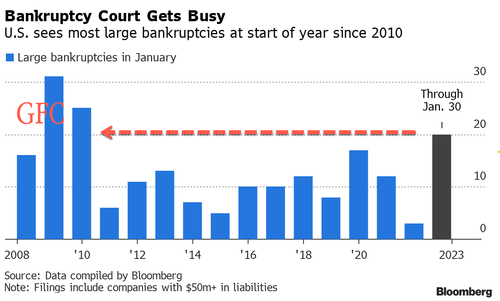
The spike in defaults was not a fluke, and according to Bloomberg data, one month later – as of the end of February – no less than 39 large companies had filed for bankruptcy in the US so far this year, as February’s pace matches that of January; the YTD total represents the fastest pace of companies filing for bankruptcy since the immediate aftermath of the global financial crisis in 2009. By comparison, US bankruptcy courts had seen 63 large filings at this point in 2009.
Last week’s seven large filings — those tied to at least $50 million of liabilities — include the liquidation of generic drugmaker Akorn and the Chapter 11 filing of Covid-19 testmaker Lucira Health
This year, some of the most notable bankruptcy filings have been festive retailer Party City Holdco Inc, mattress maker Serta Simmons Bedding LLC, and cryptocurrency lender Genesis Global Holdco.
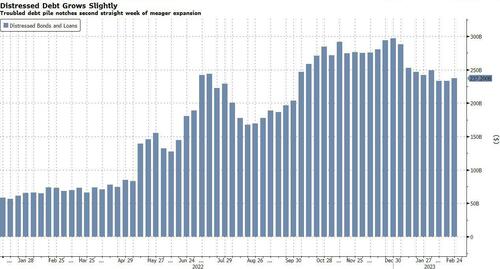
The pile of dollar-denominated corporate bonds and loans in the Americas trading at distressed levels rose to $237.2 billion in the week ended Friday, about a 1.63% increase from $233.4 billion a week earlier, according to BBG data.
Some more details from Bloomberg:
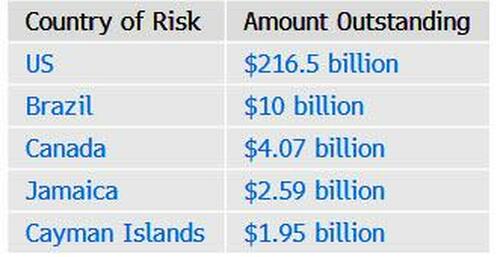
- The US accounts for the greatest volume of distressed debt in the Americas
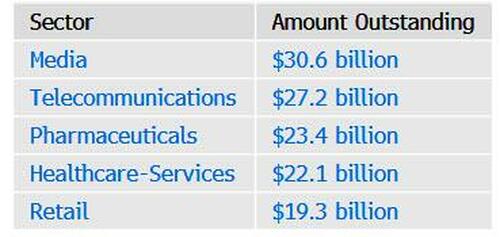
- The media sector had the greatest amount of distressed debt as of the latest week
- Bausch Health Cos. had the most distressed debt outstanding of any issuer as of Feb. 17, data compiled by Bloomberg shows
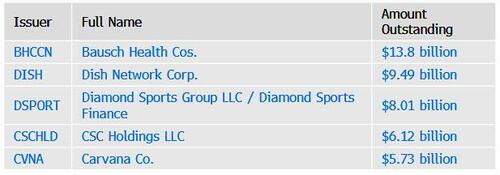
https://www.zerohedge.com/economics/us-bankruptcy-filings-surge-fastest-pace-2009
February 28, 2023
European Benzene Pressure Continues to Mount, Phenol Prices are on the Rise, MDI Producer Idles Unit
- 22-Feb-2023 3:18 PM
- Journalist: Robert Hume
Hamburg (Germany): In the European market, the continuous increase in Benzene prices has made headlines, and producers have failed to face the heat of the rising prices. In the latest turn of events, Huntsman Corporation announced the idling of one of their Methylene Diphenyl Diisocyanate (MDI) plants in Rotterdam. The company announced that the unfeasible economics and sluggish demand drove the announcement.
Earlier, Huntsman Corporation has already idled one of their MDI units in Geismar, Louisiana.
In Europe, Benzene prices have increased by more than 50% since the beginning of the year, and the mounting pressure of rising prices has been more than evident.
Benzene forms a critical intermediate to several fundamental petrochemicals, MDI, Phenol, Cyclohexanone, and many others. MDI goes into Polyurethane production; while Cyclohexanone is a crucial part of Polyamide value chains and Phenolic Resins, Caprolactam is an important source of the demand for Phenol.
The incessant rise in Benzene prices has disrupted the economics of several downstream value chains. The high energy price pressure and firm cost support have translated into rising Cumene prices. Furthermore, the unbearable pressure of the Benzene prices has translated not only on the direct downstream but also on their derivatives; the sharp rise in Phenol has been a case in point.
Europe has been facing a double whammy, rising cost pressure and weak downstream demand, which has made the producers swallow a tough pill. The producers have become the shock absorbers between the soaring energy prices and the ultimate consumers. Huntsman has stated that they won’t be carrying on being the shock absorbers anymore.
Huntsman Corporation has implemented energy surcharges since the sharp climb in energy prices; however, the impact of energy surcharges has been limited at the very most. Thus the idling of production units comes as the last resort for the MDI producer to stay afloat.
China has eased covid restrictions and increased in demand since the conclusion of the Lunar New Year holidays, suggesting the changing market dynamics after the 2022 debacle. The improving economics in China also bodes well for the global economy as China forms a crucial production house as well as a key end-use market for several products that the Western market exports heavily.
 Everchem Updates Archive
 Sign Up for Email Updates


