
The Urethane Blog
February 24, 2023

Hong Kong Exchanges and Clearing Limited and The Stock Exchange of Hong Kong Limited
take no responsibility for the contents of this announcement, make no representation as to
its accuracy or completeness and expressly disclaim any liability whatsoever for any loss
howsoever arising from or in reliance upon the whole or any part of the contents of this
announcement.
Sinomax Group Limited
盛諾集團有限公司
(Incorporated under the laws of the Cayman Islands with limited liability)
(Stock Code: 1418)
PROFIT WARNING
This announcement is made by Sinomax Group Limited (the “Company”, together with its
subsidiaries, collectively the “Group”) pursuant to Rule 13.09(2)(a) of the Rules Governing
the Listing of Securities on The Stock Exchange of Hong Kong Limited (the “Listing Rules”)
and the Inside Information Provisions (as defined in the Listing Rules) under Part XIVA of the
Securities and Futures Ordinance (Chapter 571 of the Laws of Hong Kong).
The board of directors of the Company (the “Board”) wishes to inform the shareholders of
the Company and potential investors that, based on a preliminary review of the unaudited
consolidated management accounts of the Group for the year ended 31 December 2022
(“FY2022”) and other information currently available to the Board, the Group is expected to
record a loss after taxation for FY2022 of not less than HK$35 million as compared to a profit
after taxation for the year ended 31 December 2021 of approximately HK$31 million. This
was primarily attributable to the continual outbreak of the COVID-19 which had critically
weakened both local and global consumption market and also the sales of the Group, and the
impact of the above also resulted in higher supply chain and logistic costs of the Group.
The Company is in the process of finalising the Group’s audited consolidated financial results
for FY2022. This announcement is made based on a preliminary review of the unaudited
consolidated management accounts of the Group for FY2022 and other financial information
currently available, which are subject to finalisation and possible adjustments upon review and
audit by the Company’s auditors or audit committee. Further details of the Group’s financial
results for FY2022 will be disclosed in the annual results announcement of the Company,
which is expected to be published on 28 March 2023.
Shareholders and potential investors of the Company are advised to exercise caution
when dealing in the shares of the Company.
By order of the Board
Sinomax Group Limited
Lam Chi Fan
Chairman
Hong Kong, 10 February 2023
As at the date of this announcement, the executive Directors are Mr. Lam Chi Fan (Chairman
of the Board), Mr. Cheung Tung (President), Mr. Chen Feng, Mr. Lam Kam Cheung
(Chief Financial Officer and Company Secretary) and Ms. Lam Fei Man; and the independent
non-executive Directors are Mr. Wong Chi Keung, Professor Lam Sing Kwong Simon,
Mr. Zhang Hwo Jie and Mr. Wu Tak Lung.
https://www1.hkexnews.hk/listedco/listconews/sehk/2023/0210/2023021000667.pdf
February 24, 2023
Covestro to build its largest TPU site in China
February 24, 2023Rekha NairBusiness0

Covestro will build its largest Thermoplastic Polyurethanes (TPU) site in Zhuhai, China. With an overall investment in the low three-digit million Euro range it will also be the company’s largest investment in its TPU business. TPU are a highly versatile plastic material, a real multi-talent that offers a broad range of properties for a diverse set of applications like sports shoe soles, IT devices such as sweepers, smart speakers and phonecases or automotive applications.
“This investment shows our ongoing commitment to growth in our Solutions & Specialties business entities”, said Covestro CCO Sucheta Govil. “With this new plant for TPU we want to capture the expected fast and high market growth of the TPU market globally, and especially in Asia and China. The production site will be able to serve both the growing Asian markets, as well as demand in Europe and North America.”
Located in the Zhuhai Gaolan Port Economic Development Zone in Guangdong province, the new site will eventually span across 45,000 square meters. It shall be completed by 2033 and is expected to achieve a production capacity of nearly 120,000 tons of TPU per year. It will be built in three phases. The mechanical completion of the first phase is estimated for the end of 2025. This will lead to a production capacity of about 30,000 tons per year and the creation of about 80 new jobs. The initial investment for this phase lies in the mid double-digit million Euro range.
“I’m delighted to share this important news for our Business Entity. This new plant will enable us to be in close proximity to our customers and the value chains in the IT, consumer electronics, footwear and other industries”, said Dr. Andrea Maier-Richter, Head of TPU at Covestro. “The majority of the TPU market and its growth prospects are in Asia and particularly in China. Our investment there shows our clear intention: We want to remain successful with our customers and partners in the long run.”
An innovation center will also be part of the investment, enabling researchers on-site to design customized material formulas and to do formula adjustment to meet customer demands within very short cycles. Sustainable and ever more circular solutions are among the long-term core target for these efforts. This shall also support broadening the offerings under the recently introduced, sustainable “CQ” product line. Products labelled as such consist of at least 25% alternative, non-fossil raw materials. The site will furthermore utilize the most advanced production technologies and be run on 100% green power. It will produce injection molding grades for footwear and a wide range of IT devices, as well as extrusion grades for cables, hoses and tubes or automotive applications.
Covestro to build its largest TPU site in China
February 24, 2023
BASF shows resilience in a challenging market environment and implements measures to strengthen competitiveness
- Sales: €87.3 billion (plus 11.1 percent)
- EBIT before special items: €6.9 billion (minus 11.5 percent)
- Cash flows from operating activities: €7.7 billion (plus 6.4 percent); Free cash flow: €3.3 billion (minus 10.2 percent)
- Proposed dividend of €3.40 per share for business year 2022 (2021: €3.40 per share)
- Presentation of concrete measures to save costs in Europe and to adapt Verbund structures in Ludwigshafen
Outlook 2023:
- Sales of between €84 billion and €87 billion expected
- EBIT before special items of between €4.8 billion and €5.4 billion expected
BASF Group has shown resilience in the 2022 business year in a challenging market environment that was dominated by the consequences of the war in Ukraine and in particular by increased raw material and energy prices. As Dr. Martin Brudermüller, Chairman of the Board of Executive Directors, and Dr. Hans-Ulrich Engel, Chief Financial Officer, explained during the presentation of the figures for 2022, BASF increased sales by 11.1 percent to €87.3 billion. Sales growth was mainly driven by higher prices across almost all segments due to an increase in raw materials and energy prices. The Materials and Chemicals segments implemented the highest price increases. Significantly lower volumes overall dampened sales growth in the BASF Group. Volumes development was primarily driven by lower sales volumes in the Surface Technologies and Chemicals segments.
At €6.9 billion, income from operations (EBIT) before special items was 11.5 percent below the prior-year figure, but within the forecast range. The earnings development was attributable to a strong decline in earnings contributions from the Chemicals and Materials segments. Both segments recorded lower margins and volumes as well as higher fixed costs.
By contrast, EBIT before special items rose in all other segments. The Agricultural Solutions segment increased EBIT before special items considerably, in particular as a result of the positive sales performance due to increases in volumes and prices. The Nutrition & Care segment also achieved a considerable increase, mainly due to price-driven margin growth. The Surface Technologies segment recorded considerably higher earnings, especially due to increased earnings contributions from the automotive catalysts and battery materials businesses. Higher prices and volumes in the Coatings division additionally supported the segment’s earnings performance. The Industrial Solutions segment slightly increased EBIT before special items as a result of price-driven margin growth. EBIT before special items attributable to Other improved slightly.
In 2022, BASF Group’s operational earnings were burdened by additional energy costs of €3.2 billion globally. Europe accounted for around 84 percent of this increase, which mostly impacted the Verbund site in Ludwigshafen. Higher natural gas costs accounted for 69 percent of the overall increase in energy costs globally.
Special items in EBIT amounted to minus €330 million in 2022 compared with minus €91 million in the previous year. At €6.5 billion, EBIT for the BASF Group in 2022 was considerably lower than in the previous year. This figure includes income from integral companies accounted for using the equity method, which declined by €289 million to €386 million.
Exceptionally high impairments on the shareholding in Wintershall Dea AG negatively affected the BASF Group’s net income from shareholdings. In 2022, net income from shareholdings amounted to minus €4.9 billion, after €207 million in 2021. The significant decline was due to special charges of around €6.3 billion, mainly from non-cash-effective impairment losses on the shareholding in Wintershall Dea AG. These were especially due to the deconsolidation of Wintershall Dea’s Russian exploration and production activities, which subsequently resulted in a revaluation of Wintershall Dea’s Russian shareholdings. Further write-downs were made on Wintershall Dea’s European gas transportation business, including a complete impairment on the shareholding in Nord Stream AG and the financing of the Nord Stream 2 project. Wintershall Dea’s operating earnings contribution for 2022 rose to approximately €1.5 billion, after €335 million in the previous year.
As a result of the significantly lower net income from shareholdings, net income for the BASF Group was minus €627 million compared with €5.5 billion in 2021.
Development of sales and earnings of the BASF Group in the fourth quarter of 2022
In the fourth quarter of 2022, BASF Group sales decreased by 2.3 percent to €19.3 billion, mainly on account of lower volumes. Fourth-quarter EBIT before special items fell by 69.6 percent to €373 million compared with the prior-year quarter.
Special items in EBIT amounted to minus €254 million compared with plus €1 million in the fourth quarter of 2021. The special items were mainly related to non-cash-effective impairments on plants in Ludwigshafen. In the fourth quarter of 2022, EBIT decreased by 90.3 percent to €119 million. Net income amounted to minus €4.8 billion compared with €898 million in the fourth quarter of 2021. The decline was driven by the impairments on the shareholding in Wintershall Dea.
Cash flows of the BASF Group in 2022 and in the fourth quarter of 2022
For 2022, cash flows from operating activities amounted to €7.7 billion compared with €7.2 billion in the previous year. Free cash flow amounted to €3.3 billion in 2022 after €3.7 billion in 2021.
Compared with the prior-year quarter, cash flows from operating activities improved by €1.1 billion to €4.5 billion in the fourth quarter of 2022. Free cash flow increased by €749 million to €2.6 billion in the fourth quarter.
Dividend proposal of €3.40 per share
At the Annual Shareholders’ Meeting, the Board of Executive Directors and the Supervisory Board will propose a dividend of €3.40 per share, equal to the prior-year dividend. Based on the year-end share price, the BASF share would thus offer a high dividend yield of around 7.3 percent. This would represent a payment of €3.0 billion to shareholders.
Outlook for 2023 for the BASF Group
The high level of uncertainty that arose over the course of 2022 due to the war in Ukraine, high raw materials and energy costs in Europe, rising prices and interest rates, inflation and the development of the coronavirus pandemic will continue in 2023. All of these factors will negatively impact global demand. BASF thus only expects moderate growth of 1.6 percent for the global economy in 2023 (2022: 3.0 percent). For global chemical production, BASF expects growth of 2.0 percent (2022: 2.2 percent). The company assumes an average oil price of $90 for a barrel of Brent crude and an average exchange rate of $1.05 per euro.
Based on these assumptions, the BASF Group is expected to generate sales of between €84 billion and €87 billion in 2023. The BASF Group’s EBIT before special items is expected to decline to between €4.8 billion and €5.4 billion. The company expects a weak first half of 2023 followed by an improved earnings environment in the second half of the year due to recovery effects, especially in China.
BASF specifies measures to save costs in Europe and to adapt Verbund structures in Ludwigshafen
In his presentation, Martin Brudermüller also announced concrete cost savings measures focused on Europe as well as measures to adapt the production structures at the Verbund site in Ludwigshafen. “Europe’s competitiveness is increasingly suffering from overregulation, slow and bureaucratic permitting processes, and in particular, high costs for most production input factors,” said Brudermüller. “All this has already hampered market growth in Europe in comparison with other regions. High energy prices are now putting an additional burden on profitability and competitiveness in Europe.”
Annual costs savings of more than €500 million by the end of 2024
The cost savings program, which will be implemented in 2023 and 2024, focuses on rightsizing BASF’s cost structures in Europe, and particularly in Germany, to reflect the changed framework conditions. On completion, the program is expected to generate annual cost savings of more than €500 million in non-production areas, that is in service, operating and research & development (R&D) divisions as well as the corporate center. Roughly half of the cost savings are expected to be realized at the Ludwigshafen site.
The measures under the program include the consistent bundling of services in hubs, simplifying structures in divisional management, the rightsizing of business services as well as increasing the efficiency of R&D activities. Globally, the measures are expected to have a net effect on around 2,600 positions; this figure includes the creation of new positions, in particular in hubs.
Adaptations to the Verbund structures in Ludwigshafen are expected to lower fixed costs by over €200 million annually by the end of 2026
In addition to the cost savings program, BASF is also implementing structural measures to make the Ludwigshafen site better equipped for the intensifying competition in the long term. “We are doing this because we believe in the future of the Ludwigshafen site, which is now in its 158th year. We believe in the people who work here, and we believe in the region Europe. We remain committed to this site and have the courage to further develop it,” said Brudermüller.
During the past months, the company carried out a thorough analysis of its Verbund structures in Ludwigshafen. This showed how to ensure the continuity of profitable businesses while making necessary adaptations. An overview of the major changes at the Ludwigshafen site:
- Closure of the caprolactam plant, one of the two ammonia plants and associated fertilizer facilities: The capacity of BASF’s caprolactam plant in Antwerp, Belgium, is sufficient to serve captive and merchant market demand in Europe going forward. High value-added products, such as standard and specialty amines and the Adblue® business, will be unaffected and will continue to be supplied via the second ammonia plant at the Ludwigshafen site.
- Reduction of the adipic acid production capacity and closure of the plants for cyclohexanol and cyclohexanone as well as soda ash: Adipic acid production at the joint venture with Domo in Chalampé, France, will remain unchanged and has sufficient capacity – in the changed market environment – to supply the business in Europe. Cyclohexanol and cyclohexanoneare precursors for adipic acid; the soda ash plant uses by-products of the adipic acid production. BASF will continue to operate the production plants for polyamide 6.6 in Ludwigshafen, which need adipic acid as a precursor.
- Closure of the TDI plant and the precursor plants for DNT and TDA: Demand for TDI has developed only very weakly especially in Europe, Middle East and Africa and has been significantly below expectations. The TDI complex in Ludwigshafen has been underutilized and has not met expectations in terms of economic performance. This situation has further worsened with sharply increased energy and utility costs. BASF’s European customers will continue to be reliably supplied with TDI from BASF’s global production network with plants in Geismar, Louisiana; Yeosu, South Korea; and Shanghai, China.
In total, 10 percent of the asset replacement value at the site will be affected by the adaptation of Verbund structures – and likely around 700 positions in production. Brudermüller stressed: “We are very confident that we will be able to offer most of the affected employees employment in other plants. It is very much in the company’s interest to retain their wide-ranging experience, especially since there are vacancies and many colleagues will retire in the next few years.” The measures will be implemented stepwise by the end of 2026 and are expected to reduce fixed costs by more than €200 million per year.
The structural changes will also lead to a significant reduction in the power and natural gas demand at the Ludwigshafen site. Consequently, CO2 emissions in Ludwigshafen will be reduced by around 0.9 million metric tons per year. This corresponds to a reduction of around 4 percent in BASF’s global CO2 emissions.
“We want to develop Ludwigshafen into the leading low-emission chemical production site in Europe,” said Brudermüller. BASF aims to secure greater supplies of renewable energy for the Ludwigshafen site. The company plans to make use of heat pumps and cleaner ways of generating steam. In addition, new CO2-free technologies, such as water electrolysis to produce hydrogen are to be implemented.
https://www.basf.com/global/en/media/news-releases/2023/02/p-23-131.html
February 23, 2023
Hanwha Solutions shares slump on spin-off, no dividend plans
 |
| [Courtesy of Hanwha Solutions] |
| <이미지를 클릭하시면 크게 보실 수 있습니다> |
Shares of Hanwha Solutions Corp. fell as trading the stock will be suspended for about a month on its spin-off plan, lower solar module prices and its decision to pay no dividends for three consecutive years.
The shares fell about 5 percent during past month until Tuesday to 43,150 won and dropped 24 percent from the previous high on Nov. 25. This contrasts with a rise in its rivals as the Korea Exchange Energy & Chemical Index rose by 9.9 percent to 3250 from 2955 during the same period as China’s reopening is expected to generate demand. The index includes many major domestic chemical companies, including LG Chem Ltd., Lotte Chemical Corp. and Kumho Petrochemical Co.
Hanwha Solutions will be suspended from trading from Feb. 27 to March 30 ahead of its planned spin-off of its department store unit. Institutional investors are likely to sell Hanwha Solutions shares rather than keeping them tied to a share that’s suspended for about a month. According to the Korea Exchange, institutional investors net sale of Hanwha Solutions shares reached 142.3 billion won this year and from Feb. 10 to 21, they were net sellers for eight consecutive trading days.
Shares are also lower because export prices of solar modules recently fell about 15 percent from the previous peak as prices of alternative energy sources dropped. The chemical industry had its worst year in 2022 on slowing demand and rising inventory. Given that the company’s renewable energy division, which produces solar cell modules, has been the driving force behind its corporate value, the recent decline is due to rising concerns that the division’s earnings could underperform.
Hanwha Solutions said in a conference call on Feb. 16 that it will take steps to improve shareholder returns, including share buybacks and dividend payouts, when its investment plans to grow the business start to reflect into its earnings. The company plans to spend 2.7 trillion won in U.S. facilities this year.
Investors reacted negatively by saying that Hyundai Energy Solutions Co., which runs a similar solar module business, and Hyosung Corp., which runs a chemical business, are implementing cash dividend policies.
However, some observers say that Hanwha Solutions’ stock will be able to rebound as its performance is expected to improve from this year, helped by falling raw material prices.
“The impact of the price decline in solar cell modules is expected to be offset by an increase in sales in the U.S. following its module production expansion in the U.S.,” Mirae Asset Securities analyst Lee Jin-ho said.
Hanwha Solutions’ chemical material business can also improve its performance from the first quarter of this year. In its earnings announcement this year, Hanwha Solutions predicted that demand for products such as low-density polyethylene, PVC and toluene diisocyanate could recover, helped by demand in China following its shift to live with Covid and measures to stimulate its economy.
February 22, 2023
Inflation a Bit Warmer, Still Stubborn
Dan North | February 2023
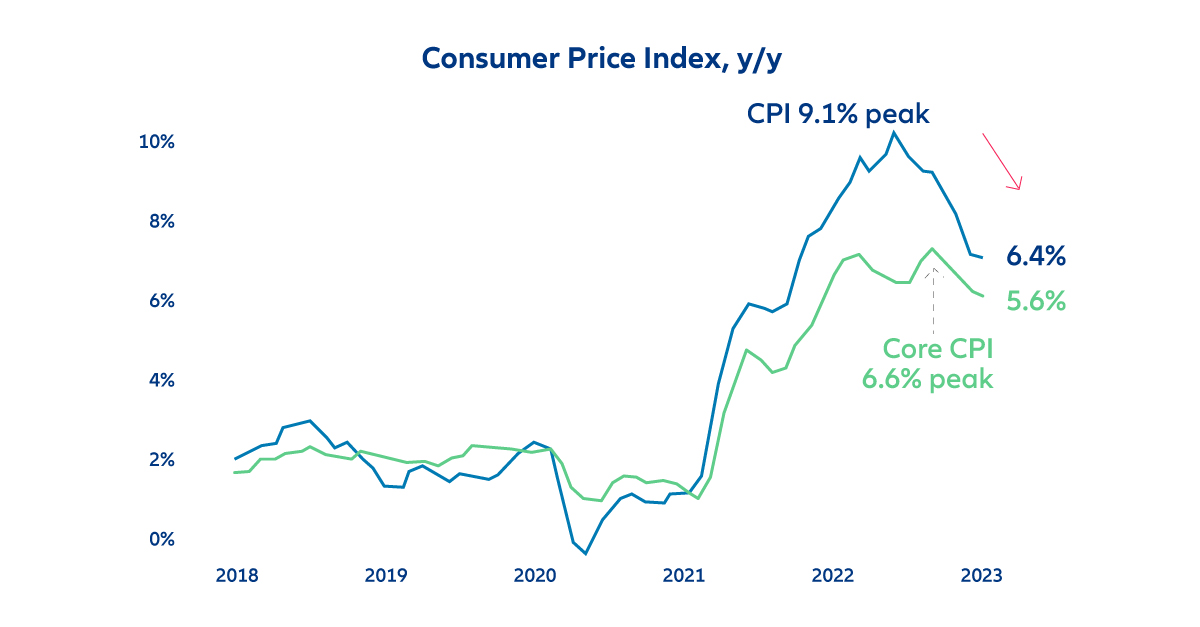
Inflation was a little warmer than expected in January. The headline Consumer Price Index (CPI) rose 0.5% m/m which was a bit higher than expectations of 0.4%. The y/y rate landed at 6.4, which was higher than expectations of 6.2%, and also only a slight improvement from last month’s 6.5%. The core rate, which strips out volatile food and energy prices, rose 0.4% m/m, again exceeding expectations of 0.3%, while the y/y rate came in at 5.6%, just above expectations of 5.5% and again also only a slight improvement from last month’s 5.7%. Energy prices drove the m/m increase with a 6.7% increase in utility gas and a notable 2.4% increase in gasoline prices. On a y/y basis, fuel out and utility gas have been big drivers, while gasoline has only risen 1.5%. Used cars and truck prices which were driven up in the pandemic due to scarcity, have now fallen 11.6% over the past year.
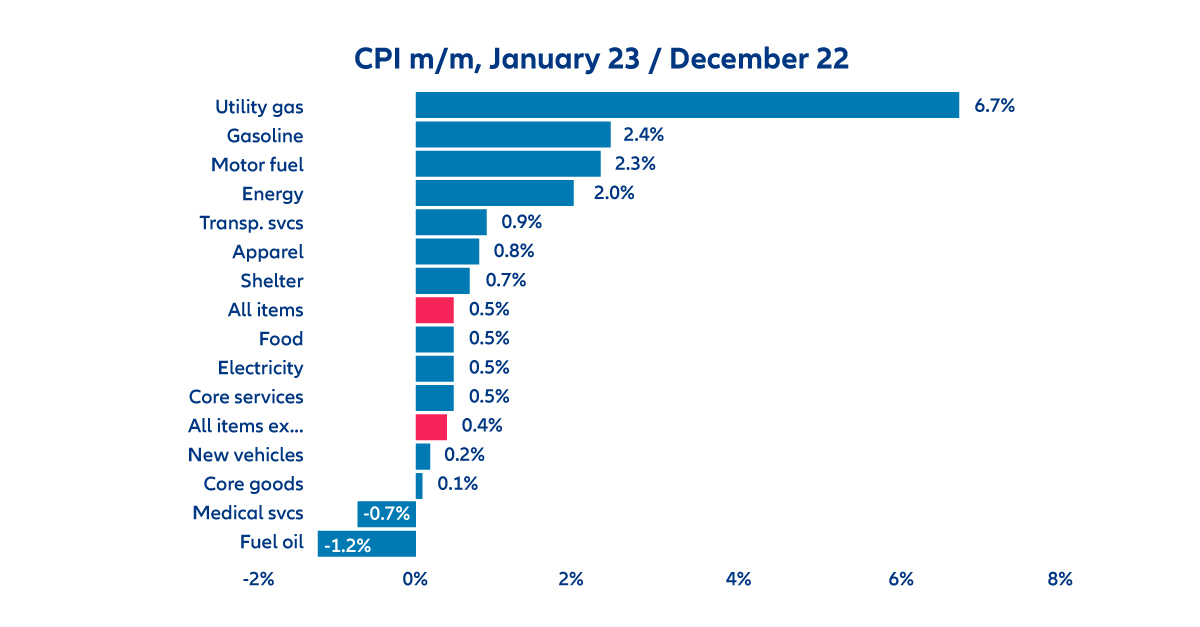
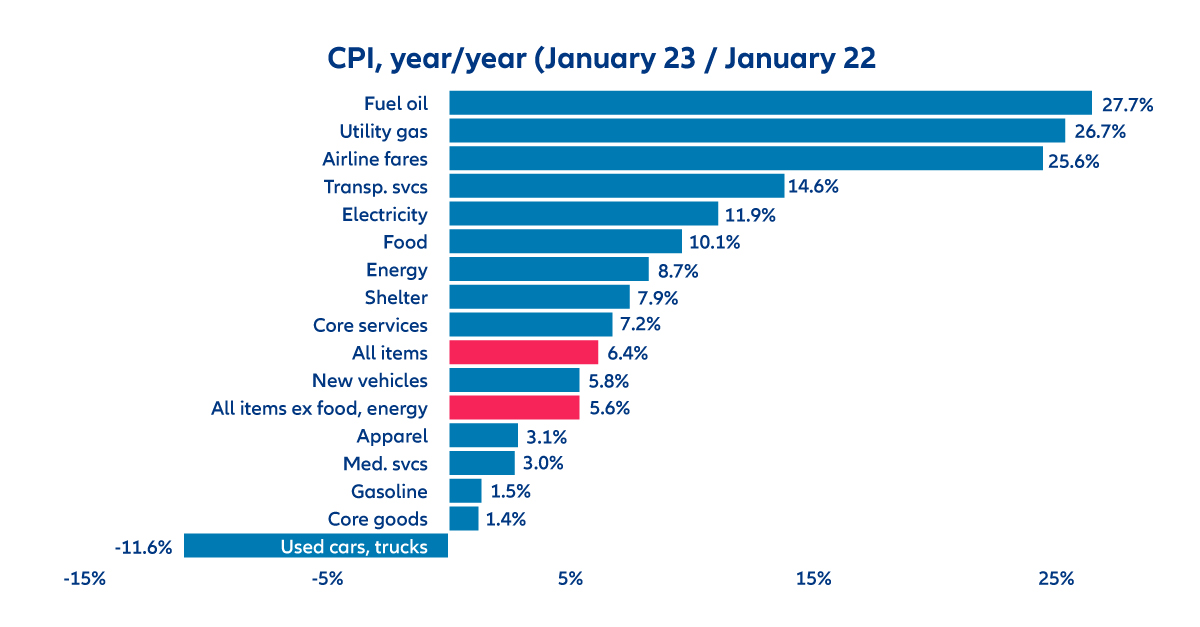
By the way, December’s report, which showed the first m/m decline in the headline CPI in the post Covid-era at -0.1%, was revised back up to +0.1% in this report.
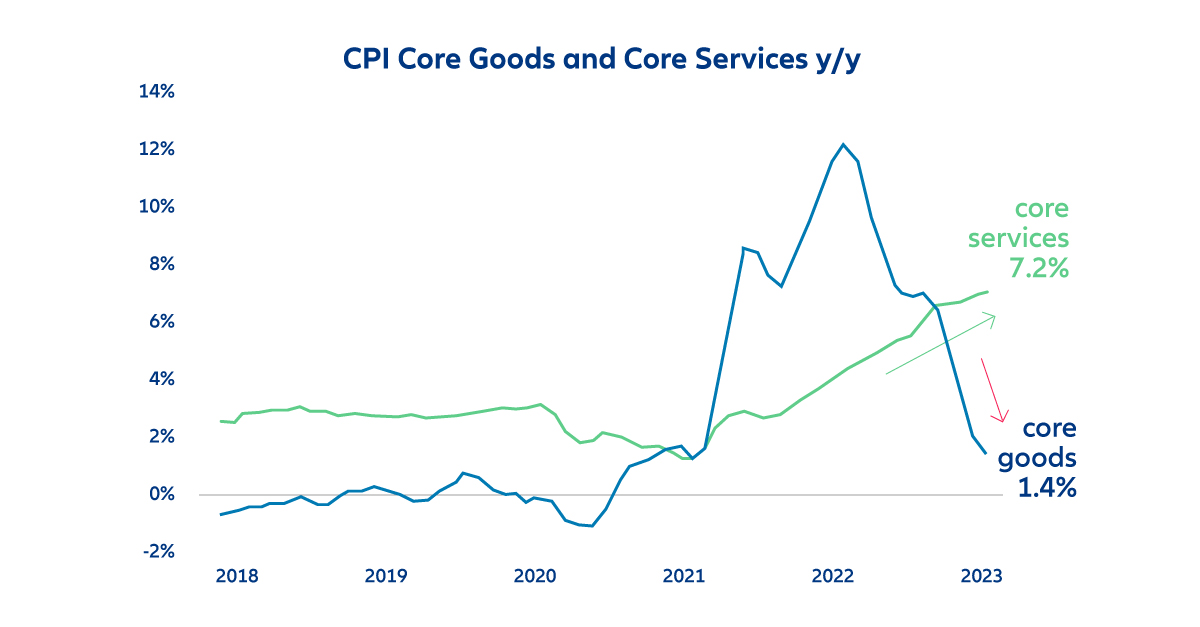
As shown in the first chart below, the headline y/y rate has fallen for seven consecutive months, dropping a total of 2.6% from June’s peak of 9.1%. However, the core rate has been more stubborn and has only fallen for four consecutive months, from the September peak, and has only dropped 1%. That is worrisome for the Fed since it focuses on core inflation. More worrisome still is that while core goods inflation is falling rapidly, core services inflation continues to rise and is now running at a very hot 7.2% y/y rate, the highest in over 40 years. The Fed is now concentrating more on services because 1. it is far outstripping goods inflation, and 2. services are more likely to be driven by labor costs, which in theory the Fed could influence more easily than the cost of goods.
Finally, the Fed has been focusing on “super core” inflation, which is core services excluding housing. Housing accounts for about one-third of the overall index, but it does not include all rental prices, only those that are signed in the month. Since those normally take a year to renew, housing inflation in the CPI lags market prices. And since market prices are falling, so will housing in the CPI going forward. In a sense then, housing inflation is already taken care of, so it makes sense to strip it out to see what’s happening underneath. Super core inflation is now running at 4% y/y, twice the Fed’s 2% target.
So the overall report was a bit warmer than expected, the core is being stubborn, core services are very high and rising, and super core isn’t good either. This report will keep the Fed on track for another 25 bps hike in March.
https://www.allianz-trade.com/en_US/insights/inflation-a-bit-warmer.html
 Everchem Updates Archive
 Sign Up for Email Updates