
The Urethane Blog
March 27, 2021
For you nostalgia fans . . .
From what we found out, a company purchased the site for $15 MM USD last year (Foamex/FXI initially sold it to a metal recycling company for $13 MM in 2010). This new entity has plans to build on the site. The demolishment is ongoing. Reinhart did a little more research. The enclosed pdf file is what, at this point in time, appears to be the proposed future plans regarding this former foam plant. The big question about this “Eddystone” development is, we do not believe there is another road in/out of that place other than the front gate. This goes right by Penn Terminals then up to Rte 291. The Railroad tracks run parallel with Rte 291 all the way up past the airport and there is no other way under the tracks to the best of our knowledge. With all the potential new truck traffic, that one way out/in could become a bottleneck.

This is what the sight looks like as of last Friday:

Plant 1 Picture: Back and to the left is where the guard house/front gate used to be. The front, left corner of the plant building was directly in front of me. The silos in the far distance are at the end of the building.

Plant 2 Picture: I am in a similar position as above but looking towards the right. The far outside rear edge of the plant building is in the distance with the river and New Jersey past that.

R&D Bldg 2: Basically I am a similar position as above but looking to the left. The R&D building, which was across the street, is completely gone.
There is nothing left I could recognize except for the remains of the rail siding tracks. Difficult to believe that at one time this sight had: 3 foam pouring machines, multiple foam felting operations, Baumer loops, multiple foam reticulation operations, foam peeling operations, flame lamination operations, multiple pilot scale foam machines, full QC lab & operations, engineering, 27 person R&D group, etc.
Courtesy of Glenn DePhillipo RS & M Technologies
March 25, 2021
Closing the loop for polyurethane mattresses
Covestro: a pioneer in foam recycling and cycle design
- Innovative process for recovering both core raw materials
- New pilot plant for chemical recycling put into operation
- Trailblazer for industrial recycling
- Co-shaping the circular economy in cooperation with value chain
Covestro has developed an innovative process for the chemical recycling of polyurethane (PU) flexible foam from used mattresses. It builds on its participation in the PUReSmart project, which is coordinated by Recticel company.
On average, mattresses contain 15 to 20 kilograms of foam, which results in a large amount of waste at the end of their useful life. The foam is primarily made of two important raw materials. While other chemical recycling approaches mainly focus on processing one of them, the Covestro process now enables the recovery of both raw materials.
Covestro has also recently started operating a pilot plant for flexible foam recycling at its Leverkusen site to confirm the positive laboratory results achieved to date. The first phase is to focus on recycling one of the raw materials, before the recovery of the second component is also to be piloted from summer this year. Covestro´s goal here is to industrialize chemical recycling processes for used flexible foams and ultimately to remarket both recovered raw materials.
Closing material loops
“The development of this innovative recycling technology and the investment in the pilot plant are further milestones in realizing our vision of fully aligning Covestro to the circular economy,” says CEO Dr. Markus Steilemann. “In doing so, we want to replace fossil resources in production, steadily further reduce the carbon footprint of our materials and create new solutions for dealing with plastic waste. Chemical recycling is particularly promising for this, and must be developed further and used more intensively overall. Above all, it should finally be put on an equal legal basis with other recycling methods.”
In cooperation with the companies Recticel and Redwave – a division of Wolfgang Binder GmbH – and as part of the PUReSmart research project, Covestro has also developed an intelligent sorting solution for separating the different PU foams from post-consumer mattresses. The software uses algorithms to correctly identify the different foam types, which facilitates an effective recycling process. This development is another element of Covestro’s digitalization strategy, combined with the new opportunities it entails for the chemicals and plastics industry.
Co-creation of a circular ecosystem
“Based on our competencies and experiences, we also want to take part in shaping the emerging value creation cycle,” says Daniel Meyer, Global Head of the Polyurethanes segment at Covestro. “To accomplish this, we rely on international cooperation with partners and also develop innovative business models. The aim is to generate new sustainable business opportunities with our customers, other partners and for ourselves.”
The project is an important step forward in taking the development of the circular economy at Covestro to entirely new heights. The increased use of used materials further contributes to solving the societal challenge of sustainable disposal of such waste and to achieving the European Union´s goals for the circular economy and for climate and environmental protection.
https://www.covestro.com/press/closing-the-loop-for-polyurethane-mattresses-public/
March 25, 2021
Closing the loop for polyurethane mattresses
Covestro: a pioneer in foam recycling and cycle design
- Innovative process for recovering both core raw materials
- New pilot plant for chemical recycling put into operation
- Trailblazer for industrial recycling
- Co-shaping the circular economy in cooperation with value chain
Covestro has developed an innovative process for the chemical recycling of polyurethane (PU) flexible foam from used mattresses. It builds on its participation in the PUReSmart project, which is coordinated by Recticel company.
On average, mattresses contain 15 to 20 kilograms of foam, which results in a large amount of waste at the end of their useful life. The foam is primarily made of two important raw materials. While other chemical recycling approaches mainly focus on processing one of them, the Covestro process now enables the recovery of both raw materials.
Covestro has also recently started operating a pilot plant for flexible foam recycling at its Leverkusen site to confirm the positive laboratory results achieved to date. The first phase is to focus on recycling one of the raw materials, before the recovery of the second component is also to be piloted from summer this year. Covestro´s goal here is to industrialize chemical recycling processes for used flexible foams and ultimately to remarket both recovered raw materials.
Closing material loops
“The development of this innovative recycling technology and the investment in the pilot plant are further milestones in realizing our vision of fully aligning Covestro to the circular economy,” says CEO Dr. Markus Steilemann. “In doing so, we want to replace fossil resources in production, steadily further reduce the carbon footprint of our materials and create new solutions for dealing with plastic waste. Chemical recycling is particularly promising for this, and must be developed further and used more intensively overall. Above all, it should finally be put on an equal legal basis with other recycling methods.”
In cooperation with the companies Recticel and Redwave – a division of Wolfgang Binder GmbH – and as part of the PUReSmart research project, Covestro has also developed an intelligent sorting solution for separating the different PU foams from post-consumer mattresses. The software uses algorithms to correctly identify the different foam types, which facilitates an effective recycling process. This development is another element of Covestro’s digitalization strategy, combined with the new opportunities it entails for the chemicals and plastics industry.
Co-creation of a circular ecosystem
“Based on our competencies and experiences, we also want to take part in shaping the emerging value creation cycle,” says Daniel Meyer, Global Head of the Polyurethanes segment at Covestro. “To accomplish this, we rely on international cooperation with partners and also develop innovative business models. The aim is to generate new sustainable business opportunities with our customers, other partners and for ourselves.”
The project is an important step forward in taking the development of the circular economy at Covestro to entirely new heights. The increased use of used materials further contributes to solving the societal challenge of sustainable disposal of such waste and to achieving the European Union´s goals for the circular economy and for climate and environmental protection.
https://www.covestro.com/press/closing-the-loop-for-polyurethane-mattresses-public/
March 25, 2021
“Might Take Weeks” – Suez Canal Still Closed As “Enormous Beached Whale” Ship Remains Stuck
by Tyler DurdenThursday, Mar 25, 2021 – 06:35 AM
Update (0956ET): Daily Mail’s deputy political editor John Stevens tweets the British government “stands ready” to support operations to free the containership blocking the Suez Canal.
Boris Johnson’s spokesman:
“We are ready to provide any assistance that we can but have not been asked yet.”
* * *
Update (0942 ET): The massive containership blocking the Suez Canal remains stuck in place and unable to refloat on Thursday. Each day the canal is blocked, it halts about $9.6 billion of traffic through the world’s most important shipping lane.
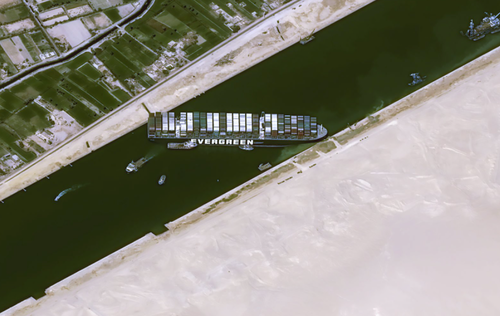
The Suez Canal Authority’s knock-on effects on closing the 120-mile long canal will likely cause shipping traffic jams at both entrances of the canal, delayed shipments, supply chain disruptions, rising prices of certain commodities, and may push up freight rates. https://platform.twitter.com/embed/Tweet.html?dnt=false&embedId=twitter-widget-0&frame=false&hideCard=false&hideThread=false&id=1375080625942724608&lang=en&origin=https%3A%2F%2Fwww.zerohedge.com%2Fenergy%2Fmight-take-weeks-suez-canal-still-closed-enormous-beached-whale-ship-remains-stuck&siteScreenName=zerohedge&theme=light&widgetsVersion=e1ffbdb%3A1614796141937&width=550px
* * *
The Suez Canal Authority (SCA) reported Thursday it had suspended traffic along the 120-mile long canal while eight tugboats worked to free a massive containership, according to Reuters.
SCA’s statement said thirteen vessels had sailed south along the canal on Wednesday and were waiting in the canal’s lakes until the containership was refloated. On either side of the canal’s entrances, dozens of ships are piling up as the world’s most crucial shipping lane grinds to a halt.
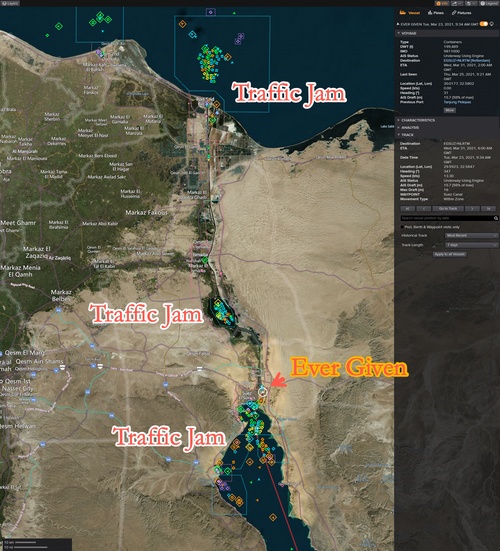
The container ship called the Ever Given, owned by Evergreen Marine Corp., “could be stuck in the canal for weeks,” according to the firm working to dislodge the vessel.
Peter Berdowski, CEO of Dutch company Boskalis which has been tasked to dislodge Ever Given, was quoted by the Daily Mail as saying:
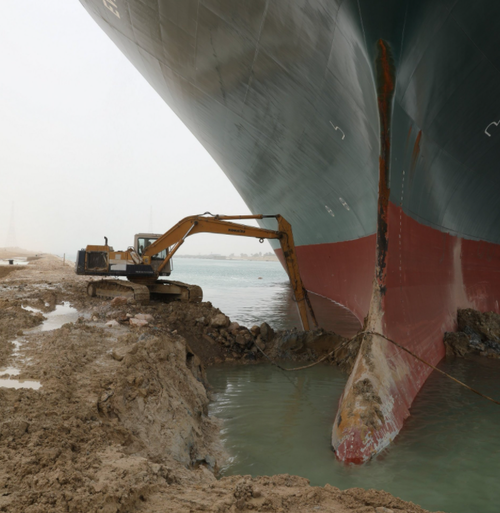
“We can’t exclude it might take weeks, depending on the situation. It’s an enormous weight on the sand. We might have to work with a combination of reducing the weight by removing containers, oil and water from the ship, tug boats, and dredging of sand.”
Berdowski compared the 1,312ft-long, 175ft-wide, 200,000-ton vessel to an “enormous beached whale” as he suggested offloading cargo might be one solution to refloat the ship.

A source familiar with the matter told Bloomberg that Ever Given is “lodged approximately 5 meters into the canal’s bank, hindering efforts to re-float it fully.”
As many as 50 vessels pass through the canal on a given day, which means upwards of 150 vessels could be waiting to transit the canal. By now, some vessels have opted for alternative routes.
NYMEX WTI crude oil futures are down 2% in the overnight session and don’t seem to care about the canal’s continued shuttering. Perhaps, oil traders are refocusing on virus troubles in Europe, hindering demand.

But as we must note, if the SCA were to release a statement indicating a prolonged shutdown of the canal, crude prices would likely continue to rise. This is because 12% of global trade and 8% of liquefied natgas traverse the canal and nearly one million oil barrels each day.
On top of global supply chains already stretched thin due to the virus pandemic, the world’s most important shipping lane is paralyzed.
March 25, 2021
“Might Take Weeks” – Suez Canal Still Closed As “Enormous Beached Whale” Ship Remains Stuck
by Tyler DurdenThursday, Mar 25, 2021 – 06:35 AM
Update (0956ET): Daily Mail’s deputy political editor John Stevens tweets the British government “stands ready” to support operations to free the containership blocking the Suez Canal.
Boris Johnson’s spokesman:
“We are ready to provide any assistance that we can but have not been asked yet.”
* * *
Update (0942 ET): The massive containership blocking the Suez Canal remains stuck in place and unable to refloat on Thursday. Each day the canal is blocked, it halts about $9.6 billion of traffic through the world’s most important shipping lane.
The Suez Canal Authority’s knock-on effects on closing the 120-mile long canal will likely cause shipping traffic jams at both entrances of the canal, delayed shipments, supply chain disruptions, rising prices of certain commodities, and may push up freight rates. https://platform.twitter.com/embed/Tweet.html?dnt=false&embedId=twitter-widget-0&frame=false&hideCard=false&hideThread=false&id=1375080625942724608&lang=en&origin=https%3A%2F%2Fwww.zerohedge.com%2Fenergy%2Fmight-take-weeks-suez-canal-still-closed-enormous-beached-whale-ship-remains-stuck&siteScreenName=zerohedge&theme=light&widgetsVersion=e1ffbdb%3A1614796141937&width=550px
* * *
The Suez Canal Authority (SCA) reported Thursday it had suspended traffic along the 120-mile long canal while eight tugboats worked to free a massive containership, according to Reuters.
SCA’s statement said thirteen vessels had sailed south along the canal on Wednesday and were waiting in the canal’s lakes until the containership was refloated. On either side of the canal’s entrances, dozens of ships are piling up as the world’s most crucial shipping lane grinds to a halt.
The container ship called the Ever Given, owned by Evergreen Marine Corp., “could be stuck in the canal for weeks,” according to the firm working to dislodge the vessel.
Peter Berdowski, CEO of Dutch company Boskalis which has been tasked to dislodge Ever Given, was quoted by the Daily Mail as saying:
“We can’t exclude it might take weeks, depending on the situation. It’s an enormous weight on the sand. We might have to work with a combination of reducing the weight by removing containers, oil and water from the ship, tug boats, and dredging of sand.”
Berdowski compared the 1,312ft-long, 175ft-wide, 200,000-ton vessel to an “enormous beached whale” as he suggested offloading cargo might be one solution to refloat the ship.
A source familiar with the matter told Bloomberg that Ever Given is “lodged approximately 5 meters into the canal’s bank, hindering efforts to re-float it fully.”
As many as 50 vessels pass through the canal on a given day, which means upwards of 150 vessels could be waiting to transit the canal. By now, some vessels have opted for alternative routes.
NYMEX WTI crude oil futures are down 2% in the overnight session and don’t seem to care about the canal’s continued shuttering. Perhaps, oil traders are refocusing on virus troubles in Europe, hindering demand.
But as we must note, if the SCA were to release a statement indicating a prolonged shutdown of the canal, crude prices would likely continue to rise. This is because 12% of global trade and 8% of liquefied natgas traverse the canal and nearly one million oil barrels each day.
On top of global supply chains already stretched thin due to the virus pandemic, the world’s most important shipping lane is paralyzed.
 Everchem Updates Archive
  Sign Up for Email Updates